
Lonnie Bunch, museum director, historian, lecturer, and author, is proud to present A Page from Our American Story, a regular on-line series for Museum supporters. It will showcase individuals and events in the African American experience, placing these stories in the context of a larger story — our American story.A Page From Our American Story
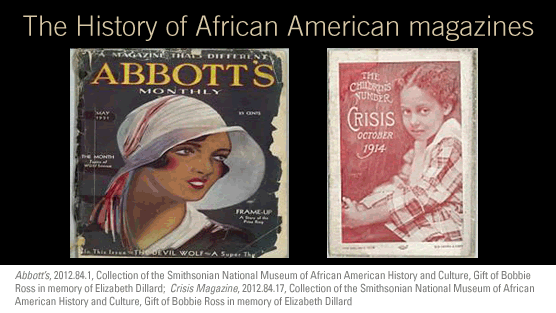
In the first half of the twentieth century, Americans became fascinated with photo journalism. Pictures were literally “worth a thousand words” as full-color magazines and tabloid newspapers became the rage. Publications targeted to African American audiences that featured illustrations and photographs began appearing in the early 1900s. One of the earliest to effectively use illustrations and photography was The Crisis, the official publication of the NAACP. Seeking to educate and inform its readers with scholarly articles, the covers of the journal and its entertainment section were designed to appeal to the masses of African Americans. In the 1930s, we see pictorial magazines such as Abbott’s Monthly, published by Robert Sengstacke Abbott, the founder of the Chicago Defender newspaper, and Flash, which billed itself as a “weekly newspicture magazine.” Published in Washington, D.C., Flash contained a mixture of news, gossip and advertisements and articles on racial issues, providing an overview of the highs and the lows of Black life in the 1930’s. In 1942, African American businessman John H. Johnson founded the Johnson Publishing Company, a corporation that would go on to publish the well-known magazines Ebony, Jet, Tan, and Ebony Jr. The magazines promoted African American achievements and affirmative black imagery in popular culture, which appealed to readers … and to advertisers. Mr. Johnson was a savvy businessman and used the statistics of a rising black middle class to persuade companies and businesses that it was in their economic “self-interest” to advertise in his magazines to reach African American consumers. With the success of the Johnson Publishing Company’s magazines, other magazines targeted to African Americans quickly came on the scene. For example, in 1947 Horace J. Blackwell published Negro Achievements, a magazine highlighting African American success articles and featuring reader-submitted true confessions stories. After Blackwell died in 1949, a white businessman named George Levitan bought the company and renamed the publication Sepia. This publication featured columns by writer John Howard Griffin, a white man who darkened his skin and wrote about his treatment in the segregated South, that eventually became the best-selling book Black Like Me. Whether featuring positive images of African Americans, inspiration stories, news features or commentaries on racism, the rise of African American magazines defied long-held racial stereotypes through rich storytelling, in-depth reporting, and stunning photography. Due to a variety of economic, editorial, and other factors, most of these magazines have ceased being published. Yet today some African American magazines are still a thriving part of popular culture. Johnson Publishing Company’s Ebony and its digital sites reach nearly 72% of African Americans and have a following of over 20.4 million people.
P.S. We can only reach our $250 million goal with your help. I hope you will consider making a donation or becoming a Charter Member today. To read past Our American Stories, visit our archives. |




You must be logged in to post a comment.