Category Archives: ~ politics petitions pollution and pop culture

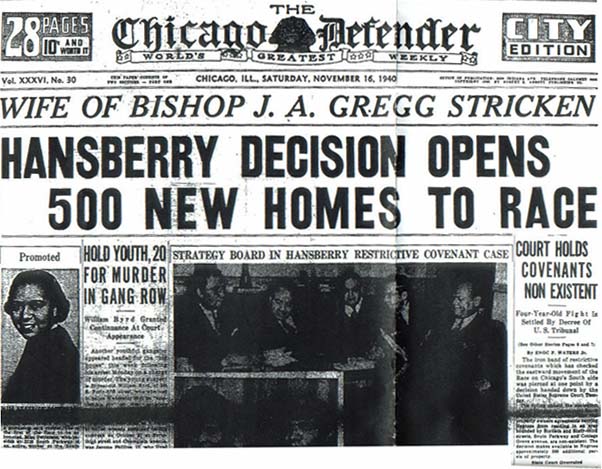
1940 – On this day, the Supreme Court ruled in Hansberry v. Lee that whites can’t bar African Americans from white neighborhoods


November 13th in African American History – Hansberry v. Lee

See the source image

The ruling states that whites could not bar African Americans from white neighborhoods, but did not rule that restrictive covenants based on race were void.

It ruled for Hansberry on a legal technicality that Lee did not represent the entire class because a number of the homeowners (approximately 46%) disagreed with the covenant. Restrictive covenants based on race were completely outlawed by the U.S. Supreme Court on May 3, 1948 in the case of Shelley v. Kraemer.

Today in African American History . com

In 2016, Teapublicans were considered extreme and there are 4 things to remember ….rep. Paul Ryan, the GOP and who they are


GOP_Elephant_WRONG_WAY_small


Here are four things to remember about Paul Ryan and very Foreboding

#1: Paul Ryan is the chief architect of the extreme GOP budget
— of which Mitt Romney is a huge fan. It funds tax breaks for the wealthiest with severe cuts to investments in education, scientific research, and clean energy. The middle class shoulders the burden.

#2: He’s the author of the original plan to turn Medicare into a voucher system
— which the Romney-Ryan ticket has absorbed, hiking out-of-pocket costs by $6,000 per year. He also backed a proposal to privatize Social Security, which would let the whims of the stock market take over
retirement security.

#3: Just like Mitt Romney, he’s severely conservative
and has consistently taken a stance against women. He voted against the
Lilly Ledbetter Fair Pay Act, and co-sponsored a bill that could ban all abortion, including in cases of rape and incest — and even some common forms of birth control.

#4: Paul Ryan, like Mitt Romney, will say absolutely anything to win votes, no matter how far it is from the truth.


1953 -Indiana Textbook Commission member charges that Robin Hood is communist


In an example of the lengths to which the “Red Scare” in America is going, Mrs. Thomas J. White of the Indiana Textbook Commission calls for the removal of references to the book Robin Hood from textbooks used by the state’s schools. Mrs. White …read more

READ MORE: How Eisenhower Secretly Pushed Back Against McCarthyism

Citation Information

Article Title

Indiana Textbook Commission member charges that Robin Hood is communist

AuthorHistory.com Editors

Website Name

HISTORY

URL

https://www.history.com/this-day-in-history/indiana-textbook-commission-member-charges-that-robin-hood-is-communistic

Access Date

November 12, 2022

Publisher

A&E Television Networks

Last Updated

November 15, 2021

Original Published Date

November 13, 2009

November Awareness Days


The main days and months you should know about for November are:

November HolidaysTypeDate
Native American Heritage MonthMonthNovember 1
Hunger & Homelessness Awareness WeekWeekNovember 11-18
World Kindness DayDayNovember 12
Giving TuesdayDayNovember 28
Veterans DayDayNovember 11
Trans Day of RemembranceDayNovember 20

Nov. 12 ~ The Story of Ellis Island


On this day in 1954, Ellis Island, the gateway to America, shuts it doors after processing more than 12 million immigrants since opening in 1892. Today, an estimated 40 percent of all Americans can trace their roots through Ellis Island, located in New York Harbor off the New Jersey coast and named for merchant Samuel Ellis, who owned the land in the 1770s.

On January 2, 1892, 15-year-old Annie Moore, from Ireland, became the first person to pass through the newly opened Ellis Island, which President Benjamin Harrison designated as America’s first federal immigration center in 1890.

Before that time, the processing of immigrants had been handled by individual states. Not all immigrants who sailed into New York had to go through Ellis Island. First- and second-class passengers submitted to a brief shipboard inspection and then disembarked at the piers in New York or New Jersey, where they passed through customs. People in third class, though, were transported to Ellis Island, where they underwent medical and legal inspections to ensure they didn’t have a contagious disease or some condition that would make them a burden to the government.

Only two percent of all immigrants were denied entrance into the U.S. Immigration to Ellis Island peaked between 1892 and 1924, during which time the 3.3-acre island was enlarged with landfill and additional buildings were constructed to handle the massive influx of immigrants. During the busiest year of operation, 1907, over 1 million people were processed at Ellis Island.

After 1924, Ellis Island switched from a processing center to serving other purposes, such as a detention and deportation center for illegal immigrants, a hospital for wounded soldiers during World War II and a Coast Guard training center.

In November 1954, the last detainee, a Norwegian merchant seaman, was released and Ellis Island officially closed.