Coronavirus on Surfaces: What You Should Know


April 1, 2020 — Many emergency room workers remove their clothes as soon as they get home — some before they even enter. Does that mean you should worry about COVID-19 transmission from your own clothing, towels, and other textiles?

While researchers found that the virus can remain on some surfaces for up to 72 hours, the study didn’t include fabric. “So far, evidence suggests that it’s harder to catch the virus from a soft surface (such as fabric) than it is from frequently touched hard surfaces like elevator buttons or door handles,” wrote Lisa Maragakis, MD, senior director of infection prevention at the Johns Hopkins Health System.
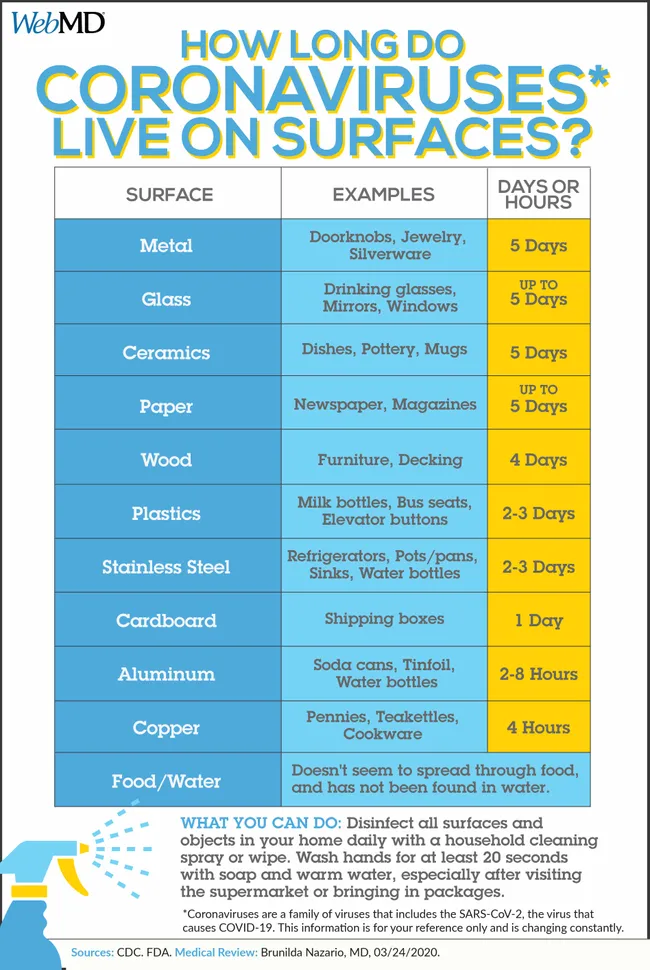
for the complete article:  webmd.com/lung/news/20200401

It is an incredible eye-opening article

Sign up for the latest coronavirus news.

October Awareness Month


October 2nd:                    World Smile Day

October 6th:                     Physician Assistant Day

October 9th:                     Emergency Nurse Day

October 13th Indigenous Peoples Day

October 13th:                   United States Navy – Happy Birthday 1775

October 14th:                   S.A.V.E. Day (Stop American Violence Everywhere)

October 16th:                   Bosses Day

October 17th:                   Sweetest Day

October 24th:                   Make A Difference Day

October 31st:                   Halloween

October 4-10:                   Mental Illness Awareness Week  (Green)

October 5-9:                     Customer Service Week

October 18-24:                 Invisible Disabilities Awareness Week (Purple)

October 19-25:                 Male Breast Cancer Awareness Week (Pink-Blue)

October 23-31:                 Red Ribbon Week  (Red)

October 31-November 2:             Day of the Dead (Dia de Los Muertos)

Breast Cancer Awareness Month  (Pink)

Fire Prevention Awareness Month  (Thin Red Line)

Domestic Violence Awareness Month  (Purple)

Down Syndrome Awareness Month  (Blue-Yellow)

Sudden Infant Death Syndrome Awareness Month  (Pink-Blue)

Pregnancy & Infant Loss Awareness Month  (Pink-Blue)

National Bullying Prevention Month  (Blue)

Liver Cancer Awareness Month  (Green)

pinmart.com

1854 Lincoln speaks out against slavery 10/16 – Black History


slavesinchainsOn this day in 1854, an obscure lawyer and Congressional hopeful from the state of Illinois named Abraham Lincoln delivers a speech regarding the Kansas-Nebraska Act, which Congress had passed five months earlier.
In his speech, the future president denounced the act and outlined his views on slavery, which he called “immoral.”Under the terms of the Kansas-Nebraska Act, two new territories—Kansas and Nebraska—would be allowed into the Union and each territory’s citizens would be given the power to determine whether slavery would be allowed within the territory’s borders. It was believed that the act would set a precedent for determining the legality of slavery in other new territories. Controversy over the act influenced political races across the country that fall.
Abolitionists, like Lincoln, hoped to convince lawmakers in the new territories to reject slavery.Lincoln, who was practicing law at the time, campaigned on behalf of abolitionist Republicans in Illinois and attacked the Kansas-Nebraska Act. He denounced members of the Democratic Party for backing a law that “assumes there can be moral right in the enslaving of one man by another.” He believed that the law went against the founding American principle that “all men are created equal.” Lincoln was an abolitionist at heart, but he realized that the outlawing of slavery in states where it already existed might lead to civil war. Instead, he advocated outlawing the spread of slavery to new states. He hoped this plan would preserve the Union and slowly eliminate slavery by confining it to the South, where, he believed, “it would surely die a slow death.”Lincoln and his fellow abolitionists were dismayed when Kansans voted a pro-slavery candidate into Congress in November. As Lincoln’s political career picked up momentum over the next several years, he continually referred to the Kansas-Nebraska Act and the seeming inevitability that Kansas should become a slave state as “a violence…it was conceived in violence, passed in violence, is maintained in violence, and is being executed in violence.”Lincoln continued to actively campaign against slavery in Kansas and helped to raise money to support anti-slavery candidates in that state.
Meanwhile he continued his law practice and ran for the U.S. Senate in 1859. Although he lost to Democrat Stephen Douglas, Lincoln began to make a name for himself in national politics and earned increasing support from the North and abolitionists across the nation. It was this constituency that helped him win the presidency in 1860.

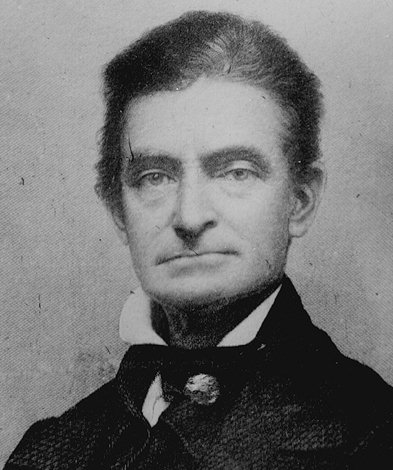
Abolitionist leader John Brown


In Charles Town, Virginia, militant abolitionist John Brown is executed on charges of treason, murder, and insurrection. Brown, born in Connecticut in 1800, first became militant during the mid-1850s, when as a leader of the Free State forces in Kansas he fought pro-slavery settlers in the sharply divided U.S. territory.

Abolitionist leader John Brown (1800-1859) was born in Torrington, Connecticut. He led an attack on the federal arsenal at Harpers Ferry in October of 1859, to secure weapons for his “army of emancipation” to liberate slaves. Inside the arsenal, Brown and his followers held 60 hostages and managed to hold out against the local militia but finally surrendered to U.S. Marines under the command of Colonel Robert E. Lee. Ten of Brown’s men, including two of his sons, were killed. Brown was taken prisoner. He was convicted by the Commonwealth of Virginia of treason, murder, and inciting slaves to rebellion, and hanged on December 2, 1859.

Resources: wiki, thehistoryplace.com

The problem with Data Centers


I went through old posts and found hints of an increase in data centers, at least in the early 2000s. A big, huge glaring warning, if you will.

One company tried to tell a story of why we need them and created a mural project; they also bought a 1960s power plant.

In 2010, Greenpeace posted a warning and petition re: The Internet is how we connect, learn new things, and share what we love. But right now, much of our Internet is also dirty, no matter how we use it.

Data centers are where Internet companies store our photos, messages, and music, and many are powered by coal and dirty energy sources that pollute our environment and harm our climate.

What’s worse — the Internet’s demand for energy is only growing. If the Internet were a country, its electricity use would already rank sixth in the world.

Source: Greenpeace petition

In this 21st Century, I, like most, use the Internet daily for research and other purposes, like blogging or sharing information that might help someone. It’s truly embarrassing to realize that warnings about Data Centers were in the news years ago! Clearly, in the early 90s and 2000s, this topic wasn’t given enough airtime or a proper platform to inform the public. Now, it is 2026; some parts of our country are suffering from droughts, while others have seen their land devastated not only by historic floods, but also by the fact that building data centers requires not only a lot of land but also an enormous amount of energy and water.

~ Nativegrly77

politics,pollution,petitions,pop culture & purses