|

|
|

|
|
|
Update: This evening, President Obama delivered a statement on the fatal shootings in Louisiana and Minnesota. Watch below:
Today, President Obama posted the following message on Facebook:
“All Americans should be deeply troubled by the fatal shootings of Alton Sterling in Baton Rouge, Louisiana and Philando Castile in Falcon Heights, Minnesota. We’ve seen such tragedies far too many times, and our hearts go out to the families and communities who’ve suffered such a painful loss.
“Although I am constrained in commenting on the particular facts of these cases, I am encouraged that the U.S. Department of Justice has opened a civil rights investigation in Baton Rouge, and I have full confidence in their professionalism and their ability to conduct a thoughtful, thorough, and fair inquiry.
“But regardless of the outcome of such investigations, what’s clear is that these fatal shootings are not isolated incidents. They are symptomatic of the broader challenges within our criminal justice system, the racial disparities that appear across the system year after year, and the resulting lack of trust that exists between law enforcement and too many of the communities they serve.
“To admit we’ve got a serious problem in no way contradicts our respect and appreciation for the vast majority of police officers who put their lives on the line to protect us every single day. It is to say that, as a nation, we can and must do better to institute the best practices that reduce the appearance or reality of racial bias in law enforcement.
“That’s why, two years ago, I set up a Task Force on 21st Century Policing that convened police officers, community leaders, and activists. Together, they came up with detailed recommendations on how to improve community policing. So even as officials continue to look into this week’s tragic shootings, we also need communities to address the underlying fissures that lead to these incidents, and to implement those ideas that can make a difference. That’s how we’ll keep our communities safe. And that’s how we can start restoring confidence that all people in this great nation are equal before the law.
“In the meantime, all Americans should recognize the anger, frustration, and grief that so many Americans are feeling — feelings that are being expressed in peaceful protests and vigils. Michelle and I share those feelings. Rather than fall into a predictable pattern of division and political posturing, let’s reflect on what we can do better. Let’s come together as a nation, and keep faith with one another, in order to ensure a future where all of our children know that their lives matter.”
I believe in a future with no discriminatory police violence. A future where 12-year-old Black children can play safely in the park without being shot by law enforcement; A future where “Am I next?” doesn’t haunt the minds of millions of Black youth and adults every day; A future where the justice system holds police who kill and harm Black communities fully and swiftly accountable.
But we’ll have to work hard for this distant future. Tomorrow, thousands of people across the country will take part in a national day of resistance, demanding justice for Mike Brown, Eric Garner, and all those targeted by the systemic crisis of anti-Black policing. Our national leaders are paying more attention to police brutality than they have in years and its the power of our collective voices and civil unrest has gotten us here — and we must continue.
Join an action tomorrow to help increase pressure on President Obama and Attorney General Eric Holder to hold Darren Wilson, Officer Pantaleo and other officers who have killed and brutalized Black youth and adults fully accountable. We need a powerful show of people to match the crisis of our time. Find an event in your area using the links below and click on the posters to download a printable version.
Ferguson National Response Network
And if you can’t make it in person, please help strengthen the growing movement by sharing the Justice For Mike Brown and Justice for Eric Garner campaigns with your friends and family.
Although the vast majority of protests are peaceful, there is a real risk of police violence or arrest. In response to the growing movement for police accountability, law enforcement have militarized their tactics and are cracking down on people exercising their first amendment right to free speech. Before attending an action, make sure you know your rights and check out the National Lawyers Guild (NLG) on twitter and your local NLG chapter for a local hotline to report police violence or receive legal support if you are arrested.

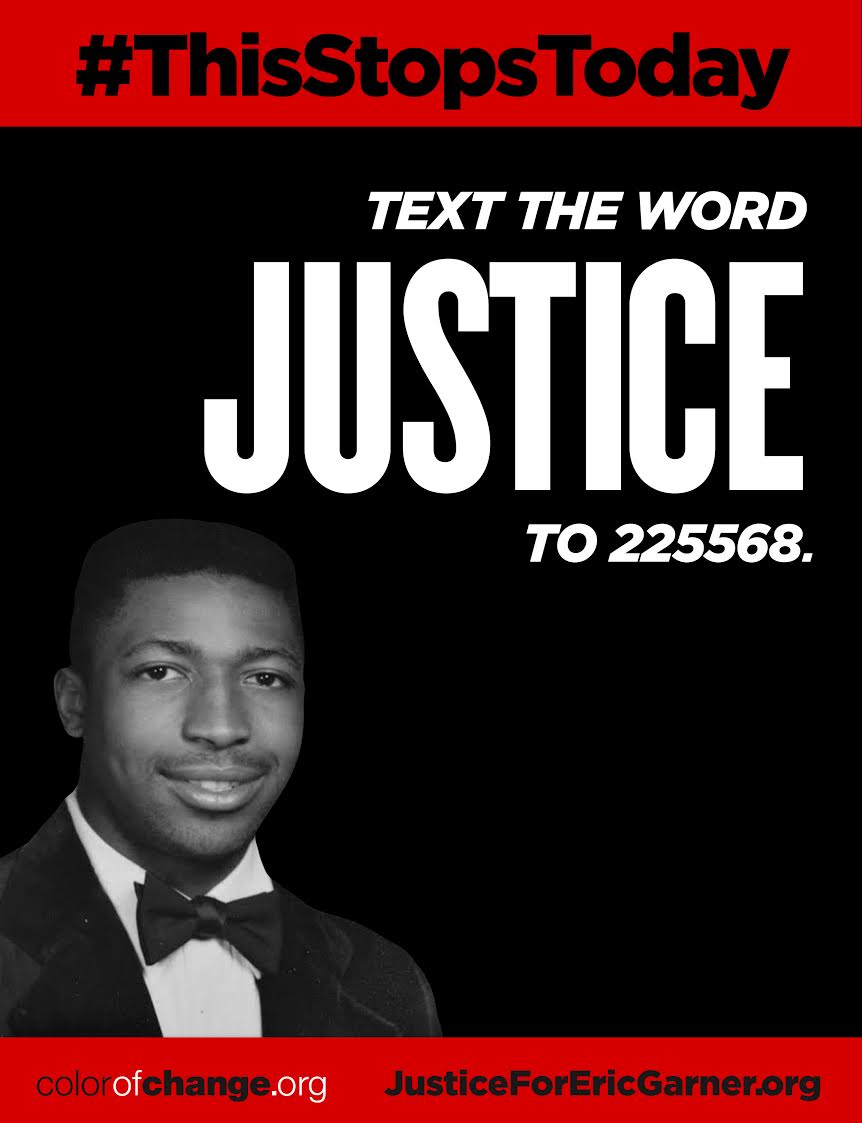
We are in a historic time — amidst a growing new civil rights movement led by inspiring Black and brown youth demanding an end to institutional racism. And since the St. Louis Grand Jury and Staten Island Grand Jury refused to indict the officers who brutally killed Mike Brown and Eric Garner, that movement has only grown. Thousands across the country have taken to the streets to shut down highways, bridges, organize sit-ins and die-ins, all in the name of a better future. Tomorrow, we will come together as a nation, to stand up in a powerful show of love and democracy and move forward systemic change to end the insidious cycle of police violence and denied justice. We organize because Mike Brown’s killer is free; Because Eric Garner’s killer is free; Because those who we have lost to discriminatory police violence deserve justice:
See you tomorrow,
Rashad Robinson
Help support our work. ColorOfChange.org is powered by YOU—your energy and dollars. We take no money from lobbyists or large corporations that don’t share our values, and our tiny staff ensures your contributions go a long way.

 |
When my 12-year-old cousin Tamir Rice was shot and killed by a police officer as he played in a park with a toy gun, our family didn’t know what to do. Shocked and heartbroken, we knew we had to find justice for Tamir. I remembered that Trayvon Martin’s parents started a petition on Change.org when police refused to arrest the killer of their young son and that it helped draw national attention to their story.
So I started my own petition on Change.org and over 50,000 people have signed it.
It’s been one year since the protests in Ferguson, Missouri, which propelled #BlackLivesMatter into a national movement. I never thought my family would be part of this conversation – that my little cousin would become one of the reasons we needed to call for police accountability and racial justice here in Cleveland and nationwide.
The simple act of signing a petition can make a difference and other families at the center of the #BlackLivesMatter movement have started petitions on Change.org. The parents of John Crawford, who was killed in a Walmart while he held a toy gun sold at the store used a petition to secure an important Department of Justice investigation into the death of their son. The brother of Walter Scott, shot and killed as he ran away, and the parents of Michael Brown, have each started petitions to call for body cameras nationwide.
From body cameras to a police shooting database, from individual calls for justice to national racial profiling reforms, the petitions on this page not only tell the stories of those directly affected, but provide a way for you to take action and continue to be part of this national conversation. Please use this moment to read these petitions and reflect on what you can do today.
Thank you,
Latonya Goldsby
Cleveland, Ohio
 At 11:08 pm Wednesday, the state of Georgia killed Troy Davis. Just before he was executed, Troy maintained his innocence, urged people to dig deeper into the case to find the truth, and said “For those about to take my life, may God have mercy on your souls, may God bless your souls.” It’s a tragic day for Troy, for his family, and for equality, fairness, and justice.
It’s hard to know what to say at a time like this. In this moment, and in the days and weeks before Troy’s execution, we’ve felt all kinds of things — anger, sadness, inspiration, hope and hopelessness. This is a time to mourn and remember Troy, to contemplate the profound loss we’re facing, to send love and support to Troy’s family and friends. It’s incredibly important to take the time to spiritually and emotionally care for Troy’s family and the amazing community that has arisen to support Troy — and it feels hard to muster the energy to do much more than that.
But before he died, Troy told us that this was about more than him — and he called on those of us who have fought against his execution to continue fighting for justice, even if we weren’t successful in saving his life. Now is also an important moment to take stock of what’s brought us to this point — the criminal justice system that allowed this to happen, and the movement we’ve built to fight for Troy and others facing injustice and oppression at the hands of that system.
Race, the criminal justice system, and the death penalty
At every stage of the criminal justice system, Black people and other minorities face inequality and discrimination. We all know about people who’ve been treated unfairly by police or by the courts. When the entire system treats Black people unequally, it means that the death penalty is applied unequally too. Troy Davis’ case underscores the way in which this systemic inequality can lead to a tragic miscarriage of justice.
In most cases, people who’ve been treated unfairly or wrongly convicted have some chance to correct the injustice. People who have been mistreated by the police can sue them. People who are wrongly serving time can be granted new trials, can be released from prison, and are sometimes entitled to compensation. As we all know, the safeguards that can correct abuse by the criminal justice system often fail, and rampant inequality persists. Usually, people can at least keep trying.
But there’s no way to correct a death sentence. If Troy Davis were serving a sentence of life in prison without parole, he could continue to press the legal system to grant him a fair trial — but because the death penalty exists, he will not have that opportunity.
Troy Davis’ case has sparked a national conversation about the death penalty. In the past, much of the debate around the death penalty has focused on the morality of killing people as a legal punishment — a very important question that brings out a lot of strong opinions. But even if we completely leave aside the question whether or not it can ever be right for the government to punish a murderer by killing them, there’s an entirely different debate to be had — whether or not we can have the death penalty and actually avoid the possibility of killing innocent people. In a criminal justice system that routinely misidentifies Black suspects and disproportionately punishes Black people, Black folks are more likely to be wrongfully executed.
There’s plenty of evidence to suggest that the death penalty has been used to kill innocent people many times. Since 1973, more than 130 people have been released from death row because of evidence that they were wrongly convicted. Troy Davis is one of many people who were executed despite serious questions about their guilt, and he’s called on his supporters to continue working to end the death penalty.
A group of NAACP organizers went to visit Troy in prison yesterday, and NAACP’s Robert Rooks said this about the visit:
For someone that was facing death the very next day, he was just full of life and wanted to spend time talking to the younger staff, the interns, giving them direction and hope and asking them to hold onto God. And he challenged them. He challenged them by saying, “You have a choice. You can either fold up your bags after tomorrow and go home, or you can stand and continue this fight.” He said it doesn’t—it didn’t begin with Troy Davis, and this won’t end if he is executed today. He just asked us all just to continue to fight to end the death penalty, if in fact he’s executed.
A powerful movement
For years, ColorOfChange members have been an important part of a growing movement to stop Troy Davis’ execution. Hundreds of phone calls from ColorOfChange members to the Georgia Board of Pardons and Parole helped delay Davis’ execution twice. Over the past year, there’s been a huge outpouring of support for Davis from ColorOfChange members — more than 100,000 of us have signed petitions, and we raised more than $30,000 to run radio ads in Georgia calling for justice for Troy.
And we’ve been part of an even bigger movement — NAACP, Amnesty International, National Action Network, Change.org, and others have all been a major part of the fight for Troy Davis, and there are now over close to a million petition signatures overall. Prominent people from all across the political spectrum have spoken out: members of the Congressional Black Caucus, Desmond Tutu, former President Jimmy Carter, Pope Benedict XVI, former FBI Director William Sessions, former Georgia Republican congressman Bob Barr, and former Georgia Supreme Court Chief Justice Norman Fletcher.
This movement couldn’t stop Davis’ execution — but it’s a movement that won’t die with Troy Davis. There’s no better way to honor Troy’s memory than to keep fighting for justice.
Thanks and Peace,
— Rashad, James, Gabriel, William, Dani, Matt, Natasha and the rest of the ColorOfChange.org team
September 21st, 2011


You must be logged in to post a comment.