
Called, The Little Rock Nine
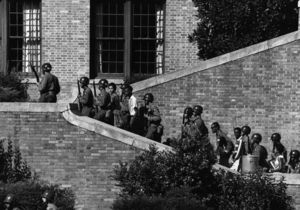
 Under escort from the U.S. Army’s 101st Airborne Division, nine black students enter all-white Central High School in Little Rock, Arkansas. Three weeks earlier, Arkansas Governor Orval Faubus had surrounded the school with National Guard troops to prevent its federal court-ordered racial integration. After a tense standoff, President Dwight D. Eisenhower federalized the Arkansas National Guard and sent 1,000 army paratroopers to Little Rock to enforce the court order.
On May 17, 1954, the U.S. Supreme Court ruled unanimously in Brown v. Board of Education of Topeka that racial segregation in educational facilities was unconstitutional. Five days later, the Little Rock School Board issued a statement saying it would comply with the decision when the Supreme Court outlined the method and time frame in which desegregation should be implemented.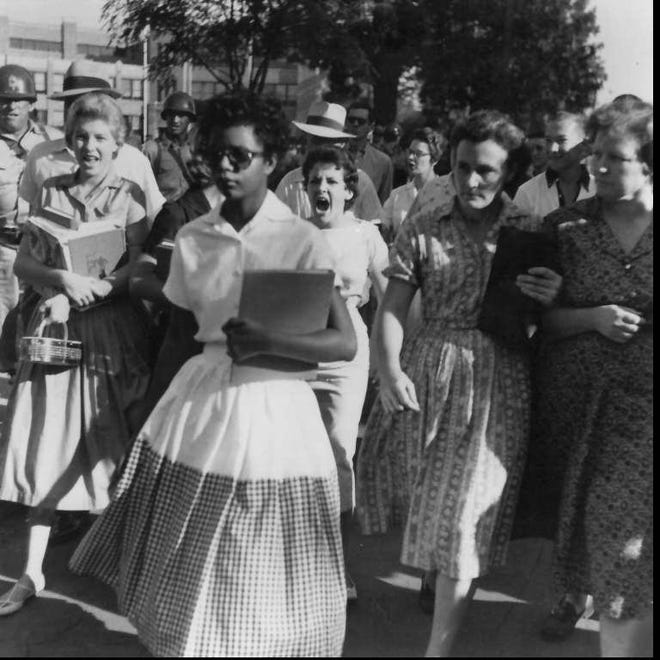
Arkansas was at the time among the more progressive Southern states in regard to racial issues. The University of Arkansas School of Law was integrated in 1949, and the Little Rock Public Library in 1951. Even before the Supreme Court ordered integration to proceed “with all deliberate speed,” the Little Rock School Board in 1955 unanimously adopted a plan of integration to begin in 1957 at the high school level. The National Association for the Advancement of Colored People (NAACP) filed suit, arguing the plan was too gradual, but a federal judge dismissed the suit, saying that the school board was acting in “utmost good faith.” Meanwhile, Little Rock’s public buses were desegregated. By 1957, seven out of Arkansas’ eight state universities were integrated.
In the spring of 1957, there were 517 black students who lived in the Central High School district. Eighty expressed an interest in attending Central in the fall, and they were interviewed by the Little Rock School Board, which narrowed down the number of candidates to 17. Eight of those students later decided to remain at all-black Horace Mann High School, leaving the “Little Rock Nine” to forge their way into Little Rock’s premier high school.
In August 1957, the newly formed Mother’s League of Central High School won a temporary injunction from the county chancellor to block integration of the school, charging that it “could lead to violence.” Federal District Judge Ronald Davies nullified the injunction on August 30. On September 2, Governor Orval Faubus—a staunch segregationist—called out the Arkansas National Guard to surround Central High School and prevent integration, ostensibly to prevent the bloodshed he claimed desegregation would cause. The next day, Judge Davies ordered integrated classes to begin on September 4.
September 4, 1957: Arkansas troops block “Little Rock Nine” from segregated high school
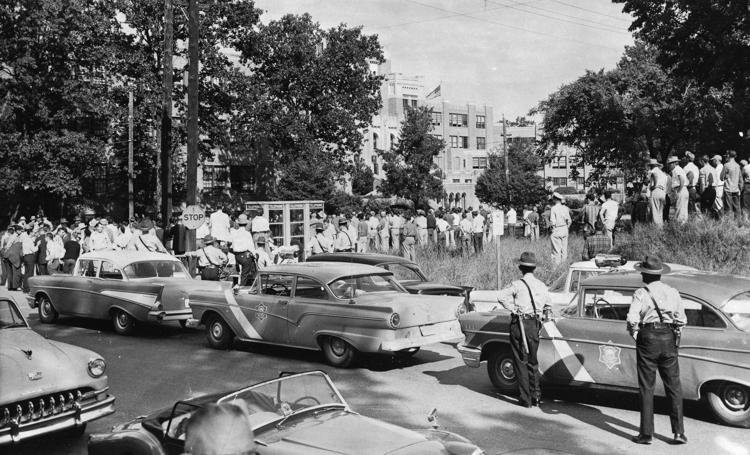
That morning, 100 armed National Guard troops encircled Central High School. A mob of 400 white civilians gathered and turned ugly when the black students began to arrive, shouting racial epithets and threatening the teenagers with violence. The National Guard troops refused to let the black students pass and used their clubs to control the crowd. One of the nine, 15-year-old Elizabeth Eckford, was surrounded by the mob, which threatened to lynch her. She was finally led to safety by a sympathetic white woman.
Little Rock Mayor Woodrow Mann condemned Faubus’ decision to call out the National Guard, but the governor defended his action, reiterating that he did so to prevent violence. The governor also stated that integration would occur in Little Rock when and if a majority of people chose to support it. Faubus’ defiance of Judge Davies’ court order was the first major test of Brown v. Board of Educationand the biggest challenge of the federal government’s authority over the states since the Reconstruction Era.
The standoff continued, and on September 20 Judge Davies ruled that Faubus had used the troops to prevent integration, not to preserve law and order as he claimed. Faubus had no choice but to withdraw the National Guard troops. Authority over the explosive situation was put in the hands of the Little Rock Police Department.
On September 23, as a mob of 1,000 whites milled around outside Central High School, the nine black students managed to gain access to a side door.
However, the mob became unruly when it learned the black students were inside, and the police evacuated them out of fear for their safety. That evening, President Eisenhower issued a special proclamation calling for opponents of the federal court order to “cease and desist.” On September 24, Little Rock’s mayor sent a telegram to the president asking him to send troops to maintain order and complete the integration process. Eisenhower immediately federalized the Arkansas National Guard and approved the deployment of U.S. troops to Little Rock. That evening, from the White House, the president delivered a nationally televised address in which he explained that he had taken the action to defend the rule of law and prevent “mob rule” and “anarchy.”
On September 25, the Little Rock Nine entered the school under heavily armed guard.
Troops remained at Central High School throughout the school year, but still the black students were subjected to verbal and physical assaults from a faction of white students. Melba Patillo, one of the nine, had acid thrown in her eyes, and Elizabeth Eckford was pushed down a flight of stairs. The three male students in the group were subjected to more conventional beatings. Minnijean Brown was suspended after dumping a bowl of chili over the head of a taunting white student. She was later suspended for the rest of the year after continuing to fight back. The other eight students consistently turned the other cheek. On May 27, 1958, Ernest Green, the only senior in the group, became the first black to graduate from Central High School.
Governor Faubus continued to fight the school board’s integration plan, and in September 1958 he ordered Little Rock’s three high schools closed rather than permit integration. Many Little Rock students lost a year of education as the legal fight over desegregation continued. In 1959, a federal court struck down Faubus’ school-closing law, and in August 1959 Little Rock’s white high schools opened a month early with black students in attendance.
All grades in Little Rock public schools were finally integrated in 1972





 Be a Seed for Change
You must be logged in to post a comment.