June 20, 1967: When Muhammad Ali Took the Weight


FILED UNDER: DRAFT RESISTANCEFEATUREDFROM

This article originally appeared at The Rag Blog.

Dave Zirin : When Muhammad Ali Took the Weight

Muhammad Ali, the former Cassius Clay, was convicted by a U.S. federal court in Houston on June 20, 1967. Above, he is shown when refusing induction at the Houston draft board, April 28, 1967. At his right is the Rev. Martin Luther King, Jr.In an era defined by endless war, we should recognize a day in history that won’t be celebrated on Capitol Hill or in the White House. On June 20, 1967, the great Muhammad Ali was convicted in Houston for refusing induction in the U.S. armed forces.

Ali saw the war in Vietnam as an exercise in genocide. He also used his platform as boxing champion to connect the war abroad with the war at home, saying, “Why should they ask me to put on a uniform and go 10,000 miles from home and drop bombs and bullets on Brown people in Vietnam while so-called Negro people in Louisville are treated like dogs?”

For these statements, as much as the act itself, Judge Joe Ingraham handed down the maximum sentence to Cassius Clay” (as they insisted upon calling him in court): five-years in a federal penitentary and a $10,000 fine. The next day, this was the top-flap story for The New York Times with the headline, “Clay Guilty in Draft Case; Gets Five Years in Prison.”

The sentence was unusually harsh and deeply tied to a Beltway, bipartisan consensus to crush Ali and ensure that he not develop into a symbol of anti-war resistance. The day of Ali’s conviction the U.S. Congress voted 337-29 to extend the draft four more years. They also voted 385-19 to make it a federal crime to desecrate the flag. Their fears of a rising movement against the war were well-founded.The summer of 1967 marked a tipping point for public support of the Vietnam “police action.” While the Tet Offensive, which exposed the lie that the United States was winning the war, was still six months away, the news out of Southeast Asia was increasingly grim. At the time of Ali’s conviction, 1,000 Vietnamese noncombatants were being killed each week by U.S. forces. One hundred U.S. soldiers were dying every day, and the war was costing $2 billion a month.Anti-war sentiment was growing and it was thought that a stern rebuke of Ali would help put out the fire. In fact, the opposite took place. Ali’s brave stance fanned the flames.

As Julian Bond said,

[It] reverberated through the whole society… [Y]ou could hear people talking about it on street corners. It was on everyone’s lips. People who had never thought about the war before began to think it through because of Ali. The ripples were enormous.

Ali himself vowed to appeal the conviction, saying,

I strongly object to the fact that so many newspapers have given the American public and the world the impression that I have only two alternatives in this stand — either I go to jail or go to the Army. There is another alternative, and that alternative is justice. If justice prevails, if my constitutional rights are upheld, I will be forced to go neither to the Army nor jail. In the end, I am confident that justice will come my way, for the truth must eventually prevail.

Already, by this point, Ali’s heavyweight title had been stripped, beginning a three-and-a-half-year exile. Already Elijah Muhammad and the Nation of Islam had begun to distance themselves from their most famous member. Already, Ali had become a punching bag for almost every reporter with a working pen.

But with his conviction came a new global constituency. In Guyana, protests against his sentence took place in front of the U.S. embassy. In Karachi, Pakistan, a hunger strike began in front of the U.S. consulate. In Cairo, demonstrators took to the streets. In Ghana, editorials decried his conviction. In London, an Irish boxing fan named Paddy Monaghan began a long and lonely picket of the U.S. Embassy.Over the next three years, he would collect more than 20,000 signatures on a petition calling for the restoration of Muhammad Ali’s heavyweight title.Ali at this point was beginning to see himself as someone who had a greater responsibility to an international groundswell that saw him as more than an athlete.

Boxing is nothing, just satisfying to some bloodthirsty people. I’m no longer a Cassius Clay, a Negro from Kentucky. I belong to the world, the black world. I’ll always have a home in Pakistan, in Algeria, in Ethiopia. This is more than money.

Eventually justice did prevail and the Supreme Court overturned Ali’s conviction in 1971. They did so only after the consensus on the war had changed profoundly. Ali had been proven right by history, although a generation of people in [Southeast] Asia and the United States paid a terrible price along the way.

Years later, upon reflection, Ali said he had no regrets.

Some people thought I was a hero. Some people said that what I did was wrong. But everything I did was according to my conscience. I wasn’t trying to be a leader. I just wanted to be free. And I made a stand all people, not just black people, should have thought about making, because it wasn’t just black people being drafted. The government had a system where the rich man’s son went to college, and the poor man’s son went to war. Then, after the rich man’s son got out of college, he did other things to keep him out of the Army until he was too old to be drafted.

As we remain mired in a period of permanent war, take a moment and consider the risk, sacrifice, and principle necessary to dismantle the war machine. We all can’t be boxing champions, but moving forward, all who oppose war can rightfully claim Ali’s brave history as our own.

[Dave Zirin is the author of Bad Sports: How Owners are Ruining the Games we Love (Scribner) and just made the new documentary Not Just a Game. Receive his column every week by emailingdave@edgeofsports.com. Contact him at edgeofsports@gmail.com. This article was also posted at The Nation blogs. Read more articles by Dave Zirin on 

Detroit Race Riot 6/20 (1943)


The image above: The intersection of 12th and Clairmount in Detroit was the epicenter of the 1967 civil disturbance. In the early hours of July 23, after police detain 85 partygoers at a blind pig, an outraged crowd gathers and soon a bottle is thrown at a police cruiser.
The Detroit News archives

Pulling a Man Off a Streetcar, Detroit Riot, 1943

The Detroit Riot of 1943 lasted only about 24 hours from 10:30 on June 20 to 11:00 p.m. on June 21; nonetheless it was considered one of the worst riots during the World War II era.  Several contributing factors revolved around police brutality, and the sudden influx of black migrants from the south into the city, lured by the promise of jobs in defense plants.  The migrants faced an acute housing shortage which many thought would be reduced by the construction of public housing.  However the construction of public housing for blacks in predominately white neighborhoods often created racial tension.

The Sojourner Truth Homes Riot in 1942, for example, began when whites were enraged by the opening of that project in their neighborhood.  Mobs attempted to keep the black residents from moving into their new homes.  That confrontation laid the foundation for the much larger riot one year later.

On June 20, a warm Saturday evening, a fist fight broke out between a black man and a white man at the sprawling Belle Isle Amusement Park in the Detroit River.  The brawl eventually grew into a confrontation between groups of blacks and whites, and then spilled into the city.  Stores were looted, and buildings were burned in the riot, most of which were located in a black neighborhood.  The riot took place in an area of roughly two miles in and around Paradise Valley, one of the oldest and poorest neighborhoods in Detroit, Michigan.

As the violence escalated, both blacks and whites engaged in violence.  Blacks dragged whites out of cars and looted white-owned stores in Paradise Valley while whites overturned and burned black-owned vehicles and attacked African Americans on streetcars along Woodward Avenue and other major streets.  The Detroit police did little in the rioting, often siding with the white rioters in the violence.

The violence ended only after President Franklin Roosevelt, at the request of Detroit Mayor Edward Jeffries, Jr., ordered 6,000 federal troops into the city.  Twenty-five blacks and nine whites were killed in the violence.  Of the 25 African Americans who died, 17 were killed by the police.  The police claimed that these shootings were justified since the victims were engaged in looting stores on Hastings Street.  Of the nine whites who died, none were killed by the police.  The city suffered an estimated $2 million in property damages.

Sources:
Allen D. Grimshaw, ed., Racial Violence in the United States (Chicago: Aldine Publishing, 1969); Stephen Thernstrom and Abigail Thernstrom, America in Black and White (New York: Simon and Schuster, 1997).

Contributor:

University of Washington

– See more at: http://www.blackpast.org/aah/detroit-race-riot-1943#sthash.SE2l3O76.dpuf

1782 Congress adopts the Great Seal of the United States


On June 20, 1782, Congress adopts the Great Seal of the United States after six years of discussion. The front of the seal depicts a bald eagle clutching an olive branch in its right talon and arrows in its left. On its breast appears a shield marked with 13 vertical red and …read more

2025 Summer Solstice


By Jamie Carter

This year, the summer solstice in the Northern Hemisphere occurs at 02:42 UTC on Saturday, June 21, 2025.

That means it’s at 10:42 p.m. EDT on Friday, June 20 and at 3:41 a.m. BST on Saturday, June 21.

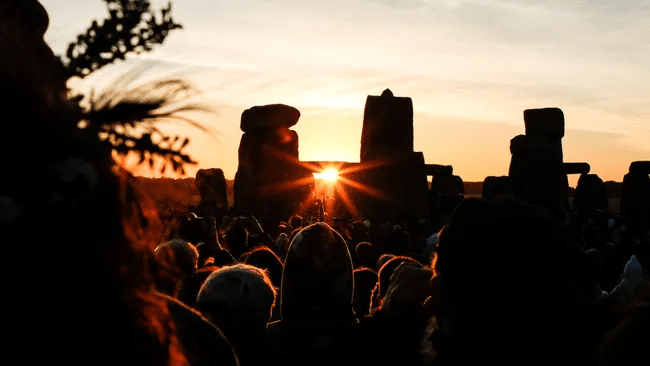
Crowds celebrating the summer solstice and the dawn of the longest day of the year at Stonehenge in Wiltshire, England. (Image credit: paul mansfield photography via Getty Images)

Each year on the summer solstice, revelers at Stonehenge in England stay up all night to celebrate the dawn of the longest day of the year in the Northern Hemisphere, with many images streamed live.

But this year, there’s a twist: The summer solstice there will occur on a different day than the solstice in North America, due to time zone differences.

So, when is the summer solstice in 2025, and what’s the science behind it?

Source: livescience.com for the complete article

on this day 6/19 1964 – The Civil Rights Act of 1964 was approved after surviving an 83-day filibuster in the U.S. Senate.


0240 BC – Eratosthenes estimated the circumference of the Earth using two sticks.

1586 – English colonists sailed away from Roanoke Island, NC, after failing to establish England’s first permanent settlement in America.

1778 – U.S. General George Washington’s troops finally left Valley Forge after a winter of training.

1821 – The Ottomans defeated the Greeks at the Battle of Dragasani.

1846 – The New York Knickerbocker Club played the New York Club in the first baseball game at the Elysian Field, Hoboken, NJ. It was the first organized baseball game.

1862 – U.S. President Abraham Lincoln outlined his Emancipation Proclamation, which outlawed slavery in U.S. territories.

1864 – The USS Kearsarge sank the CSS Alabama off of Cherbourg, France.

1865 – The emancipation of slaves was proclaimed in Texas.

1867 – In New York, the Belmont Stakes was run for the first time.

1873 – Eadweard Muybridge successfully photographed a horse named “Sallie Gardner” in fast motion using a series of 24 stereoscopic cameras. This is considered the first step toward motion pictures.

1903 – The young school teacher, Benito Mussolini, was placed under investigation by police in Bern, Switzerland.

1910 – The first Father’s Day was celebrated in Spokane, Washington.

1911 – In Pennsylvania, the first motion-picture censorship board was established.

1912 – The U.S. government established the 8-hour work day.

1917 – During World War I, King George V ordered the British royal family to dispense with German titles and surnames.

1933 – France granted Leon Trotsky political asylum.

1934 – The U.S. National Archives and Records Administration was established.

1934 – The U.S. Congress established the Federal Communications Commission (FCC). The commission was to regulate radio and TV broadcasting (later).

1937 – The town of Bilbao, Spain, fell to the Nationalist forces.

1939 – In Atlanta, GA, legislation was enacted that disallowed pinball machines in the city.

1942 – Norma Jeane Mortenson (Marilyn Monroe) and her 21-year-old neighbor Jimmy Dougherty were married. They were divorced in June of 1946.

1942 – British Prime Minister Winston Churchill arrived in Washington, DC, to discuss the invasion of North Africa with U.S. President Roosevelt.

1943 – Henry Kissinger became a naturalized United States citizen.

1943 – The National Football League approved the merger of the Philadelphia Eagles and the Pittsburgh Steelers.

1944 – The U.S. won the battle of the Philippine Sea against the Imperial Japanese fleet.

1951 – U.S. President Harry S. Truman signed the Universal Military Training and Service Act, which extended Selective Service until July 1, 1955 and lowered the draft age to 18.

1958 – In Washington, DC, nine entertainers refused to answer a congressional committee’s questions on communism.

1961 – Kuwait regained complete independence from Britain.

1961 – The U.S. Supreme Court struck down a provision in Maryland’s constitution that required state officeholders to profess a belief in God.

1964 – The Civil Rights Act of 1964 was approved after surviving an 83-day filibuster in the U.S. Senate.

1965 – Air Marshall Nguyen Cao Ky became South Vietnam’s youngest premier at age 34.

1968 – 50,000 people marched on Washington, DC. to support the Poor People’s Campaign.

1973 – The Case-Church Amendment prevented further U.S. involvement in Southeast Asia.

1973 – The stage production of “The Rocky Horror Picture Show” opened in London.

1973 – Gordie Howe left the NHL to join his sons Mark and Marty in the WHA (World Hockey League).

1981 – The European Space Agency sent two satellites into orbit from Kourou, French Guiana.

1983 – Lixian-nian was chosen to be China’s first president since 1969.

1987 – The U.S. Supreme Court struck down the Louisiana law that required that schools teach creationism.

1997 – William Hague became the youngest leader of Britain’s Conservative party in nearly 200 years.

1998 – Gateway was fined more than $400,000 for illegally shipping personal computers to 16 countries subject to U.S. export controls.

1998 – A study released said that smoking more than doubles risks of developing dementia and Alzheimer’s.

1998 – Switzerland’s three largest banks offered $600 million to settle claims they’d stolen the assets of Holocaust victims during World War II. Jewish leaders called the offer insultingly low.

2000 – The U.S. Supreme Court ruled that a group prayer led by students at public-school football games violated the 1st Amendment’s principle that called for the separation of church and state.

on-this-day.com

politics,pollution,petitions,pop culture & purses