
Nat Turner’s Revolt (1831) 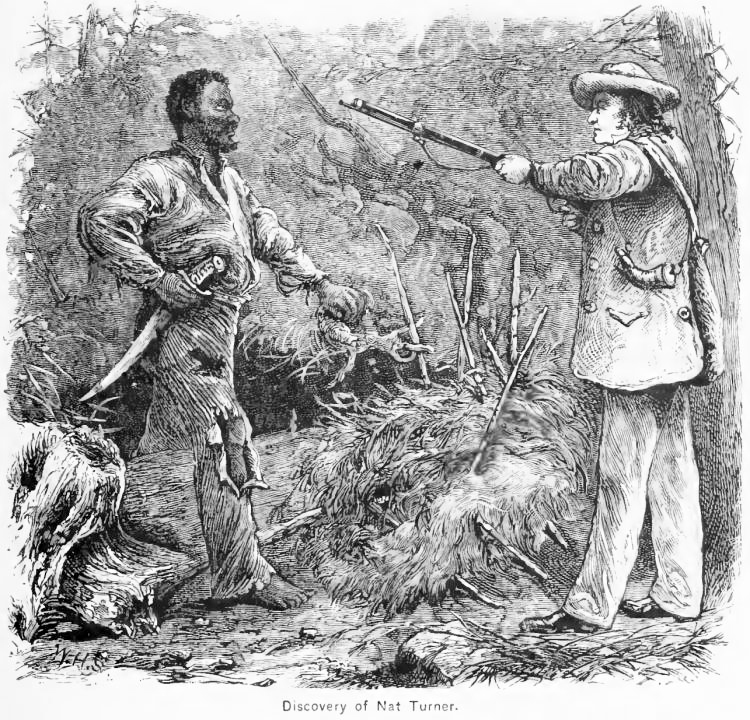
Contributed by Patrick H. Breen
On the evening of August 21–22, 1831, an enslaved preacher and self-styled prophet named Nat Turner launched the most deadly slave revolt in the history of the United States. Over the course of a day in Southampton County, Turner and his allies killed fifty-five white men, women, and children as the rebels made their way toward Jerusalem, Virginia (now Courtland).
Nat Turner, the leader of a bloody revolt of enslaved people in Southampton County, Virginia, is hanged in Jerusalem, the county seat, on November 11, 1831.
Less than twenty-four hours after the revolt began, the rebels encountered organized resistance and were defeated in an encounter at James Parker’s farm. Following this setback, Turner and other rebels scrambled to reassemble their forces.
The next day, a series of defeats led to the effective end of the revolt. Whites quickly and brutally reasserted their control over Southampton County, killing roughly three dozen blacks without trials. Within a few days of the revolt, white leaders in Southampton became increasingly confident that the revolt had been suppressed and worked to limit the extralegal killing of blacks. Instead, white leaders made sure that the remaining suspected slaves were tried, which also meant that the white slave owners would receive compensation from the state for condemned slaves, a benefit that the state did not extend to slave owners who owned suspected rebels killed without trials. This effort, which reached a climax with the declaration of martial law in Southampton a week after the revolt began, meant that Southampton court system would ultimately decide what to do with suspected slave rebels.
Trials began on August 31, 1831, and the majority of trials were completed within a month. By the time that the trials were finished the following spring, thirty slaves and one free black had been condemned to death. Of these, nineteen were executed in Southampton: Governor John Floyd, following the recommendations of the court in Southampton, commuted twelve sentences. Turner himself had eluded whites throughout September and into October when two slaves spotted him close to where the revolt began. Once detected, Turner was forced to move, but he was unable to elude the renewed manhunt. He was captured on October 30. While in jail awaiting trial, Turner spoke freely with whites about the revolt. Local lawyer Thomas R. Gray approached Turner with a plan to take down his confessions. The Confessions of Nat Turner was published within weeks of Turner’s execution on November 11, 1831, and remains one of the most important sources for historians working on slavery in the United States. The revolt had important ramifications outside of Southampton, as several southern communities feared that slaves in their community were part of the revolt. In Richmond, Thomas Jefferson Randolph—the grandson of Thomas Jefferson—tried but failed to convince the General Assembly to enact a plan that would have put the state on the path to gradual emancipation. Abolitionists remembered the revolt as an important example of both slaves’ hate for the system of slavery and their bravery. The cultural legacy of the revolt is still vibrant; the revolt remains the clearest example of overt resistance in the United States to the system of slavery
Origins
Nat Turner’s Bible
While the oppressive system of slavery provided the essential backdrop for the revolt, Nat Turner described his motivation for the Southampton slave revolt in religious terms. Little is known about Turner beyond what Thomas R. Gray published in The Confessions of Nat Turner. According to The Confessions, Turner was born into slavery on a Southampton plantation on October 2, 1800. He could read and write, which was unusual for an enslaved person of that time and place, and he owned a Bible. He had a family, including a grandmother to whom he was “much attached”; a father who escaped slavery; and a wife and son, who lived on a neighboring farm. He was deeply religious, “devoting [his] time to fasting and prayer,” and experienced private revelations in which “the Spirit that spoke to the prophets in former days” spoke to him. When he was in his twenties, Turner ran away from his overseer. He was gone for a month, returning only, he said, at the spirit’s urging.
In the late 1820s, his religious visions—which up to this point appeared to be apolitical or even counterrevolutionary—became more overtly political. On May 12, 1828, the spirit appeared to Turner and told him that “the time was fast approaching when the first should be last and the last should be first.” It also told him that there would be a sign, a prediction that Turner believed was fulfilled on February 12, 1831, when Southampton experienced a total solar eclipse. While The Confessions describes Turner’s motivations in primarily religious terms, the historian David F. Allmendinger Jr. noted that the religious signs might not have been the only thing that led Turner to undertake the conspiracy. At this time, Turner lived on the farm of his master, Joseph Travis; his son lived on a neighboring farm belonging to Piety Reese. In February 1831, just days before Turner approached his future conspirators, Reese’s son John W. signed a note that put Turner’s son up as collateral for a debt that he, Reese, had struggled to pay.
Nat Turner & His
Confederates in Conference.
Inspired by a combination of religious, familial, and perhaps other unrecorded motives, Nat Turner shared his idea of revolting with four other slaves in whom he “had the greatest confidence”—Henry, Hark, Nelson, and Sam. None of the four betrayed the plot, and all joined a conspiracy that they understood would likely cost them their lives. These men never had the chance to explain why they cast their lots with Turner. Many whites at the time of the revolt dismissed Turner’s followers as pawns “who acted under the influence of their leader,” as the Richmond Whig and Commercial Journal put it, but it is unclear how many—if any—were disciples of Turner. (The only person who was named as a religious follower in The Confessions was a white man, Etheldred Brantley, whom Turner baptized.) While Turner described the revolt in religious terms, the new conspirators appear to have seen the revolt in more political terms. When the conspirators selected a date to begin the revolt, initially they picked the Fourth of July.
As the five conspirators tried to turn Turner’s inspiration into a plan, they thought about the revolt strategically. Nothing was more important to the conspirators than to make sure that their plan went undetected. Turner and his men understood that “the negroes had frequently attempted similar things,” but because they “confided their purpose to several,” the news of the conspiracy “always leaked out.” Based upon this insight, the rebels decided to keep the revolt small, deciding not even to stockpile weapons. Instead, the conspirators accepted Turner’s strategy to “slay my enemies with their own weapons.” While this made the rebels less dangerous at the beginning of the revolt, it also decreased the chance that the conspiracy would be detected before the revolt began.
The Confessions of Nat
Turner, the Leader of the Late
Insurrection in Southampton,
Va.
Keeping the revolt small meant that whites would not uncover the conspiracy, but keeping it small created a new hurdle for the rebels: they had to figure out how to get slaves and free blacks who had not heard about the revolt to join them. Turner recalled the conspirators thought hard about this problem—”Many were the plans formed and rejected by us,” he noted in The Confessions—but with little success. On July 4, 1831, the day the original conspirators initially agreed upon to begin the revolt, Turner “fell sick,” in part because he had little confidence that the rebels had a plan that would work.
Eventually, perhaps spurred on by a new sign from God—a solar event on August 13, 1831, where across the east coast the sun appeared silver and then green—the conspirators settled on a plan that they hoped would lead slaves and free blacks to rally to their banner: they would undertake a sudden strike and kill whites, including women and children, indiscriminately. Hearing about the rebels’ power and success, other slaves and free blacks would join. When one potential recruit objected that there were too few rebels to begin a slave revolt, one of the original conspirators assured him that as the rebels “went on and killed the whites[,] the blacks would join them.” This was just the first stage of the revolt. According to The Confessions, once they rebels had formed and equipped a “sufficient force,” the indiscriminate killings of whites would end, and the revolt would continue albeit using more conventional methods of war.
The plan was clearly a long shot, as the rebels understood, but given the odds against them, the five conspirators were willing to stake their lives on it. On Saturday evening, August 20, Turner, Henry, and Hark made plans for a feast the following day for the men who had joined the revolt. When they gathered the next day, the original five conspirators had added two. After a feast and a trip to Joseph Travis’s cider press, the conspirators were ready to begin the revolt.
The Revolt
The revolt began on Sunday night, August 21, 1831, at Joseph Travis’s farm. During the night, the rebels caught the whites completely by surprise, and sleeping whites were in no position to escape the small rebel force. At the same time, while the rebels were in their own neighborhood, they could recruit slaves that they knew to their cause. For example, at Travis’s home, the rebels recruited Austin, who despite living on the same small farm as Turner had not been included in the feast that the conspirators held during the day. At the same time, however, other slaves, even slaves with strong personal connections to the original conspirators, were hesitant to join the revolt. Hark’s brother-in-law Jack agreed to join only reluctantly. Others, including the free black Emory Evans, who lived on Salathial Francis’s farm, refused to join at all. Over the course of the night, the rebels attacked three households, killing eight whites, including a sleeping infant at Travis’s.
As dawn approached on the morning of August 22, the rebels—then numbering about a dozen—changed their method of attack. During the night, they moved stealthily and attacked in silence; during the day, they moved quickly and boldly. At Elizabeth Turner’s, Austen shot Hartwell Peebles, the first time that any rebel killed someone with a gun. During the morning, the rebels also separated into two squads: one on horseback, one traveling by foot. This allowed the one on horseback to launch more and faster strikes. These attacks were successful in terms of killing whites. At Catherine Whitehead’s plantation, for example, rebels killed all but one of the white residents—including Margaret Whitehead, the only person Nat Turner killed—but the rebels continued to struggle to win supporters among slaves. Among Whitehead’s twenty-seven slaves, the rebels found, at most, a single recruit, and several of Catherine Whitehead’s slaves foiled the rebels’ efforts to kill Harriet Whitehead. At Newit Harris’s even larger plantation, the rebels failed to gain a single recruit. By late morning, it was clear that the rebels would not inspire a mass movement, as they had hoped. Nevertheless, at about forty slaves, the rebel army was a dangerous force.
By midmorning the challenge of recruiting was compounded by a new problem for the rebels: news about the revolt had spread, making it harder for the rebels to find whites. Most whites who heard of the revolt immediately fled to the woods, eluding the rebel army. Others tried to create defensible positions. At Levi Waller’s farm, the site of a local school, word arrived of the insurrection, and Waller made the decision to gather the children together to defend them. This led to the most devastating raid of the revolt, as the rebels arrived after the children had congregated but before Waller could set up any defense. Waller’s wife and ten children died during that assault. By midday, when the rebels left Rebecca Vaughn’s house, they had encountered no more defenseless whites. Arthur Vaughn was the last person killed by the rebel forces.
By the afternoon of August 22, 1831, the dynamic of the revolt had shifted in an important way. Turner and his men remained on the offensive, heading to Jerusalem where they hoped to “procure arms and ammunition,” but they were being pursued by several groups of whites who had organized to suppress the revolt. At James Parker’s farm, a group of whites led by Alexander P. Peete, who had been pursuing the rebels along the road toward Jerusalem, dispersed a small group of rebels who had remained by the gate while the other rebels went to Parker’s slave quarters to recruit. This white force then engaged the main rebel force at Parker’s farm. Peete and his men were driven from the field. The rebels pursued the fleeing men, but the pursuit led the rebels into an ambush set by other whites who had heard the sounds of fighting. Turner’s men were dispersed, and the rebels were turned back from their approach toward Jerusalem.
Following the defeat at Parker’s farm, the rebels spent the afternoon trying to regroup. By evening, when they made their camp at Thomas Ridley’s plantation, Turner had about forty men in arms. But the rebels were on edge. When rebel sentries went out before dawn to investigate potential attack, they found nothing, but their return set off a commotion in the rebels’ camp. Awake and ill at ease, the rebels who had not fled made their way to Samuel Blunt’s plantation. They believed that the whites had abandoned the plantation, but Blunt and five other whites set up a defense and the rebels scattered. In the commotion following the encounter at Blunt’s, Nat Turner lost contact with the other rebels, who broke up into ever-smaller groups, pursued by more and more whites. Although some rebels remained at large for days—and Turner himself would not be captured for more than two months—the revolt was effectively over by midday on August 23, a day and a half after it first began.
Aftermath
News of the revolt created fear among whites, many of whom left their houses to gather together in central places. One reporter noted, “Jerusalem was never so crowded from its foundation.” As the families gathered, whites organized paramilitary units to put down the revolt and in many cases get revenge. In the days after the revolt, whites from Southampton and beyond killed about three dozen blacks without trial in Southampton County. At Catherine Whitehead’s, for example, a white unit from Greensville County was about to kill an enslaved man named Hubbard, when Harriet Whitehead stopped the execution by explaining to the whites that Hubbard had actually saved her life. Whites also tortured blacks, often by putting the suspected slave’s feet in a fire. One white recounted how one suspect nearly had his foot “burnt off” before his interrogators “found at last that he was innocent.” A newspaper editor admitted that the brutality was “hardly inferior in barbarity to the atrocities of the insurgents.”
The pattern of retribution and killing in the days after the revolt posed a serious threat to black community and to the county’s largest slaveholders. After the revolt, anyone could freely kill a slave and escape punishment if the killer claimed that he thought that the slave was a suspected rebel. To stop such indiscriminate killings, on August 28, 1831, General Richard Eppes, the leader of the state militia force in Southampton, issued an order calling for whites “to abstain in the future from any acts of violence to any personal property whatever”—in other words, enslaved men and women—”for any cause whatever.” Those who disobeyed this order would be subject to “the rigors of the articles of war.” The effort to stop extralegal killings was largely successful and meant that thereafter, most slaves who were suspected of supporting the rebels appeared in court.
Slaves Executed for the Nat
Turner Revolt
The trials of suspected slave rebels began on August 31, 1831. The trials were held in courts of oyer and terminer, which meant that slaves were tried without a jury before a panel of slaveholding judges. Accused slaves all had paid appointed defense attorneys, and the judges made an effort to make sure that the trials were not show trials. The court demanded properly drawn charges—it dismissed a case where the prosecutor had not properly drawn his charges—and required that the prosecutor present some credible evidence that the accused were guilty of a crime. In many of these cases, these formal hurdles posed no problem for the prosecutor, Meriwether Broadnax, who was able to secure thirty convictions against accused slaves. Every one of the convictions led to a death sentence, although in twelve of these cases, the court found some extenuating circumstance—such as youth, lack of substantive involvement in the revolt, or reluctance to join the conspirators—to recommend that Governor John Floyd commute the death sentence to sale from the state of Virginia. (The governor followed the recommendations of the court in every case the court provided a unanimous recommendation, although he was inclined, but unable, to commute the sentence of Lucy, the one woman convicted for a role in the revolt. In the one case where a split court recommended commutation, Floyd sided with the minority and allowed the execution to proceed.) The judges also examined five free blacks. Four were remanded until the next meeting of the Superior Court of Chancery, where three would be acquitted. One, Barry Newsom, was convicted and, on May 11, 1832, became the last of nineteen people executed in Southampton County for their role in the revolt.
Discovery of Nat
Turner
While the trials and executions were ongoing, Nat Turner himself remained at large. For nearly two months, he evaded whites, until a dog happened upon his hideout and found some meat. The dog returned a few nights later, accompanied by two blacks who were out hunting. When Turner revealed himself to them, he pleaded for them to keep his hiding place secret, but they ran away. Realizing that “they would betray me,” Turner fled from his initial hiding place. Whites, who had no clear idea where Turner was up to that point, renewed their manhunt near where the revolt began. Benjamin Phipps finally captured Turner on October 30, 1831. Turner was brought to Jerusalem the next day, where he was examined by James Trezvant and James W. Parker, two of the most prominent political figures in Southampton County. The examination lasted more than an hour and witnesses found Turner “quite communicative.” Turner’s willingness “to answer any questions” created an opportunity for Thomas R. Gray, a young ne’er-do-well attorney, who offered to publish Turner’s confession. Turner agreed. Gray met with Turner over a series of three days and took down Turner’s confessions. On November 5, 1831, Trezvant may have read a draft of The Confessions at Turner’s trial. Gray took the final version of The Confessions to Washington, D.C., to register it for copyright, something that was done even before Turner was executed on November 11, 1831. The Confessions was published by the end of November 1831.
William Preston
Outside of Southampton County, the revolt had important repercussions. Whites in nearby Virginia and North Carolina worried that the plot extended beyond Southampton. This led to both extralegal and legal retribution taken against blacks suspected to have been privy to the plot. Elsewhere in the South, most notably in and around Wilmington, North Carolina, fears of slave insurrections led to terrible panics and brutal reprisals against local blacks. Because the revolt reminded whites about the dangers of slavery, roughly 2,000 Virginians petitioned the state legislature to do something about slavery. A committee charged with considering the petitions reported that it was “inexpedient” for the General Assembly to pass any laws that would end slavery in Virginia. Delegate William Preston offered an amendment that replaced “inexpedient” with “expedient,” but the reformers lost this vote, marking the last time that the Virginia legislature would consider a movement away from slavery until the end of the American Civil War (1861–1865). Instead the legislature passed a series of restrictions aimed at further suppressing black religion and limiting the rights of free blacks.
Legacy
The Confessions of Nat
Turner
Nat Turner’s Revolt has been an important part of the cultural landscape in the United States. In the Cooper’s Union Address, Republican presidential candidate Abraham Lincoln reminded his New York audience of what he called the Southampton Insurrection, suggesting that slavery revolts were a threat before John Brown or the rise of the Republican Party. The abolitionist Thomas Wentworth Higginson wrote a history of the revolt that appeared in the Atlantic Monthly in the first months of the Civil War. In the twentieth century, the historian Herbert Aptheker wrote about the revolt and myriad other episodes of slave resistance as a way to combat the common perception that slaves were content in the antebellum South. Aptheker’s most important work, American Negro Slave Revolts (1943), was panned by many historians of his era, but this work on Southampton nonetheless prepared the ground for a revisionist understanding of slavery as an oppressive system that slaves actively resisted. In 1967, the novelist William Styron gave the revolt a broader audience when he wrote a best-selling novel based upon The Confessions published by Thomas R. Gray. The book won critical praise—including a Pulitzer Prize for fiction—but it also engendered strong protest from black activists who objected to the way that Styron, a white man, had portrayed the leader of the revolt. In 2016, Virginia native Nate Parker released the movie Birth of a Nation, which dramatized the story of the revolt.
http://www.EncyclopediaVirginia.org


You must be logged in to post a comment.