
1919 Chicago race riot (15 whites & 23 blacks killed, 500 injured)


On July 27, 1919, an African American teenager drowned in Lake Michigan after violating the unofficial segregation of Chicago’s beaches and being stoned by a group of white youths.

His death, and the police’s refusal to arrest the white man whom eyewitnesses identified as causing it, sparked a week of rioting between gangs of Black and white Chicagoans, concentrated on the South Side neighborhood surrounding the stockyards.

When the riots ended on August 3, 15 white and 23 Black people had been killed and more than 500 people injured; an additional 1,000 Black families had lost their homes when they were torched by rioters.
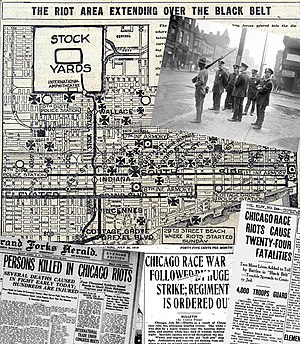
1919 Chicago Race Riot.jpg


July 27 – August 3, 191

Did you know? In the summer of 1919, Richard J. Daley, who served as Chicago’s powerful mayor from 1955 until his death in 1976, was a 17-year-old member of an Irish-American organization called the Hamburg Athletic Club. Though an investigation later identified the club among the instigators of the rioting, Daley and his supporters never admitted that he participated in the violence.

For the complete article: history.com

So, what’s so sad is that there is no mention of his name or the conditions aka temperature that would make a black teen and friends try to have fun…least we talk about that poor child…was a child, referred only as Williams!

GRAND RAPIDS UPRISING (1967)


CONTRIBUTED BY: WILL MACK

Grand Rapids Uprising, 1967
Fair use image

The 1967 Grand Rapids Uprising occurred on July 25, 1967 in a predominantly black and impoverished neighborhood in Grand Rapids, Michigan.  The uprising came only days after the much larger uprising in Detroit, Michigan but a post-riot official report titled “Anatomy of a Riot” written by the city’s Planning Department in November 1967, did not believe the two were related and that it was only a matter of time before the African American community in Grand Rapids would have exploded.

For the complete article: blackpast.org

1969 – The Nixon Doctrine is announced


President Richard Nixon announces that henceforth the United States will expect its Asian allies to tend to their own military defense. The Nixon Doctrine, as the president’s statement came to be known, clearly indicated his determination to “Vietnamize” the Vietnam War.

When Richard Nixon took office in early 1969, the United States had been at war in Vietnam for nearly four years. The bloody conflict had already claimed the lives of more than 25,000 American troops and countless Vietnamese. Despite its best efforts, the United States was no closer to victory than before. At home, antiwar protesters were a constant presence in American cities and on college campuses. Nixon campaigned in 1968 with the promise of “peace with honor” in Vietnam. In July 1969, an important part of his plan for Vietnam became evident.

During a stopover in Guam during a multination tour, the president issued a statement. It was time, he declared, for the United States to be “quite emphatic on two points” in dealing with its Asian allies. First, he assured America’s friends in Asia that “We will keep our treaty commitments.” However, “as far as the problems of military defense, except for the threat of a major power involving nuclear weapons,” the United States would be adopting a different stance. In relation to military defense, America would now “encourage and has a right to expect that this problem will be increasingly handled by, and the responsibility for it taken by, the Asian nations themselves.” He concluded that his recent talks with several Asian leaders indicated, “They are going to be willing to undertake this responsibility.”

The Nixon Doctrine marked the formal announcement of the president’s “Vietnamization” plan, whereby American troops would be slowly withdrawn from the conflict in Southeast Asia and be replaced by South Vietnamese troops. Over the course of his first term in office, Nixon held true to this doctrine by withdrawing a substantial portion of America’s fighting forces from Vietnam. In 1973, the United States and North Vietnam signed a peace treaty formally bringing the Vietnam War to a conclusion. Two years later, North Vietnamese forces crushed the South Vietnamese army and succeeded in reuniting the divided country under a communist regime.

Source: history.com

1861 – The Crittenden Resolution, which called for the American Civil War to be fought to preserve the Union and not for slavery, was passed by the U.S. Congress., which called for the American Civil War to be fought to preserve the Union and not for slavery, was passed by the U.S. Congress.


… take a deep breath because the stuff started before 1861!

But for the facts: You have got to read the entire article and click on the links to actually understand the ugly!

The 1860 Compromise That Would Have Preserved Slavery in the US Constitution

The author of Crittenden Compromise argued his six amendments presented a good deal. But then-President-elect Lincoln drew a firm line.

BY: FARRELL EVANS

UPDATED: JULY 11, 2023 | ORIGINAL: DECEMBER 6, 2021

For the entire article, please go to: history.com/news/crittenden-compromise-slavery-civil-war

The article is long the facts are real, and we should all thank Farrell Evans for this exceptional fact-based historical reminder.

-Nativegrl77

politics,pollution,petitions,pop culture & purses