

June 1963 – University of Alabama and Desegregation
On June 10, 1963, President John F. Kennedy federalized National Guard troops and deployed them to the University of Alabama to force its desegregation. The next day, Governor Wallace yielded to the federal pressure, and two African American students—Vivian Malone and James A. Hood—successfully enrolled. In September of the same year, Wallace again attempted to block the desegregation of an Alabama public school—this time Tuskegee High School—but President Kennedy once again employed his executive authority and federalized National Guard troops. Wallace had little choice but to yield.
Facing federalized Alabama National Guard troops, Alabama Governor George Wallace ends his blockade of the University of Alabama in Tuscaloosa and allows two African American students to enroll on June 11, 1963.
George Wallace, one of the most controversial politicians in U.S. history, was elected governor of Alabama in 1962 under an ultra-segregationist platform. In his 1963 inaugural address, he promised his white followers: “Segregation now! Segregation tomorrow! Segregation forever!” When African American students attempted to desegregate the University of Alabama in June 1963, Alabama’s new governor, flanked by state troopers, literally blocked the door of the enrollment office. The U.S. Supreme Court, however, had declared segregation unconstitutional in 1954’s Brown v. Board of Education, and the executive branch undertook aggressive tactics to enforce the ruling.
READ MORE: Segregation in the United States
Citation Information
Article Title
University of Alabama desegregated
AuthorHistory.com Editors
Website Name
HISTORY
URL
https://www.history.com/this-day-in-history/university-of-alabama-desegregated
Access Date
June 11, 2022
Publisher
A&E Television Networks
Last Updated
June 8, 2021
Original Published Date
February 9, 2010
Share this:

June 11, 2008 ~ Norway

Norway’s legislature passes a law giving same-sex couples the same rights to marriage and the adoption of children enjoyed by opposite-sex couples; the upper house approves the law on June 17.
Source: Britannica
Share this:

1963 – Dr. Martin Luther King, Jr. was arrested in Florida for trying to integrate restaurants.
In 1963, Dr. King was arrested at a rally in Birmingham, Ala. while protesting against segregation at lunch counters. The letter he wrote during his 11-day imprisonment argued that “Injustice anywhere is a threat to justice everywhere,” and set the tone for the civil rights movement by inspiring like-minded people to join him in uniting against injustice.

Resources: southernstudies.olemiss.edu
reference.com
Share this:

June 10: President John F. Kennedy signs into law Equal Pay Act of 1963, aimed at eliminating wage disparities based on gender
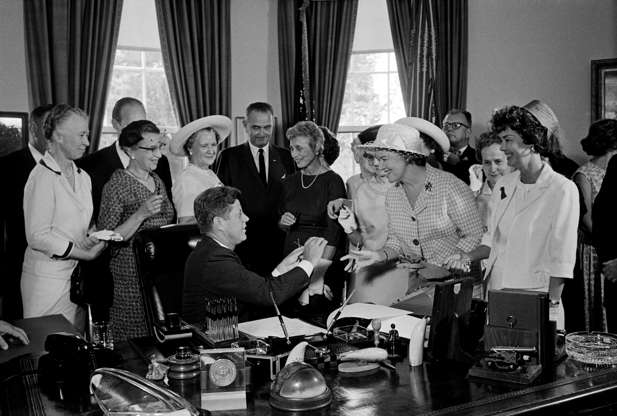

The Equal Pay Act, signed in to law by President John F. Kennedy on June 10, 1963, was one of the first federal anti-discrimination laws that addressed wage differences based on gender. The Act made it illegal to pay men and women working in the same place different salaries for similar work.
During the first decades of the 20th century, women made up less 24% of the U.S. workforce. During World War II, however, labor shortages brought large numbers of women in to the workplace and by 1945, women made up 37% of the civilian workforce. Because women had traditionally earned less than men for doing similar work, male workers feared that this growing source of cheap labor would replace them or lower their wages. As men began to join the military and women began to take over their civilian jobs, unions started to advocate for equal pay. They felt that this would prevent employers from undercutting future wages for men. In addition, the National War Labor Board endorsed the idea of equal pay for equal work. They issued a General Order supporting equal pay for men and women for work that was of “comparable quality and quantity.”
P.G. Harris, US Employment Service War Manpower Commission, 1942-1945
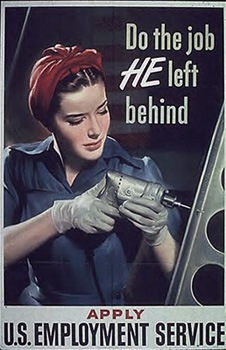
World War II Employment Poster
For the complete article: go to nps.gov
imagage with kennedy : Bettmann Archive/ Getty Images

 Be a Seed for Change
You must be logged in to post a comment.