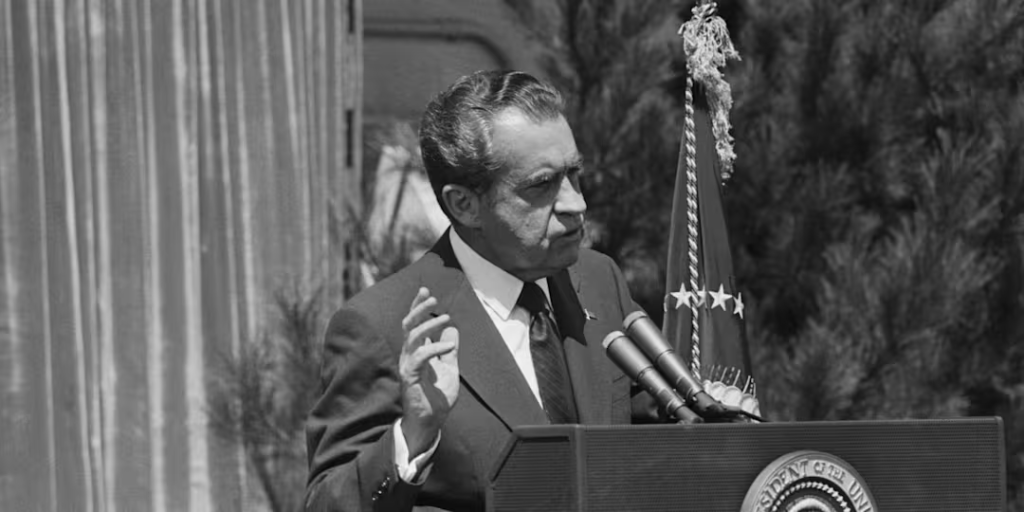
President Nixon refuses to hand over tapes


Bettmann Archive via Getty Images

On July 23, 1973, President Richard Nixon refuses to hand over his secret audio recordings to the Senate Watergate Committee and Special Prosecutor Archibald Cox, citing executive privilege. His refusal kicked off a legal battle that culminated in the U.S. Supreme Court’s unanimous ruling one year later that Nixon must hand over the tapes.

Between February 16, 1971, and July 18, 1973, Nixon secretly recorded some 3,700 hours of meetings and telephone conversations in the Oval Office, the Cabinet Room, his office in the Executive Office Building, the Lincoln Sitting Room and the Aspen Lodge at Camp David. Presidential aide Alexander Butterfield helped the Secret Service install the recording system at Nixon’s request, and Butterfield was one of the few people who knew about it.

Source: for the complete article history.com

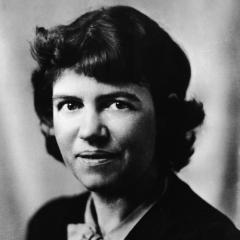
A quote by Margaret Mead


Where families suffer from disasters that are preventable, this is a measure of a whole nation’s neglect.

A society imperils its own future when, out of negligence or contempt, it overlooks the need of children to be reared in a family … or when, in the midst of plenty, some families cannot give their children adequate food and shelter, safe activity and rest, and an opportunity to grow into full adulthood as people who can care for and cherish other human beings like themselves.

Margaret Mead

a message in a bottle

Civil Rights Act of 1964 Facts ~ taught in some schools


Civil Rights Act of 1964 Facts

The Civil Rights Act of 1964 was a far-ranging law that was passed by Congress and signed into law by President Lyndon Johnson.

The Act essentially outlawed racial and gender discrimination in the workplace and outlawed most forms of racial segregation.

The bill was originally the idea of President John F. Kennedy, who was viewed by many in the Civil Rights movement as apathetic at best to their plight. Kennedy said he was influenced by sights of civil rights marchers being beaten by the police in Alabama, so he put forward the legislation in June 1963. The bill probably had the votes to pass, but was stopped in committee by Representative Howard Smith of Virginia, who was a segregationist.

After Kennedy was assassinated on November 22, 1963, the Congress and the general public were much more sympathetic to the bill.

The bill was passed 289-126 in the House of Representatives and a modified compromise version by the Senate 73-27 on June 19, 1964.

President Johnson signed the bill into law on July 2, 1964.


CivilRightsactsigned

Interesting Civil Rights Act of 1964 Facts:
  • Opposition to the bill was more along geographic than political lines with a majority of both southern Democrats and Republicans voting “nay.”
  • Representative Emanuel Cellar (D-NY) was one of the bill’s early advocates. He was also instrumental in passing the Immigration Act of 1965.
  • Southern Democrats filibustered for fifty-four days to prevent the passage of the bill before a compromise bill was introduced that lessened the power of the government to regulate private business.
  • Civil rights organizations, such as the NAACP, and leaders, like Martin Luther King Jr., lobbied congressmen and both presidents to pass the bill.
  • Title VII of the Act expressly prohibits workplace discrimination on the basis of race, color, religion, sex, or national origin.
  • The Equal Employment Opportunity Commission (EEOC), oversees enforcement of Title VII of the Civil Rights Act of 1964.
  • Among the more interesting of the congressmen who were opposed to the bill were Senators Robert Byrd (D-WV), who became a mentor to the next generation of Democrat politicians, and Albert Gore Sr. (D-TN), who was the father of former vice president and senator, Al Gore.
  • The legality of the Act has been upheld in several Supreme Court decisions, including:

Heart of Atlanta Hotel v. United States, Philips v. Martin Marietta Corp., and Pittsburgh Press Co. v. Pittsburgh Commission on Human Relations.

  • Title IX of the Act made it easier for criminal cases involving civil rights violations to be tried in federal court. This was extremely important as many Klansmen who were acquitted in state courts for crimes ranging from assault and arson to murder were usually convicted for civil rights violations, although the convictions usually carried far less time.
  • The passage of the Civil Rights Act of 1964 paved the way for the Civil Rights Act of 1968, which barred racial discrimination in housing.
Although some aspects of voting problems were addressed in the Civil Rights Act of 1964, most of the barriers to black disenfranchisement in the southern states were dealt with in the Voting Rights Act of 1965.

softschools.com

If you see any errors please feel free to comment… so many opinions on who actually came up with the idea of the Bill

WA ~ Heat Advisory


Tue, Jul 21, 3:19 PM PDT to Wed, Jul 22, 11:00 PM PDT

What

Hot conditions with high temperatures in the mid to upper 90s expected and low temperatures from 60 to 65 degrees. This will pose a major risk of heat-related illness.

Where

Eastern Kitsap County, City of Seattle, Downtown Everett / Marysville Area, Eastside, Foothills and Valleys of Central King County, Foothills and Valleys of Pierce and Southern King Counties, Foothills and Valleys of Snohomish and Northern King Counties, Lowlands of Pierce and Southern King Counties, and Shoreline / Lynnwood / South Everett Area.

When

Until 11 PM PDT Wednesday.

Impacts

Extreme heat will significantly increase the risk of heat-related illnesses for much of the population, especially those who are heat sensitive and those without effective cooling or adequate hydration.

Additional Details

Areas immediately along the water will experience cooler daytime high temperatures.

Summary

Drink plenty of fluids, stay in an air-conditioned room, stay out of the sun, and check up on relatives and neighbors. Young children and pets should never be left unattended in vehicles under any circumstances. Take extra precautions if you work or spend time outside. When possible, reschedule strenuous activities to early morning or evening. Know the signs and symptoms of heat exhaustion and heat stroke. Wear lightweight and loose-fitting clothing when possible. To reduce risk during outdoor work, the Occupational Safety and Health Administration recommends scheduling frequent rest breaks in shaded or air-conditioned environments. Anyone overcome by heat should be moved to a cool and shaded location. Heat stroke is an emergency! Call 9 1 1. For sheltering information and other human services in your area, dial 2 1 1 during business hours or visit wa211.org anytime.

Issued By

NWS Seattle WA

politics,pollution,petitions,pop culture & purses