on this day … 7/15 1901 – Over 74,000 Pittsburgh steel workers went on strike. 


1099 – Jerusalem fell to the Crusaders.

1410 – Poles and Lithuanians defeated the Teutonic knights at Tannenburg, Prussia.

1789 – The electors of Paris set up a “Commune” to live without the authority of the government.

1806 – Lieutenant Zebulon Pike began his western expedition from Fort Belle Fountaine, near St. Louis, MO.

1813 – Napoleon Bonaparte’s representatives met with the Allies in Prague to discuss peace terms.

1834 – Lord Napier of England arrived in Macao, China as the first chief superintendent of trade.

1870 – Georgia became the last of the Confederate states to be readmitted to the Union.

1876 – George Washington Bradley of St. Louis pitched the first no-hitter in baseball in a 2-0 win over Hartford.

1885 – In New York, the Niagara Reservation State Park opened.

1888 – “Printers’ Ink” was first sold.

1895 – Ex-prime minister of Bulgaria, Stephen Stambulov, was murdered by Macedonian rebels.

1901 – Over 74,000 Pittsburgh steel workers went on strike. 

1904 – The first Buddhist temple in the U.S. was established in Los Angeles, CA.

1916 – In Seattle, WA, Pacific Aero Products was incorporated by William Boeing. The company was later renamed Boeing Co.

1918 – The Second Battle of the Marne began during World War I.

1922 – The duck-billed platypus arrived in America, direct from Australia. It was exhibited at the Bronx Zoo in New York City.

1942 – The first supply flight from India to China over the ‘Hump’ was carried to help China’s war effort.

1958 – Five thousand U.S. Marines landed in Beirut, Lebanon, to protect the pro-Western government. The troops withdrew October 25, 1958.

1965 – The spacecraft Mariner IV sent back the first close-up pictures of the planet Mars. 

1968 – Commercial air travel began between the U.S. and the U.S.S.R., when the first plane, a Soviet Aeroflot jet, landed at Kennedy International Airport in New York. 

1971 – U.S. President Nixon announced he would visit the People’s Republic of China to seek a “normalization of relations.”

1972 – NASA’s Pioneer 10 spacecraft became the first to enter the asteroid belt. 

1973 – Nolan Ryan (California Angels) became the first pitcher in two decades to win two no-hitters in a season. (California)

1985 – Baseball players voted to strike on August 6th if no contract was reached with baseball owners. The strike turned out to be just a one-day interruption.

1987 – Taiwan ended thirty-seven years of martial law.

2006 – The social networking service Twitter was launched.

2009 – “Harry Potter and the Half-Blood Prince” was released in theaters in the U.S. It was the sixth movie in the series.

2011 – “Harry Potter and the Deathly Hallows: Part 2” was released in theaters in the U.S. and U.K. It was the final film in the Harry Potter series.

June 13, 1866 ~ July 9,1868 ~ the 14th amendment to the US constitution was passed in Congress


Things that Congress can do but has yet to do while Republicans are in Control

Passed by Congress June 13, 1866, and ratified July 9, 1868, the 14th amendment extended liberties and rights granted by the Bill of Rights to former slaves.

Following the Civil War, Congress submitted to the states three amendments as part of its Reconstruction program to guarantee equal civil and legal rights to black citizens. The major provision of the 14th amendment was to grant citizenship to “All persons born or naturalized in the United States,” thereby granting citizenship to former slaves. Another equally important provision was the statement that “nor shall any state deprive any person of life, liberty, or property, without due process of law; nor deny to any person within its jurisdiction the equal protection of the laws.” The right to due process of law and equal protection of the law now applied to both the Federal and state governments.

On June 16, 1866, the House Joint Resolution proposing the 14th amendment to the Constitution was submitted to the states.

On July 28, 1868, the 14th amendment was declared, in a certificate of the Secretary of State, ratified by the necessary 28 of the 37 States, and became part of the supreme law of the land.

Congressman John A. Bingham of Ohio, the primary author of the first section of the 14th amendment, intended that the amendment also nationalize the Federal Bill of Rights by making it binding upon the states. Senator Jacob Howard of Michigan, introducing the amendment, specifically stated that the privileges and immunities clause would extend to the states “the personal rights guaranteed and secured by the first eight amendments.” Historians disagree on how widely Bingham’s and Howard’s views were shared at the time in the Congress, or across the country in general. No one in Congress explicitly contradicted their view of the Amendment, but only a few members said anything at all about its meaning on this issue. For many years, the Supreme Court ruled that the Amendment did not extend the Bill of Rights to the states.

Not only did the 14th amendment fail to extend the Bill of Rights to the states; it also failed to protect the rights of black citizens. One legacy of Reconstruction was the determined struggle of black and white citizens to make the promise of the 14th amendment a reality. Citizens petitioned and initiated court cases, Congress enacted legislation, and the executive branch attempted to enforce measures that would guard all citizens’ rights. While these citizens did not succeed in empowering the 14th amendment during the Reconstruction, they effectively articulated arguments and offered dissenting opinions that would be the basis for change in the 20th century.

(Information excerpted from Teaching With Documents [Washington, DC: The National Archives and Records Administration and the National Council for the Social Studies, 1998] p. 40.)

resource:

ourdocuments.gov

the journey the 14th A took, the hurdles and struggles continues

~ Nativegrl77

1946 – THE MOORE’S FORD LYNCHING (JULY 1946) – Black Hisoty –


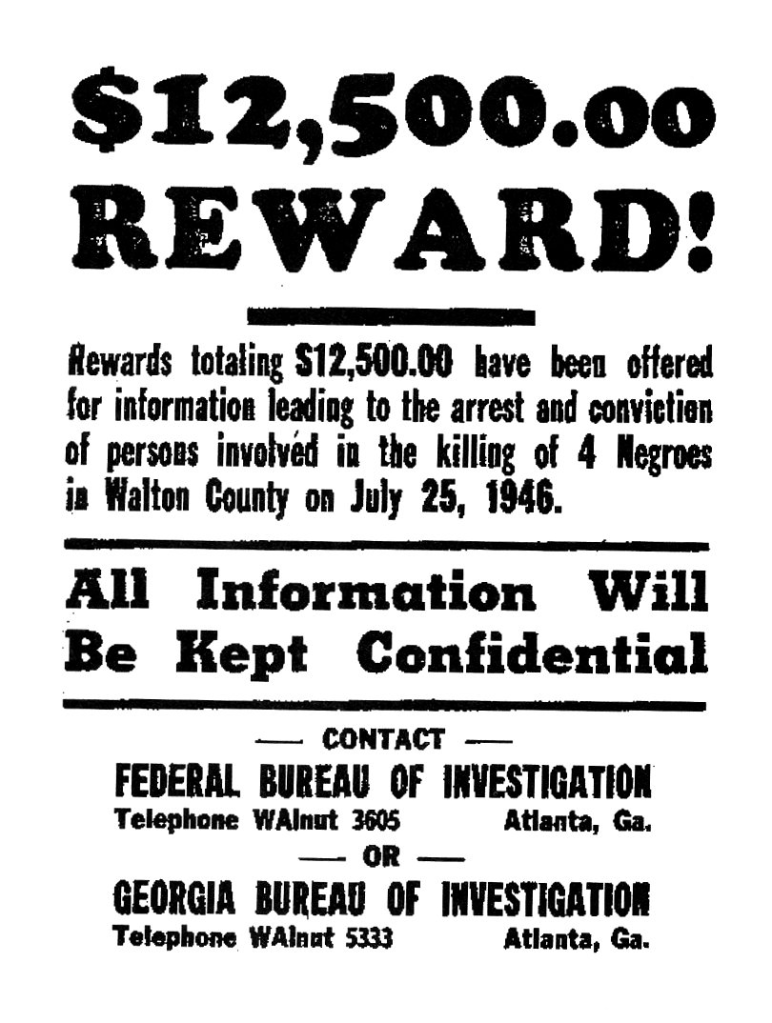
FBI Poster asking the public on the Moore’s Ford Lynching in Georgia, 1946
Public Domain Image

On July 14, 1946, four African American sharecroppers were lynched at Moore’s Ford in northeast Georgia in an event now described as the “last mass lynching in America.” Yet the killers of George Dorsey, Mae Murray Dorsey, Roger Malcolm, and Dorothy Malcolm were never brought to justice. The violence and public outcry surrounding the event reflected growing African American challenges to Jim Crow in the post-World War II years as well the failures of state and federal authorities to address racial inequality and violence in the South.

A fight between Roger Malcolm and his wife Dorothy sparked the crisis that unfolded in mid-July in Walton County, just sixty miles outside of Atlanta. On July 14, Malcolm was arrested by local authorities after stabbing white overseer Barnette Hester who had intervened in the domestic conflict. Hester may have had a sexual relationship with Dorothy Malcolm. Eleven days after this assault on July 25, white landowner J. Loy Harrison drove Dorothy Malcolm and fellow sharecroppers George and Mae Murray Dorsey to the Monroe, Georgia, jail to bail out Roger Malcolm. A large white mob stopped Harrison and the two couples on their return trip near the Moore’s Ford Bridge on the Apalachee River. What happened next was hotly debated by Harrison and other witnesses. Loy Harrison was reputed to be a member of the Ku Klux Klan, as were many others who gathered at Moore’s Ford Bridge. Ultimately, the mob beat the sharecroppers before tying them to a tree and shooting them to death. George Dorsey was a World War II veteran recently returned from service in the Pacific while Dorothy Malcolm was seven months pregnant.

For the complete article: blackpast.org

HATCH ACT/ AN ACT TO PREVENT PERNICIOUS POLITICAL ACTIVITIES [AUGUST 2, 1939]


Has the trump campaign violated the Hatch and the Logan Act?

8/2 1939 – U.S. President Roosevelt signed the Hatch Act. The act prohibited civil service employees from taking an active part in political campaigns.

Be it enacted, That it shall be unlawful for any person to intimidate, threaten, or coerce, or to attempt to intimidate, threaten, or coerce, any other person for the purpose of interfering with the right of such other person to vote or to vote as he may choose, or of causing such other person to vote for, or not to vote for, any candidate for the office of President, Vice President, Presidential elector, Member of the Senate, or Member of the House of Representatives at any election….

SEC. 2. It shall be unlawful for any person employed in any administrative position by the United States, or by any department, independent agency, or other agency of the United States (including any corporation controlled by the United States or any agency thereof, and any corporation all of the capital stock of which is owned by the United States or any agency thereof ), to use his official authority for the purpose of interfering with, or affecting the election or the nomination of any candidate for the office of President, Vice President, Presidential electors Member of the Senate, or Member of the House of Representatives, Delegates or Commissioners from the Territories and insular possessions.

SEC. 3. It shall be unlawful for any person, directly or indirectly, to promise any employment, position, work, compensation, or other benefit, provided for or made possible ill whole or in part by any Act of Congress, to give consideration, favor, or reward for any political activity or for the support of or opposition to any candidate or any political party in any election.

SEC. 4. Except as may be required by the provisions of subsection (b), section 9 of this Act, it shall be unlawful for any persons to deprive, attempt to deprive, or threaten to deprive, by any means, any person of any employment, position, work, compensation, or other benefit provided for or made possible by any Act of Congress appropriating funds for work relief or relief purposes, on account of race, creed, color, or any political activity, support of, or opposition to any candidate or any political party in any election.

SEC. 5. It shall be unlawful for any person to solicit or receive or be in any manner concerned in soliciting or receiving any assessment, subscription, or contribution for any political purpose whatever from any person known by him to be entitled to or receiving compensation, employment, or other benefit provided for or made possible by any Act of Congress appropriating funds for work relief or relief purposes.

SEC. 6. It shall be unlawful for any person I for political purposes to furnish or to disclose, or to aid or assist in furnishing or disclosing, any list or names of persons receiving compensation, employment, or benefits provided for or made possible by any Act of Congress appropriating, or authorizing the appropriation of, funds for work relief or relief purposes, to a political candidate, committee, campaign manager, or to any person for delivery to a political candidate, committee, or campaign manager, and it shall be unlawful for any person to receive any such list or names for political purposes.

SEC. 7. No part of any appropriation made by any Act, heretofore or hereafter enacted making appropriations for work relief, relief, or otherwise to increase employment by providing loans and grants for public-works projects, shall be used for the purpose of, and no authority conferred by any such Act upon any person shall be exercised or administered for the purpose of, interfering with, restraining, or coercing any individual in the exercise of his right to vote at any election.

SEC. 8. Any person who violates any of the foregoing provisions of this Act upon convict; on thereof shall be fined not more than $1,000 or imprisoned for not more than one year, or both.

SEC. 9. (a) It shall be unlawful for any person employed in the executive branch of the Federal Government, or any agency or department thereof, to use his official authority or influence for the purpose of interfering with an election or affecting the result thereof. No officer or employee in the executive branch of the Federal Government, or any agency or department thereof, shall take any active part in political management or in political campaigns. All such persons shall retain the right to vote as they may choose and to express their opinions on all political subjects. For the purposes of this section the term “officer” or “employee” shall not be construe to include

(1) the President and the Vice Presdent of the United States;

(2) persons whose compensation is paid from the appropriation for the office of the President;

(l) heads and assistant heads of executive departments; (4) officers who are appointed by the President, by and with the advice and consent of the Senate, and who determine policies to be pursued by the United States in its relations with foreign powers or in the Nation-wide administration of Federal laws.

(b) Any person violating the provisions of this section shall be immediately removed from the position or office held by him, and thereafter no part of the funds appropriated by any Act of Congress for such position or office shall be used to pay the compensation of such person.

SEC. 9A. (1) It shall be unlawful for any person employed in any capacity by any agency of the Federal Government, whose compensation, or any part thereof, is paid from funds authorized or appropriated by any Act of Congress, to have membership in any political party or organization which advocates the overthrow of our constitutional form of government in the United States.

(2) Any person violating the provisions of this section shall be immediately removed from the position or office held by him, and thereafter no part of the funds appropriated by any Act of Congress for such position or office shall be used to pay the compensation of such person.

SEC. 10. All provisions of this Act shall be in addition to, not in substitution for, existing law.

SEC. 11. If any provision of this Act, or the application of such provision to any person or circumstance, is held invalid, the remainder of the Act, and the application of such provision to other persons or circumstances, shall not be affected thereby.

resource: historycentral.com

politics,pollution,petitions,pop culture & purses