11 Pillars of Fascism


one angle …

In this post, I’ll walk through the 11 pillars of fascism — as defined by historians and political theorists — and provide concrete proof points that show how each one is manifesting under the Trump administration.

These are not hypotheticals. These are happening now.

Let’s get into it.

1. Authoritarianism: Centralized Power and Suppression of Dissent

Fascist Pattern: Consolidation of power by a single leader or ruling party, often accompanied by the suppression of opposition and the erosion of checks and balances.

Proof Points:

  • Retaliation Against Legal Professionals: The Trump administration has targeted law firms representing political opponents, revoking security clearances and initiating investigations, thereby undermining the independence of the legal system.1
  • Utilization of the Alien Enemies Act: The administration invoked this rarely used act to deport individuals without due process, exemplifying authoritarian overreach.2
  • Project 2025: A comprehensive plan by The Heritage Foundation aiming to consolidate executive power and replace civil servants with loyalists, effectively dismantling the administrative state.3

2. Ultra-nationalism: Elevating the Nation Above All

Fascist Pattern: Promoting a sense of national superiority, often at the expense of marginalized groups and international cooperation.

Proof Points:

  • “America First” Policies: The administration’s rhetoric and policies prioritize national interests, leading to strained international relations and the alienation of allies.
  • Immigration Crackdowns: Aggressive deportation strategies, including the deportation of individuals to countries where they face persecution, reflect a disregard for international human rights norms.

3. Militarism and Violence: Glorification of Strength and Force

Fascist Pattern: Emphasizing military power and the use of violence to achieve political ends.

Proof Points:

  • Deployment of Federal Forces Against Protesters: The use of federal agencies to suppress domestic protests demonstrates a militaristic approach to civil dissent.
  • Advocacy for Harsh Law Enforcement Measures: Endorsements of aggressive policing tactics and the pardoning of officials convicted of violent actions signal an acceptance of violence within governance.

4. Scapegoating and Propaganda: Blaming ‘The Other’

Fascist Pattern: Attributing national problems to specific groups, often minorities, to divert attention from governmental shortcomings.

Proof Points:

  • Targeting of Immigrants: Labeling migrants as criminals or terrorists without substantial evidence, leading to policies like mass deportations to dangerous environments.4
  • Discrediting of Media Outlets: Frequent accusations of “fake news” aimed at undermining the credibility of independent journalism.

5. Anti-democracy and Anti-liberalism: Undermining Democratic Institutions

Fascist Pattern: Erosion of democratic norms and institutions, often through the delegitimization of electoral processes and the judiciary.

Proof Points:

  • Challenging Election Legitimacy: Persistent claims of electoral fraud without evidence, aiming to erode public trust in democratic processes.
  • Defiance of Court Orders: Ignoring or circumventing judicial rulings, such as the refusal to comply with orders to return wrongfully deported individuals.5

6. Cult of Personality: Elevating the Leader

Fascist Pattern: Creating an idealized and heroic image of the leader, often demanding unwavering loyalty.

Proof Points:

  • Personalization of Political Power: The leader’s name and image are prominently used in political campaigns and government communications, emphasizing personal loyalty over institutional allegiance.
  • Attacks on Critics: Public denunciations and threats against political opponents, former allies, and dissenting voices within the administration.6

7. Control of Information: Censorship and Manipulation

Fascist Pattern: Manipulating or controlling media and information to suppress dissent and promote the regime’s narrative.

Proof Points:

  • Defunding Independent Media: Cutting funds to organizations like Radio Free Asia and Voice of America, jeopardizing journalistic independence.7
  • Surveillance of Journalists: Implementing measures that intimidate and suppress investigative journalism.

8. Suppression of Unions and Dissent: Silencing Opposition

Fascist Pattern: Cracking down on labor movements and any form of organized opposition.

Proof Points:

  • Targeting Academic Institutions: Freezing federal funds to universities like Cornell and Northwestern under the guise of addressing campus protests, thereby stifling academic freedom.8
  • Executive Orders Against Law Firms: Issuing directives that penalize law firms perceived as oppositional, undermining the right to legal representation.9

9. Corporatism / Crony Capitalism: Favoring Loyal Businesses

Fascist Pattern: Economic power is consolidated among favored corporations that align with the state, undermining fair competition.

Proof Points:

  • Preferential Treatment for Allies: The administration has implemented policies that benefit certain businesses, often those with political connections, while sidelining competitors.
  • Tariff Policies Impacting Small Businesses: The imposition of tariffs under the guise of national security has disproportionately affected small businesses, while larger corporations with government ties have navigated these challenges more effectively.10

10. Sexism and Gender Control: Enforcing Traditional Roles

Fascist Pattern: Traditional gender roles are aggressively enforced, with policies that marginalize women and LGBTQ+ individuals.

Proof Points:

  • Executive Orders Limiting Gender Recognition: The administration has issued orders defining sex strictly as male or female based on biological characteristics, effectively erasing recognition of transgender and non-binary identities.11
  • Restrictions on Gender-Affirming Care: Policies have been enacted to limit or prohibit gender-affirming care, particularly for minors, framing such care as harmful despite medical consensus on its benefits.12

11. Fear as a Tool: Maintaining Control Through Anxiety

Fascist Pattern: A constant state of crisis is maintained to justify authoritarian measures and suppress dissent.

Proof Points:

  • Use of Emergency Powers for Trade Policies: The administration has invoked emergency powers to implement trade policies, such as tariffs, under the pretext of national security threats, fostering a climate of fear and uncertainty.13
  • Rhetoric Targeting Marginalized Groups: Public statements and policies have often portrayed immigrants and LGBTQ+ individuals as threats to societal values, fueling fear and justifying restrictive measures.14

These examples, which don’t include any presidential actions, illustrate a troubling alignment with the core aspects of fascism.

It’s imperative to remain vigilant and advocate for democratic principles and human rights.

Source: pathfinderchronicles.com

History of Halloween… Britannica


Halloween, contraction of All Hallows’ Eve, a holiday observed on October 31, the evening before All Saints’ (or All Hallows’) Day.

The celebration marks the day before the Western Christian feast of All Saints and initiates the season of Allhallowtide, which lasts three days and concludes with All Souls’ Day. In much of Europe and most of North America, observance of Halloween is largely nonreligious.

Halloween is celebrated on October 31.

youtube.com

on this day 10/31


1517 – Martin Luther posted the 95 Theses on the door of the Wittenberg Palace Church. The event marked the start of the Protestant Reformation in Germany.

1864 – Nevada became the 36th state to join the U.S.

1868 – Postmaster General Alexander Williams Randall approved a standard uniform for postal carriers.


1914 – The Ottoman Empire (Turkey) joined the Central Powers (Germany, Austria-Hungary, and Bulgaria).

1922 – Benito Mussolini became prime minister of Italy.

1926 – Magician Harry Houdini died of gangrene and peritonitis resulting from a ruptured appendix. His appendix had been damaged twelve days earlier when he had been punched in the stomach by a student unexpectedly. During a lecture Houdini had commented on the strength of his stomach muscles and their ability to withstand hard blows.

1940 – The British air victory in the Battle of Britain prevented Germany from invading Britain.

1941 – Mount Rushmore was declared complete after 14 years of work. At the time the 60-foot busts of U.S. Presidents George Washington, Thomas Jefferson, Theodore Roosevelt and Abraham Lincoln were finished.

1941 – The U.S. Navy destroyer Reuben James was torpedoed by a German submarine near Iceland. The U.S. had not yet entered World War II. More than 100 men were killed.

1952 – The U.S. detonated its first hydrogen bomb. 

1954 – The Algerian National Liberation Front (FLN) began a revolt against French rule.

1959 – Defense Department announced elimination of all segregated regiments in the armed forces.

1955 – Britain’s Princess Margaret announced she would not marry Royal Air Force Captain Peter Townsend.

1956 – Rear Admiral G.J. Dufek became the first person to land an airplane at the South Pole. Dufek also became the first person to set foot on the South Pole.

1959 – Lee Harvey Oswald, a former U.S. Marine from Fort Worth, TX, announced that he would never return to the U.S.At the time he was in Moscow, Russia.

1961 – In the Soviet Union, the body of Joseph Stalin was removed from Lenin’s Tomb where it was on public display.

1968 – U.S. President Lyndon B. Johnson ordered a halt to all U.S. bombing of North Vietnam.

1969 – Wal-Mart Discount City stores were incorporated as Wal-Mart Stores, Inc.

1981 – Antiqua and Barbuda became independent of Great Britain.

1983 – The U.S. Defense Department acknowledged that during the U.S. led invasion of Grenada, that a U.S. Navy plane had mistakenly bombed a civilian hospital.

1984 – Indian Prime Minister Indira Gandhi was assassinated near her residence by two Sikh security guards. Her son, Rajiv, was sworn in as prime minister.

1992 – In Liberia, it was announced that five American nuns had been killed near Monrovia. Rebels loyal to Charles Taylor were blamed for the murders.

1993 – River Phoenix died at the age of 23 after collapsing outside The Viper Room in Hollywood.

1993 – The play “Wonderful Tennessee” closed after only 9 performances.

1994 – 68 people were killed when an American Eagle ATR-72, plunged into a northern Indiana farm.

1997 – Louise Woodward, British au pair, was sentenced to life in prison after being convicted of second-degree murder in the death of 8-month-old Matthew Eappen. She was released after her sentence was reduced to manslaughter.

1998 – Iraq announced that it was halting all dealings with U.N. arms inspectors. The inspectors were investigating the country’s weapons of mass destruction stemming from Iraq’s invasion of Kuwait in 1990.

1999 – EgyptAir Flight 990 crashed off the coast of Nantucket, MA, killing all 217 people aboard.

1999 – Leaders from the Roman Catholic Church and the Lutheran Church signed the Joint Declaration on the Doctrine of Justification. The event ended a centuries-old doctrinal dispute over the nature of faith and salvation.

2001 – Microsoft and the U.S. Justice Department reached a tentative agreement to settle the antitrust case against the software company.

2007 – Google shares hit $700 for the first time.

2008 – Distribution Video Audio, Inc. shipped its final shipment of VHS tapes to stores. The company was the last major United States supplier of pre-recorded VHS tapes.

Legal Rules on Police Presence at Polling Places


In the U.S., federal law and most state laws prohibit armed federal forces and, in many states, armed local police from standing at polling places, except in narrow, legally defined situations.

Federal Law

Several federal statutes explicitly bar armed federal forces and law enforcement from polling places:

  • 18 U.S.C. § 592 – Prohibits deploying federal troops or armed federal law enforcement agents to any polling place, except to repel armed enemies of the United States electiontaskforce.orgelectiontaskforce.org+1.
  • 18 U.S.C. § 594 – Makes it a federal crime to intimidate voters electiontaskforce.orgelectiontaskforce.org.
  • 42 U.S.C. § 1985 – Prohibits conspiracies to intimidate or injure voters in federal elections electiontaskforce.orgelectiontaskforce.org.
  • Voting Rights Act, § 11(b) – Bars intimidation of voters by public or private entities electiontaskforce.orgelectiontaskforce.org.
  • Posse Comitatus Act (1878) – Restricts the use of the U.S. Army and Air Force for domestic law enforcement, including election policing, unless Congress authorizes it electiondesk.orgelectiondesk.org.

These laws mean that federal military or armed federal law enforcement cannot be stationed at polling places except in extremely narrow, historically rare circumstances Brennan Center for JusticeBrennan Center for Justice+1.

State Law

While each state’s statutes differ, all states have restrictions on behavior at or near polling places to ensure voters can cast ballots without intimidation Katie Couric MediaKatie Couric Media+1. Many states:

  • Directly prohibit armed personnel (including police) from entering polling places except for specific purposes such as:
    • Casting their own ballot
    • Responding to an immediate emergency at the request of election officials electiondesk.orgelectiondesk.org
  • Ban firearms at or near polling locations for anyone, including law enforcement Katie Couric MediaKatie Couric Media+1.

If you believe local police are violating these rules, you can document the incident and contact the Washington State Department of Elections or the U.S. Department of Justice’s Civil Rights Division.

What is Ocean Acidification?


SalmonAcidification

The Chemistry

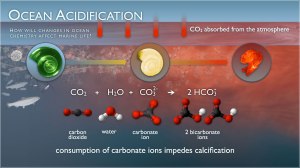
When carbon dioxide (CO2) is absorbed by seawater, chemical reactions occur that reduce seawater pH, carbonate ion concentration, and saturation states of biologically important calcium carbonate minerals. These chemical reactions are termed “ocean acidification” or “OA” for short. Calcium carbonate minerals are the building blocks for the skeletons and shells of many marine organisms. In areas where most life now congregates in the ocean, the seawater is supersaturated with respect to calcium carbonate minerals. This means there are abundant building blocks for calcifying organisms to build their skeletons and shells. However, continued ocean acidification is causing many parts of the ocean to become undersaturated with these minerals, which is likely to affect the ability of some organisms to produce and maintain their shells.

Since the beginning of the Industrial Revolution, the pH of surface ocean waters has fallen by 0.1 pH units. Since the pH scale, like the Richter scale, is logarithmic, this change represents approximately a 30 percent increase in acidity. Future predictions indicate that the oceans will continue to absorb carbon dioxide and become even more acidic. Estimates of future carbon dioxide levels, based on business as usual emission scenarios, indicate that by the end of this century the surface waters of the ocean could be nearly 150 percent more acidic, resulting in a pH that the oceans haven’t experienced for more than 20 million years.

The Biological Impacts

Ocean acidification is expected to impact ocean species to varying degrees. Photosynthetic algae and seagrasses may benefit from higher CO2 conditions in the ocean, as they require CO2 to live just like plants on land. On the other hand, studies have shown that a more acidic environment has a dramatic effect on some calcifying species, including oysters, clams, sea urchins, shallow water corals, deep sea corals, and calcareous plankton. When shelled organisms are at risk, the entire food web may also be at risk. Today, more than a billion people worldwide rely on food from the ocean as their primary source of protein. Many jobs and economies in the U.S. and around the world depend on the fish and shellfish in our oceans.


Pteropods

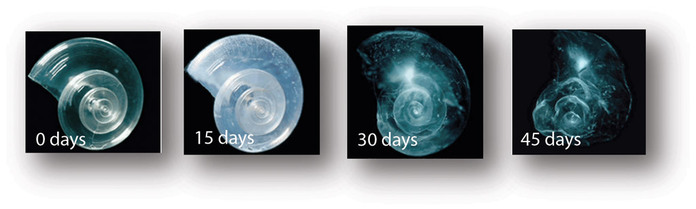
The pteropod, or “sea butterfly”, is a tiny sea creature about the size of a small pea. Pteropods are eaten by organisms ranging in size from tiny krill to whales and are a major food source for North Pacific juvenile salmon. The photos below show what happens to a pteropod’s shell when placed in sea water with pH and carbonate levels projected for the year 2100. The shell slowly dissolves after 45 days.  Photo credit: David Liittschwager/National Geographic Stock. Used with permission. All rights reserved. National Geographic Images.

Pteropod image showing acidification results


Shellfish

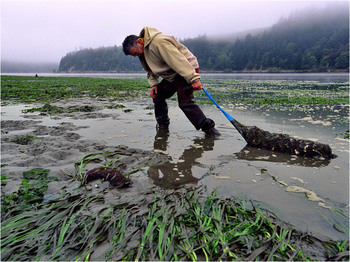
Freshly harvested oysters from Yaquina Bay, Oregon

In recent years, there have been near total failures of developing oysters in both aquaculture facilities and natural ecosystems on the West Coast. These larval oyster failures appear to be correlated with naturally occurring upwelling events that bring low pH waters undersaturated in aragonite as well as other water quality changes to nearshore environments. Lower pH values occur naturally on the West Coast during upwelling events, but a recent observations indicate that anthropogenic CO2 is contributing to seasonal undersaturation. Low pH may be a factor in the current oyster reproductive failure; however, more research is needed to disentangle potential acidification effects from other risk factors, such as episodic freshwater inflow, pathogen increases, or low dissolved oxygen. It is premature to conclude that acidification is responsible for the recent oyster failures, but acidification is a potential factor in the current crisis to this $100 million a year industry, prompting new collaborations and accelerated research on ocean acidification and potential biological impacts.

Photo: Freshly harvested oysters from Yaquina Bay, Oregon (Credit: NOAA)


Coral

Many marine organisms that produce calcium carbonate shells or skeletons are negatively impacted by increasing CO2 levels and decreasing pH in seawater. For example, increasing ocean acidification has been shown to significantly reduce the ability of reef-building corals to produce their skeletons. In a recent paper, coral biologists reported that ocean acidification could compromise the successful fertilization, larval settlement and survivorship of Elkhorn coral, an endangered species. These research results suggest that ocean acidification could severely impact the ability of coral reefs to recover from disturbance. Other research indicates that, by the end of this century, coral reefs may erode faster than they can be rebuilt. This could compromise the long-term viability of these ecosystems and perhaps impact the estimated one million species that depend on coral reef habitat.  For more information on the impact of ocean acidification on coral, see NOAA’s Coral Reef Watch website.

Ocean Acidification: An Emerging Global Problem

Ocean acidification is an emerging global problem. Over the last decade, there has been much focus in the ocean science community on studying the potential impacts of ocean acidification. Since sustained efforts to monitor ocean acidification worldwide are only beginning, it is currently impossible to predict exactly how ocean acidification impacts will cascade throughout the marine food chain and affect the overall structure of marine ecosystems. With the pace of ocean acidification accelerating, scientists, resource managers, and policymakers recognize the urgent need to strengthen the science as a basis for sound decision making and action.

~ NOAA

politics,pollution,petitions,pop culture & purses