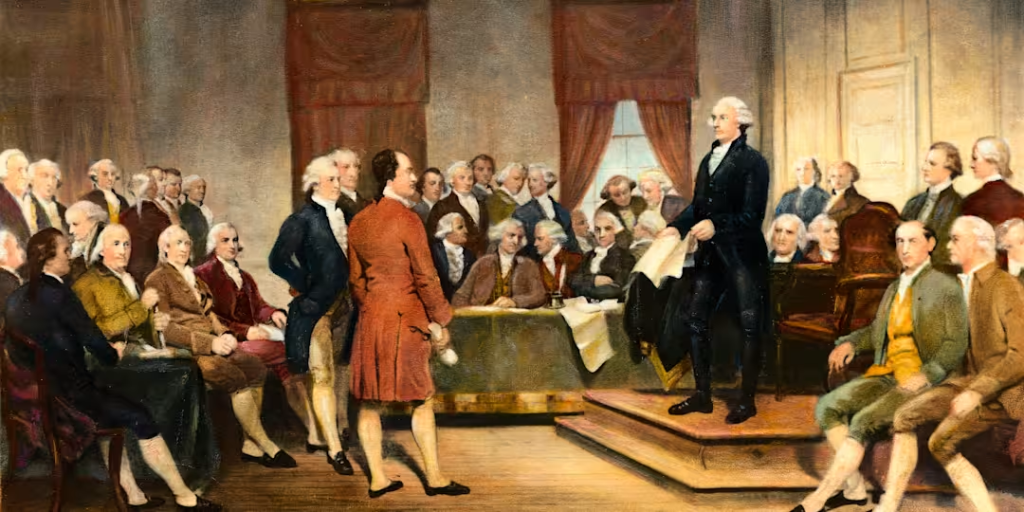
Logan Act … and why it was created


Dr. George Logan of Pennsylvania attempted to normalize relations with France. He entered into negotiations with France, without authorization, in the hopes of resuming normal relations. In 1799, Congress passed legislation outlawing such contacts between foreign governments and private individuals. The law remains in the books to this day.


In early 1807, a British squadron was stationed off the coast of Virginia. They were there primarily to intercept French frigates, which had taken refuge in Annapolis, Maryland. From time to time, the British vessels made use of American port facilities. British sailors were constantly deserting their ships. This became a major irritant to the British. Three deserters were said to have enlisted on the American naval frigate “Chesapeake.” The British protested, and the Secretary of Navy ordered an inquiry. This inquiry confirmed that three deserters from the “Melampus” had indeed enlisted on the “Chesapeake,” but it was determined that the sailors were Americans who had been illegally impressed. This was transmitted to the British, and the matter seemed to be at an end.

Nevertheless, the British commander in charge of the North Atlantic issued an order to search the “Chesapeake” for deserters, if the ship were encountered at sea. The “Chesapeake” was commanded by Captain Charles Gordon, and had Commodore Barron on board. On June 22, the ship departed from Hampton Roads, headed for the Mediterranean Sea. At 3:30 p.m., the British frigate the “Leopard” came down before the wind. The crew hailed the “Chesapeake,” stating that it had dispatches for the Commodore Barron. Barron replied “We will heave to and you can send your boat on board of us.” At 3:45 p.m., the “Leopard’s” Lieutenant Meade arrived with the following note demanding that the British deserters be turned over.

Since the deserters from the Melampus were not on the list submitted, Captain Gordon believed that his assurance would suffice, and sent back a stern reply to the British.

After the British officer had departed, Barron showed the notes to his other officers. While he felt that the matters was closed, he realized that some show of strength was appropriate. Therefore, Barron ordered Gordon to clear the gun deck. Unfortunately, it took 30 minutes to prepare the “Chesapeake” for battle, and the British officer returned to the ship only five minutes later. Barron was hailed. Trying to obtain more time for his crew, Barron replied that he did not understand. The “Leopard” then fired two shots across the “Chesapeake’s” bow, followed by whole broadside at nearly point blank range. The “Leopard then poured two more broadsides into the “Chesapeake,” while it was still unready to respond. Commodore Barron then ordered the flag to be struck. Several British officers then came aboard and seized the three Americans deserters from the Melampus. They also found a true British deserter, named Jenkin Ratford, who was serving under an assumed name. Ratford was later hanged.

The attack on the “Chesapeake” stirred America into a war fervor. If anyone but Jefferson had been President, this incident would probably have been enough to begin a war.

About

American history and world history can be found at historycental- History’s home on the web. Explore our complete time lines of major events in American history as well as World History. Research our special sections on diverse subjects ranging from presidential elections to naval history.

Whatever aspect of history you wish learn about, you will find it at

Source: Historycentral.com

1972 – Watergate


Following a seemingly routine burglary, five men were arrested at the National Democratic Headquarters in the Watergate complex in Washington, D.C.

However, subsequent investigations revealed the burglars were actually agents hired by the Committee for the Re-election of President Richard Nixon.

A long chain of events then followed in which the president and top aides became involved in an extensive cover-up of this and other White House-sanctioned illegal activities, eventually leading to the resignation of President Nixon on August 9, 1974.

Sources: britannica.com, wiki

1858 ~ Lincoln warns that America is becoming a “house divided”


On June 16, 1858, newly nominated senatorial candidate Abraham Lincoln addresses the Illinois Republican Convention in Springfield and warns that the nation faces a crisis that could destroy the Union. Speaking to more than 1,000 delegates in an ominous tone, Lincoln paraphrased a passage from the New Testament: “a house divided against itself cannot stand.”

The issue dividing the nation was slavery’s place in the growing western territories and the extent of federal power over individual states’ rights. Lincoln declared that only the federal government had the power to end slavery. While the southern states relied on an economy and lifestyle dependent upon the labor provided by enslaved African Americans, the North opposed slavery. The northern states also considered industrialization and manufacturing the key to America’s economic future, not farming.

Source: complete article history.com

“A house divided against itself cannot stand.” – Abraham Lincoln, 1858

Abraham Lincoln delivered his famous “House Divided” speech on June 16, 1858, at the Illinois Republican State Convention in Springfield, Illinois, upon accepting the Republican nomination for U.S. Senate against Stephen A. Douglas. The speech opens with the iconic line: “A house divided against itself cannot stand. I believe this government cannot endure, permanently half slave and half free. I do not expect the Union to be dissolved—I do not expect the house to fall—but I do expect it will cease to be divided. It will become all one thing, or all the other.”

abrahamlincolnonline.org

on this day


0455 – Rome was sacked by the Vandal army.

1487 – The War of the Roses ended with the Battle of Stoke.

1567 – Mary, Queen of Scots, was imprisoned in Lochleven Castle in Scotland.

1815 – Napoleon defeated the Prussians at the Battle of Ligny, Netherlands.

1858 – In a speech in Springfield, IL, U.S. Senate candidate Abraham Lincoln said the slavery issue had to be resolved. He declared, “A house divided against itself cannot stand.”

1884 – At Coney Island, in Brooklyn, NY, the first roller coaster in America opened.

1883 – The New York Giants baseball team admitted all ladies for free to the ballpark. It was the first Ladies Day.

1897 – The U.S. government signed a treaty of annexation with Hawaii.

1903 – Ford Motor Company was incorporated.

1904 – The novel “Ulysses” by James Joyce took place. The main character of the book was Leopold Bloom.

1907 – The Russian czar dissolved the Duma in St. Petersburg.

1909 – Glenn Hammond Curtiss sold his first airplane, the “Gold Bug” to the New York Aeronautical Society for $5,000.

1922 – Henry Berliner accomplished the first helicopter flight at College Park, MD.

1925 – France accepted a German proposal for a security pact.

1932 – The ban on Nazi storm troopers was lifted by the von Papen government in Germany.

1940 – Marshal Henri-Philippe Petain became the prime minister of the Vichy government of occupied France.

1941 – U.S. President Franklin D. Roosevelt ordered the closure of all German consulates in the United States. The deadline was set as July 10.

1952 – “Anne Frank: Diary of a Young Girl” was published in the United States.

1955 – The U.S. House of Representatives voted to extend Selective Service until 1959.

1955 – Pope Pius XII excommunicated Argentine President Juan Peron. The ban was lifted eight years later.

1955 – Argentine naval officers launched an attack on President Juan Peron’s headquarters. The revolt was suppressed by the army.

1961 – Rudolf Nureyev defected from the Soviet Union while in Paris, traveling with the Leningrad Kirov Ballet.

1963 – 26-year-old Valentina Tereshkova went into orbit aboard the Vostok 6 spacecraft for three days. She was the first female space traveler.

1972 – Ulrike Meinhof was captured by West German police in Hanover. She was co-founder of the Baader-Meinhof terrorist group and the Red Army Faction (Rote Armee Fraktion).

1975 – The Simonstown agreement on naval cooperation between Britain and South Africa ended. The agreement was formally ended by mutual agreement after 169 years.

1976 – In Soweto, thousands of school children revolted against the South African government’s plan to enforce Afrikaans as the language for instruction in black schools.

1977 – Leonid Brezhnev was named the first Soviet president of the USSR. He was the first person to hold the post of president and Communist Party General Secretary. He replaced Nikolai Podgorny.

1978 – U.S. President Carter and Panamanian leader Omar Torrijos ratified the Panama Canal treaties.

1978 – The film adaptation of “Grease” premiered in New York City.

1980 – The movie “The Blues Brothers” opened in Chicago, IL.

1981 – The “Chicago Tribune” purchased the Chicago Cubs baseball team from the P.K. Wrigley Chewing Gum Company for $20.5 million.

1983 – Yuri Andropov was elected chairman of the Presidium of the Supreme Soviet. The position was the equivalent of president.

1984 – Wilson Ferreira Aldunate was arrested upon his return from an eleven year exile. Aldunate had been a popular Uruguayan opposition leader.

1985 – Willie Banks broke the world record for the triple jump with a leap of 58 feet, 11-1/2 inches in the U.S.A. championships in Indianapolis, IN.

1992 – U.S. President George H.W. Bush welcomed Russian President Boris Yeltsin to a meeting in Washington, DC. The two agreed in principle to reduce strategic weapon arsenals by about two-thirds by the year 2003.

1993 – The U.S. Postal Service released a set of seven stamps that featured Bill Haley, Buddy Holly, Clyde McPhatter, Otis Redding, Ritchie Valens, Dinah Washington and Elvis Presley.

1996 – Russian voters had their first independent presidential election. Boris Yeltsin was the winner after a run-off.

1999 – The U.S. Circuit Court of Appeals said that a 1992 federal music piracy law does not prohibit a palm-sized device that can download high-quality digital music files from the Internet and play them at home.

2000 – U.S. federal regulators approved the merger of Bell Atlantic and GTE Corp. The merger created the nation’s largest local phone company.

2000 – U.S. Secretary of Energy Bill Richardson reported that an employee at the Los Alamos National Laboratory in New Mexico had discovered that two computer hard drives were missing.

2008 – California began issuing marriage licenses to same-sex couples.

politics,pollution,petitions,pop culture & purses