9/6 1941 – JEWS IN GERMAN-OCCUPIED AREAS WERE ORDERED TO WEAR THE STAR OF DAVID WITH THE WORD “JEW” INSCRIBED. THE ORDER ONLY APPLIED TO JEWS OVER THE AGE OF 6. 


Sep 6 1941 – All Jews over 6 years old in Nazi-occupied territories ordered to wear the yellow Star of David.

Holocaust Badges

The Jews of Europe were legally compelled to wear badges or distinguishing garmets (e.g., pointed hats) at least as far back as the 13th century. 

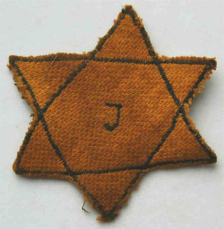
A yellow Star of David outlined with black
with an Hebraic styled J, an
abbreviation for Jew. BELGIUM
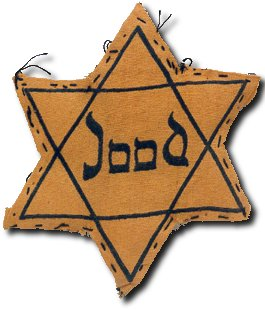
A yellow Star of David outlined with black
 with the Dutch word for Jew written
in Hebraic style. NETHERLAND

This practice continued throughout the Middle Ages and Renaissnace, but was largely phased out during the 17th and 18th centuries.

Source: internet


 With the coming of the French Revolution and the emancipation of western European Jews throughout the 19th century, the wearing of Jewish badges was abolished in Western Europe.

A yellow Star of David outlined with black
 with the French word forJew written
in Hebraic style.FRANCE

on this day … 9/6 1941 – Jews in German-occupied areas were ordered to wear the Star of David with the word “Jew” inscribed. The order only applied to Jews over the age of 6. 


1620 – The Pilgrims left on the Mayflower from Plymouth, England to settle in the New World.

1819 – Thomas Blanchard patented a machine called the lathe.

1837 – The Oberlin Collegiate Institute of Ohio went co-educational.

1876 – The Southern Pacific rail line from Los Angeles to San Francisco was completed. 

1899 – Carnation processed its first can of evaporated milk.

1901 – U.S. President William McKinley was shot and mortally wounded (he died eight days later) by Leon Czolgosz. Czolgosz, an American anarchist, was executed the following October.

1909 – Robert Peary, American explorer, sent word that he had reached the North Pole. He had reached his goal five months earlier.

1939 – South Africa declared war on Germany.

1941 – Jews in German-occupied areas were ordered to wear the Star of David with the word “Jew” inscribed. The order only applied to Jews over the age of 6. 

1943 – The youngest player to appear in an American League baseball game was pitcher Carl Scheib of the Philadelphia Athletics. Scheib was 16 years, eight months and five days old.

1944 – During World War II, the British government relaxed blackout restrictions and suspended compulsory training for the Home Guard.

1952 – In Montreal, Canadian television began broadcasting.

1972 – Rick DeMont lost the gold medal he received in a 400-meter swimming event because a banned drug was found in his system during routine drug testing.

1975 – Martina Navratilova requested political asylum while in New York for the U.S. Open Tennis Tournament.

1978 – James Wickwire and Louis Reichardt reached the top of the world’s second largest mountain, Pakistan’s K-2. They were the first Americans to reach the summit.

1990 – Iraq warned that anyone trying to flee the country without permission would be put in prison for life.

1991 – The State Council of the Soviet Union recognized the independence of the Baltic states.

1991 – The name St. Petersburg was restored to Russia’s second largest city. The city was founded in 1703 by Peter the Great. The name has been changed to Petrograd (1914) and to Leningrad (1924).

1992 – A 35-year old man died ten weeks after receiving a transplanted baboon liver.

1993 – Renault of France and Volvo of Sweden announced they were merging. Volvo eventually canceled the deal the following December.

1995 – U.S. Senator Bob Packwood was expelled by the Senate Ethics Committee.

1995 – Cal Ripken played his 2,131st consecutive game setting a new record. Lou Gehrig previously held the record.

1996 – Eddie Murray (Baltimore Orioles) hit his 500th career home run during a game against the Detroit Tigers. He was only the third person to have at least 3,000 hits and 500 home runs.

2000 – The U.N. Millennium Summit began in New York. It was the largest gathering of world leaders in history with more than 150 present.

2001 – The U.S. Justice Department announced that it was seeking a lesser antitrust penalty and would not attempt to break up Microsoft.

2002 – In New York, the U.S. Congress convened at Federal Hall for a rare special session. The session was held in New York to express the nation’s mourning for the loss on September 11, 2001 and unity in the war against terrorism.

2002 – At the Smithsonian American Art Museum, the exhibition “George Catlin and His Indian Gallery” went on view. The exhibit contained over 400 objects.

1774 – First Continental Congress convenes


In response to the British Parliament’s enactment of the Coercive Acts in the American colonies, the first session of the Continental Congress convenes at Carpenter’s Hall in Philadelphia. Fifty-six delegates from all the colonies except Georgia drafted a declaration of rights and grievances and elected Virginian Peyton Randolph as the first president of Congress. Patrick HenryGeorge WashingtonJohn Adams and John Jay were among the delegates.

The first major American opposition to British policy came in 1765 after Parliament passed the Stamp Act, a taxation measure designed to raise revenues for a standing British army in America. Under the argument of “no taxation without representation,” colonists convened the Stamp Act Congress in October 1765 to vocalize their opposition to the tax. With its enactment in November, most colonists called for a boycott of British goods, and some organized attacks on the customhouses and homes of tax collectors. After months of protest in the colonies, Parliament voted to repeal the Stamp Act in March 1766.

For the complete article: history.com

Meet Governor Orval Faubus – did you know his story?


Born January 7, 1910 – December 14, 1994) was an American politician who served as the 36th Governor of Arkansas from 1955 to 1967, as a member of the Democratic Party.

In 1957, he refused to comply with a decision of the U.S. Supreme Court in the 1954 case Brown v. Board of Education, and ordered the Arkansas National Guard to prevent black students from attending Little Rock Central High School. This event became known as the Little Rock Crisis.

Faubus’s name became internationally known during the Little Rock Crisis of 1957, when he used the Arkansas National Guard to stop African Americans from attending Little Rock Central High School as part of federally ordered racial desegregation.

Critics have long charged that Faubus’s fight in Little Rock against the 1954 Brown v. Board of Education decision by the U.S. Supreme Court that separate schools were inherently unequal was politically motivated. The ensuing battle helped to shield him from the political fallout from a tax increase. Journalist Harry Ashmore (who won a Pulitzer Prize for his columns on the subject) portrayed the fight over Central High as a crisis manufactured by Faubus. Ashmore said that Faubus used the Guard to keep blacks out of Central High School because he was frustrated by the success his political opponents were having in using segregationist rhetoric to arouse white voters.

Faubus’s decision led to a showdown with President Dwight D. Eisenhower and former Governor Sid McMath.

On September 5, 1957, Eisenhower sent a telegram to Faubus in which he wrote “The only assurance I can give you is that the Federal Constitution will be upheld by me by every legal means at my command.”

This was a response to Faubus’s concerns about being taken into custody and his telephones being wired. Eisenhower did say in his telegram that the Department of Justice was collecting facts as to why there was a failure to comply with the courts.[7] This led to the September 14 conference where Faubus and Eisenhower discussed the Court order in Newport, Rhode Island. The quoted “friendly and constructive discussion” led to Faubus claiming his desire to comply with his duty to the Constitution, personal opinions aside. Faubus did express his hope that the Department of Justice would be patient.[8] He did stay true to his word and on September 21, President Eisenhower released a statement which announced that Faubus had withdrawn his troops, the Little Rock School Board was carrying out desegregation plans, and local law was ready to keep order.[9]

On September 23, however, Little Rock Mayor Woodrow Wilson Mann sent a telegram to Eisenhower stating a mob had formed at Central High School. State police made efforts to control the mob, but for the safety of the newly enrolled children, they were sent home. The mayor stressed how this was a planned act and that the principal agitator, Jimmy Karam, was an associate of Governor Faubus. The mayor further stated his belief that there was no way the governor could not have been aware of this planned attack.[10] In October 1957, Eisenhower federalized the Arkansas National Guard and ordered them to return to their armories which effectively removed them from Faubus’s control. Eisenhower then sent elements of the 101st Airborne Division to Arkansas to protect the black students and enforce the federal court order. The Arkansas National Guard later took over protection duties from the 101st Airborne Division. In retaliation, Faubus shut down Little Rock high schools for the 1958–1959 school year. This is often referred to as “The Lost Year” in Little Rock.[11]

In a 1985 interview with a Huntsville, Arkansas, student, Faubus stated that the crisis was due to an “usurpation of power” by the federal government.[citation needed] The State knew forced integration by the federal government was going to meet with unfavorable results from the Little Rock public. In his opinion, Faubus was acting in the State’s best interest at the time.

Though Faubus later lost general popularity as a result of his support for segregation, at the time he was included among the “Ten Men in the World Most Admired by Americans”, according to Gallup’s most admired man and woman poll for 1958. This dichotomy was later summed up as follows: Faubus was both the “best loved” and “most hated” of Arkansas politicians of the second half of the twentieth century.[citation needed]

The Little Rock Crisis inspired the song “Fables of Faubus” by jazz artist Charles Mingus.[12]

Faubus was elected governor to six two-year terms and hence served for twelve years. He maintained a defiant, populist image, while he shifted toward a less confrontational stance with the federal government, particularly during the administrations of Presidents John F. Kennedy and Lyndon B. Johnson, with each of whom he remained cordial, and both of whom carried Arkansas.

In the 1956 general election, Faubus, having already beaten Jim Johnson, overwhelmed GOP candidate Roy Mitchell, later the GOP state chairman from Hot Springs, 321,797 (80.7%) to 77,215 (19.4%). In 1958, he defeated Republican George W. Johnson of Greenwood in Sebastian County by drawing 82.5% of the votes.

In 1962, Faubus broke with the White Citizens’ Councils and other groups, who preferred, but did not officially endorse, U.S. Representative Dale Alford in that year’s gubernatorial primary.[13] Faubus cast himself as a moderate, he completely ignored the race issue during the 1962 election campaign, and barely secured a majority over Alford, McMath, and three other candidates. He then handily defeated the Republican Willis Ricketts, a then 37-year-old pharmacist from Fayetteville in the general election.[4]

While Faubus was still shunned by black leaders, he nevertheless won a large percent of the black vote. In 1964, when he defeated the Republican Winthrop Rockefeller by a 57–43 percent margin, Faubus won 81 percent of the black vote. He even collected a share of the base Republican vote from the conservative party members who had sided with former Republican state chairman William L. Spicer of Fort Smith, an intraparty rival of Rockefeller.

1960 presidential election[edit]

During the 1960 presidential election, at a secret meeting held in a rural lodge near Dayton, Ohio, the National States Rights Party (NSRP) nominated Faubus for President and retired U.S. Navy Rear Admiral John G. Crommelin of Alabama for Vice President. Faubus, however, did not campaign on this ticket actively, and won only 0.07% of the vote (best in his native Arkansas: 6.76%), losing to the John F. Kennedy and Lyndon B. Johnson ticket.[citation needed]

Source: wiki.org

If you see inaccurate information, please notify them

For more History re: Little Rock Nine… the link below https://www.history.com/news/the-story-behind-the-famous-little-rock-nine-scream-image

It might be said that this man was a Dixiecrat, NOT a true member of the Democratic Party maybe a supporter of Kennedy by then?

– Nativegrl77

A power plant for the Internet: our newest data center in Alabama


Two technicians servicing server racks in a modern data center
Technicians maintain server racks beneath an extensive network of overhead cables in a modern data center.


Every time you check your Gmail, search on Google for a nearby restaurant, or watch a YouTube video, a server whirs to life in one of our data centers.
Data centers are the engines of the Internet, bringing the power of the web to millions of people around the world. And as millions more people come online, our data centers are growing, too. We’ve recently expanded our data centers in Iowa, Georgia, Singapore and Belgium.
And today we’re announcing a new data center in Alabama—our 14th site globally.
 
This time, we’re doing something we’ve never done before: we’ll be building on the grounds of the Widows Creek coal power plant in Jackson County, which has been scheduled for shutdown. Data centers need a lot of infrastructure to run 24/7, and there’s a lot of potential in redeveloping large industrial sites like former coal power plants. Decades of investment shouldn’t go to waste just because a site has closed; we can repurpose existing electric and other infrastructure to make sure our data centers are reliably serving our users around the world.

At Widows Creek, we can use the plants’ many electric transmission lines to bring in lots of renewable energy to power our new data center. Thanks to an arrangement with Tennessee Valley Authority, our electric utility, we’ll be able to scout new renewable energy projects and work with TVA to bring the power onto their electrical grid. Ultimately, this contributes to our goal of being powered by 100% renewable energy.

In 2010, we were one of the first companies outside of the utility industry to buy large amounts of renewable energy. Since then, we’ve become the largest corporate renewable energy purchaser in the world (in fact we’ve bought the equivalent of over 1.5 percent of the installed wind power capacity in the U.S.). We’re glad to see this trend is catching on among other companies.

Of course, the cleanest energy is the energy you don’t use. Our Alabama data center will incorporate our state-of-the-art energy efficiency technologies. We’ve built our own super-efficient servers, invented more efficient ways to cool our data centers, and even used advanced machine learning to squeeze more out of every watt of power we consume. Compared to five years ago, we now get 3.5 times the computing power out of the same amount of energy.

Since the 1960s, Widows Creek has generated power for the region—now the site will be used to power Internet services and bring information to people around the world. We expect to begin construction early next year and look forward to bringing a Google data center to Alabama.

Source: Posted by Patrick Gammons, Senior Manager, Data Center Energy and Location Strategy

The SOS was right in front of our… my face. Yes, I felt the urgency to post this article, giving us info about what they are doing, as well as the other side telling voters the reality of how the data centers will impact the lives of Americans, and not necessarily in a good way. talk’bout naivete. sigh

Now, the struggle for land, energy, water, and utilities will be seen in real time, and there may be an increase in costs for constituents!  Will the negative impact on communities in America affect those who agreed to have a data center in their city? I added the image of a data center

Nativegrl77

politics,pollution,petitions,pop culture & purses