A power plant for the Internet: our newest data center in Alabama


Two technicians servicing server racks in a modern data center
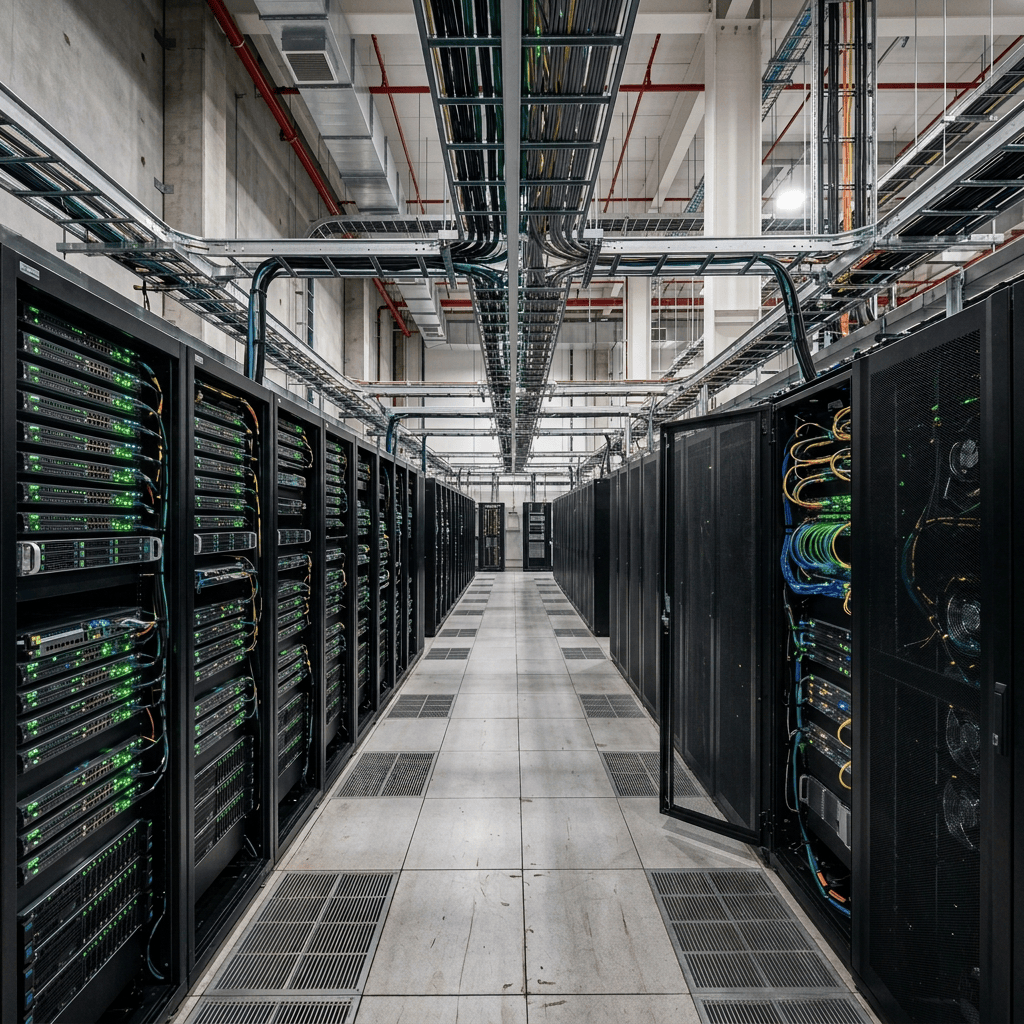
Technicians maintain server racks beneath an extensive network of overhead cables in a modern data center.


Every time you check your Gmail, search on Google for a nearby restaurant, or watch a YouTube video, a server whirs to life in one of our data centers.
Data centers are the engines of the Internet, bringing the power of the web to millions of people around the world. And as millions more people come online, our data centers are growing, too. We’ve recently expanded our data centers in Iowa, Georgia, Singapore and Belgium.
And today we’re announcing a new data center in Alabama—our 14th site globally.
 
This time, we’re doing something we’ve never done before: we’ll be building on the grounds of the Widows Creek coal power plant in Jackson County, which has been scheduled for shutdown. Data centers need a lot of infrastructure to run 24/7, and there’s a lot of potential in redeveloping large industrial sites like former coal power plants. Decades of investment shouldn’t go to waste just because a site has closed; we can repurpose existing electric and other infrastructure to make sure our data centers are reliably serving our users around the world.

At Widows Creek, we can use the plants’ many electric transmission lines to bring in lots of renewable energy to power our new data center. Thanks to an arrangement with Tennessee Valley Authority, our electric utility, we’ll be able to scout new renewable energy projects and work with TVA to bring the power onto their electrical grid. Ultimately, this contributes to our goal of being powered by 100% renewable energy.

In 2010, we were one of the first companies outside of the utility industry to buy large amounts of renewable energy. Since then, we’ve become the largest corporate renewable energy purchaser in the world (in fact we’ve bought the equivalent of over 1.5 percent of the installed wind power capacity in the U.S.). We’re glad to see this trend is catching on among other companies.

Of course, the cleanest energy is the energy you don’t use. Our Alabama data center will incorporate our state-of-the-art energy efficiency technologies. We’ve built our own super-efficient servers, invented more efficient ways to cool our data centers, and even used advanced machine learning to squeeze more out of every watt of power we consume. Compared to five years ago, we now get 3.5 times the computing power out of the same amount of energy.

Since the 1960s, Widows Creek has generated power for the region—now the site will be used to power Internet services and bring information to people around the world. We expect to begin construction early next year and look forward to bringing a Google data center to Alabama.

Source: Posted by Patrick Gammons, Senior Manager, Data Center Energy and Location Strategy

The SOS was right in front of our… my face. Yes, I felt the urgency to post this article back then. They were giving us info about what they were doing,  telling voters the reality of how Data centers will impact our lives in America, and not necessarily in a good way. talk’bout naivete. sigh

The struggle for land, energy, water, and utilities will be felt in real time, with increased costs to constituents in ways no one wants but has no authority to regulate.

Will the negative impact on communities in America affect those who agreed to have a data center in their city, finally causing them to speak up and out against this astronomical amount

image of a data center is from the internet

Nativegrl77

How Upton Sinclair’s ‘The Jungle’ Led to US Food Safety Reforms


Upton Sinclair, Pulitzer Prize-winning writer and reformer, is born in Baltimore, Maryland on September 20, 1878.

The 1906 bestseller was one of the most influential books in American history—but not in the way its author intended.

BY: CHRISTOPHER KLEIN

Upton Sinclair published The Jungle in 1906, the novel became an instant sensation, exposing the horrifying conditions in America’s meat-processing industry. With its stomach-turning depictions of the stockyards and slaughterhouses, the book lit a new fire under the pure food movement and inspired swift passage of landmark food safety laws.

Two years earlier, in the fall of 1904, Sinclair had boarded a train to Chicago in search of material for his Great American Novel. For seven weeks, the 26-year-old writer and devout socialist investigated the dangerous and oppressive working conditions endured by what he called “the wage slaves of the Beef Trust.” Donning grimy clothes and carrying a dinner pail to sneak into Chicago’s “Packingtown,” a dense complex of stockyards, feed lots, slaughterhouses and meat-packing plants, Sinclair was horrified by what he saw.

Titled The Jungle as a metaphor for capitalism, Sinclair’s novel originally appeared in monthly installments between February and November 1905 in the socialist newspaper Appeal to Reason. It tells the story of an idealistic Lithuanian immigrant working for a fictional meat-processing company who loses his family, job, home and health in a succession of calamities before finding hope in socialism.

The Jungle had a limited audience at first, but it became a bestselling sensation when Doubleday, Page & Company published a revised version in February 1906. It sold more than 150,000 copies in its first year.

Much as Uncle Tom’s Cabin had influenced the national conversation about slavery, Sinclair hoped his epic would spark outrage about “wage slavery” and promote socialism as a solution. The Jungle did shock the American public and prompt legislative change—but not in the way he wanted.

creedal ~~ creedalism


If America is truly defined by universal principles — liberty, equality, autonomy — then restricting rights for Women and Black Americans undermines the very creed being invoked.

I am asking and saying:

If America is truly creedal, then the creed must apply equally — and current legal and political actions often undermine that.

Many scholars argue that the “creedal” narrative can be used to mask unequal treatment by pretending the playing field is already level.

Me and AI

Native Tribes and S.3548 what’s the latest news ?


S. 3548, Natives Veterans’ Memorial Amendments Act of 2012 http://www.cbo.gov/sites/default/files/cbofiles/attachments/s3548.pdf

GOP Ignores Environment and Native Americans to Pollute Lakes in Wisconsin                                                                   Native Americans in the Great Lakes region are concerned about proposals for mining in the area, which could create substantial pollution.
read more

                                    Deforestation. Palm oil. Mining. Oil and gas drilling. Although the tribes that call the Amazon home have lived in peace with the planet for centuries,…
read more

Introducing The Data Center Mural Project


GOOGLe
Posted: 12 May 2016 09:22 AM PDT

Whether it’s sharing photos, searching the web or translating languages, billions of requests are sent to “the cloud” every day. But few people think about how all this information flows through physical locations, called data centers. Because these buildings typically aren’t much to look at, people usually don’t—and rarely learn about the incredible structures and people inside who make so much of modern life possible.

To begin to change that, we created the Data Center Mural Project: a partnership with artists to bring a bit of the magic from the inside of our data centers to the outside.

We’re starting with two data center locations.

In Mayes County, Oklahoma, digital artist Jenny Odell’s mural is made up of Google Maps satellite imagery. Her mural artwork focuses on types of infrastructure that enable the flow of goods, power and information—not unlike data centers themselves.

Belgium local street artist Oli-B took inspiration from “the cloud” for his colorful mural on the outside of our St. Ghislain data center. He’s painted clouds that include elements specific to the region, the data center and the people who run it—including the sheep that roam the data center grounds and a balloon from the annual festival L’Ascension à Saint-Ghislain.

Soon, we’ll add murals at two more data centers, and eventually we hope to bring the project to more locations around the world. Check out photos, videos and more at g.co/datacentermurals.

Posted by Joe Kava, VP Google Data Centers https://beaseedforchange.org/wp-content/uploads/2016/05/c92ba-launch-thumbnail2b252812529.jpg Joe Kava VP Google Data Centers

How embarrassing to know that this 2016 article was actually a warning! Now, in this year of 2026, ai, and data centers are out of control, including an obvious disregard for our privacy, but the words in our Constitution

Nativegrl77

politics,pollution,petitions,pop culture & purses