NEW ORLEANS DOCKWORKERS RIOT (1894-1895)


CONTRIBUTED BY: WILL MACK

on October 26 after black workers were hired to replace striking white workers on some docks. In December, 1894, the original 50/50 compromise was re-instated. But racial antagonisms remained as
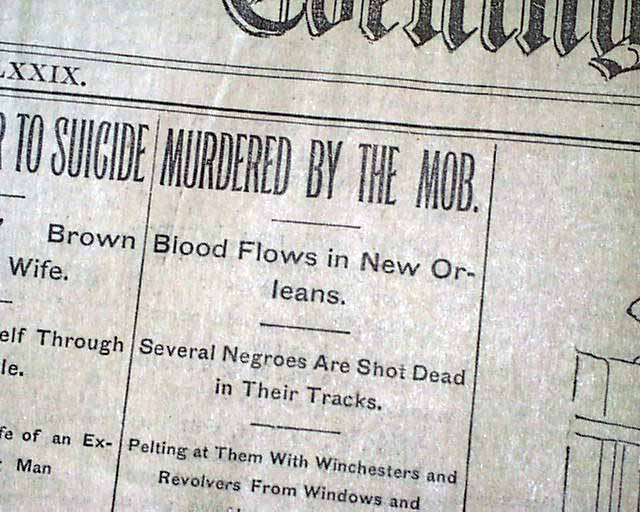
The 1895 New Orleans Dockworkers Riot was a racially motivated attack on non-union black dockworkers by white dockworkers and their sympathizers.  The riot occurred in New Orleans, Louisiana from March 9 through 12, 1895 and marked the end of nearly 15 years of bi-racial union cooperation and union power in New Orleans.  The riot also left six black laborers dead and many other wounded.

Throughout the 1880s and into the 1890s, black and white dockworker unions worked together to promote fair working conditions and wages for their workers along the New Orleans waterfront.  In 1892, the year of the New Orleans general strike, black and white dockworker unions agreed to share work equally between white and black workers.

Following the economic panic of 1893 and the onset of a national depression, New Orleans commerce suffered tremendously from diminished trade, low cotton prices, smaller crops, and a decline in profits.  Economic concerns intensified racial tensions and black dockworkers as white dockworkers began to discuss withdrawing from the equal share agreement.

In 1894, white dockworkers specifically accused black dockworkers of breaking the 1892 agreement by undercutting wages and agreeing to work for less money.  By October of 1894, the white dockworkers’ union used that charge to formally expel the black unions from their alliance, terminating the brief bi-racial union association.  White dockworkers also dock owners and merchants into hiring white workers only by refusing to work alongside black dockworkers.  Rioting first erupted on October 26 after black workers were hired to replace striking white workers on some docks.

In December, 1894, the original 50/50 compromise was re-instated.  But racial antagonisms remained as white unions, attempting to maintain their racially dominant position, did not give black dockworkers an equal number of jobs.  And black workers, fearful of racial violence and unemployment, and encouraged by Booker T. Washington to abandon their interests in unions and strikes, became increasingly disillusioned.  Many of them were now willing to work non-unions jobs both on and away from the docks that paid far less.  As a result, an all-black, low-wage enclave developed that competed in a “race to the bottom” bidding war in wages with white unions.

In March 1895, the bidding war between white and black laborers erupted into violence.  On March 9, nearly 500 armed white men looted a black dockworkers’ storage house destroying half of their equipment. Two days later two coordinated attacks by several hundred armed white men on black laborers left six black dockworkers dead and many more wounded.  On March 13, Louisiana Governor Murphy J. Foster dispatched the state militia to protect commerce and property and allow the black dockworkers to continue working.  Although peace prevailed, racial tensions along the New Orleans docks remained strained for years.

SUBJECTS:African American HistoryEventsTERMS:19th Century (1800-1899)United States – LouisianaRacial Conflict – Race Riots

blackpast.org

1853 ~ Native Americans attack transcontinental railroad survey crew in Utah


On October 25, 1853, members of the Paiute Indian Tribe attack U.S. Army Captain John W. Gunnison and his party of 37 soldiers and railroad surveyors near Sevier Lake, Utah. Gunnison and seven other men were killed, but the survey party continued with its work and eventually reported its findings to the United States Congress.

U.S. officials touted the transcontinental railroad as a project that, once complete, would provide critical infrastructure for 19th-century America.

Gunnison was a West Point graduate who had led several previous topographical surveys before being assigned to conduct this survey of potential railroad routes across central Colorado and Utah. Gunnison’s mission was only one of four surveys dispatched by the U.S. Congress in an attempt to break a sectional deadlock over which route the proposed transcontinental railroad should follow

Seattle, WA ~ Wind Advisory ~Issued: National Weather Service


Alert is through Sunday

Update: Wind Advisory

From Sat 1:00 pm until Sun 5:00 am PDT

Issued By

Seattle/Tacoma – WA, US, National Weather Service

Affected Area

Puget Sound and Hood Canal

Description

…GALE WARNING IN EFFECT FROM 2 PM THIS AFTERNOON, Saturday TO 5 AM PDT SUNDAY… WHAT…South winds 25 to 35 kt. WHERE…Puget Sound and Hood Canal.

WHEN…From 2 PM this afternoon, Saturday to 5 AM PDT Sunday. IMPACTS… Strong winds will cause hazardous seas, which could capsize or damage vessels and reduce visibility. PRECAUTIONARY/PREPAREDNESS ACTIONS… A Gale Warning means winds of 34 to 47 knots are imminent or occurring. Operating a vessel in gale conditions requires experience and properly equipped vessels. It is highly recommended that mariners without the proper experience seek safe harbor prior to the onset of gale conditions.

...WIND ADVISORY IN EFFECT FROM 9 AM SATURDAY TO MIDNIGHT PDT
SATURDAY NIGHT...

* WHAT...Southeast to southwest winds 10 to 20 mph with gusts up to
35 to 40 mph expected at times.

* WHERE...Portions of northwest and west central Washington.

* WHEN...From 9 AM Saturday to midnight PDT Saturday Night.

* IMPACTS...Gusty winds could blow around unsecured objects.
Tree limbs could be blown down and a few power outages may result.

PRECAUTIONARY/PREPAREDNESS ACTIONS...

Use extra caution when driving, especially if operating a high profile vehicles. Secure outdoor objects.

Secure outdoor objects.

wunderground.com

The White House Was, in Fact, Built by Slaves


SmartNews Keeping you current

smithsonian.com
White House

The first-known photograph of the White House, by John Plumbe, Jr. Library of Congress via The White House Historical Association Continue reading The White House Was, in Fact, Built by Slaves

11 Pillars of Fascism


one angle …

In this post, I’ll walk through the 11 pillars of fascism — as defined by historians and political theorists — and provide concrete proof points that show how each one is manifesting under the Trump administration.

These are not hypotheticals. These are happening now.

Let’s get into it.

1. Authoritarianism: Centralized Power and Suppression of Dissent

Fascist Pattern: Consolidation of power by a single leader or ruling party, often accompanied by the suppression of opposition and the erosion of checks and balances.

Proof Points:

  • Retaliation Against Legal Professionals: The Trump administration has targeted law firms representing political opponents, revoking security clearances and initiating investigations, thereby undermining the independence of the legal system.1
  • Utilization of the Alien Enemies Act: The administration invoked this rarely used act to deport individuals without due process, exemplifying authoritarian overreach.2
  • Project 2025: A comprehensive plan by The Heritage Foundation aiming to consolidate executive power and replace civil servants with loyalists, effectively dismantling the administrative state.3

2. Ultra-nationalism: Elevating the Nation Above All

Fascist Pattern: Promoting a sense of national superiority, often at the expense of marginalized groups and international cooperation.

Proof Points:

  • “America First” Policies: The administration’s rhetoric and policies prioritize national interests, leading to strained international relations and the alienation of allies.
  • Immigration Crackdowns: Aggressive deportation strategies, including the deportation of individuals to countries where they face persecution, reflect a disregard for international human rights norms.

3. Militarism and Violence: Glorification of Strength and Force

Fascist Pattern: Emphasizing military power and the use of violence to achieve political ends.

Proof Points:

  • Deployment of Federal Forces Against Protesters: The use of federal agencies to suppress domestic protests demonstrates a militaristic approach to civil dissent.
  • Advocacy for Harsh Law Enforcement Measures: Endorsements of aggressive policing tactics and the pardoning of officials convicted of violent actions signal an acceptance of violence within governance.

4. Scapegoating and Propaganda: Blaming ‘The Other’

Fascist Pattern: Attributing national problems to specific groups, often minorities, to divert attention from governmental shortcomings.

Proof Points:

  • Targeting of Immigrants: Labeling migrants as criminals or terrorists without substantial evidence, leading to policies like mass deportations to dangerous environments.4
  • Discrediting of Media Outlets: Frequent accusations of “fake news” aimed at undermining the credibility of independent journalism.

5. Anti-democracy and Anti-liberalism: Undermining Democratic Institutions

Fascist Pattern: Erosion of democratic norms and institutions, often through the delegitimization of electoral processes and the judiciary.

Proof Points:

  • Challenging Election Legitimacy: Persistent claims of electoral fraud without evidence, aiming to erode public trust in democratic processes.
  • Defiance of Court Orders: Ignoring or circumventing judicial rulings, such as the refusal to comply with orders to return wrongfully deported individuals.5

6. Cult of Personality: Elevating the Leader

Fascist Pattern: Creating an idealized and heroic image of the leader, often demanding unwavering loyalty.

Proof Points:

  • Personalization of Political Power: The leader’s name and image are prominently used in political campaigns and government communications, emphasizing personal loyalty over institutional allegiance.
  • Attacks on Critics: Public denunciations and threats against political opponents, former allies, and dissenting voices within the administration.6

7. Control of Information: Censorship and Manipulation

Fascist Pattern: Manipulating or controlling media and information to suppress dissent and promote the regime’s narrative.

Proof Points:

  • Defunding Independent Media: Cutting funds to organizations like Radio Free Asia and Voice of America, jeopardizing journalistic independence.7
  • Surveillance of Journalists: Implementing measures that intimidate and suppress investigative journalism.

8. Suppression of Unions and Dissent: Silencing Opposition

Fascist Pattern: Cracking down on labor movements and any form of organized opposition.

Proof Points:

  • Targeting Academic Institutions: Freezing federal funds to universities like Cornell and Northwestern under the guise of addressing campus protests, thereby stifling academic freedom.8
  • Executive Orders Against Law Firms: Issuing directives that penalize law firms perceived as oppositional, undermining the right to legal representation.9

9. Corporatism / Crony Capitalism: Favoring Loyal Businesses

Fascist Pattern: Economic power is consolidated among favored corporations that align with the state, undermining fair competition.

Proof Points:

  • Preferential Treatment for Allies: The administration has implemented policies that benefit certain businesses, often those with political connections, while sidelining competitors.
  • Tariff Policies Impacting Small Businesses: The imposition of tariffs under the guise of national security has disproportionately affected small businesses, while larger corporations with government ties have navigated these challenges more effectively.10

10. Sexism and Gender Control: Enforcing Traditional Roles

Fascist Pattern: Traditional gender roles are aggressively enforced, with policies that marginalize women and LGBTQ+ individuals.

Proof Points:

  • Executive Orders Limiting Gender Recognition: The administration has issued orders defining sex strictly as male or female based on biological characteristics, effectively erasing recognition of transgender and non-binary identities.11
  • Restrictions on Gender-Affirming Care: Policies have been enacted to limit or prohibit gender-affirming care, particularly for minors, framing such care as harmful despite medical consensus on its benefits.12

11. Fear as a Tool: Maintaining Control Through Anxiety

Fascist Pattern: A constant state of crisis is maintained to justify authoritarian measures and suppress dissent.

Proof Points:

  • Use of Emergency Powers for Trade Policies: The administration has invoked emergency powers to implement trade policies, such as tariffs, under the pretext of national security threats, fostering a climate of fear and uncertainty.13
  • Rhetoric Targeting Marginalized Groups: Public statements and policies have often portrayed immigrants and LGBTQ+ individuals as threats to societal values, fueling fear and justifying restrictive measures.14

These examples, which don’t include any presidential actions, illustrate a troubling alignment with the core aspects of fascism.

It’s imperative to remain vigilant and advocate for democratic principles and human rights.

Source: pathfinderchronicles.com

politics,pollution,petitions,pop culture & purses