Tag Archives: Arizona

Hard to Resist


By

More GOP-Led States Are Moving To Expand Medicaid

A successful first open enrollment period with 8 million enrollees. The uninsured rate at a record low 13.4 percent. Insurers clamoring to join state exchanges for next year. Health insurance premiums for 2015 beating expectations. The successes of the Affordable Care Act are clear.

Supporters of the law in competitive races have taken notice, and are increasingly running on, not from, the ACA. But they are not the only ones acknowledging the changing political landscape; the ACA’s opponents have also seen it, and are taking action. In particular, some GOP-led states who have been putting politics over people by opposing Medicaid expansion are now taking steps to accept it. Here are some of the latest to change their tune:

Pennsylvania: The Keystone State will become the 27th state, and the 12th Republican-led state, to expand its Medicaid program in accordance with the Affordable Care Act. The Obama Administration announced last Thursday that it had granted a waiver and reached agreement with the state to provide health care coverage to 500,000 low-income residents through private insurance. Gov. Tom Corbett (R), the deeply unpopular Pennsylvania governor, has previously fought against expansion but trails in his re-election bid by 25 points while 59 percent of voters support expanding Medicaid.

Tennessee: Gov. Bill Haslem indicated late last week that the state will likely submit a Medicaid expansion plan this soon. “I think we’ll probably go to [the Obama Administration] sometime this fall with a plan … that we think makes sense for Tennessee,” Haslem said. While he did not comment on any further details, the move could mean health coverage for 162,000 Tennesseans.

Wyoming: After initially rejecting Medicaid expansion that would provide health insurance to 17,600 low-income Wyoming residents, Gov. Matt Mead has now said he is now in negotiations with the Obama Administration to find a way to expand the program next year. The LA Times reports that “the reason for Wyoming’s wavering is clear: It’s money.” The state stands to save $50 million per year by expanding. Meanwhile, Wyoming hospitals are losing $200 million per year by treating people who lack insurance.

Another thing for these states, and all other conservative-led states who continue to deny health care to their low-income residents, to consider: they are sending hundreds of billions of taxpayer dollars to other states who are expanding Medicaid, and receiving nothing in return.

BOTTOM LINE: As candidates who support the ACA increasingly embrace it on the campaign trail, conservatives nationwide are downplaying their opposition to the law. In the latest sign, more conservative states are finally changing course by pushing forward with Medicaid expansion to provide health care to hundreds of thousands of low-income working people and save billions of dollars.

Like CAP Action on Facebook and follow us on Twitter!

Bill Gates: End your investment in private prisons


Immediately withdraw your $2.2 million investment in the GEO Group.

Sign Presente.org’s petition

One of the world’s biggest social good foundations is contributing to one of society’s biggest ills — the private prison industry. The Bill and Melinda Gates Foundation Trust has invested more than $2 million in GEO Group, one of the largest and most abusive private prison corporations in the United States.

GEO makes a business of jailing those with the fewest resources, profiting from their labor, stripping them of their dignity, and leaching precious human capital from already-distressed communities.

GEO Group and other private prison companies have a perverse profit motive to drive criminal justice and immigration policy towards more incarceration of citizens and immigrants in prisons, jails, and immigrant detention centers. They spend millions of dollars — dollars provided in part by investors like the Gates Foundation Trust — lobbying local, state, and federal governments to institute longer sentences, to incarcerate more people for mi nor crimes, and to terrorize immigrant communities.

If that weren’t bad enough, GEO’s prisons are notorious for their awful treatment of prisoners. Accounts of sexual assault, physical abuse, medical neglect, rotten and inadequate food, forced signing of immigration papers, and death have been well-documented at GEO facilities. A federal judge called the inhumane conditions at GEO’s now-closed Walnut Grove Youth Correctional Facility, “a picture of such horror as should be unrealized anywhere in the civilized world.”

In light of this evidence, it is shocking that the Gates Foundation Trust would maintain its investment in the GEO group. The Gates Foundation prides itself on the good it does in the world. But this investment fundamentally contradicts the Foundation’s stated mission: to “ensure that all people — especially those with the fewest resources — have access to the opportunities they need to succeed in school and life.”

If enough of us speak out now, we’ll be able to create a powerful media narrative that exposes this contradiction and shames the Gates Foundation Trust to withdraw its investment.

Join Presente, Enlace, and 25 other organizations in calling on the Bill and Melinda Gates Foundation Trust to immediately withdraw its investment in the GEO Group.

Click here to add your name to this petition, and then pass it along to your friends.

Thanks!

–Presente.org

This petition was created on MoveOn’s online petition site, where anyone can start their own online petitions. Presente.org didn’t pay us to send this email—we never rent or sell the MoveOn.org list.

Ryan’s Poverty … a repost


By

Paul Ryan’s Latest Rhetoric On Poverty Doesn’t Add Up To Any New Ideas

Congressman Paul Ryan (R-WI) introduced a new anti-poverty plan in a speech in Washington today. But while Ryan is trying out new rhetoric around the issue of poverty, his “American idea” is full of the same empty promises he’s been making for years, this time with Ryan Rhetoric 2.0. His plan to fight poverty doesn’t include a fair wage for hard work and would dismantle the safety net. We need an economy that works for everyone, and Ryan’s cuts to low and moderate income Americans are not what this country needs to continue to prosper.

Here are a few things we know about his plan:

1. The Math Doesn’t Add Up. Ryan claims his plan is deficit-neutral. That’s a 180 degree turn from his budget proposal from earlier this year, which gets over two-thirds of its cuts from programs helping low and moderate income families. So either the plan is a dressed-up version of his budget, or he has abandoned his goal to balance the budget.

2. “Consolidation.” Ryan’s rhetoric calls it consolidation, hoping you won’t notice he is actually cutting programs helping low and moderate income Americans. And we already know that this strategy doesn’t work. Ryan holds up the Temporary Assistance for Needy Families (TANF) program as a model reform of the safety net. But under TANF, extreme poverty rose, fewer families received help, and states were unable to respond to the Great Recession. Consolidating multiple programs into a single funding stream would carry these same risks. In fact, Ryan undermines his own argument by proposing to eliminate an already-existing block grant, the Social Services Block Grant, calling it “ineffective” (which, by the way, helps approximately 23 million people).

3. Not Every Idea Ryan Proposes Is Without Merit. Depending on the details, ideas such as reforming our criminal justice system to give people the opportunity to rebuild their lives have a lot of merit and could attract bipartisan support. In fact, Ryan is not a leader on this issue, which has already had a bipartisan team of Senate champions in Sen. Cory Booker (D-NJ) and Sen. Rand Paul (R-KY). On the whole, however, his plan would exacerbate poverty and inequality.

If Ryan were serious about cutting poverty, here are three policy ideas he could embrace — taken from a column by the Center for American Progress’s Melissa Boteach:

1. Increase The Minimum Wage. Ryan’s speech comes on the day marking five years since the last federal minimum wage increase. Progressive leaders and advocates around the country are marking the occasion by taking the “Live The Wage” Challenge — walking in the shoes of a minimum wage worker by living on the average minimum wage budget of $77 for one week. It’s simply not enough to live on. Raising the minimum wage to $10.10 could lift as many as 4.6 million people out of poverty.

2. Bring Our Work And Family Policies Into The 21st Century. Women are now the primary breadwinners or co-breadwinners in nearly two-thirds of families, but our workplace policies and public policies don’t reflect this change. One thing Rep. Ryan could do in this realm is support the Family and Medical Insurance Leave Act, or FAMILY Act, which would create a national paid leave program and stop the United States from being the only developed country that with no paid maternity leave. This is a critical poverty issue, as having a child is a major cause of poverty for families that can’t afford to leave the workforce.

3. Support High-Quality Child Care And Early Education. Poor families who pay out of pocket for child care spend approximately one-third of their incomes just to be able to work. Ryan could support policies to provide greater economic mobility for low-income families, like Head Start. He could also sign onto the bipartisan Strong Start for America’s Children Act, which would invest in preschool, quality child care for infants and toddlers, and home visiting as a resource to pregnant women and mothers with young babies, simultaneously helping parents work while boosting the future economic mobility of young children.

Instead, just a day after his speech, he and his House Republican colleagues will vote tomorrow to exclude millions of low-income working families from the Child Tax Credit, pushing millions of children deeper into poverty.

BOTTOM LINE: Addressing poverty with more than rhetoric is the challenge our country faces. America was not built on rhetoric, it was built on an idea that if we came together and worked hard, we could create a nation full of opportunity. There are policy proposals that exist that would help us do that — create an economy that works for everyone, not just the wealthiest. Paul Ryan’s latest rhetoric on poverty is not the answer we need.

Running On, Not From, Obamacare


By

Candidates Who Support The Affordable Care Act Are Going On Offense

It has been widely reported this week that Senator Mark Pryor released an ad touting his support for Obamacare in his re-election campaign in Arkansas. While Pryor’s ad shows that those running in tough races see access to affordable health care as a strong issue to highlight, this is not the first time a candidate has run on all or part of the Affordable Care Act, even if conventional wisdom has suggested otherwise.

As The New Republic’s Jonathan Cohn noted yesterday, Republicans tried the repeal argument two years ago, which led to the President touting the benefits of the law during his campaign. He was obviously re-elected. In the past, the most notable piece has been the Medicaid expansion, which has insured millions of Americans in states that have chosen to implement it, while stubborn conservative governors let their states fall behind.

Below is a selection of headlines from around the country on the issue.

ACA supporters on the offense:

BOTTOM LINE: For months, we’ve seen those who voted for the ACA embrace it on the campaign trail and use it to go on offense, particularly in competitive races. Pryor is just the latest example. The conventional wisdom is that candidates want to avoid talking about the many benefits of the Affordable Care Act. But as we are increasingly seeing, the conventional wisdom is wrong.

Like CAP Action on Facebook and follow us on Twitter!

Finally! A candid exposé of Chevron’s dirty tricks


Amazon Watch
Português | Español | Deutsch | More
Finally!
A Candid Exposé of Chevron’s Dirty Tricks
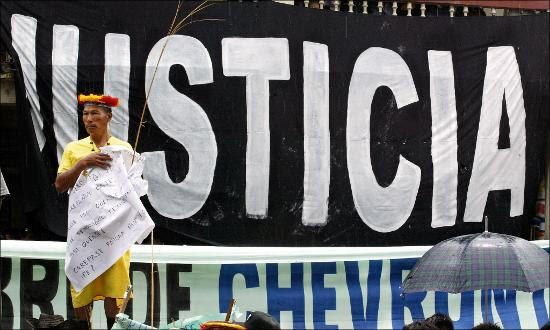
It’s not easy to try to explain the saga of the decades long battle to hold Chevron to account for deliberately poisoning people and planet in the Ecuadorian Amazon. Rolling Stone does a very good job of it, however, in yesterday’s article Sludge Match: Inside Chevron’s $9 Billion Legal Battle With Ecuadorean Villagers by AlexanderZaitchik.The article skillfully explains how Chevron turned a straightforward case into a neverending legal battle – because winning based on the merits was never an option for the oil giant. From blaming the victim to threatening and pressuring their allies, Chevron’s tactics are as dirty as the crude they dumped in the rainforest. The oil giant has launched the greatest assault on corporate accountability to date, yet until now, mainstream coverage of that attack has been frustratingly scarce.

In fact, considering Chevron’s history of going after anyone critical of their actions in Ecuador, Rolling Stone should be applauded for aggressively investigating a story that few others have been brave enough to take on. Zaitchik confronts the sordid details of the false narrative concocted by Chevron to fuel its retaliatory RICO suit against Steven Donziger and the Ecuadorians, but unlike others reporters, he doesn’t let fear of Chevron’s army of lawyers or Judge Kaplan’s outrageously biased decision dilute his reporting or outweigh the facts.

Most importantly, Zaitchik reminds readers that, “it’s the farmers and the Indians, not the lawyers, who continue to struggle daily with the 50-year legacy of oil production in the region.” For their sake, it’s about time the media told the full story.

Read the article here »