Tag Archives: Jan Brewer

A power plant for the Internet: our newest data center in Alabama


Two technicians servicing server racks in a modern data center
Technicians maintain server racks beneath an extensive network of overhead cables in a modern data center.


Every time you check your Gmail, search on Google for a nearby restaurant, or watch a YouTube video, a server whirs to life in one of our data centers.
Data centers are the engines of the Internet, bringing the power of the web to millions of people around the world. And as millions more people come online, our data centers are growing, too. We’ve recently expanded our data centers in Iowa, Georgia, Singapore and Belgium.
And today we’re announcing a new data center in Alabama—our 14th site globally.
 
This time, we’re doing something we’ve never done before: we’ll be building on the grounds of the Widows Creek coal power plant in Jackson County, which has been scheduled for shutdown. Data centers need a lot of infrastructure to run 24/7, and there’s a lot of potential in redeveloping large industrial sites like former coal power plants. Decades of investment shouldn’t go to waste just because a site has closed; we can repurpose existing electric and other infrastructure to make sure our data centers are reliably serving our users around the world.

At Widows Creek, we can use the plants’ many electric transmission lines to bring in lots of renewable energy to power our new data center. Thanks to an arrangement with Tennessee Valley Authority, our electric utility, we’ll be able to scout new renewable energy projects and work with TVA to bring the power onto their electrical grid. Ultimately, this contributes to our goal of being powered by 100% renewable energy.

In 2010, we were one of the first companies outside of the utility industry to buy large amounts of renewable energy. Since then, we’ve become the largest corporate renewable energy purchaser in the world (in fact we’ve bought the equivalent of over 1.5 percent of the installed wind power capacity in the U.S.). We’re glad to see this trend is catching on among other companies.

Of course, the cleanest energy is the energy you don’t use. Our Alabama data center will incorporate our state-of-the-art energy efficiency technologies. We’ve built our own super-efficient servers, invented more efficient ways to cool our data centers, and even used advanced machine learning to squeeze more out of every watt of power we consume. Compared to five years ago, we now get 3.5 times the computing power out of the same amount of energy.

Since the 1960s, Widows Creek has generated power for the region—now the site will be used to power Internet services and bring information to people around the world. We expect to begin construction early next year and look forward to bringing a Google data center to Alabama.

Source: Posted by Patrick Gammons, Senior Manager, Data Center Energy and Location Strategy

The SOS was right in front of our… my face. Yes, I felt the urgency to post this article, giving us info about what they are doing, as well as the other side telling voters the reality of how the data centers will impact the lives of Americans, and not necessarily in a good way. talk’bout naivete. sigh

Now, the struggle for land, energy, water, and utilities will be seen in real time, and there may be an increase in costs for constituents!  Will the negative impact on communities in America affect those who agreed to have a data center in their city? I added the image of a data center

Nativegrl77

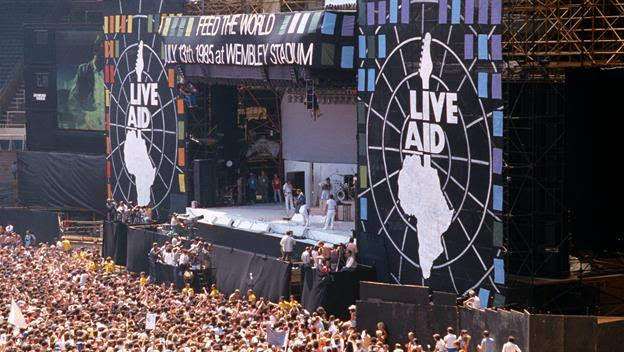
1985 ~On this day ~ Live Aid


On July 13, 1985, at Wembley Stadium in London, Prince Charles and Princess Diana officially open Live Aid, a worldwide rock concert organized to raise money for the relief of famine-stricken Africans. Continued at JFK Stadium in Philadelphia and at other arenas around the world, the 16-hour… read more »

Congress enacts the Northwest Ordinance »

Rockefeller announces new peace proposal »

Live Aid is held simultaneously in London and Philadelphia and broadcast live throughout the world »

1967 ~ The Lovings ~On June 12th, 1967, the Court’s ruling declared all laws against interracial marriage in the United States to be unconstitutional – possibly on a future ballot? In Memory


 visit Loving Day’s website.

================

The Loving Story:

Richard P. Loving, and his wife Mildred, shown in this January 26, 1965 photograph, will file a suit at Federal Court in Richmond, Va., asking for permission to live as husband and wife in Virginia. Both are from Carolin County, south of Fredericksburg, Va., and were married in Washington in 1958. Upon their return the interracial couple was convicted under the state’s miscegenation law that bans mixed marriages. They received a suspended sentence on the condition they leave the state, but they now want to return to Virginia. (AP Photo)

With fight for same-sex marriage such a regular point of conflict today, it’s easy to forget about the first fight for marriage equality: interracial marriage. But while anti-miscegenation laws may seem like a relic of the past, it wasn’t until 2000 that Alabama became the last state to adapt its constitutional laws on interracial marriage.

In 1967, the United States Supreme Court put an end to the prohibition of interracial marriage in the monumental case of Loving v. Virginia.

The case was sparked by Mildred Loving, née Jeter, who after discovering she was pregnant traveled with boyfriend Richard Loving and from their home in Virginia to Washington, D.C. They made the move to evade Virginia’s Racial Integrity Act of 1924, which prohibited them from marrying John was a white male while Mildred was black and Native American.

Five weeks after their nuptials, they returned to Virginia. An anonymous tip led to a police raid. Instead of finding them having sex, which was another criminal offense at the time, they caught them sleeping in their marital bed. The couple was taken to jail after Mildred pointed out their D.C. marriage certificate. It was used as evidence of “cohabiting as man and wife, against the peace and dignity of the Commonwealth.”

The Lovings were sentenced to one year in prison, but it was suspended on the condition that the couple leaves Virginia and not return together for 25 years.

Initially they did just that, but by 1963, Mildred had enough and decided to write to Attorney General Robert F. Kennedy. The letter inspired Kennedy to connect her with the ACLU, which took the case to the U.S. Supreme Court.

On June 12th, 1967, the Court’s ruling declared all laws against interracial marriage in the United States to be unconstitutional.

While cases like Brown v. Board of Education or Rosa Parks’ stand against segregation are taught regularly in schools, the Loving case gets less attention. Thirty-six years after the trial, Ken Tanabe first learned of the case as a grad student and founded the Loving Day Project to commemorate the anniversary. He, like many others, discovered it by accident.

“I realized that I might not be alive today (along with millions of other Americans) if it wasn’t for this case and those that came before it,” Tanabe, who is mixed race, told AOL via email.

The project has since expanded from its humble roots in New York City across the nation and even around the world.

According to a recent Gallup poll, 11 percent of Americans do not interracial marriage. When the Lovings were arrested the numbers, disapproval ratings were 94 percent. The falling disapprove numbers may appear to be a victory, but Tanabe says they are still worth worrying about.

“When Barack Obama was elected president, some people thought that racism was ‘over.’ While his election was an important sign of progress, it’s dangerous to believe we can stop being vigilant and proactive,” Tanabe explained. “The stories surrounding Trayvon Martin, Michael Brown, and so many others are some well-known examples. Racism also affects interracial couples and multiracial people every day.”

Rather than remain mutually exclusive, Loving Day embraced, and been embraced, by the LGBTQ community. On the 40th anniversary of the Supreme Court ruling, Mrs. Loving urged that gay men and lesbians should be allowed to marry. A march has been planned for this year’s Loving Day in Abilene, TX by Parents, Families and Friends of Lesbians and Gays (PFLAG).

“We see Loving Day as an educational resource for everyone to learn more about the history of marriage and understanding it as a civil rights issue,” said Tenebe.

National attention turned to Loving v. Virginia in 2011 when ‘The Loving Story’ premiered at the Tribeca Film Festival and was purchased by HBO. This year, Jeff Nichols, writer and director of the Matthew McCounghey flick ‘Mud,’ announced he will direct a new Hollywood “Loving” film starring Ruth Negga and Joel Edgerton.

===============================================================

Black History is American History

In the Library: Fresh Fruit, Broken Bodies


fruit&veggiesThis book is an ethnographic witness to the everyday lives and suffering of Mexican migrants. : Migrant Farm workers in the United States (California Series in Public Anthropology)

Based on five years of research in the field (including berry-picking and traveling with migrants back and forth from Oaxaca up the West Coast), Holmes, an anthropologist and MD in the mold of Paul Farmer and Didier Fassin, uncovers how market forces, anti-immigrant sentiment, and racism undermine health and health care. Holmes’ material is visceral and powerful—for instance, he trekked with his informants illegally through the desert border into Arizona, where they were apprehended and jailed by the Border Patrol. After he was released from jail (and his companions were deported back to Mexico), Holmes interviewed Border Patrol agents, local residents, and armed vigilantes in the borderlands. He lived with indigenous Mexican families in the mountains of Oaxaca and in farm labor camps in the United States, planted and harvested corn, picked strawberries, accompanied sick workers to clinics and hospitals, participated in healing rituals, and mourned at funerals for friends. The result is a “thick description” that conveys the full measure of struggle, suffering, and resilience of these farm workers.

Fresh Fruit, Broken Bodies weds the theoretical analysis of the anthropologist with the intimacy of the journalist to provide a compelling examination of structural and symbolic violence, medicalization, and the clinical gaze as they affect the experiences and perceptions of a vertical slice of indigenous Mexican migrant farm workers, farm owners, doctors, and nurses. This reflexive, embodied anthropology deepens our theoretical understanding of the ways in which socially structured suffering comes to be perceived as normal and natural in society and in health care, especially through imputations of ethnic body difference. In the vehement debates on immigration reform and health reform, this book provides the necessary stories of real people and insights into our food system and health care system for us to move forward to fair policies and solutions.

from amazon.com


The 2009 Racial Justice Act … reminder


The North Carolina Racial Justice Act of 2009

Prohibited seeking or imposing the death penalty on the basis of race. The act identified types of evidence that might be considered by the court when considering whether race was a basis for seeking or imposing the death penalty and established a process by which relevant evidence might be used to establish that race was a significant factor in seeking or imposing the death penalty. The defendant had the burden of proving that race was a significant factor in seeking or imposing the death penalty, and the state was allowed to offer evidence to rebut the claims or evidence of the defendant. If race was found to be a significant factor in the imposition of the death penalty, the death sentence would automatically be commuted to life imprisonment without the possibility of parole.[1]

North Carolina General Assembly Repeal Attempts [edit]

Under pressure from a group of 43 district attorneys, who expressed opposition to the act citing the clog of the court system in the state, the North Carolina Senate passed a bill by a 27-14 vote on November 28, 2011, that would have effectively repealed the Racial Justice Act.[2]

However, on December 14, Governor Bev Perdue, a Democrat, vetoed the bill, saying that while she supports the death penalty, she felt it was “simply unacceptable for racial prejudice to play a role in the imposition of the death penalty in North Carolina.”[3] The state legislature did not have enough votes to override Perdue’s veto.

Major revision (2012)[edit]

The North Carolina General Assembly passed a major revision of the law in 2012 authored by Rep. Paul Stam (R-Wake). The rewrite “severely restricts the use of statistics to only the county or judicial district where the crime occurred, instead of the entire state or region. It also says statistics alone are insufficient to prove bias, and that the race of the victim cannot be taken into account.” The bill was vetoed by Gov. Perdue, but this time, the legislature overrode the governor’s veto.[4]

Repeal[edit]

The North Carolina General Assembly voted to effectively repeal the entire law in 2013 and Gov. Pat McCrory, a Republican, signed the repeal into law.[5]

Appeals under act[edit]

On April 20, 2012, in the first case appealed under the Racial Justice Act, the then-Senior Resident Superior Court Judge in Cumberland County (Fayetteville), Judge Greg Weeks, threw out the death sentence of Marcus Raymond Robinson, automatically commuting his sentence to life without parole. Robinson contended that when he was sentenced to death in 1994, prosecutors deliberately kept blacks off the jury. Robinson’s lawyers cited a study from Michigan State University College of Law indicating that prosecutors across North Carolina improperly used their peremptory challenges to systemically exclude qualified black jurors from jury service.[6][7][8]

References[edit]

  1. Jump up ^ Senate Bill 461, General Assembly of North Carolina, Session 2009
  2. Jump up ^ Bufkin, Sarah. “North Carolina General Assembly Votes To Repeal Landmark Racial Justice Law”. Think Progress: Justice. Retrieved 8 December 2011. 
  3. Jump up ^ Jarvis, Greg (2012-12-15). “Perdue veto saves death-row appeal law”. The News & Observer. 
  4. Jump up ^ News & Observer
  5. Jump up ^ Charlotte Observer
  6. Jump up ^ “Judge: Racism played role in Cumberland County trial, death sentence converted in N.C.’s first Racial Justice Act case”. The Fayetteville Observer. April 20, 2012. Retrieved April 21, 2012. 
  7. Jump up ^ “Racial bias saves death row man”. BBC News (BBC). April 20, 2012. Retrieved April 21, 2012. 
  8. Jump up ^ Zucchino, David (April 20, 2012). “Death penalty vacated under North Carolina’s racial justice law”. Los Angeles Times. Retrieved April 21, 2012.

Resource …wiki

so, I do not know how accurate this is