Tag Archives: Barack Obama

Historic negotiations with Iran


VoteVets.orgThis is historic. Iran, and western governments, including the United States, have negotiated a framework that would end the immediate threat of a nuclear Iran.

As Major General (Ret.) Paul Eaton, Brigadier General (Ret.) Steven Anderson, and Colin Powell’s former Chief of Staff, Colonel (Ret.) Lawrence Wilkerson said:

“[This agreement] sends a very strong signal to all of us in the US, and especially those in Congress — the United States will stand up firmly to Iran, when Iran’s demands conflict with our best interests. There can be no doubt that our negotiating team, while fair, is tough.

At the same time, our team remains committed to negotiating a good deal, that will move the region away from another war in the Middle East, peacefully. That is in the best traditions of America, and its leadership role in the world. It is an ideal to which we all must remain committed – for America, for our military, and for our security.”

Join retired Generals Eaton, Anderson, Wilkerson and VoteVets and add your name in support of these historic negotiations with Iran.

This framework would set the stage for an incredibly strong deal, which would drastically cut back Iran’s nuclear capability, limit it to peaceful purposes, force it to submit to constant, intrusive inspections, and not see any relief in sanctions until it proves to nuclear inspectors that it is meeting benchmarks.

In short, it would defuse a major powder keg in the region, that would have led to a protracted war in the Middle East.

But this is not done. Hardliners in Congress still may try to derail a final agreement. We need to stand up to them. You can help do that, by signing on to the statement from retired Generals Eaton, Anderson, Wilkerson and VoteVets:

http://action.votevets.org/iran-negotiations

Thanks for your support, and we will keep you up to date.

Jon Soltz
Iraq War Veteran
Chairman, VoteVets.org

Floating coffins


 Avaaz's profile photo
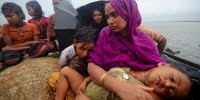
Dear friends,The most persecuted peoples on our earth are right now taking to ‘floating coffins’ to flee violence and seek sanctuary for their families. But instead of responding with humanity, our governments are closing their doors, letting them starve and drown at sea.

The Mediterranean and Andaman Seas are becoming graveyards.

Burma is driving the Rohingya out, and thousands of families are drifting helplessly at sea, forced to drink their own urine because Malaysia, Thailand and Indonesia had turned them away. Syrians and Africans risk drowning every week off the coast of Southern Europe, braving the terrifying crossing as their last hope to escape torture, hunger, and traffickers.

We are facing the biggest refugees crisis since World War II, but so far governments have let them die in a climate of rising xenophobia. Now it has reached a crisis, and our community has a unique chance to jam the culture of fear with a wave of compassion.

If we each chip in a small amount now, we’ll help fund rescue operations at sea; build an Avaaz refugee team to assist those missions and resettlement, and create effective lobby cells to get leaders to open up borders; and launch ads to counter the racism.

Together we can help rescue refugees, and rescue our shared humanity.

Unless we act fast, 2015 could become the year of the boat people!

Pledge to urgently launch the Avaaz refugee campaign — Avaaz will only process your donations if we raise enough to start saving lives:

To pledge another amount, click here.
Avaazers have already kick-started this campaign in the UK. The government has only allowed in 143 Syrians out of the 4 million refugees! In response, over 1,000 Avaazers have joined forces to challenge this disgraceful policy by offering to help refugees resettle, and calling on their local councils to give homes to 50 Syrian refugees each. Already 4 councils have agreed and with our pressure, we hope many more will too.

But this isn’t just a UK and Syria problem. It is a crisis of humanity when our planet’s most vulnerable are treated as criminals and left to die. Here’s a five point plan of the most critical actions Avaaz could take if we raise enough together:

  1. Support organisations that are bravely rescuing the refugees at sea.
  2. Launch Flotillas for Humanity with more private boats to assist rescue operations.
  3. Build an Avaaz refugee team to lobby governments, the EU and the Association of South East Asian Nations (ASEAN) to push for effective search and rescue operations, and increased numbers of refugee places.
  4. Support local groups in Europe and South East Asia to provide assistance to refugees arriving in reception centres, and into communities.
  5. Run hard hitting billboards and newspaper ads to counter the culture of xenophobia.

30 thousand refugees could drown in the Mediterranean this year. These families are fleeing terror and misery, and their choice to board a boat may be the only choice they have. Let’s join forces to stop these tragedies at sea. Pledge now:
Our community is one of the only in the world with millions of citizens in both the countries from which these families are fleeing and the countries they are seeking help. We have already funded extraordinary work to tackle Ebola and humanitarian work in Nepal. Now let’s take on this emergency and catalyse change with acts of inspired love and inspired bravery.

With hope and determination,

Alice, Ben, Oli, Diego, Mais, Emily, Dalia, Ricken and the Avaaz team

SOURCES:

Myanmar Muslim migrants abandoned at sea have been ‘drinking their own urine’ to survive  (The Independent UK)
http://www.independent.co.uk/news/world/asia/myanmar-muslim-migrants-abandoned-at-sea-drinking-their-own-urine-to-survive-after-thailand-refuses-boat-entry-10249854.html

Syria Refugee Regional Response (UNHCR)
http://data.unhcr.org/syrianrefugees/regional.php

Mediterranean migrants: Details emerge of deadly capsize (BBC)
http://www.bbc.com/news/world-europe-32399433

Lost at sea, unwanted: The plight of Myanmar’s Rohingya ‘boat people’ (CNN)
http://edition.cnn.com/2015/05/19/asia/rohingya-refugee-ships-explainer/

Stranded Rohingya migrants say: ‘We’re dying on board’ (Al Jazeera)
http://www.aljazeera.com/news/2015/05/stranded-rohingya-migrants-dying-board-150517130244345.html

We want Jon Stewart to moderate a 2016 presidential debate.


Petitioning NEW YORK TIMES, Washington Post, Commission on Presidential Debates, CNN, MSNBC, FOX News, CBS, NBC, FOX Broadcasting Company, Wall Street Journal, Al Jazeera, Comedy Central, MTV

We want Jon Stewart to moderate a 2016 presidential debate.

Petition by M. Waters
Stanhope, New Jersey
24,913
Supporters

what a successful Presidency looks like


The following sponsored message was sent to you by AlterNet on behalf of DCCC:

To be sure the numbers have shot upward

This is what a successful Presidency looks like:

President Obama Took Office
(January 2009)
Today
7,949 The Dow Jones Index 17,573
7.8% Unemployment 5.8%
-5.4% GDP Growth 3.5%
9.8% Deficit GDP % 2.8%
37.7 Consumer Confidence 94.5

In 6 years under President Barack Obama, we’ve made incredible progress as a country.

Often in the face of incredible obstruction, the President has continued to fight for us and lead us forward.

Will you add your name now and say that you’re still standing with President Obama in his final two years in office?

Sign your name to say you’re standing with President Obama:
http:// action.dccc.org/i-stand-with-obama

Pursuing transformative technology with the Google Impact Challenge: Disabilities ~ a repost


GOOGLeWhen Laura Palmaro was 10 years old, she woke one morning to find that the central vision in her left eye had all but disappeared. She was not ill and had no genetic issues—it was completely out of the blue. When she was 14, the same rare condition struck her right eye, and she began her freshman year of high school legally blind. Suddenly she was forced to depend on other people to read everything aloud, from school assignments to menus. The toughest part, according to Laura, was losing her sense of independence—and not knowing when or how she would get it back.

Laura has since adopted technological solutions to her vision challenges, using a combination of screen-readers and magnification software to read, work and more. Now a program manager at Google, she is following her passion, helping Chrome and Chrome OS teams make their products more accessible. “Technology has truly transformed my life,” she says. “Assistive technology can tear down boundaries, and empower people to find their independence and fulfill their dreams.”

We agree with Laura about the power of technology to change lives. And in order to support more people like her—people who see obstacles as opportunities—we’re launching the Google Impact Challenge: Disabilities. We’re putting $20 million in Google.org grants behind nonprofits using emerging technologies to increase independence for people living with disabilities, and today we’re issuing an open call to identify new areas of opportunity at g.co/ImpactChallengeDisability.

We’re kicking things off with support for two remarkable organizations. Each of these organizations is using technology to dramatically reduce the cost of and access to prosthetic limbs and auditory therapy, respectively—which could be transformative for hundreds of millions of people.

  • The Enable community connects people who want prosthetics with volunteers who use 3D printers to design, print, assemble, and fit them, for free. This dramatically cuts costs, increases speed of distribution, and meets unmet needs. We’ll support the Enable Community Foundation’s efforts with a $600,000 grant to advance the design, distribution and delivery of open-source 3D-printed upper-limb prosthetics.
  • Diagnosing auditory challenges can be a struggle in low income communities—the equipment is expensive, bulky and unrealistic, particularly in the developing world. With our support, and a $500,000 grant, World Wide Hearing will develop, prototype and test an extremely low cost tool kit for hearing loss using smartphone technology that’s widely available—and affordable—in the developing world.

The Google Impact Challenge: Disabilities will seek out nonprofits and help them find new solutions to some serious “what ifs” for the disabled community. We will choose the best of these ideas and help them to scale by investing in their vision, by rallying our people and by mobilizing our resources in support of their missions.

But of course, we realize there’s always room to improve our products as well. We have a team committed to monitoring the accessibility of Google tools; and we provide engineering teams with training to incorporate accessibility principles into products and services. That doesn’t just mean improving existing Google tools, it means developing new ones as well. For example, Liftware is a stabilizing utensil designed to help people with hand tremors eat more easily, and self-driving cars could one day transform mobility for everyone.

Historically, people living with disabilities have relied on technologies that were often bulky, expensive, and limited to assisting with one or two specific tasks. But that’s beginning to change. Thanks to groups like Enable and World Wide Hearing, and with tools like Liftware, we’re starting to see the potential for technologies that can profoundly and affordably impact millions. But we’ll all get there sooner if we make it a team effort—which is why we’re launching Google Impact Challenge: Disabilities today. Together, we can create a better world, faster.

Posted by Jacquelline Fuller, Director, Google.org