Tag Archives: black people

Where Do We Go From Here?


By

Processing Baltimore’s Events In The Last Two Weeks Will Be Tough But Essential

In the last two weeks following Freddie Gray’s death from spinal cord injuries suffered while in police custody, Baltimore has been riven with civil unrest, both protests and riots. While the focus of the aftermath of Gray’s death should be on the initial peaceful protests, a number of media outlets have ignored them in favor of sensationalizing the riots from earlier this week. On the ground organizing has been an essential part of the aftermath, and while a few have taken to criminal activity, many, many more have worked to rebuild Baltimore’s communities. While protests continue in the city, we must continue to provoke discussion as to why this cycle of violence continues in seemingly perpetual motion.

To understand the root causes of Baltimore’s civil unrest, we have to take a step back and understand the context Gray and some Baltimore residents experience daily. Sandtown-Winchester, Gray’s neighborhood, is 97 percent African-American and one of the many economically depressed areas of Baltimore. More than half of the neighborhood’s residents are out of work, the median income is below the poverty line for a family of four and a third of its buildings are vacant Compared to Baltimore’s average, Sandtown-Winchester has twice as many families receiving welfare and roughly half of the median household income. And as you can see on these maps, the inner harbor and a sliver of the northern suburbs are doing well economically, while vast stretches of east and west Baltimore with majority and significant African American populations are struggling with households earning less than $25,000 per year. In short, while parts of Baltimore have done very well in the last twenty years, the city’s leadership has failed to deliver those economic benefits to its most vulnerable residents.

People have and will argue that the events of Baltimore are not a racial problem because, while Baltimore is more than 60 percent African-American, the mayor and the police chief are both African-American. The problem with this argument is that it ignores the systemic criminal justice issues contributing to Baltimore’s issues. Since 2011, the city of Baltimore has spent $5.7 million to settle numerous police brutality lawsuits since 2011. In addition, Sandtown-Winchester “has more people in state prisons than any Baltimore neighborhood,” 458 people out of a population of 14,000. And last week, the New York Times chronicled the 1.5 million African-American men (ages 25 through 54) “missing ” from their communities due to incarceration and an increased early mortality rate. Baltimore ranked 6th in “places with most missing men” at 19,000.

While we can and should condemn the violence against local businesses and property, what it comes down to is ending the series of officer-involved deaths plaguing our country and communities with seemingly impunity. With that being said, it is worth taking a look at how our progressive leaders are addressing these important issues:

President Barack Obama:

“We can’t just leave this to the police. I think there are police departments that have to do some soul searching. I think there are some communities that have to do some soul searching. But I think we, as a country, have to do some soul searching. This is not new. It’s been going on for decades.

[…]

If we are serious about solving this problem, then we’re going to not only have to help the police, we’re going to have to think about what can we do — the rest of us — to make sure that we’re providing early education to these kids; to make sure that we’re reforming our criminal justice system so it’s not just a pipeline from schools to prisons; so that we’re not rendering men in these communities unemployable because of a felony record for a nonviolent drug offense; that we’re making investments so that they can get the training they need to find jobs.”

Senate Minority Leader Harry Reid:

“We are all saddened by what we’ve witnessed unfold on the streets of Baltimore. A man is dead who should not be dead. His name was Freddie Gray. […] So instead of turning a blind eye, let’s work together and take this problem seriously. There is bipartisan work being done on criminal justice reform and that is a good start. Ensuring that populations are not unfairly targeted for incarceration will be a positive step. But we also need to be investing in inner cities and rural areas, and ensuring that jobs and training and educational opportunities are available where they are needed most. Looking out at the year ahead, the only bill on the agenda I see that does anything to create jobs is the highway bill. That is not enough. We need to do more. It’s up to us here in this Capitol to create jobs. Republicans and Democrats must work together to make sure that America continues to be a land of opportunity for all of our fellow citizens.”

BOTTOM LINE: There is a stark reality sweeping across the country that many of our cities and towns remain painfully divided, whether it be along racial lines, between law enforcement and our communities, or across the huge socioeconomic gap that continues to widen. We haven’t just seen young black men and women lose their lives at the hands of police; we’ve seen the ongoing degradation of our communities because of a struggling economy, lack of access to a good education, and the failure to ensure your zip code doesn’t determine the opportunity you have to get ahead in America. We can’t solve this scourge until we address the inherent, but obvious inequalities in our country. It’s past time for us to get to work.

Edison R. Wato Jr., Membership Program Manager


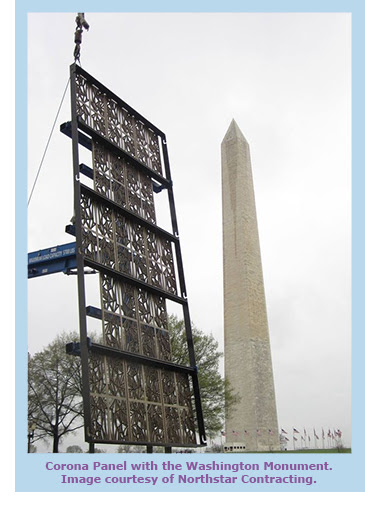
Corona Panels with Washington MonumentIt is not just cherry blossoms that are blooming in Washington, DC

April is always an exciting time of year in Washington, D.C., as thousands flock to the city to experience the blossoming of the Yoshino Cherry trees. This year the peak bloom was April 11-14th according to the National Park Service.

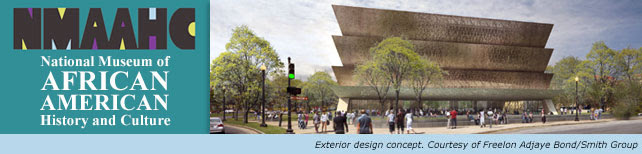
Yet on April 14th the National Museum of African American History and Culture also had some exciting things blossoming. The first of the building’s exterior panels for the Museums Corona have been hung! NMAAHC
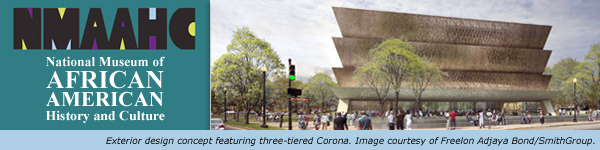
Each panel is roughly 3’ by 5’, and approximately 3,600 are required to clad the entire building. The design of the panels is our architect David Adjaye’s modern interpretation of slave-made New Orleans ornamental iron work. The panels are made of cast aluminum with a custom artisan painted finish and weigh from 95-130 pounds each, depending on the opacity of the design. There are four opacities ranging from 10% open to 35% open for the panels on each side of the building. This opacity will allow a certain amount on sunlight into the building helping to regulate the temperature of the building. This will help establish the buildings LEED Gold Certification for an energy efficient building.

The installation of the panels is slated for completion towards the end of June or early July. Once completed, the corona will visually define the Museum inside and out. Sunlight entering through the panels will gently illuminate the Museum’s wood-covered interior walls. And at night, light reflecting off the corona’s spectacular exterior will make the Museum truly stand out on the National Mall — as it reaches to the heavens to express the faith, hope and resilience of the African American spirit.

We wanted to take this chance to thank YOU for all your support, and helping to make this Museum become a reality! These construction milestones would not have been possible without the steadfast commitment from our amazing Charter Members!

Corona Panels on Building

We hope if you live in the area or will be visiting in the next few months, you will stop by our construction site to go see this amazing milestone in progress.

Sincerely,
edison signature
Edison R. Wato Jr.
Membership Program Manager

Please, consider helping the museum with a donation!
Or join as a Charter Member of the Museum!

No gays allowed …


I’m an openly gay Eagle Scout, and the Boy Scouts recently rescinded a job offer based solely on my sexual orientation. I’m calling on the Boy Scouts to end its ban on gay leaders.

History, Rebellion and Reconciliation : NMAAHC


NMAAHC -- National Museum of African American History and Culture

The Smithsonian’s National Museum
of African American History and Culture
presents a national conversation by hosting a daylong symposium,
 

HRR Logo.jpg

Saturday, April 25, 2015, 9:45am to 8:30pm EDT
National Museum of the American Indian
Rasmuson Theater
Independence and 4th St SW
Washington, D.C.

 Metro: Orange and Blue lines, L’Enfant Plaza or Federal Center SW
The symposium will be live streamed via Ustream


Admission is free and open to the public; however, seating is on a first-come, first-served basis and reservations are recommended. Reserve your free tickets by visiting Eventbrite. Please note if you wish to attend all panels, be sure to reserve a ticket for each panel.

A police shooting of an unarmed black man in Ferguson, Mo., this summer, along with other shootings by police officers around the county, led to weeks of protests in communities around the country. “We need to explore what this moment in our nation’s history means, especially in terms of leadership,” said Lonnie Bunch III, NMAAHC director. “What impact does generational change have on leadership and faith communities? What are the lessons to be learned from Ferguson, particularly within the context of community mobilization?”
Symposium Schedule

9:45am, director Lonnie Bunch opens the symposium and welcomes guests, followed by a discussion with Rev. Willis H. Johnson, pastor of Ferguson’s Wellspring Church. Willis will describe the conditions that led to the distrust between law enforcement and the city’s African American community.

10:30am-12:30pm, panel #1, “Ferguson: Impact, Importance & Long-Range Hopes.” This panel explores the evolution of the media, community leadership and activism as they relate to communities organized against excessive police force and economic inequality. Panel moderated by Juan Williams, journalist and Fox News political analyst. Panelists include: Lisa Crooms, Howard University law professor; Opal Tometi, founder of Black Lives Matter; Rev. F. Willis Johnson Jr., pastor Wellspring Church, Ferguson.

1:30pm to 2:30 pm, “On Art and History: A Conversation with Ava DuVernay.” Selma director, DuVernay, will discuss filmmaking and the creative responses to historic events such as the Selma to Montgomery march.

3:00pm – 5pm, panel #2, “Ferguson & Faith in the 21st Century.” This panel addresses the past, present and future roles of faith organizations as advocates for social change. It also examines changing roles of faith leaders. Moderated by Rex Ellis, NMAAHC associate director of curatorial affairs, the panel includes: Jeff Johnson, journalist and motivational speaker; Renee Harrison, Howard University School of Divinity professor and former Los Angeles police officer; Lerone A. Martin, assistant professor of Religion and Politics, John C. Danforth Center on Religion and Politics, Washington University, St. Louis; Rev. Osagyefo Uhuru Sekou, pastor, theologian, author, and community organizer; Stephanie Wolfe, dissertation fellow, John C. Danforth Center.

6:30pm – 8:30pm, panel #3, “#Words Matter: Making Revolution Irresistible.” This panel features the response of the creative community to excessive police violence, racism and communal demands for equality. Moderated by Jared Ball, associate professor of Communications, Morgan State University. The panel includes: Mark Bolden, psychologist and co-moderator; Jasiri X, Spoken Word artist; Jamilah Lemieux, senior digital editor, Ebony magazine; Jef Tate: DJ, Words, Beats and Life.
 

Other Presentations during the Symposium

12:30pm – 1:30pm, “Citizen” works by award-winning poet Claudia Rankine, interpreted on film by director John Lucas. The film shorts, titled Situation #1through 5, are based on Rankine’s book Citizen: An American Lyric.

5:00pm – 6 pm, view a slide presentation of social justice related objects from the museum’s collection and select artists, accompanied by a mix from DJ Jef Tate of “Words, Beats and Life.”

For questions about the symposium, email NMAAHCpubpgms@si.edu.

View the daylong symposium at Ustream. A dialogue on social media will be held throughout the symposium. The public may follow the museum on Twitter @NMAAHC to participate in the discussion using #HRRlive or #WordsMatter.

For more information, visit www.nmaahc.si.edu or call (202) 633-1000(202) 633-1000.

Right As Republicans Vote Against Equal Pay, New Evidence Reaffirms the Gender Wage Gap ~repost


By

Right As Republicans Vote Against Equal Pay, New Evidence Reaffirms the Gender Wage Gap

Last night, only a week after the Republican National Committee claimed that all Republicans support an equal wage, Senate Republicans unanimously voted to block the Paycheck Fairness Act. The bill, which failed to advance despite achieving a majority of 52 votes in favor, would ban salary secrecy and tighten rules to try to narrow the persisting wage gap between men and women.

This isn’t the first time that the GOP has blocked bills that require equal pay for equal work over the years. They usually claim that the gap isn’t as large as stated and that provisions are already in place to protect women workers. But we know those claims to be untrue: the gender wage gap can’t just be explained away and discrimination against women is likely at least partly to blame.

What’s more, this morning the Census Bureau released new numbers on the earnings of men and women that proves that the GOP’s position on equal pay remains out of touch. In 2013, according to the Census, the average woman who works full time makes 78 cents to every man’s dollar, just a single penny improvement from the 77 cent wage gap in 2012. As the chart below depicts, in 2013 median earnings for men were $50,000 while median earnings for women hovered at just $39,200.

Screen Shot 2014-09-16 at 10.09.14 AMCREDIT: Census Bureau

We already know that the claim that the gender wage gap is a myth is a myth itself. The new evidence shows that the problem isn’t getting any better — in fact, for the last decade, there has been little progress on closing the wage gap. The Paycheck Fairness Act is one of many policies that would help address this gap, and more broadly help increase economic opportunity for women and families.

BOTTOM LINE: With their latest vote to block equal pay for equal work, Senate Republicans continue to ignore the facts about the gender pay gap and continue to reject policies that would help women and families succeed. New data from the Census Bureau released today proves that point by showing the wage gap hasn’t budged. If conservatives really supported women, they would stop paying lip service to women on the one hand, and voting against policies to help women and families on the other