|
Tag Archives: black
Rashad Robinson, ColorOfChange.org
It has been more than two weeks since Baltimore police killed Freddie Gray and no officer has been fired, arrested, or prosecuted. Local officials don’t even have answers to the most basic questions: Why did police violently arrest Gray? Why was this healthy 25-year-old’s voice box crushed, his spleen ruptured and 80% of his spine severed after 45 minutes with Baltimore law enforcement? 1
The lack of accountability for Gray’s killing is unacceptable and the solution to Baltimore’s policing crisis is not martial law or more militarized policing. Right now, we need widespread public pressure to ensure the necessary leadership and independent oversight to bring Gray’s killers to justice and overhaul the Baltimore Police Department. Without independent oversight it’s unlikely that Gray’s killers will be held accountable. Local prosecutors work too closely with police on a day to day basis to hold them accountable — and they almost never do.2
Demand that Governor Hogan appoint Maryland’s Attorney General to assist in the case.
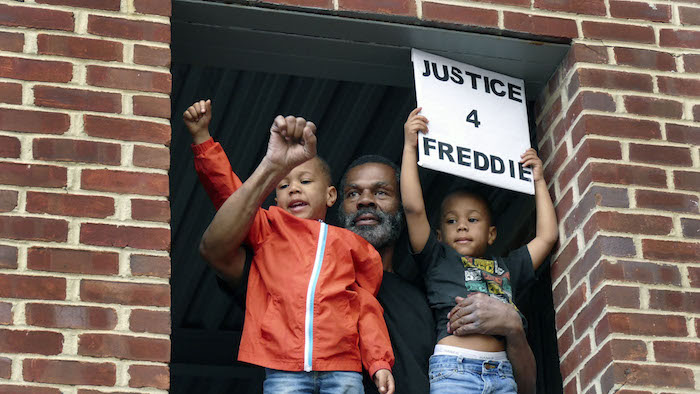
To be Black in Baltimore means every day is a risk. In a city overcome with racism, police violence, and a police union blocking reform,3 even the most simple activities — a walk down the street or the drive to work — could mean an unlawful arrest or deadly attack at the hands of law enforcement. According to an investigation by the Baltimore Sun, in just 5 years, 100 Baltimore residents have won $5.7 million worth of settlements relating to police brutality and civil rights. The stories are shocking, yet almost none of the officers were held accountable:4
- Jerriel Lyles, who was attacked by police on his way out of a convenience store: “The blow was so heavy. My eyes swelled up. Blood was dripping down my nose and out my eye.”
- Starr Brown, a pregnant woman slammed to the ground and kneed in the back by police after calling them for help: “They slammed me down on my face…The skin was gone on my face”
- An 87-year-old grandmother, who was attacked after calling an ambulance for her wounded son, was told: “B****, you ain’t no better than any of the other old black b**** I have locked up.”
Following Freddie Gray’s killing, a community tired of living under siege and facing decades of employment discrimination and decimated public housing is rising up to demand change.5 Last night, as the National Guard moved into Baltimore, images of militarized police tear gassing and beating protestors, fires, and outrage once again flashed across our TV screens. The best way to restore peace to Baltimore is for Governor Hogan and local leadership to undo the structural racism targeting its people. But right now, police are preparing to announce even harsher measures to crack down on the protests — like a curfew for youth6 — that will likely continue to escalate an already unacceptable level of confrontation and violence between police and citizens.
Protestors in Baltimore are showing the same courageous resistance and vision for a better country that we see coming out of Ferguson, Madison, New York, Cleveland, Milwaukee, and other cities across the country. And just as in Ferguson, justice for the brutal police killing of Freddie Gray depends on Governor Hogan’s leadership to do more than ramp up law enforcement.
Thanks and peace,
— Rashad, Matt, Arisha, Lyla, Shani, and the rest of the ColorOfChange team
April 28th, 2015
Help support our work. ColorOfChange.org is powered by YOU—your energy and dollars. We take no money from lobbyists or large corporations that don’t share our values, and our tiny staff ensures your contributions go a long way.
References
1. “Nonviolence as Compliance,” The Atlantic 04-27-2015 http://act.colorofchange.org/go/4768?t=6&akid=4315.1174326.07z6yO
2. “Why I Don’t Trust Baltimore Prosecutors with Freddie Gray Case,” Legal Speaks 04-22-2015 http://act.colorofchange.org/go/4769?t=8&akid=4315.1174326.07z6yO
3. “Maryland Cop Lobbyists Helped Block Reforms Just Last Month,” Intercept 04-28-2015 http://act.colorofchange.org/go/4770?t=10&akid=4315.1174326.07z6yO
4. “Undue Force,” The Baltimore Sun 09-04-2014 http://act.colorofchange.org/go/4771?t=12&akid=4315.1174326.07z6yO
5. “Baltimore’s shame is America’s shame: How job flight and police brutality spelled doom for Freddie Gray’s neighborhood,” Salon 04-28-2015 http://act.colorofchange.org/go/4772?t=14&akid=4315.1174326.07z6yO
6. “Gov. Larry Hogan promises more than 1,000 additional troops, vows to prevent rioting,” The Baltimore Sun 04-28-2015 http://act.colorofchange.org/go/4773?t=16&akid=4315.1174326.07z6yO

The Real NRA: Making A Killing
With only one day left to meet our goal, we are within reach of funding our new feature length documentary The Real NRA: Making A Killing.
Director Robert Greenwald just got back from filming families torn apart by needless gun violence. Watch one of the remarkable stories Robert was able to capture for this film.
It is more important than ever to tell these stories and call out the NRA and gun companies for profiting off of these families tragic and heartbreaking losses.
You can produce this film by contributing what you can today.
We will never be able to match the money of the NRA and gun companies, but by telling these heartbreaking stories through film, we can energize this movement and be a real force for change on this profit-driven public health crisis. We are not making this documentary to seek profit or notoriety; we are making this documentary to facilitate real change in our lifetimes and make the world a better place.
With only one day to meet our goal we need your help, contribute now.
Thanks for your support.
Jim Miller, Executive Director
Brave New Films
“Otagai no tame ni: With and for Each Other”
Yesterday, President Obama and the First Lady welcomed Japanese Prime Minister Shinzo Abe and Japanese First Lady Akie Abe to the White House.
After the State Arrival Ceremony on the South Lawn, President Obama and Prime Minister Abe met to talk about trade, investment, and international security. During a joint press conference in the Rose Garden, the two leaders also announced that they would continue to work together to fight climate change.
President Obama on Freddie Gray’s Death: “This Is Not New, and We Shouldn’t Pretend that It’s New”
While speaking in the Rose Garden yesterday, President Obama shared his thoughts on the recent protests following the death of Freddie Gray — a 25-year-old Baltimore native who died while in police custody. The President noted that the events in Baltimore called attention to the urgent need throughout the country to build trust between communities and their police.
President Obama on Why Transparency Matters in Securing the Most Progressive Trade Deal in History
The TPP gives us the greatest opportunity to level the playing field for American businesses and their employees. That’s why the President has taken important steps to include new voices in the trade discussion and increase the transparency of our trade negotiations. In an interview with the Wall Street Journal, the President laid out what the public can expect to see before he signs an agreement and before any vote is taken in Congress.
America’s Response to the Earthquake in Nepal: What We Can Do to Help
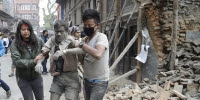
A 7.8-magnitude earthquake struck the heart of Nepal on April 25. It toppled communities, severely cut off access to food and water, and caused tens of thousands of people to take shelter in makeshift camps. Find out how you can help make a difference and assist us in spreading the word.
Where Do We Go From Here?
Processing Baltimore’s Events In The Last Two Weeks Will Be Tough But Essential
In the last two weeks following Freddie Gray’s death from spinal cord injuries suffered while in police custody, Baltimore has been riven with civil unrest, both protests and riots. While the focus of the aftermath of Gray’s death should be on the initial peaceful protests, a number of media outlets have ignored them in favor of sensationalizing the riots from earlier this week. On the ground organizing has been an essential part of the aftermath, and while a few have taken to criminal activity, many, many more have worked to rebuild Baltimore’s communities. While protests continue in the city, we must continue to provoke discussion as to why this cycle of violence continues in seemingly perpetual motion.
To understand the root causes of Baltimore’s civil unrest, we have to take a step back and understand the context Gray and some Baltimore residents experience daily. Sandtown-Winchester, Gray’s neighborhood, is 97 percent African-American and one of the many economically depressed areas of Baltimore. More than half of the neighborhood’s residents are out of work, the median income is below the poverty line for a family of four and a third of its buildings are vacant Compared to Baltimore’s average, Sandtown-Winchester has twice as many families receiving welfare and roughly half of the median household income. And as you can see on these maps, the inner harbor and a sliver of the northern suburbs are doing well economically, while vast stretches of east and west Baltimore with majority and significant African American populations are struggling with households earning less than $25,000 per year. In short, while parts of Baltimore have done very well in the last twenty years, the city’s leadership has failed to deliver those economic benefits to its most vulnerable residents.
People have and will argue that the events of Baltimore are not a racial problem because, while Baltimore is more than 60 percent African-American, the mayor and the police chief are both African-American. The problem with this argument is that it ignores the systemic criminal justice issues contributing to Baltimore’s issues. Since 2011, the city of Baltimore has spent $5.7 million to settle numerous police brutality lawsuits since 2011. In addition, Sandtown-Winchester “has more people in state prisons than any Baltimore neighborhood,” 458 people out of a population of 14,000. And last week, the New York Times chronicled the 1.5 million African-American men (ages 25 through 54) “missing ” from their communities due to incarceration and an increased early mortality rate. Baltimore ranked 6th in “places with most missing men” at 19,000.
While we can and should condemn the violence against local businesses and property, what it comes down to is ending the series of officer-involved deaths plaguing our country and communities with seemingly impunity. With that being said, it is worth taking a look at how our progressive leaders are addressing these important issues:
President Barack Obama:
“We can’t just leave this to the police. I think there are police departments that have to do some soul searching. I think there are some communities that have to do some soul searching. But I think we, as a country, have to do some soul searching. This is not new. It’s been going on for decades.
[…]
If we are serious about solving this problem, then we’re going to not only have to help the police, we’re going to have to think about what can we do — the rest of us — to make sure that we’re providing early education to these kids; to make sure that we’re reforming our criminal justice system so it’s not just a pipeline from schools to prisons; so that we’re not rendering men in these communities unemployable because of a felony record for a nonviolent drug offense; that we’re making investments so that they can get the training they need to find jobs.”
Senate Minority Leader Harry Reid:
“We are all saddened by what we’ve witnessed unfold on the streets of Baltimore. A man is dead who should not be dead. His name was Freddie Gray. […] So instead of turning a blind eye, let’s work together and take this problem seriously. There is bipartisan work being done on criminal justice reform and that is a good start. Ensuring that populations are not unfairly targeted for incarceration will be a positive step. But we also need to be investing in inner cities and rural areas, and ensuring that jobs and training and educational opportunities are available where they are needed most. Looking out at the year ahead, the only bill on the agenda I see that does anything to create jobs is the highway bill. That is not enough. We need to do more. It’s up to us here in this Capitol to create jobs. Republicans and Democrats must work together to make sure that America continues to be a land of opportunity for all of our fellow citizens.”
BOTTOM LINE: There is a stark reality sweeping across the country that many of our cities and towns remain painfully divided, whether it be along racial lines, between law enforcement and our communities, or across the huge socioeconomic gap that continues to widen. We haven’t just seen young black men and women lose their lives at the hands of police; we’ve seen the ongoing degradation of our communities because of a struggling economy, lack of access to a good education, and the failure to ensure your zip code doesn’t determine the opportunity you have to get ahead in America. We can’t solve this scourge until we address the inherent, but obvious inequalities in our country. It’s past time for us to get to work.


You must be logged in to post a comment.