Tag Archives: Congress

Fact – Averse


By

Marco Rubio Is In Denial, But Man-Made Climate Change Is All Around Us

Two years ago, when Marco Rubio was asked about how old the earth was, the Republican Senator from Florida punted: “I’m not a scientist, man.”

Apparently Rubio, a potential Republican candidate for President in 2016, was feeling more confident with his credentials this Sunday. The recent National Climate Assessment (NCA) once again confirmed that climate change is here now and it is up to us how much worse it will get. Rubio, however, offered his own alternative opinion:

I don’t agree with the notion that some are putting out there, including scientists, that somehow, there are actions we can take today that would actually have an impact on what’s happening in our climate. Our climate is always changing. And what they have chosen to do is take a handful of decades of research and — and say that this is now evidence of a longer-term trend that’s directly and almost solely attributable to man-made activity.

And today, when pressed on his climate denialism (which he shares with the majority of Republicans in Congress), Rubio couldn’t name a single source that shares his climate views.

On the flip side, the 300 climate scientists and experts who authored the lengthy Assessment do have evidence of how man-made climate change is affecting diverse regions in America right now. Here’s a glimpse of those regional impacts, drawing from exhaustive reporting done by Climate Progress after the report’s release last week.

The Southeast is “exceptionally vulnerable to sea level rise, extreme heat events, hurricanes, and decreased water availability,” according to the National Climate Assessment. And as Jennifer Jurado, Director of the Natural Resources Planning and Management Division in Broward County, Florida, puts it, many of these impacts are already being felt: “It’s not just coincidence — we really are seeing these things taking place.” The region has already experienced more billion-dollar disasters in the past 30 years than the rest of the country combined.

Temperatures in the Midwest have already risen over 1.5°F from 1900 to 2010, with the increase speeding up in the last 30 years. That means crop reductions, as warmer temperatures cause lower yields. It means more droughts, heavier rains, and more heat waves. And it even threatens the Great Lakes, whose water levels have fallen significantly over the last decade or two. Dozens of communities along Michigan’s shoreline had to be dredged in 2013 to keep shipping lanes open. This climate change impact caused economic losses.

The Northeast quickly became familiar with the threat posed by sea level rise in the aftermath of Superstorm Sandy, which caused up to $80 billion in damage. But the East Coast faces not just sea level rise, but also flooding from the skies. The region has experienced a greater recent increase in extreme precipitation — 71 percent — than any other region of the United States. Only the Midwest even comes close, with a 37 percent increase in extreme precipitation events.

Ocean acidification and wildfires are taking their toll on the Pacific Northwest. Ocean waters in Willapa Bay, for example, have become so acidic that one company can’t grow oyster larvae off the coast of Washington anymore. Meanwhile, Oregon experienced one of the worst fire seasons since 1951 last year: wildfires burned through 100,000 state-protected acres and cost the state $122 million in firefighting costs alone.

Great Plains: The second-most severe category of drought now covers almost half of Kansas, pushing outward from Oklahoma and Texas. This week a brutal heatwave sent temperatures over 100 degrees, putting a major strain on utilities and threatening to devastate this year’s wheat crop. And according to the National Climate Assessment, even in an optimistic scenario where we cut back on carbon emissions, those in the Great Plans should expect significantly more drought and water scarcity in the next 50 to 100 years.

As its population surges, the harsh climate of the Southwest will only get harsher. “Just think of this year’s California drought — the type of hot, snowless, severe drought that we expect more of in the future,” said Gregg Garfin, a lead author of the Southwest portion of the National Climate Assessment and assistant professor of climate, natural resources, and policy at the University of Arizona. That’s the kind of change that could have a tremendous impact on not only the availability of water for nearly 100 million people, but also on a critical part of the economy, agriculture.

BOTTOM LINE: Conservatives like Marco Rubio may be in denial when it comes to climate science, but changes to our climate are real, and humans play a major role by burning fossil fuels. And no matter what region of the country, the negative effects are already hurting our economy. Reducing carbon pollution and investing in clean energy are essential steps to restrain future damages.

Update for our Progressive Radio Enthusiasts


TumblrOrcasIslandWe’re happy to report that Progressive Radio Northwest (PRNW) recently incorporated as a nonprofit organization and elected our first Board of Directors – important milestones in our mission to:

  •          bring strong-signal progressive talk radio back to the Pacific Northwest, and
  •          promote progressive programming on the free public airwaves and digital technologies.

We can’t do it without you.

Those of you who have signed up on our website, attended Party On with Norman Goldman or one of our free community forums, “liked” us on Facebook, or just sent random thoughts and comments are all an important part of our progressive radio community. You send a strong message to potential advertisers and investors that the greater Seattle area can support progressive talk programming … BIG time!

We’ll be making an announcement soon about some exciting plans for the summer and beyond. As they say, stay tuned….

In the meantime, check out the video from our March 26 Forum on Progressive Media in the Social Media Age: https://www.youtube.com/watch?v=oGRvh4cCr10


Moderated by PRNW Vice President Phil Harrison, the panel featured independent journalist Mark Taylor Canfield (https://www.facebook.com/mtaylorcanfield), online radio host Space Dog of the Seattle-Portland based Space Dog Radio (http://spacedogradio.com/) and Jacob Dean of Portland-based Filter Free Radio (http://filterfreeradio.com/).


If you haven’t already done so, please sign up on the Progressive Radio Northwest website to receive updates and invitations to PRNW events.

www.progressiveradionorthwest.org

“Like” us on Facebook.

https://www.facebook.com/progressiveradionorthwest

With appreciation,

The PRNW Team

progressiveradionorthwest@gmail.com

The 2014 WA state legislative session


First posted in March 2014 …

While progressives earned a couple of important wins this legislative
session, Rodney Tom and his Senate Republicans put greedy corporations
first and obstructed progress every step of the way. Fuse members stood
up to hold them accountable online, on the ground and in person. Here’s a
rundown of some of our biggest accomplishments during the 2014
legislative session and what we need to do next to build a more
progressive Washington.

The Good News:


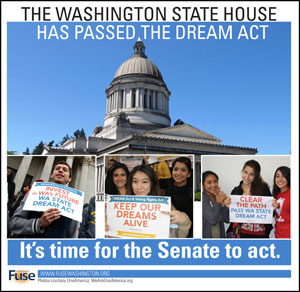
The Dream Act
The clear highlight from this legislative session was the passage of the Dream Act. The Washington Dream Act allows all of our brightest students to apply for the state need grant, regardless of their immigration status. Our friends at OneAmerica, the Washington Student Association, the Washington Bus, and many others worked for years to build grassroots support for this legislation. More than 1,500 Fuse members joined them by urging legislators to support the Dream Act this year. Thanks to this unwavering pressure, the Senate finally passed The Dream Act.

Gun safety and domestic violence prevention
The House and Senate also unanimously approved a bill to expand gun violence protections for survivors of domestic violence. This legislation allows judges to require people under a restraining order to surrender their guns while the order is in effect. Even the NRA supported it, and in a functioning Senate it wouldn’t be controversial. Sadly, it took more than a year for Sen. Rodney Tom to allow a vote. Our friends at the Washington Alliance for Gun Responsibility deserve much credit for organizing support for this bill.

Why we need change:

In their second year in power, Sen. Rodney Tom and his Republican caucus were even more partisan and dysfunctional than 2013. They spent much of the legislative session congratulating themselves and repeating their tired sound bites, rather than working together to pass major legislation. Here are a few key bills that failed in 2014:


Closing tax loopholes and funding education
There are more than 650 tax loopholes on the books that cost our state billions of dollars every year. Closing some of the unnecessary or inefficient tax loopholes is critical to funding education. The House made modest progress by voting to close four tax loopholes to save $200 million in the budget for education. Yet Sen. Andy Hill of Redmond, the Senate’s budget writer, balked at this responsible solution to our state’s education funding crisis. Instead, he actually created or extended 18 other loopholes that will cost taxpayers $87 million. It’s sad to say, but Sen. Hill’s budget prioritizes every one of these 650 tax loopholes over our kids’ future.

Transportation and transit funding
The House passed a comprehensive transportation package in 2013 while the Senate Republicans spoke at length about the need for a transportation package. Yet nearly a year later – huge transit cuts looming across the state –– the Senate Republicans still have yet to approve any solutions to fix our bridges and roads or  improve public transit.

Reproductive Parity Act
The Reproductive Parity Act (RPA) would require health insurance companies to cover all of a woman’s legal pregnancy options, ensuring every woman has the freedom and privacy to make her own pregnancy decisions. The House passed the RPA and a majority of Senators have signed a letter in support, yet Sen. Tom refused to allow a vote yet again this year. His hand–picked anti–women’s health committee chair, Sen. Randi Becker, refused to allow a vote on the critical bill. More than 2,600 Fuse members called on Senators Tom and Becker to allow a vote before the deadline. With a change in leadership, the RPA could pass the Senate in a matter of minutes.

“[Senator Jan] Angel was playing insider politics at its worst, with no concern about punishing homeless children and families.”

-The Olympian, March 9, 2014 3

Homeless Housing
One of the biggest controversies in 2014 was over funding for homeless housing. A strong bipartisan coalition worked to extend the fee that funds a huge portion of the state’s budget for housing assistance for low–income and homeless families. Unfortunately, Rodney Tom’s committee chair, Republican Sen. Jan Angel, abruptly ended a committee hearing without voting on the bill just before the legislative deadline. According to Sen. Steve Hobbs, one of the bill’s champions, Sen. Tom told Sen. Angel to kill the bill. Only after a flurry of outraged press coverage1  and editorials2  did Tom and Angel back down and agree to extend the funding in the final moments of session.

Raising the minimum wage
Fuse members sent more than 7,500 messages to legislators in support of raising the statewide minimum wage to $12 per hour. This important legislation would help ensure that no one who works full time lives in poverty. Unfortunately, we came up several votes short in the House while the Senate Republicans, led by Sen. Michael Baumgartner of Spokane, tried to cut the minimum wage for thousands of Washington workers.

Fuse Senior Organizer Alex Epstein preps volunteers to meet with legislators about the Big Oil tax loophole

Holding the Senate accountable:

Fuse members were there every step of the way to put grassroots pressure on the Senate Republicans and educate the public about their far–right agenda. We organized canvasses, phonebanks and constituent meetings with swing Senators. We also provided rapid–response communications and social media to spread the word and ensure the media and our members online also held the Senators accountable.

More than anything else, the 2014 legislative session showed how much we need a change in the Senate. Tom and his Republican caucus continue to be an obstacle to progress, which means our hopes of passing meaningful progressive reforms depend on retaking the Senate this fall. That’s where you come in.

It’s going to take a, long–term campaign to both retake the Senate and build grassroots support for change on the issues that matter, from commonsense gun laws to raising the minimum wage.

Will you give us the long–term funding we need to win by donating $10 per month as part of the Fuse PowerSource team?

and since this post we found out that Rodney Tom will not run for reelection ! So, that happened

#Infrastructure


Why We Need to Invest in Infrastructure

The United States was once a leader in infrastructure, but we’re slipping. Repairing our crumbling roads and bridges will help position our economy for long-term growth.

“Every time we’ve invested in infrastructure, as Democrats, as Republicans — every time we’ve done it, the economy grows,” said Vice President Biden. “And it grows good, decent-paying jobs.”

Listen to the Vice President explain why we need to invest in our infrastructure:

Video player: Investing in American Ports Infrastructure


President Obama and Vice President Biden Honor America’s TOP COPS

The President and Vice President welcomed some of the country’s best law enforcement officials to the White House, honoring their remarkable service and sacrifice.

READ MORE

A Numbers-Based Case for Why It’s Time to Act on Infrastructure

President Obama is calling on Congress to pass a bill to put Americans to work repairing our crumbling roads and bridges — avoiding a crisis in the short term, and helping to position our economy for long-term growth.

READ MORE

Share these words


“Knowing what’s right doesn’t mean much unless you do what’s right.” 

-Theodore Roosevelt

Teens see bullying everyday. They want to help, but don’t know how. Teach them how to be more than a bystander. Share these words and learn how you can motivate teens to take action when bullying occurs.