

Tag Archives: Congress

ACTION:Turn On The Water … it’s the right thing -reminder


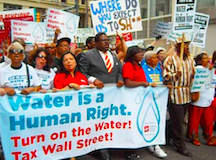
Thousands of low-income Black Detroit residents have already had their water shut-off risking both public health and personal safety. What’s worse — the city plans to resume shut-offs tomorrow.
Water is a human right.ImageTell the panel: turn the water back on in DetroitTake Action

Thousands of low income Black Detroit residents have already had their water shut off, risking both public health and personal safety. What’s worse — the city plans to resume shut-offs tomorrow.1

Just weeks ago, under pressure from organizers in Detroit and thousands of supporters online, Governor Rick Snyder’s hand-picked Emergency Manager returned control of the Detroit Water and Sewerage Department (DWSD) to the duly-elected mayor.2 While a small victory for local control, the move was ultimately a political ploy to provide cover for Emergency Manager Kevyn Orr. Mayor Duggan’s “10 Point Plan” does little more than offer better customer service while continuing the inhumane and unjust practice of shutting off water.3

The solution is the Water Affordability Program (WAP) passed by the city council back in 2005. The WAP would provide relief to thousands and create a safety net that allows low income residents to pay on a sliding scale, based on their income. A 3-judge panel is holding a hearing on August 29th during which they could order the WAP back into effect and end the shutoffs once and for all.

Sign the petition: tell the panel to turn the water back on and implement the Water Affordability Program.

While Detroiters suffer under policies implemented by an unelected emergency manager, corporations are protected and speculators are circling. Individuals with as little as $33 owed have had their water shut off without warning while the Palmer Park Golf Course which owes $437,714 still has water.4 The initial round of shutoffs were a tactic to make the city’s water rights a more attractive target to potential private investors. 5

Even with authority tenuously returned to the Mayor, his plan offers little hope to residents whose rates have risen 119% in the past decade.6 Under this scheme, relief is only available after putting down a large lump sum payment and there is no promise that the emergency manager will not seize back control and change the rules yet again.

The Water Affordability Program would provide relief to all residents living under 175% of the federal poverty line and reign in the out-of-control rates DWSD has charged.7 The WAP is the best way to restore water to thousands of residents in Detroit at reasonable rates.

Turn the water back on: Sign the petition to implement the WAP.

Water is a basic human right and denying access to water poses a dire threat to public health. To make matters worse, earlier this month there were historic floods in Detroit. A state of emergency was declared. The flooding has caused millions of gallons of sewage to back up into waterways and basements. 8 How are you supposed to clean sewage from your basement when the city has shut off your water?

Sign the petition: Turn the water back on in Detroit!

Thanks and Peace,

Aimée, Rashad, Arisha, Matt, Johnny and the entire ColorOfChange.org team.

Help support our work. ColorOfChange.org is powered by YOU—your energy and dollars. We take no money from lobbyists or large corporations that don’t share our values, and our tiny staff ensures your contributions go a long way.

1. “Duggan, DWSD to release updated plan on water shutoffs Thursday; moratorium extended until Aug. 25,” Metro Times, 8/4/14,
http://act.colorofchange.org/go/3787?t=8&akid=3599.1174326.1Q65qP

2.”Detroit’s drought of democracy,” New York Times, 7/29/14,
http://act.colorofchange.org/go/3789?t=10&akid=3599.1174326.1Q65qP

3.”Orr Dumps ‘Hot Mess’ of Water Shut-offs in Duggan’s Lap,” People’s Water Board, 7/29/14
http://act.colorofchange.org/go/3790?t=12&akid=3599.1174326.1Q65qP

4. “Detroit water department now sending shut-off crews to commercial customers,” Detroit Free Press, 7/14/14
http://act.colorofchange.org/go/3798?t=14&akid=3599.1174326.1Q65qP

5.”Detroit shuts off water to thousands of broke residents,” Think Progress, 6/20/14,
http://act.colorofchange.org/go/3791?t=16&akid=3599.1174326.1Q65qP

6. See reference 3.

7. See reference 3.

8. “Snyder declares flood disaster for southeast Michigan,” Detroit Free Press, 8/20/14,
http://act.colorofchange.org/go/3792?t=18&akid=3599.1174326.1Q65qP

Tell Congress: Support pregnant workers … a repost


by Emily J. Martin

Mother’s Day is quickly approaching — but for some moms, celebrating is the last thing on their minds.

Because Congress has failed to act, some pregnant women might be spending this holiday facing an impossible choice between risking their health and risking their family’s economic security.

Tell Your Members of Congress
to Support Pregnant Workers

No mom-to-be should be forced to choose between risking her health and risking her family’s economic security this Mother’s Day. Write to your Members of Congress now.

Lots of pregnant women don’t need any changes on the job, but some do, and for them the stakes are high. The Pregnant Workers Fairness Act is commonsense legislation that would require employers to make reasonable accommodations when workers have a medical need for them because of pregnancy, childbirth, or related conditions — just as employers are already required to do for people with disabilities.

Over the next several weeks, we’re turning the pressure up to raise awareness and take action in support of pregnant workers. The Pregnant Workers Fairness Act will be re-introduced in Congress soon. But to give it a strong start, we need to make sure we have as many co-sponsors on the bill as possible.

It’s time we turn it up a notch and push for what moms really need. Please take a minute to honor the mothers in your life by supporting the Pregnant Workers Fairness Act.

Thanks for all that you do.

Sincerely,
Emily J. Martin
Vice President and General Counsel
National Women’s Law Center

Share This With A Mother In Your Life


By

Wishing Moms Everywhere A Happy Mother’s Day — With Progressive Policies!

It’s a fact of life that none of us would be anywhere without our moms. It’s also a fact of life that the Progress Report loves talking about progressive policies. So it’s natural, then, that on the Friday before Mother’s Day we will take the opportunity to share some of the reasons why our public policies lag behind for women and families — and why America’s mothers deserve better.

Here are five steps we can take right now:

1. Establish paid family and sick leave. Nearly all workers need to take time away from work to deal with a serious personal or family illness, or to care for a new child or aging parent. Access to paid family and medical leave could allow workers to meet those needs without jeopardizing their economic security. The United States is the only developed country that doesn’t guarantee workers the right to earn paid time off in some form; only 12 percent of U.S. workers have access to paid family leave through their employers. We need a national paid family and medical leave insurance program that allows workers to continue to earn at least a portion of their pay while they take time away from work: it’s good for families and its good for the economy, too.

2. Ensure equal pay for equal work. Women are the primary, sole, or co-breadwinners in nearly two-thirds of families, yet they continue to earn less than their male counterparts, with Latinas and African American women experiencing the sharpest pay disparities. Although the law prohibits unequal pay for equal work, there is more we need to do to ensure that both women and men enjoy the fullest protections against discrimination. Unfortunately, despite overwhelming public support, conservatives in Congress continue to be unwilling to move forward concrete action steps that could help uncover discriminatory pay practices, create greater pay transparency, and ensure that the law works fairly for everyone.

3. Raise the minimum wage. Raising the minimum wage will help hardworking women better support their families. Women made up approximately two-thirds of all minimum wage workers in 2012. The current federal minimum wage is $7.25 an hour, which means someone working fulltime earns
$15,080 a year. That is below the poverty rate for a family of three. Progressives are stepping up on this issue: last week new legislation was introduced calling on Congress to raise the wage to $12 per hour and eliminate the sub-minimum tipped wage, a move that would boost earnings for 19.6 million women.

4. Require paid sick days. Everyone gets sick, but not everyone has time to get better. Almost 40 million U.S. employees, or about 40 percent of the nation’s private-sector workforce, do not have access to paid sick days. If employees choose to skip work, the loss of pay can take a toll, particularly on the low- income workers who are least likely to have access to these policies. Allowing employees to earn paid sick days helps keep our economy, families, and communities healthy.

5. Expand access to preventative healthcare. Make no mistake, health care — from affordable insurance coverage to reproductive freedom — is an economic issue. In a 5-4 decision in Burwell v. Hobby Lobby, five conservative male justices on the Supreme Court gave unprecedented power to closely-held, for-profit, secular corporations to make health care decisions for their female employees. That needs to change — along with the minority of U.S. Senators who blocked a bill to overturn that decision. At the same time, conservative officials in some states continue to refuse to close the Medicaid coverage gap for low-income working families. In fact, it turns out Florida Gov. Rick Scott used his mother’s own death as a ruse in his political games to deny hundreds of thousands the right to affordable care.

Do you like what you are reading here? These and other important policy issues are part of a nationwide campaign called the Fair Shot campaign to help women and families get ahead. Check out the website here to learn more, and sign on to become a Fair Shot voter.

BOTTOM LINE: The mothers in our lives deserve the very best from us, and Mother’s Day is one easy way to show we appreciate them. But they also deserve the best from the employers and policymakers that can affect their ability to help their families succeed. Those officials who stand in the way should be more afraid than the child who forgets to call their mom this Sunday.

Save the Brazilian Amazon’s last tributary from destruction


Photo credit: Aaron Vincent Elkaim

Believe it or not there is only one major tributary in the Brazilian Amazon that still runs free – the pristine Tapajós River. Today, the Tapajós and its vast forests are at risk of imminent destruction from the Brazilian government’s plans to build 29 large dams and approximately 80 smaller dams across its tributaries. Local communities such as the Mundurukú people, whose ancestral lands would be flooded, are fiercely resisting this devastation. Please donate today and support our work to keep the Tapajós running free.

“The fact is that there is only one earth and that nature provides everything. This is the indigenous reality and that is why our peoples are uniting in order to put an end to the damage caused by the Federal Government.”
– Mundurukú Chief Saw

Working with the Mundurukú, we have already made a difference: last year, our collective efforts forced Brazil’s Ministry of Mines and Energy to postpone the dam’s license. Yet, we‘re aware that this victory, while important, is temporary.

Only the Mundurukú’s resolve and support from people around the world will defend the Tapajós basin, helping to preserve rivers, rainforests, and our climate. That’s why Amazon Watch stands with the Mundurukú while advocating for clean energy alternatives. We are advancing solutions that respect the rights of indigenous cultures, promote truly renewable energy sources, and allow the Amazon to thrive as it works to regulate our global climate.

The Mundurukú are our frontline allies in the struggle to save our planet from the devastation of climate change. How the world responds to their call reflects the choices we make about our own future. Today we invite you to make a choice in favor of people and planet.

For the Amazon,

Smells Like Death and Bad Decisions …repost


RioCoverby
Bring up Rio de Janeiro and you’ll conjure delectable images in my mind. Images like … Beaches. Mouthfuls of picanha bursting with juicy flavor. Grown and sexy natives are pressing their bodies against each other to samba music in dusky bars. Brazilian women flaunting their beautiful Brazilian bundas in skin-baring bikinis as they walk along the beach, hips swaying in the sunlight – not to mention their bronze skin and sun-kissed waist-length tresses. (Excuse me while I whip out my credit card to order 22 inches of Brazilian Remy hair. Now I want to look Brazilian for a few weeks.)


These appetizing images aren’t all that come to mind. I haven’t forgotten about soccer. Brazil and soccer are synonymous with one another and Brazil is hosting its first World Cup in 64 years.

Rio is also home to the 2016 Olympic Games – the first country in South America to claim the privilege. But these facts are troubling, particularly because despite these honors, Rio is socially, environmentally and financially stewing in a sewage and pollution crisis that’s as disgusting as it is disturbing. This is affecting peoples’ lives and threatening the country’s tourism industry. If these issues aren’t checked by August 5, 2016, then the 2016 Olympics are in jeopardy.

Rio’s Crappy Situation

“When Brazil was selected as the host of the World Cup five years ago, we celebrated. We celebrated because we didn’t know that it was going to cost so much,” said Mateos da Costa, a 53-year-old taxi driver told CNN. “Our leaders should have known that Brazil was not in a condition to organize the event.”

To say Brazil was not in a condition is an understatement. Brazil’s competence for hosting global events has been under scrutiny several times, but after beating out Tokyo, Madrid and Chicago to host the games, the country promised to get their act together and clean up their public sewage issues in time for the games. Now, these same unsavory sewage conditions are the reason Brazil will not make good on its commitment to clean up in time for neither the World Cup nor the 2016 Olympic Games.

UNFULFILLED PROMISES


Rio residents, or Cariocas, are frustrated with Rio’s behavior. Initially, the World Cup and the Olympics came attached to promises of economic prosperity for not only the government but also the people. Taxpayers have paid over $3.6 billion to develop stadiums across Brazil – and that amount is just a portion of the World Cup’s $11.5 billion price tag.

Despite all the money poured into these sports initiatives, Brazil’s has a laundry list of mostly built stadiums that aren’t ready for World Cup use. And according to discussions, there are so many factors to blame, including corruption, shortsighted planning and “overwhelming bureaucracy,” says to Wall Street Journal writers John Lyons and Loretta Chao. They insist there’s widespread belief prioritization of tourism and entertainment over education and health care keep the country poor.

“It’s an affront, in a country with so many deficiencies in basic needs, to organize a Cup in this way,” Alcyr Leme told the Wall Street Journal. Although Leme has “fond memories of going to see Brazilian legend Pelé play in the 1960s,” he plans to watch this Cup from home. “Buying game tickets would only condone the waste,” he said.

Continued…