Tag Archives: ~ Culture & History

Ferguson: Urgent Action – Forever Black History


a message from Congressman Hank Johnson

The following sponsored email was sent to you by AlterNet on behalf of Congressman Hank Johnson:

Urgent Petition: DontMilitarizeMainStreet.com

Dear AlterNet Reader,

I’m outraged.

The failure of the grand jury to indict Darren Wilson is a travesty of justice. And, the reaction of the police? The tear gas. The armored vehicles. The body armor. It’s the kind of action we expect from despotic governments, not the United States.

We in Congress can’t fix the grand jury’s terrible decision, but what we can do is stop the militarization of our police.

Join with me and sign my petition at DontMilitarizeMainStreet.com.

Police don’t need more armored vehicles to enforce the law. They need the trust of our citizens.

Police don’t need more grenade launchers. They need to build trust with people in our communities.

Police don’t need more assault rifles. They need more accountability.

I’m leading on this issue. I have introduced a bill in Congress to stop the militarization of our police. Both Republicans and Democrats alike are supporting this effort. Now, I need your support.

Sign the petition now. As a nation, we need to have discussions to tackle difficult questions about how officers patrol communities, prevent crime, and arrest suspects. Seeing the way a militarized police confronted protestors after the murder of an unarmed teenager makes it clear to me we have more work to do – the struggle for equal justice under the law must continue. That’s why Congress must pass our bill to stop the militarization of Main Street.

We have some incredible news. Our bill to end Main Street militarization now has 45 co-sponsors and our own petition now has hundreds of signatures. And it’s not just Democrats. Republicans have joined our effort as well. Help put us over 2,500 signatures. Together, will pressure Congress to act!

Our quest for justice continues. I hope you’ll stand with us.

For justice,

Hank Johnson

Hank

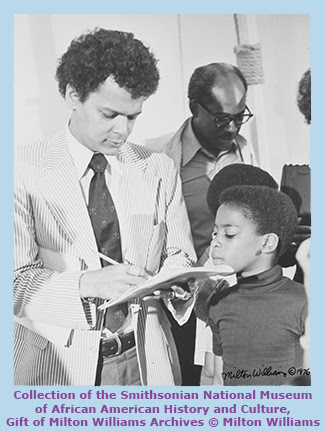
Horace Julian Bond


NMAAHC -- National Museum of African American History and Culture

“We are better people because he walked
among us for a while.”

 
Julian Bond

Julian Bond came of age during that critical time in this nation’s history when winning equal rights for all took a great deal: a clear head, a big heart, a razor-sharp intellect, and a way with words.

Julian Bond had it all. And he could wrap all of it up to create whatever was needed at the time – either a tool or a weapon, a poem or a sermon. He was driven by a commitment to make America better.

While a Morehouse-based member of Student Nonviolent Coordinating Committee (SNCC), helping to organize the Freedom Summer of 1964 and its massive voter registration drive in Mississippi, Julian Bond took to task the American public and President Lyndon B. Johnson.

“We have learned through bitter experience in the past three years that the judicial, legislative and executive bodies of Mississippi form a wall of absolute resistance to granting civil rights to Negroes. It is our conviction that only a massive effort by the country backed by the full power of the President can offer some hope for even minimal change in Mississippi.”

Those words came from a letter Julian Bond wrote on April 28, 1964 to one of America’s most inspiring writers, James Baldwin. He was writing to encourage Baldwin to join a “jury” to hear “testimony” about Civil Rights violations from African Americans facing discrimination in employment, housing, and voting rights in Mississippi. Under a plan designed by SNCC and other members of the Council of Federated Organizations, the testimony would be presented to the President so he would be moved to create a government-sanctioned way to protect the Freedom Summer workers.

“The President must be made to understand that this responsibility rests with him, and him alone, and that neither he nor the American people can afford to jeopardize the lives of the people who will be working in Mississippi this summer by failing to take the necessary precautions before the summer begins.”

Bond’s letter to Baldwin has entered the collections of the National Museum of African American History and Culture. It will be used alongside similar documents to show how people like Julian Bond helped design and fuel the Civil Rights Movement.

Bond was so committed to helping us tell that story well, that he became a member of the museum’s Civil Rights History Project advisory committee. In that role he helped us land interviews with some of the most important workers in the movement; he also conducted two of the more than 150 interviews for this oral history project. One was with Lawrence Guyot, the director of the 1964 Freedom Summer project in Hattiesburg, Mississippi.

Julian Bond wrote his letter to James Baldwin in 1964 at the age of 23. Less than three years later he would be awarded his seat in the Georgia House of Representatives by a unanimous decision of the U.S. Supreme Court. Four years after that, in 1971, he would become the founding president of the Southern Poverty Law Center. Nearly 30 years later, in 1998, he would take the helm of the NAACP serving as its national chairman for an astonishing 12 years.

Julian Bond has spent his life as a champion in the campaign for equality. Much of what we as a nation know about compassion and commitment, we have learned from Julian Bond, the people he emulated and the people he inspired. We are sad because he has left us. And we are deeply honored that we had him for as long as we did … to help us help America live up to her promises. We are better people because he walked among us for a while.

Thank you, Horace Julian Bond.

Lonnie_Signature.jpg
Lonnie G. Bunch
Founding Director
Smithsonian
National Museum of African American History and Culture

Civil Rights Activist Rosa Parks


All images

Rosa Parks
Born: February 4, 1913
Died: October 24, 2005
Age: 92 years old
Birthplace: Tuskegee, AL, United States
Occupation: Activist

Early Life & Family

Rosa Parks was born Rosa Louise McCauley on February 4, 1913, in Tuskegee, Alabama. After her parents, James and Leona McCauley, separated when Rosa was two, Rosa’s mother moved the family to Pine Level, Alabama to live with her parents, Rose and Sylvester Edwards. Both were former slaves and strong advocates for racial equality; the family lived on the Edwards’ farm, where Rosa would spend her youth. In one experience, Rosa’s grandfather stood in front of their house with a shotgun while Ku Klux Klan members marched down the street.

Childhood and Education

Rosa Parks’ childhood brought her early experiences with racial discrimination and activism for racial equality. Taught to read by her mother at a young age, Rosa attended a segregated, one-room school in Pine Level, Alabama, that often lacked adequate school supplies such as desks. African-American students were forced to walk to the 1st- through 6th-grade schoolhouse, while the city of Pine Level provided bus transportation as well as a new school building for white students.

Through the rest of Rosa’s education, she attended segregated schools in Montgomery, including the city’s Industrial School for Girls (beginning at age 11). In 1929, while in the 11th grade and attending a laboratory school for secondary education led by the Alabama State Teachers College for Negroes, Rosa left school to attend to both her sick grandmother and mother back in Pine Level. She never returned to her studies; instead, she got a job at a shirt factory in Montgomery.

In 1932, at age 19, Rosa met and married Raymond Parks, a barber and an active member of the National Association for the Advancement of Colored People. With Raymond’s support, Rosa earned her high school degree in 1933. She soon became actively involved in civil rights issues by joining the Montgomery chapter of the NAACP in 1943, serving as the chapter’s youth leader as well as secretary to NAACP President E.D. Nixon — a post she held until 1957.

Life After the Bus Boycott

Although she had become a symbol of the Civil Rights Movement, Rosa Parks suffered hardship in the months following her arrest in Montgomery and the subsequent boycott. She lost her department store job and her husband was fired after his boss forbade him to talk about his wife or their legal case. Unable to find work, they eventually left Montgomery; the couple, along with Rosa’s mother, moved to Detroit, Michigan. There, Rosa made a new life for herself, working as a secretary and receptionist in U.S. Representative John Conyer’s congressional office. She also served on the board of the Planned Parenthood Federation of America.

biography.com

70th anniversary of the death camp’s liberation


A Holocaust survivor stands outside a detention block of the Auschwitz Nazi death camp in Oswiecim, Poland, Tuesday, Jan. 27, 2015.
Some 300 Holocaust survivors traveled to Auschwitz for the 70th anniversary of the death camp’s liberation by the Soviet Red Army in 1945, down from 1,500 who attended the event 10 years ago.(AP Photo/Alik Keplicz)

time to make the dream come alive …


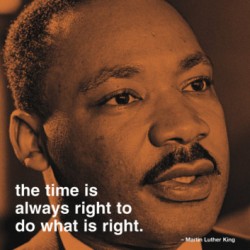
mLKjr

Born on 1/15/1929 ….

Inspired by the philosophy of non-violent protest, Martin Luther King Jr. led the American Civil Rights Movement and played a key role in the struggle for racial and economic equality. –
biography.com

 Martin Luther King Jr.

“People are dying for the right to speak freely, for a better life, human rights in all its forms”

No one speaks to life’s struggles better than

 – MLK jr.

“Human Progress is neither automatic nor inevitable even a superficial look at history reveals that no social advance rolls in on the wheels of inevitability. Every step toward the goal of justice requires sacrifice, suffering, and struggle; the tireless exertions and passionate concern of dedicated individuals without persistent effort, time itself becomes an ally of the insurgent and primitive forces of irrational emotionalism and social destruction.

“This is no time for apathy or complacency … This is a time for vigorous and positive action.”

– MLK Jr.