
Tag Archives: Dick Cheney



How You Can Tell When the Deficit is a Problem
A Lot More Important Than the Federal Deficit.
A few days ago, I was stuck in the car for a long drive. Because of the complete absence of progressive talk from Orlando’s airwaves, I had no real choice but to listen to the nasal maundering of Mark Levin on the radio. Levin was very upset about the federal deficit.
Interestingly, Levin was a high-level appointee in the Reagan Administration. Dick Cheney, who was Reagan’s Defense Secretary and later the Vice President, said 10 years ago that “Reagan proved deficits don’t matter.”
I must concede that it is rather difficult to reconcile the conflicting statements of these two gentlemen, Messrs. Levin and Cheney. Evidently, they believe deficits are a terrible tragedy when a Democrat is President, and a wonderful gift when a Republican is President.
There has got to be a more objective standard than that.
Here’s one: the federal deficit is a problem when long-term interest rates are high, and not much of a problem when long-term interest rates are low. The Federal Reserve dictates short-term interest rates, but long-term rates still are, pretty much, set by the market, in its usual ruthless fashion. (Which is why James Carville said that after he dies, he “want[s] to come back as the bond market. You can intimidate everybody.”)
When long-term interest rates are high, a federal deficit competes against and “crowds out” private borrowing and investment. When long-term interest rates are low, the federal deficit is not taking away from borrowing by the private sector. On the contrary, the federal deficit is acting as a needed boost to aggregate demand in the economy, an action also known as “fiscal policy.” When the economy is slack, every dollar of reduction in federal spending takes three or four dollars off of our gross national product.
So, by that test, where are we? Well, as I explained last week, long-term U.S. interest rates are at their lowest in history. So what does that tell you about the deficit?
Sorry – I didn’t mention that there was going to be a quiz.
When Ronald Reagan was President, long-term interest rates sometimes exceeded 15% – ten times as high as long-term interest rates today. The market was screaming at the top of its lungs that the Reagan deficit was too high. And today? Silence.
Look around the world. The ten-year note in Greece yields a little less than 30%. Pakistan, 13%. Portugal and Venezuela, 12%. In those countries, the bond market is shouting, “Cut that out!”
Not here.
Thanks to all the deficit-mongering by Mark Levin, Rush Limbaugh, Fox “News,” etc., a lot of Americans are scared by the federal deficit. The advice from Democratic pollsters is to go along with this hand-wringing. But there is an alternative: Explain to the American people when a federal deficit is bad, and when it is not.
Like I just did.
Courage,
Share this:

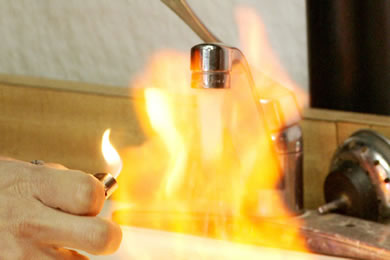
Your Water Might Be Flammable … CREDO
Did you know that oil and gas companies are allowed to pump secret, toxic fluids, through our drinking water – and the EPA is currently powerless to do anything about it?
High Pressure Hydraulic Fracturing (or fracking) is a method of drilling for natural gas by pumping a mixture of water and chemicals, including known toxics and carcinogens, deep underground, and it’s responsible for poisoning water in states across the country.
Fracking wells are spreading at an alarming rate. But even more alarming, thanks to the work of Dick Cheney and his infamous energy policy, frackers don’t have to disclose the chemicals used in their fluid to the EPA, and the process is totally exempt from regulation under the Safe Drinking Water Act.
The FRAC Act, a bill that has been in the Senate since 2009, would correct both these problems. As public concern over fracking has grown, the bill has gained some momentum, but we still need more senators actively working to pass it. Will you urge your senators to support the bill?
Tell your senators: Co-sponsor the FRAC Act to protect our water from dangerous fracking.
Fracking a single gas well uses as much as millions of gallons of water, and hundreds of tons of chemicals. While the exact contents of the fluid remains largely undisclosed, scientific examination reveals that it can contain diesel fuel, which includes benzene, as well as dozens of chemicals including methanol, formaldehyde and hydrochloric acid.
The fluid is injected thousands of feet underground at extremely high pressure, literally cracking the rock to release trapped gas. Unfortunately, it must pass through our water table, where the fluids, along with methane gas, can leak through well casings into our drinking water.
If you’ve ever seen the picture of the man lighting his tap water on fire from the recent documentary Gasland, that was because of nearby fracking.
Yet somehow, the EPA has been handcuffed from regulating fracking to keep our water clean since 2005, in what has become known as “the Halliburton loophole.” Halliburton, where Dick Cheney was CEO before becoming Vice President, patented fracking in the 1940’s and remains the third largest producer of fracking fluids. And in trademark Bush administration style, Halliburton staff were actively involved in a 2004 EPA report on fracking safety.
The “Halliburton loophole” remains a dangerous legacy of the Bush Administration and if we’re going to protect our water, we need to close it.
Tell your senators: Co-sponsor the FRAC Act to protect our water from dangerous fracking. http://us.greenpeace.org/site/R?i=eowykN6lXhtd7eIVIF3Kdw..
The oil and gas industry is the only industry in America that is allowed by EPA to inject known hazardous materials — unchecked — directly into or adjacent to underground drinking water supplies.
Thanks in no small part to the continued resistance of industry to disclose the poisons involved in fracking, the risks of this practice are only beginning to be realized. However, an important investigative series by the New York Times recently concluded that “the dangers to the environment and health are greater than previously understood.”
In addition to below ground leaks, fracking also poses serious threats to our rivers and streams from insufficiently treated, and often radioactive, waste water. What’s more, above ground spills of toxic fracking fluids are becoming increasingly common. A large spill this April in Pennsylvania dumped thousands of gallons into fields and streams, eerily, on the one year anniversary of the Deep Water Horizon oil spill.
Fracking is currently underway in 36 states. And while some state regulations do exist, they vary widely. But water contamination isn’t constrained by state boundaries, and we need a baseline national standard to make sure fracking chemicals are publicly disclosed, and to prevent this practice from putting our nation’s drinking water at risk.
Tell your senators: Co-sponsor the FRAC Act to protect our water from dangerous fracking.http://us.greenpeace.org/site/R?i=eowykN6lXhtd7eIVIF3Kdw..
Thanks for fighting the unchecked oil and gas influence threatening our water.
Elijah Zarlin, Campaign Manager
CREDO Action from Working Assets
1. Fracking,” Food and Water Watch.
2. Hydraulic Fracturing 101,” EARTHWORKS.
3. Burning Tap Water and More: GASLAND Exposes the Natural Gas Industry,” Treehugger, June 25, 2010.
4. Regulation Lax as Gas Wells‘ Tainted Water Hits Rivers,” New York Times, February 26, 2011
Share this:

Stop Fracking Now
I bet you’re wondering what the heck “fracking” is. That’s a good question.
Hydraulic fracturing, also known as fracking, is a controversial drilling technique used by the oil and gas industry that has injected millions of tons of highly toxic chemical fluids into the ground to break apart shale and release natural gas.
Scientists believe these chemicals are poisoning America’s drinking water.
That didn’t stop Vice President Dick Cheney from exempting fracking from the Safe Water Drinking Act in the 2005 Energy Bill or the natural gas industry from unleashing a massive 34-state drilling campaign.
Now, six years later, with the facts stacking up showing the damage being caused and the American lives being placed at risk, a few members of Congress are standing up to close the loophole and hold the oil and gas production industry to the same standards as any other industry to ensure the safe protection of America’s drinking water.
But they’ll need our help to win. Join us in calling on Congress to pass the FRAC Act now.
Representatives Diana DeGette, Jared Polis, and Maurice Hinchey have introduced the Fracturing Responsibility and Awareness of Chemicals Act in the U.S. House while Senators Bob Casey and Chuck Schumer have introduced the companion bill in the U.S. Senate.
In the past, the oil and gas industry has spent millions of dollars fighting against these common-sense regulations and have succeeded in defeating similar bills. This time, we’re not going to let Congress fight the industry alone.
That’s why Democracy for America is building a coalition of grassroots activists and environmental organizations to work together with leaders in Congress to pass the FRAC Act this year.
We’ll educate the public, expose scientific studies that reveal the real risks, hold rallies, meetings, public forums, and organize grassroots action until we win.
Please add your name and join the campaign to protect America’s drinking water right now.
It’s been reported that since 1999 more than 90 percent of the natural gas wells have used the fracking process. Because of the Safe Water Drinking Act exemption, industry is not required to reveal the exact chemicals used in fracking, but researchers in independent scientific studies suspect 65 percent of the compounds used in fracking are hazardous to human health.
It only takes low concentrations of benzene and diesel fuel, two compounds found in fracking studies, to lead to severe health and environmental consequences and illnesses traced to fracking have been documented in Ohio, Pennsylvania, Arkansas, Colorado, Wyoming, and Alabama.
As if that wasn’t enough to demand proper regulation and environmental oversight, a recent New York Times article revealed that the inability to properly process wastewater from fracking, may even be allowing radioactive materials into local rivers, streams, and drinking water.
The oil and gas industry is too big and too powerful for us to let members of Congress take them on alone. It’s up to us to stand with them, fight back, and make sure they have the support they’ll need to win.
Join the campaign at www.StopFrackingNow.com today.
Thank you for everything you do.
-Jim
Jim Dean, Chair
Democracy for America
Share this:


Nigeria to Charge Dick Cheney in Pipeline Bribery Case
Dec. 1 (Bloomberg) — Nigeria will file charges against former U.S. Vice President Dick Cheney and officials from five foreign companies including Halliburton Co. over a $180 million bribery scandal, a prosecutor at the anti-graft agency said.
Full report here: http://bit.ly/f8JJos
More info here: http://halliburtonwatch.org/about_hal/nigeria_timeline.html

 Be a Seed for Change
You must be logged in to post a comment.