Tag Archives: Ethnicity

MLK jr. speech 5/17/1957 ~ Give Us the Ballot ~ In Memory


“Give Us the Ballot, We Will Transform the South”

giveustheballot

by Martin Luther King, Jr.
Speech given before the Lincoln Memorial at the March on Washington, May 17, 1957

Three years ago the Supreme Court of this nation rendered in simple, eloquent and unequivocal language a decision which will long be stenciled on the mental sheets of succeeding generations. For all men of good will, this May 17 decision came as a joyous daybreak to end the long night of segregation. It came as a great beacon light of hope to millions of distinguished people throughout the world who had dared only to dream of freedom. It came as a legal and sociological deathblow to the old Plessy doctrine of “separate-but-equal.” It came as a reaffirmation of the good old American doctrine of freedom and equality for all people.

Unfortunately, this noble and sublime decision has not gone without opposition. This opposition has often risen to ominous proportions. Many states have risen up in open defiance. The legislative halls of the South ring loud with such words as “interposition” and “nullification.” Methods of defiance range from crippling economic reprisals to the tragic reign of violence and terror. All of these forces have conjoined to make for massive resistance.

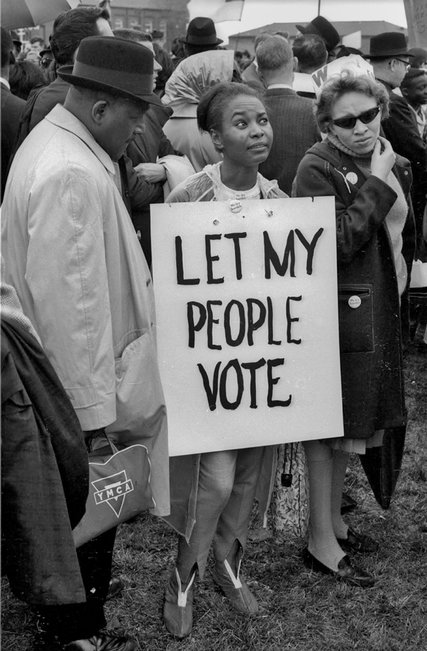
But, even more, all types of conniving methods are still being used to prevent Negroes from becoming registered voters. The denial of this sacred right is a tragic betrayal of the highest mandates of our democratic traditions and its is democracy turned upside down.

So long as I do not firmly and irrevocably possess the right to vote I do not possess myself. I cannot make up my mind — it is made up for me. I cannot live as a democratic citizen, observing the laws I have helped to enact — I can only submit to the edict of others.

So our most urgent request to the president of the United States and every member of Congress is to give us the right to vote. Give us the ballot and we will no longer have to worry the federal government about our basic rights. Give us the ballot and we will no longer plead to the federal government for passage of an anti-lynching law; we will by the power of our vote write the law on the statute books of the southern states and bring an end to the dastardly acts of the hooded perpetrators of violence. Give us the ballot and we will transform the salient misdeeds of blood-thirsty mobs into calculated good deeds of orderly citizens. Give us the ballot and we will fill our legislative halls with men of good will, and send to the sacred halls of Congressmen who will not sign a Southern Manifesto, because of their devotion to the manifesto of justice. Give us the ballot and we will place judges on the benches of the South who will “do justly and love mercy,” and we will place at the head of the southern states governors who have felt not only the tang of the human, but the glow of the divine. Give us the ballot and we will quietly and nonviolently, without rancor or bitterness, implement the Supreme Court’s decision of May 17, 1954.

<!–Read about recent allegations of voter disenfranchisement in Florida
and other states across the country in these articles.

17

–>

Learn more about Martin Luther King, Jr. and read more of his speeches and writings at The Martin Luther King, Jr. Papers Project at Stanford University.

Resources: pbs.org

Celebrate black history all year round ~~ repost


naacp

Black History Month may be over, but, we can celebrate the stories that make up our history throughout the year.
We are making history every day thanks to the men and women who serve our communities all over the country, fighting for justice and equality.
The NAACP’s commitment to those who move black history forward has been unbroken for more than a century. Let’s continue that commitment together. Become a member of the NAACP. Support our work and join us in making new stories—American stories.

Join today!Every time a new voter is registered, or we march in unison to a state capitol, lifting our voices for those who can’t, or fight to end a “Stand Your Ground” law, we are creating black history—American history. Not every hero is as well known as W. E. B. DuBois, Harriet Tubman, or Rosa Parks, but this in no way diminishes the measure of these accomplishments and contributions.
NAACP members stand behind these champions by fighting for the things that matter to all of us. When we work to ensure every person has the right to vote, when we demand an end to racial profiling, when we help to ensure folks have access to health insurance, when we fight for better education and an end to economic inequality, it amplifies the work being done by our unsung heroes every day. We all know that black history is more than one month of note—we stand tall throughout the year. Stand with us. Join us in making history. Become an NAACP member today:

http://action.naacp.org/history-year-round
Thank you for making history with us,
Lorraine C. Miller Interim President and CEO

Selling Artifacts – In Memory


Talk about poppin’ tags.

Goodwill offers up African artifacts for sale

Posted on November 19, 2013 | By
Goodwill African artifacts
antique-african-art
Some of the artifacts for sale

Goodwill in Tacoma is beginning to sell African artifacts valued at more than $11,000.

The 55 artifacts, from the mid-19th to mid-20th century, were used in tribal life and for tribal ceremonies. An anonymous donor left the 55 artifacts at the Port Townsend Goodwill store last month.

The items will be sold online at Shopgoodwill.com, a site used to produce the highest prices for items. The site uses competitive bidding to sell high-end fashion, jewelry, art and other items.

Go to the search portion of the site, pick Tacoma in the drop-down menu of sellers, then search for the items.

Goodwill wants the public to know about the online sales. Officials figure if people know valuable goods can fetch a good price, they might be more willing to donate.

“Many people hesitate to donate their high-end furniture, jewelry, clothing, art and collectibles because they assume their treasures will end up for $4 in our thrift stores,” said Dylan Lipert, manager of online sales, in a news release. “My job is to make sure that doesn’t happen.”

(The gallery above shows some of the artifacts, as well as other items that have or will be sold online.)

More than 140 Goodwill agencies provide items for sale online. In the past six years, Tacoma online operations have more than doubled in size and sales from $2.1 million in FY 2008 to $4.5 million in FY 2013.

**************************************************

Century-old Native American artifact dropped off at Goodwill

                  By                                        Published:  Jan 30, 2013 at 4:01 PM PST Last Updated: Apr 26, 2013 at 12:40 PM PST
Century-old Native American artifact dropped off at Goodwill
»Play Video          
SEATTLE — Someone recently donated an old vest

SEATTLE — Someone recently donated an old vest to Goodwill, and while that could happen everyday, this one was unusual.

By old, we mean a century old. It’s a beaded Native American vest that’s so valuable, Goodwill couldn’t bear to sell it.

Instead, the non-profit decided to make its own donation. Now, curators from the Burke Museum are analyzing the vest.

It’s an exquisitely detailed piece from the early 1900s. Everything from the color of the beads to the geometric designs to the velvet lining is a clue pointing to the vest’s history.

“Whoever gave it to Goodwill probably knew more about it. They probably knew their grandfather got it while on a train ride through Glacier. That’s the kind of information we’d love to have,” said Robin Wright, Curator of Native American Art.

The vest was inside a trunk, donated to Goodwill in 2006. Someone recognized its value, and instead of going up for sale, the vest went into storage.

Katherine Boury of Goodwill explained, “We have to make the decision, what’s the best use of the donation. In this case because it’s of cultural significance, it seems it would be best to be accessible to everyone.”

Assessors pinpointed it as Native American work from the northern plains.

“There’s been some discussion with various experts about which particular tribe and we’re not able to say precisely which tribe it might be,” said Wright.

It might have been regalia for a pow wow, but at some point, it seems it was sold to a tourist.

Written on the lining – a price tag of $18 – for a vest that probably took several months to make. There is no price on the vest now, and while there are still questions about where it came from, there’s no question where it’s going.

The museum will keep the vest in its collection for the public to see and treasure.

Do you think you have an artifact in your home? Take up to three objects to the annual Artifact ID Day at the Burke on Feb. 9.

********************************************************

Buyer Will Return Hopi

Face it, says auctioneer, not every mask is sacred

theage.com.au – 10 months ago
Seventy masks revered as sacred by an American Indian tribe have been auctioned in Paris, despite a court attempt to stop the sale.
 

Hopi masks snapped up after French court allows auction

msnbc.msn.com – 10 months ago
The Hopi tribe of northeastern Arizona and supporters including the U.S. ambassador to France and actor Robert Redford had urged the Paris auction house to suspend the sale due to the masks’ cultural
 

Hopi masks auctioned in Paris amid outrage and legal objections

latimes.com – 10 months ago
The gavel came down on 70 sacred Hopi Indian masks at the Drouot auction house in Paris on Friday, generating $1.2 million for the owners and auctioneers – and anger and emotional cries from

wonder if there are updates on any of these stories and hopefully progress on stopping this from happening… return them to their place of origin

Heritage Month … Asian-Pacific American


May is Asian-Pacific American Heritage Month.

The month-long observance was officially designated in 1992 and the month of May was chosen to commemorate the first Japanese immigrants to the U.S. on May 7, 1843 and to recognize the Chinese immigrants who helped lay tracks for the transcontinental railroad, which was completed on May 10, 1869.

Visit asianpacificheritage.gov to learn more about the contributions of Asians and Pacific Islanders in the United States.

a repost

and some just say #AsianAmericanHeritage

Cherokee Freedmen Facts – by Marilyn Vann – Black History


Cherokee Freedmen Facts – by Marilyn Vann – President – Descendants of Freedmen

www.freedmen5tribes.com

1) Who are Cherokee freedmen and their descendants?
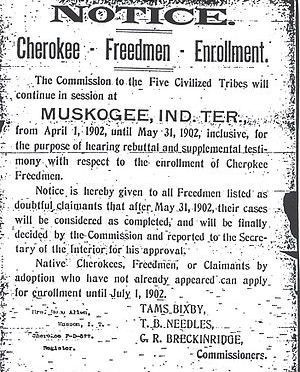
Cherokee freedmen are people of African descent who have rights to Cherokee citizenship since 1866 (and in some cases
prior) based under a treaty between the US government and the Cherokee nation, the amended 1839 constitution and the
present 1976 constitution. The freedmen were either former slaves of the Cherokees or were free mixed black Cherokees who
generally did not have citizenship rights prior to 1866.

******
2) Who has the right to Cherokee citizenship now?
All persons who were listed on the Dawes Rolls and their descendants, during the early 1900s have the right to Cherokee
citizenship based on the 1976 constitution. The Dawes rolls of the Cherokee nation have several sections – Delaware,
Cherokee by blood, Cherokee Freedmen, etc.

******
3) Didn’t the Freedmen lose their tribal membership and voting rights for a few years?
In 1983, the freedmen people were voting against Chief Swimmer, the registrar sent out letters canceling their tribal
membership cards and the freedmen were blocked from voting at the polls. In 1988, under Chief Mankiller, the tribal council
approved the registration policy of requiring all tribal members to have a CDIB card to keep tribal membership. A tribal
court in 2006 ruled that the tribal council could not pass additional requirements to bar any segment of Dawes enrollees from
receiving tribal membership cards or voting.

******
4) If most of the freedmen have Cherokee blood, why cant they get a cdib card?
The current BIA policy is to only give the card based on the blood degree listed on the Dawes Rolls. The Dawes
Commissioners had the sole authority to place people on any part of the Dawes rolls they wanted to. Because Congress had
decided that people listed as Freedmen would have unrestricted allotments, Commissioners were encouraged to list as many
people as possible as Freedmen with no blood degrees listed rather than as Cherokees with blood degrees even if the person
was listed on previous rolls as blood Cherokee or received payments earlier from the US government as a Cherokee by
blood. An example was Perry Ross who had a Cherokee mother and black father. Perry Ross, was listed on the 1852 Drennan
Roll proving Cherokee by blood, received a 1908 Guion Miller payment for having Cherokee blood, but yet was listed as a
freedmen citizen on the Dawes Rolls. Some Freedmen did get CDIB cards in the past based on other records, but they
stopped giving them out. The tribe never kept degrees of blood records and anything on the Dawes Roll is just guesswork so
far as a true degree of blood. To determine blood degrees for freedmen one must look at Dawes testimony and other records.

******
5) Chief Smith and Councilman Jackie Bob Martin have called for a special election to see if the freedmen people
should keep their tribal membership rights. What’s wrong with that?
Whats right about it? There something wrong about trying to take away the rights of people who have had them for more than
100 years. The court held that the people had been wronged, and now, instead of accepting that, these people are to be more
wronged? Would you not fight a president who wanted to put the US citizenship rights of Cherokee people on a ballot to the
people? Whose next to lose rights? Also, the people who are being asked to vote on the freedmen citizenship rights are not
being told that the freedmen have had rights since at least 1866, have served on the tribal council, generally have Cherokee
blood, and voted between 1971 and 1983 (between 1907 and 1971 there were no elections at all). When did Cherokee people
ever kick people out of the tribe? And why kick out only freedmen who came before Delaware and Shawnee – all 3 have
treaty rights to citizenship? Does anyone sitting here wonder if the movement to kick out the freedmen is fear that they may
not vote for some people now serving in office? Hardly any freedmen will be able to vote in such election because of the
slow process to register tribal members and even freedmen people with old 1970s membership cards must reregister. Is this
justice? Is it right for Cherokee leaders to break the promises made to these people by previous chiefs such as Lewis
Downing and WP Ross – just as the whites have broken their word to the Cherokee people time after time? What if the white
people say, if the Cherokees can break their treaty at will, we will do so too and demand back the Arkansas Riverbed money?

******
6) Won’t the freedmen take away from the rest of the Cherokees so far as benefits?
The Chief and the tribal council can request additional funds from the US government and supposedly are working hard on
economic development. Stop and think – Would you want your US citizenship rights to be taken away because white people
don’t want you to have rental assistance or such the same as them? Freedmen wont cancel medical insurance to go to I H S.

******

7) Did Freedmen get the same rights as Cherokees by blood previously?
Yes, all citizens including freedmen received 110 acres of tribal land equivalent when tribal lands were allotted, they received
the 1912 payroll, and the per capita payment given out in 1962. Freedmen held office between 1866 and 1907 – One
freedman Frank Vann even served with Redbird Smith on the council. Another freedmen councilman was Stick Ross.