Tag Archives: Ethnicity

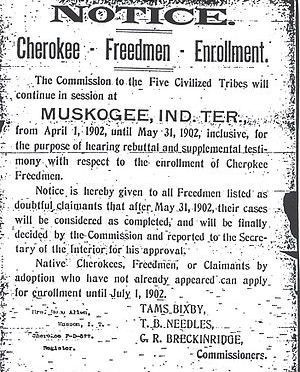
Cherokee Freedmen Facts – by Marilyn Vann – Black History


Cherokee Freedmen Facts – by Marilyn Vann – President – Descendants of Freedmen

www.freedmen5tribes.com

1) Who are Cherokee freedmen and their descendants?
Cherokee freedmen are people of African descent who have rights to Cherokee citizenship since 1866 (and in some cases
prior) based under a treaty between the US government and the Cherokee nation, the amended 1839 constitution and the
present 1976 constitution. The freedmen were either former slaves of the Cherokees or were free mixed black Cherokees who
generally did not have citizenship rights prior to 1866.

******
2) Who has the right to Cherokee citizenship now?
All persons who were listed on the Dawes Rolls and their descendants, during the early 1900s have the right to Cherokee
citizenship based on the 1976 constitution. The Dawes rolls of the Cherokee nation have several sections – Delaware,
Cherokee by blood, Cherokee Freedmen, etc.

******
3) Didn’t the Freedmen lose their tribal membership and voting rights for a few years?
In 1983, the freedmen people were voting against Chief Swimmer, the registrar sent out letters canceling their tribal
membership cards and the freedmen were blocked from voting at the polls. In 1988, under Chief Mankiller, the tribal council
approved the registration policy of requiring all tribal members to have a CDIB card to keep tribal membership. A tribal
court in 2006 ruled that the tribal council could not pass additional requirements to bar any segment of Dawes enrollees from
receiving tribal membership cards or voting.

******
4) If most of the freedmen have Cherokee blood, why cant they get a cdib card?
The current BIA policy is to only give the card based on the blood degree listed on the Dawes Rolls. The Dawes
Commissioners had the sole authority to place people on any part of the Dawes rolls they wanted to. Because Congress had
decided that people listed as Freedmen would have unrestricted allotments, Commissioners were encouraged to list as many
people as possible as Freedmen with no blood degrees listed rather than as Cherokees with blood degrees even if the person
was listed on previous rolls as blood Cherokee or received payments earlier from the US government as a Cherokee by
blood. An example was Perry Ross who had a Cherokee mother and black father. Perry Ross, was listed on the 1852 Drennan
Roll proving Cherokee by blood, received a 1908 Guion Miller payment for having Cherokee blood, but yet was listed as a
freedmen citizen on the Dawes Rolls. Some Freedmen did get CDIB cards in the past based on other records, but they
stopped giving them out. The tribe never kept degrees of blood records and anything on the Dawes Roll is just guesswork so
far as a true degree of blood. To determine blood degrees for freedmen one must look at Dawes testimony and other records.

******
5) Chief Smith and Councilman Jackie Bob Martin have called for a special election to see if the freedmen people
should keep their tribal membership rights. What’s wrong with that?
Whats right about it? There something wrong about trying to take away the rights of people who have had them for more than
100 years. The court held that the people had been wronged, and now, instead of accepting that, these people are to be more
wronged? Would you not fight a president who wanted to put the US citizenship rights of Cherokee people on a ballot to the
people? Whose next to lose rights? Also, the people who are being asked to vote on the freedmen citizenship rights are not
being told that the freedmen have had rights since at least 1866, have served on the tribal council, generally have Cherokee
blood, and voted between 1971 and 1983 (between 1907 and 1971 there were no elections at all). When did Cherokee people
ever kick people out of the tribe? And why kick out only freedmen who came before Delaware and Shawnee – all 3 have
treaty rights to citizenship? Does anyone sitting here wonder if the movement to kick out the freedmen is fear that they may
not vote for some people now serving in office? Hardly any freedmen will be able to vote in such election because of the
slow process to register tribal members and even freedmen people with old 1970s membership cards must reregister. Is this
justice? Is it right for Cherokee leaders to break the promises made to these people by previous chiefs such as Lewis
Downing and WP Ross – just as the whites have broken their word to the Cherokee people time after time? What if the white
people say, if the Cherokees can break their treaty at will, we will do so too and demand back the Arkansas Riverbed money?

******
6) Won’t the freedmen take away from the rest of the Cherokees so far as benefits?
The Chief and the tribal council can request additional funds from the US government and supposedly are working hard on
economic development. Stop and think – Would you want your US citizenship rights to be taken away because white people
don’t want you to have rental assistance or such the same as them? Freedmen wont cancel medical insurance to go to I H S.

******

7) Did Freedmen get the same rights as Cherokees by blood previously?
Yes, all citizens including freedmen received 110 acres of tribal land equivalent when tribal lands were allotted, they received
the 1912 payroll, and the per capita payment given out in 1962. Freedmen held office between 1866 and 1907 – One
freedman Frank Vann even served with Redbird Smith on the council. Another freedmen councilman was Stick Ross.

WHITE ON WHITE CRIME IN WACO TEXAS MOTORCYCLE MASSACRE! (ARTICLE )


Our-Truth Media's avatarOUR✊🏿TRUTH

image

BY : LEON KWASI KUNTUO-ASARE

In another tragic case of white on white violent crime, on sunday afternoon May 17, 2015 several white supremacist motorcycle gangs got into a shot out. There were at least five gang factions involved and 9 people were murdered while 18 were injured as a result of the guns, chains, clubs and knives used in the Waco, Texas motorcycle gang melee.
When police arrived they set up a command center to interview , arrest and process the biker thugs involved in the mini massacre. Fortunately for the murderous gang members, unlike the Baltimore and Ferguson protestors, who killed no one, the national guard was not called and Waco was not occupied like Iraq, even though there were over a 100 weapons recovered .

For additional information use the link:

http://www.cnn.com/2015/05/17/us/texas-shooting/

View original post

Patricia Robert Harris ~ Women’s History Month


National Museum of African American History and Culture
Lonnie Bunch, museum director, historian, lecturer, and author, is proud to present A Page From Our American Story, a regular on-line series for Museum supporters. It will showcase individuals and events in the African American experience, placing these stories in the context of a larger story — our American story.
A Page From Our American Story
A Higher Standard: Patricia Roberts Harris
Patricia Roberts Harris sworn in as US Ambassador to Luxembourg
Patricia Harris in her swearing in ceremony
to be the U.S. Ambassador to Luxembourg.
Provided by the U.S. State Department.

Black women have always served a critical role in the African American community, from the names we all know — Harriet Tubman, Sojourner Truth, and Rosa Parks — to today’s young mother fighting for educational opportunities for her children. Others have quietly broken barriers to open doors that were once closed to people of color.

Patricia Roberts Harris is one of those quiet warriors whose life stands as a testament to excellence, tenacity, and commitment to change.

She was born on May 31, 1924, the daughter of Hildren and Bert Roberts, in Mattoon, Illinois. A product of Illinois public schools, Harris attended Howard University in Washington, D.C., on scholarship and graduated summa cum laude in 1945. From early in her life as a brilliant scholar at Howard, she went on to become the first African American woman to serve as a United States ambassador and later the first African American woman to serve as a Cabinet Secretary. Harris was a powerful influence in American politics and a major figure during the Civil Rights Movement.

After graduation from Howard, she went back to the mid-west and began graduate work at the University of Chicago in 1946. But the opportunity to become actively involved in working for social justice drew her back to Washington, D.C. She continued her graduate work at American University, and, at the same time, served as assistant director for the American Council of Human Rights. She also served as the first national executive director of Delta Sigma Theta Sorority, Inc., of which she was a member.

At the encouragement of her husband, William Beasley Harris, a prominent attorney in the District, Harris enrolled in The George Washington University Law School, where she graduated in 1960, first in her class.

During this time, while still active in the fight for civil rights, Harris became increasingly involved in the Democratic Party. Her ability to organize and manage did not go unnoticed. In 1963, President John F. Kennedy selected Harris to co-chair the National Women’s Committee for Civil Rights, described as an “umbrella organization encompassing some 100 women’s groups throughout the nation.”

In October of 1965, President Lyndon Johnson appointed Harris ambassador to Luxembourg, making her the first African American woman to be chosen as a United States envoy. For Harris the historic moment was bittersweet, saying, “I feel deeply proud and grateful this President chose me to knock down this barrier, but also a little sad about being the ‘first Negro woman’ because it implies we were not considered before.”

With the change of administration in 1968, Harris’ diplomatic role ended. She returned to Washington, D.C., and became the first woman to serve as Dean of Howard University’s School of Law.

In the early 1970s, Harris’ involvement in the Democratic Party culminated in her being named chairman of the powerful credentials committee and an at-large-delegate to the Democratic National Convention.

The election of Jimmy Carter in 1976 thrust Harris into the spotlight, again for another “first.” Shortly after taking office in 1977, Carter selected Harris to become Secretary of Housing and Urban Development (HUD). Again Harris made history, this time by not only becoming the first African American woman to become a Cabinet Secretary, but also the first to be in the line of succession to the Presidency, at number 13.

During her confirmation hearing, Senator William Proxmire challenged her nomination and asked her if she felt capable of representing the interests of the poor and less fortunate in America. By this time in Harris’ life she had established herself as not only a recognized leader for civil rights, but also as a prominent corporate lawyer and businesswoman. Some, including a few black leaders, wondered if Harris had grown out of touch with the very people she was charged with serving.

Harris’ answer silenced her critics and perhaps best explains what motivated her throughout her life:

“Senator, I am one of them. You do not seem to understand who I am. I am a black woman, the daughter of a dining car waiter. …a black woman who could not buy a house eight years ago in parts of the District of Columbia. I didn’t start out as a member of a prestigious law firm, but as a woman who needed a scholarship to go to school. If you think I have forgotten that, you are wrong…if my life has any meaning at all, it is that those who start out as outcasts may end up being part of the system.”


US Postal Stamp of Patricia Roberts Harris

During her tenure as HUD Secretary, she helped reshape the focus of the department. A staunch supporter of housing rehabilitation, Harris funneled millions of dollars into upgrading deteriorating neighborhoods rather than wiping them out through slum clearance. She developed a Neighborhood Strategy Program that subsidized the renovation of apartments in deteriorated areas. In addition, she expanded the Urban Homesteading Plan and initiated Urban Development Action Grants to lure businesses into blighted areas. She poured millions of dollars into renovating deteriorating housing projects throughout the nation.

Harris was so effective in her post, that when HUD was split to create two new entities — the Department of Education and the Department of Health and Human Services (HHS) — Carter moved quickly to name Harris secretary of HHS, a position she held for the remainder of his administration.

In 1982, following an unsuccessful bid to become mayor of Washington, D.C., Harris became a full-time professor at The George Washington University National Law Center. She passed away on March 23, 1985 at the age of 60.

In January, 2000, the U.S. Postal Service honored Ms. Harris with a commemorative postage stamp bearing her likeness. Dignitaries from around the nation attended the unveiling ceremony at Howard University, her alma mater, to pay tribute and recognize her contribution to the nation. In addition, Howard created the Harris Public Service Program in her honor to augment its course offerings in public policy and to encourage students to consider careers in public service.

Patricia Roberts Harris’ life is a powerful chapter in our American story. “I am one of them…,” she said at her 1977 hearing to become HUD Secretary. Those words underscored her commitment to social justice and her sense of responsibility to the African American community and to the nation. Those words serve as testament to her life and legacy: political pioneer, successful businesswoman, educator, and champion for civil and equal rights.

All the best,
Lonnie Bunch, Director

Lonnie Bunch
Director
The National Museum of African American History and Culture is the newest member of the Smithsonian Institution’s family of extraordinary museums.

The Museum will be far more than a collection of objects.
The Museum will be a powerful, positive force in the national discussion about race and the important role African Americans have played in the American story — a museum that will make all Americans proud.

Black History Month …a repost


by on Feb 9, 2012 still rings true

African American History Month honors the rich legacy of African Americans throughout our nation’s history. This year’s theme recognizes the unique contributions of African American women. February 9, 2012.

FDR had something to say about voting


votingFranklin D. Roosevelt once said

“Nobody will ever deprive the American people of the right to vote except the American people themselves and the only way they could do this is by not voting.”