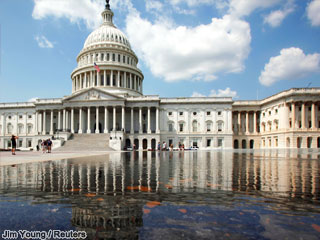
the Senate Convenes: 9:30amET May 17, 2012
- Following the prayer and the pledge, the Majority Leader will be recognized.
- It is the Majority Leader’s intention to begin consideration of the motion to proceed Calendar #400, S.3187, the FDA user fees bill with the time until 10:30am equally divided and controlled between the two Leaders or their designees with the Republicans controlling the first half and the Majority controlling the final half.
- At 10:30am, the Senate will proceed to Executive Session to consider the following items:
- Executive Calendar #646, Jeremy C. Stein, of Massachusetts, to be a Member of the Board of Governors of the Federal Reserve System for the unexpired term of fourteen years from February 1, 2004 and
- Executive Calendar #647, Jerome H. Powell, of Maryland, to be a Member of Board of Governors of the Federal Reserve System for the unexpired term of fourteen years from February 1, 2000
- with up to 90 minutes of debate on the nominations equally divided and controlled between Senators Johnson (SD) and Shelby or their designees.
- Upon the use or yielding back of time (at approximately 12:00pm), the Senate will vote on confirmation of the nominations in the order listed above. Each nomination will require 60-votes in the affirmative.
11:07am The Senate is considering the motion to proceed to S.3187, A bill to amend the Federal Food, Drug, and Cosmetic Act to revise and extend the user-fee programs for prescription drugs and medical devices, to establish user-fee programs for generic drugs and biosimilars, and for other purposes.
11:07am At 10:30am, the Senate will proceed to Executive Session with 90 minutes for debate prior to votes on confirmation of the following nominations:
– Executive Calendar #646, Jeremy C. Stein, of Massachusetts, to be a Member of the Board of Governors of the Federal Reserve System for the unexpired term of fourteen years from February 1, 2004; and
– Executive Calendar #647, Jerome H. Powell, of Maryland, to be a Member of Board of Governors of the Federal Reserve System for the unexpired term of fourteen years from February 1, 2000.
If all time is used, these votes will begin at approximately 12:00 noon today. Both nominations are subject to 60 vote thresholds.
The time until 10:30am is equally divided and controlled between the two Leaders or their designees, with the Republicans controlling the first half and the Majority controlling the second half.
The Senate is considering the motion to proceed to S.3187, A bill to amend the Federal Food, Drug, and Cosmetic Act to revise and extend the user-fee programs for prescription drugs and medical devices, to establish user-fee programs for generic drugs and biosimilars, and for other purposes.
The time until 10:30am is equally divided and controlled between the two Leaders or their designees, with the Republicans controlling the first half and the Majority controlling the second half.
At 10:30am, the Senate will proceed to Executive Session with 90 minutes for debate prior to votes on confirmation of the following nominations:
12:01pm The Senate began a roll call vote on confirmation of Executive Calendar #646 the nomination of Jeremy C. Stein, of MA, to be a Member of the Board of Governors of the Federal Reserve System; Confirmed: 70-24
12:28pm The Senate began a roll call vote on Executive Calendar #647, the nomination of Jerome H. Powell, of MD, to be a Member of the Board of Governors of the Federal Reserve System; Confirmed: 74-21
Senator Reid filed cloture on the nomination of Paul J. Watford, of California, to be United State District Judge for the 9th Circuit. Senators should expect the cloture vote at approximately 5:30pm on Monday, May, 21.
Senator Reid also filed cloture on the motion to proceed to Legislative Calendar #400, S.3187, the FDA Safety and Innovation Act.
Senator Reid asked unanimous consent to take up and pass H.R.1905, as amended by the text of the Reid-Johnson (SD)-Shelby amendment, which is the text of S.2101, and the Reid-Johnson (SD)-Shelby amendment.
Senator Kyl objected.
There will be no further roll call votes during Thursday’s session of the Senate
WRAP UP
ROLL CALL VOTES
1) Confirmation of Executive Calendar #646 the nomination of Jeremy C. Stein, of MA, to be a Member of the Board of Governors of the Federal Reserve System; Confirmed: 70-24
2) Confirmation of Executive Calendar #647, the nomination of Jerome H. Powell, of MD, to be a Member of the Board of Governors of the Federal Reserve System; Confirmed: 74-21
LEGISLATIVE ITEMS
Passed Calendar #401, H.R.2415, To designate the facility of the United States Postal Service located at 11 Dock Street in Pittston, Pennsylvania, as the “Trooper Joshua D. Miller Post Office Building”.
Passed Calendar #402, H.R.3220, To designate the facility of the United States Postal Service located at 170 Evergreen Square SW in Pine City, Minnesota, as the “Master Sergeant Daniel L. Fedder Post Office”.
Passed Calendar #403, H.R.3413, To designate the facility of the United States Postal Service located at 1449 West Avenue in Bronx, New York, as the “Private Isaac T. Cortes Post Office”.
Passed H.R.4045, a bill to modify the Department of Defense Program Guidance relating to the award of Post-Deployment/Mobilization Respite Absence (PDMRA program) administrative absence days to members of the reserve components to exempt any member whose qualified mobilization commenced before October 1, 2011, and continued on or after that date, from the changes to the program guidance that took effect on that date.
Passed H.R.4119, the Border Tunnel Prevention Act.
Passed H.R.4849, Sequoia and Kings County National Parks Backcountry Access Act with a Boxer-Feinstein substitute amendment.
No EXECUTIVE ITEMS
The Senate is back on 5/21
———————————————————————————————————–
CURRENT HOUSE FLOOR PROCEEDINGS
LEGISLATIVE DAY OF MAY 17, 2012
112TH CONGRESS- SECOND SESSION
-H.R. 4310DEBATE – Pursuant to the provisions H. Res. 661, the Committee of the Whole proceeded with 20 minutes of debate on the McKeon Amendments En Bloc No. 2.6:02:21 P.M. -H.R. 4310Amendments en bloc offered by Mr. McKeon.6:01:49 P.M. -H.R. 4310POSTPONED PROCEEDINGS – At the conclusion of debate on the Polis amendment, the Chair put the question on adoption of the amendment and by voice vote, announced that the noes had prevailed. Mr. Polis demanded a recorded vote and the Chair postponed further proceedings on the question of adoption of the amendment until a time to be announced.5:48:50 P.M. -H.R. 4310DEBATE – Pursuant to the provisions H. Res. 661, the Committee of the Whole proceeded with 10 minutes of debate on the Polis amendment No. 12.5:48:48 P.M. -H.R. 4310An amendment, offered by Mr. Polis, numbered 12 printed in House Report 112-485 to reduce the amount for the ground-based midcourse missile defense system by $403 million.5:47:51 P.M. -H.R. 4310POSTPONED PROCEEDINGS – At the conclusion of debate on the Markey amendment, the Chair put the question on adoption of the amendment and by voice vote, announced that the noes had prevailed. Mr. Markey demanded a recorded vote and the Chair postponed further proceedings on the question of adoption of the amendment until a time to be announced.5:34:20 P.M. -H.R. 4310DEBATE – Pursuant to the provisions H. Res. 661, the Committee of the Whole proceeded with 10 minutes of debate on the Markey amendment No. 11.5:34:17 P.M. -H.R. 4310An amendment, offered by Mr. Markey, numbered 11 printed in House Report 112-485 to delay the development of the new long-range nuclear-capable bomber by ten years and the funding in the bill would be reduced by $291,742,000, which is the amount planned for this bomber.5:34:10 P.M. -H.R. 4310The Committee resumed its sitting.5:33:15 P.M. -The House received a message from the Senate. The Senate passed H.R. 4849, with an amendment, H.R. 2415, without amendment, H.R. 3220, without amendment, H.R. 3413, without amendment, H.R. 4045, without amendment, H.R. 4119, without amendment.5:33:14 P.M. -The Committee rose informally to receive a message from the Senate.5:33:13 P.M. -H.R. 4310On agreeing to the Quigley amendment; Failed by voice vote.5:21:24 P.M. -H.R. 4310DEBATE – Pursuant to the provisions H. Res. 661, the Committee of the Whole proceeded with 10 minutes of debate on the Quigley amendment No. 10.5:21:22 P.M. -H.R. 4310An amendment, offered by Mr. Quigley, numbered 10 printed in House Report 112-485 to eliminate funds available for procurement of the V-22 Osprey aircraft, and puts the savings toward deficit reduction.5:21:03 P.M. -H.R. 4310On agreeing to the Conyers amendment; Failed by voice vote.5:07:52 P.M. -H.R. 4310DEBATE – Pursuant to the provisions H. Res. 661, the Committee of the Whole proceeded with 10 minutes of debate on the Conyers amendment No. 9.5:07:48 P.M. -H.R. 4310An amendment, offered by Mr. Conyers, numbered 9 printed in House Report 112-485 to terminate the F-35B aircraft program. Would authorize the Secretary to procure an additional number of F/A-18E or F/A-18F aircraft to replace the F-35B aircraft.5:06:26 P.M. -H.R. 4310POSTPONED PROCEEDINGS – At the conclusion of debate on the Bartlett amendment, the Chair put the question on adoption of the amendment and by voice vote, announced that the ayes had prevailed. Mr. Smith (WA) demanded a recorded vote and the Chair post poned further proceedings on the question of adoption of the amendment until a time to be announced.4:53:54 P.M. -H.R. 4310DEBATE – Pursuant to the provisions H. Res. 661, the Committee of the Whole proceeded with 10 minutes of debate on the Bartlett amendment No. 8.4:53:51 P.M. -H.R. 4310An amendment, offered by Mr. Bartlett, numbered 8 printed in House Report 112-485 to prevent federal agencies from requiring contractors to sign an anti-competitive and costly project labor agreement (PLA) as a condition of winning a federal construction contract.4:52:11 P.M. -H.R. 4310POSTPONED PROCEEDINGS – At the conclusion of debate on the Rooney amendment, the Chair put the question on adoption of the amendment and by voice vote, announced that the noes had prevailed. Mr. Smith (WA) demanded a recorded vote and the Chair postponed further proceedings on the question of adoption of the amendment until a time to be announced.4:40:53 P.M. -H.R. 4310DEBATE – Pursuant to the provisions H. Res. 661, the Committee of the Whole proceeded with 10 minutes of debate on the Rooney amendment No. 7.4:40:49 P.M. -H.R. 4310An amendment, offered by Mr. Rooney, numbered 7 printed in House Report 112-485 to direct the Department of Defense to hold detainee trials in the US Facility at Guantanamo Bay, Cuba, and not in the United States.4:40:27 P.M. -H.R. 4310POSTPONED PROCEEDINGS – At the conclusion of debate on the Connolly (VA) amendment, the Chair put the question on adoption of the amendment and by voice vote, announced that the ayes had prevailed. Mr. Connolly (VA) demanded a recorded vote and the Chair postponed further proceedings on the question of adoption of the amendment until a time to be announced.4:33:32 P.M. -H.R. 4310DEBATE – Pursuant to the provisions H. Res. 661, the Committee of the Whole proceeded with 10 minutes of debate on the Connolly (VA) amendment No. 6.4:33:29 P.M. -H.R. 4310An amendment, offered by Mr. Connolly (VA), numbered 6 printed in House Report 112-485 to withhold funds from the Coalition Support Fund until the Secretary of Defense certifies that Pakistan has opened the Ground Lines of Communication, is allowing the transit of NATO supplies through Pakistan into Afghanistan, is supporting the retrograde of U.S. equipment out of Afghanistan.4:32:00 P.M. -H.R. 4310POSTPONED PROCEEDINGS – At the conclusion of debate on the Lee amendment, the Chair put the question on adoption of the amendment and by voice vote, announced that the noes had prevailed. Ms. Lee demanded a recorded vote and the Chair postponed further proceedings on the question of adoption of the amendment until a time to be announced.4:07:52 P.M. -H.R. 4310DEBATE – Pursuant to the provisions H. Res. 661, the Committee of the Whole proceeded with 20 minutes of debate on the Lee amendment No. 5.4:07:47 P.M. -H.R. 4310An amendment, offered by Ms. Lee (CA), numbered 5 printed in House Report 112-485 to end the war in Afghanistan by limiting funding to the safe and orderly withdrawal of U.S. troops and military contractors from Afghanistan.4:07:08 P.M. -H.R. 4310POSTPONED PROCEEDINGS – At the conclusion of debate on the Rohrabacher amendment, the Chair put the question on adoption of the amendment and by voice vote, announced that the noes had prevailed. Mr. Rohrabacher demanded a recorded vote and the Chair postponed further proceedings on the question of adoption of the amendment until a time to be announced.3:55:09 P.M. -H.R. 4310DEBATE – Pursuant to the provisions H. Res. 661, the Committee of the Whole proceeded with 10 minutes of debate on the Rohrabacher amendment No. 4.3:54:39 P.M. -H.R. 4310An amendment, offered by Mr. Rohrabacher, numbered 4 printed in House Report 112-485 to prohibit the availability of funds for assistance to Pakistan in fiscal year 2013.3:54:22 P.M. -H.R. 4310On agreeing to the Kucinich amendment; Failed by voice vote.3:39:52 P.M. -H.R. 4310DEBATE – Pursuant to the provisions H. Res. 661, the Committee of the Whole proceeded with 10 minutes of debate on the Kucinich amendment No. 3.3:39:38 P.M. -H.R. 4310An amendment, offered by Mr. Kucinich, numbered 3 printed in House Report 112-485 to prohibit the Joint Special Operations Command from conducting signature drone strikes, drone strikes against targets whose identity is not known or based solely on patterns of behavior this target.3:39:22 P.M. -H.R. 4310On agreeing to the McKeon amendments; Agreed to by voice vote.3:23:53 P.M. -H.R. 4310DEBATE – Pursuant to the provisions H. Res. 661, the Committee of the Whole proceeded with 20 minutes of debate on the McKeon Amendments En Bloc No. 1.3:23:23 P.M. -H.R. 4310Amendments en bloc offered by Mr. McKeon, comprised of the following amendments : Amendments Nos. 2, 13, 14, 15, 16, 21, 23, 25, 27, 28, 40, 43, 57, 74, 83, 95, 97, 102, 107, and 126 printed in House Report 112-485.3:22:38 P.M. -H.R. 4310On agreeing to the McKeon amendment; as modified Agreed to by voice vote.3:11:42 P.M. -H.R. 4310DEBATE – Pursuant to the provisions H. Res. 661, the Committee of the Whole proceeded with 10 minutes of debate on the McKeon Manager’s amendment No. 1.3:11:31 P.M. -H.R. 4310McKeon amendment; modified by unanimous consent.3:11:08 P.M. -H.R. 4310An amendment, offered by Mr. McKeon, numbered 1 printed in House Report 112-485 to make conforming changes in the bill.3:08:52 P.M. -H.R. 4310The House resolved into Committee of the Whole House on the state of the Union for further consideration.3:08:42 P.M. -H.R. 4310Considered as unfinished business. H.R. 4310 — “To authorize appropriations for fiscal year 2013 for military activities of the Department of Defense, to prescribe military personnel strengths for fiscal year 2013, and for other purposes.”2:53:01 P.M. -H.R. 5740Motion to reconsider laid on the table Agreed to without objection.2:53:00 P.M. -H.R. 5740On motion to suspend the rules and pass the bill Agreed to by the Yeas and Nays: (2/3 required): 402 – 18 (Roll no. 262).2:46:28 P.M. -H.R. 5740Considered as unfinished business. H.R. 5740 — “To extend the National Flood Insurance Program, and for other purposes.”2:46:13 P.M. -H. Res. 568Motion to reconsider laid on the table Agreed to without objection.2:46:12 P.M. -H. Res. 568On motion to suspend the rules and agree to the resolution, as amended Agreed to by the Yeas and Nays: (2/3 required): 401 – 11, 9 Present (Roll no. 261).2:38:34 P.M. -H. Res. 568Considered as unfinished business. H. Res. 568 — “Expressing the sense of the House of Representatives regarding the importance of preventing the Government of Iran from acquiring a nuclear weapons capability.”2:38:20 P.M. -UNFINISHED BUSINESS – The Chair announced that the unfinished business was the question of adoption of motions to suspend the rules which had been debated earlier and on which further proceedings had been postponed.2:37:58 P.M. -H. Res. 661Motion to reconsider laid on the table Agreed to without objection.2:37:57 P.M. -H. Res. 661On agreeing to the resolution Agreed to by recorded vote: 244 – 178 (Roll no. 260).2:28:56 P.M. -H. Res. 661On ordering the previous question Agreed to by the Yeas and Nays: 236 – 182 (Roll no. 259).12:54:43 P.M. -H. Res. 661DEBATE – The House proceeded with one hour of debate on H. Res. 661.12:54:40 P.M. -H. Res. 661Considered as privileged matter. H. Res. 661 — “Providing for further consideration of the bill (H.R. 4310) to authorize appropriations for fiscal year 2013 for military activities of the Department of Defense, to prescribe military personnel strengths for fiscal year 2013, and for other purposes.”12:48:28 P.M. -H. Res. 661On motion to consider the resolution Agreed to by voice vote.12:48:18 P.M. -H. Res. 661At the conclusion of debate on the Larson (CT) point of order, the Chair put the question on consideration of the resolution.12:34:27 P.M. -H. Res. 661POINT OF ORDER AGAINST CONSIDERATION – Mr. Larson (CT) made a point of order that the provisions of H. Res. 661 violate clause 9(b) of rule XXI. Under clause 9(b) of rule XXI, the House proceeded with 20 minutes of debate on the question of consideration. At the conclusion of debate on the question of consideration, the Chair will put the question to wit: Will the House now consider the resolution?12:34:18 P.M. -H. Res. 661The Chair recognized Mr. Bishop (UT) who by direction of the Committee on Rules called up H. Res. 661 and asked for its immediate consideration.12:29:40 P.M. -The Speaker laid before the House a message from the President transmitting a notification that the national emergency with respect to Burma will continue beyond May 20, 2012 – referred to the Committee on Foreign Affairs and ordered to be printed (H. Doc. 112-110).12:04:20 P.M. -ONE MINUTE SPEECHES – The House proceeded with one minute speeches which by direction of the Chair, would be limited to 15 per side of the aisle.12:03:35 P.M. -Without objection, the Chair recognized Rep. Reed (NY) for the purpose of welcoming Reverend Dr. Ken Chroniger as Guest Chaplain.12:02:34 P.M. -PLEDGE OF ALLEGIANCE – The Chair designated Mr. Reed to lead the Members in reciting the Pledge of Allegiance to the Flag.12:02:29 P.M. -The Speaker announced approval of the Journal. Pursuant to clause 1, rule I, the Journal stands approved.12:01:04 P.M. -Today’s prayer was offered by Reverend Dr. Ken Chroniger, Alfred Station Seventh Day Baptist Church, Alfred Station, New York.12:00:47 P.M. -The House convened, returning from a recess continuing the legislative day of May 17.11:12:35 A.M. -The Speaker announced that the House do now recess. The next meeting is scheduled for 12:00 P.M. today.10:00:43 A.M. -MORNING-HOUR DEBATE – The House proceeded with Morning-Hour Debate. At the conclusion of Morning-Hour, the House will recess until 12:00 p.m. for the start of legislative business.10:00:22 A.M. -The Speaker designated the Honorable John Shimkus to act as Speaker pro tempore for today.10:00:09 A.M. -The House convened, starting a new legislative day.




 Be a Seed for Change
You must be logged in to post a comment.