Tag Archives: Joe Lieberman

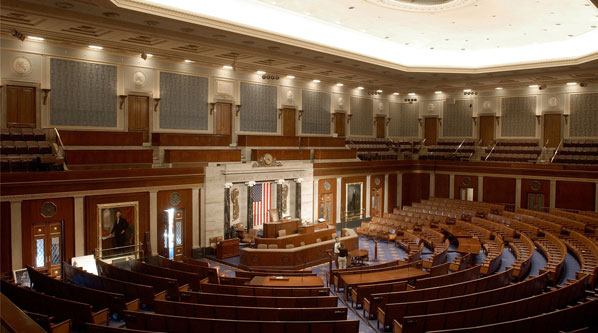
Congress … The Republican led House of Representatives -in Session …the Senate back on 1/25


CURRENT HOUSE FLOOR PROCEEDINGS

LEGISLATIVE DAY OF JANUARY 20, 2011

112TH CONGRESS – FIRST SESSION

2:05 P.M. –

The House adjourned pursuant to a previous special order. The next meeting is scheduled for 12:00 p.m. on January 24, 2011.

On motion to adjourn Agreed to by voice vote.

Mr. Wolf moved that the House do now adjourn.

11:47 A.M. –

SPECIAL ORDER SPEECHES – The House has concluded all anticipated legislative business and has proceeded to Special Order speeches.

11:45 A.M. –

ONE MINUTE SPEECHES – The House proceeded with further one minute speeches.

H. Con. Res. 10 : http://clerk.house.gov/floorsummary/bill-information.php?num=400010           

providing for a joint session of Congress to receive a message from the President

11:41 A.M. –

Motion to reconsider laid on the table Agreed to without objection.

On agreeing to the resolution Agreed to without objection.

Considered as privileged matter.

11:40 A.M. –

Mr. Cantor asked unanimous consent That when the House adjourns on Thursday, January 20, 2011 it adjourn to meet at 12 p.m. Monday, January 24, 2011, for Morning-Hour Debate. Agreed to without objection.

H. Res. 9 :    http://clerk.house.gov/floorsummary/bill-information.php?num=100009

instructing certain committees to report legislation replacing the job-killing health care law

11:08 A.M. –

Motion to reconsider laid on the table Agreed to without objection.

On agreeing to the resolution Agreed to by the Yeas and Nays: 253 – 175 (Roll no. 16) .   http://clerk.house.gov/cgi-bin/vote.asp?year=2011&rollnumber=16   

11:00 A.M. –

On agreeing to the Matheson amendment Agreed to by the Yeas and Nays: 428 – 1 (Roll no. 15). http://clerk.house.gov/cgi-bin/vote.asp?year=2011&rollnumber=15

10:36 A.M. –

The previous question was ordered on the amendment and the resolution pursuant to the rule.

10:30 A.M. –

DEBATE – Pursuant to the provisions of H.Res. 26, the House proceeded with 10 minutes of debate on the Matheson (UT) amendment.

Amendment offered by Mr. Matheson.

An amendment printed in Part B of House Report 112-2 to instruct the committees of jurisdiction to include a permanent fix to the Medicare physician payment formula in legislation to replace the Patient Protection and Affordable Car Act.

9:15 A.M. –

DEBATE – The House proceeded with one hour of debate on H. Res. 9.  http://clerk.house.gov/floorsummary/bill-information.php?num=100009

9:14 A.M. –

Rule provides for consideration of H.R. 2 and H. Res. 9. Measure provides for consideration of H.R. 2, as amended, with the amendment printed in Part A of the report. H.R. 2, as amended, shall be debatable in the House for seven hours, equally divided and controlled. Measure provides for consideration of H. Res. 9 which shall be considered as read, debatable for one hour, equally divided and controlled, and makes in order the amendment printed in Part B of the report.

Considered under the provisions of rule H. Res. 26. http://clerk.house.gov/floorsummary/bill-information.php?num=100026

9:03 A.M. –

ONE MINUTE SPEECHES – The House proceeded with one minute speeches which by direction of the Chair, would be limited to 5 per side of the aisle.

9:02 A.M. –

PLEDGE OF ALLEGIANCE – The Chair designated Mr. Poe of TX to lead the Members in reciting the Pledge of Allegiance to the Flag.

The Speaker announced approval of the Journal. Pursuant to clause 1, rule I, the Journal stands approved.

9:01 A.M. –

Today’s prayer was offered by the House Chaplain, Rev. Daniel Coughlin.

9:00 A.M. –

The House convened, starting a new legislative day.

a message from Joe Solmonese …


Human Rights Campaign


I know you must have been disappointed when you saw my earlier email tonight saying that the U.S. Senate stopped action on “Don’t Ask, Don’t Tellrepeal, the discriminatory law that bans gays and lesbians from serving openly in the military. This news certainly draws attention to the actions the President can take to end the discharges, and it’s important that we continue to urge him to do so. Aside from that, I also wanted to share some late breaking news that keeps congressional repeal as a possibility THIS YEAR.

After the failed vote to bring up the Defense Authorization bill today, two champions for repeal – Senators Joe Lieberman and Susan Collins – announced that they would introduce repeal of “Don’t Ask, Don’t Tell” as a stand-alone piece of legislation. While passing this new bill will be an uphill battle, it is another chance for a durable legislative solution.

Over the past few days we’ve seen a number of senators speak out for repeal and it’s clear that under the right circumstances, we can get above the 60 votes needed to overcome a filibuster. What got in the way today was procedure.

Thankfully a bipartisan group of senators has committed to finding an alternative method of achieving repeal. We encourage all senators to take up this bill and pass it quickly so that the military has the power to implement a repeal of “Don’t Ask, Don’t Tell.”

I’ll be in touch in the coming days to give you ways to get involved and help pass this stand-alone bill to repeal “Don’t Ask, Don’t Tell.” The fight for open service has had many twists and turns but until “Don’t Ask, Don’t Tell” is left in the dustbin of history we will never give up the fight.

Thank you,

Joe Solmonese
Joe Solmonese
President

MILITARY: Asked And Answered


Yesterday, after an exhaustive and at times controversial ten-month review of Don’t Ask, Don’t Tell, Defense Secretary Robert Gates and Joint Chiefs of Staff Chairman Adm. Mike Mullen announced that the purported risk of repealing the discriminatory policy is quite low. The 274-page report was released one day early after Sens. Joe Lieberman (I-CT) and Susan Collins (R-ME) pressured Gates to give the Senate as much time as possible to review the results and lift the ban during the lame duck session. (The House passed the measure in May.) On MSNBC this morning, Lieberman said, “I believe we have more than 60 Senators, including a good solid handful of Republicans, who are prepared to vote to take up the Armed Services bill, which already has within it the repeal of Don’t Ask, Don’t Tell.” Gates himself endorsed the review and called on Congress to pass repeal before another court decision found the ban unconstitutional and compelled the armed forces to stop enforcing the policy. “Now that we have completed this review,  I strongly urge the Senate to pass this legislation and send it to the president for signature before the end of this year,” he said. “It is only a matter of time before the federal courts are drawn once more into the fray, with the very real possibility that this change would be imposed immediately by judicial fiat — by far the most disruptive and damaging scenario I can imagine, and the one most hazardous to military morale, readiness and battlefield performance.” Defense Department General Counsel Jeh C. Johnson and Army Gen. Carter F. Ham — the co-chairs of the Working Group that conducted the review — also reiterated that the study represented “the largest,  most comprehensive review of a personnel policy matter which which the Department of Defense has ever undertaken.” The study is far more comprehensive, for example, than efforts taken to prepare the force for the integration of African Americans and women.

LITTLE RISK FROM REPEAL:   The Working Group’s extensive survey of 400,000 servicemembers and 150,000 military spouses found that  70 percent of servicemembers said they would be able to “work together to get the job done” with a gay servicemember in their immediate units.  Sixty-nine percent admitted to working in a unit with a co-worker that they believed to be gay and, of those who did, 92 percent said that their unit’s “ability to work together” with a gay person was “very good,” “good” or “neither good nor poor” (89 percent for those in Army combat arms units; 84 percent for those in Marine combat arms units.) What’s more, 74 percent of spouses of military servicemembers said repeal of DADT would not have a negative “impact on their view of whether their husbands or wives should continue to serve.” The highest rate of resistance to lifting the ban came from the Marine Corps, where servicemembers said they were least likely to encounter gay troops. Whereas approximately 30 percent of servicemembers across all branches expressed “negative views or concerns” about lifting the ban, between 40 and 60 percent of Marines in various combat arms specialties offered a negative opinion. As Johnson explained, that resistance “is driven by misperceptions and stereotypes.” The Marine Corps respondents also indicated ” a lower percentage who had actual experience of serving in a unit alongside someone who was gay or lesbian,” Ham added. “We did find, for example, in Marine Corps and Army combat arms units who had — in combat environments when those were — when they were asked about their experience with gay servicemembers in their unit reported actually quite favorably on the unit’s performance. So I think — again, I think it’s a largely —  there is a differential in actual experience.” U.S. allies with experience in repealing similar bans, notably Canada and the United Kingdom, also saw indicators of opposition in pre-repeal surveys. Once the bans were dropped, however, repeal proved to be a non-event.

IMPLEMENTING REPEAL:   During the press conference yesterday, the military leadership stressed the importance of lifting the ban in a deliberate yet timely manner. The study itself offers  several recommendations. For instance, the Working Group assumes that implementation of repeal will depend upon “strong leadership, a clear message, and proactive education.” The report recommends equipping commanders in the field with the education and training tools to educate the force on  what is expected of them in a post repeal environment. The group also rules out the need for special regulations governing the conduct of gay servicemembers or the establishment of separate facilities and argues that the Department “should issue guidance that all standards of conduct apply uniformly, without regard to sexual orientation.” On the delicate issue of providing benefits to the same-sex partners of servicemembers, the report notes that while the 1996 Defense of Marriage Act (DOMA) prevents same-sex partners from accessing many benefits, there are some benefits that are available to anyone of a Service member’s choosing. “Department of Defense and the Services  should inform servicemember about these types of benefits, if the policy is repealed,” Johnson noted during the press conference, arguing that another set of benefits, which are not statutorily prohibited, but do not extend to same-sex partners under current regulation, “should be revised and redefined to include same-sex partners.” The Working Group does not, however, recommend that the DoD “revise their regulations to specifically add same-sex committed relationships to the definition of ‘dependent,’ ‘family members,’ or other similar terms in those regulations, for purposes of extending benefits eligibility.” As legal analyst Andrew Cohen points out, for gay or lesbian service members who choose to come out after the end of Don’t Ask, Don’t Tell, “this means  no financial breaks on housing allowances or health care benefits that are available to married couples.” The Working Group also recommends that “service members who have been previously separated under Don’t Ask, Don’t Tell be permitted to apply for reentry into the military.”

SENATE MUST ACT:   On Thursday and Friday the Senate Armed Services Committee will hold two days of hearings with Gates, Mullen, the co-chairmen of the Working Group, and the four Service Chiefs. In a preview of the hearings, Gates was asked about Sen. John McCain’s (R-AZ)  recent argument that the study would not provide the military or Congress with sufficient information about the effects of military readiness and unit cohesion. Gates said McCain “is mistaken” before adding, “This report does provide a sound basis for making decisions on this law.” “It’s hard for me to imagine that you can come up with a more comprehensive approach,” he said. President Obama, who discussed the results of the study with Service Chiefs on Monday, also issued a statement endorsing the report’s findings and calling on the Senate to “act as soon as possible so I can sign this repeal into law this year and ensure that Americans who are willing to risk their lives for their country are treated fairly and equally.” Still, with a busy calendar full of economic concerns and urgency surrounding the new START treaty, Senate Majority Leader Harry Reid (D-NV) has yet to announce his floor plan for the National Defense Authorization Act – the bill which includes the DADT repeal amendment. Earlier this week, Sen. Mark Pryor (D-AR), long considered a swing vote on the issue, said that he considered homosexuality a “sin” and would be voting against the measure. Newly-sworn in Sen. Mark Kirk (R-IL) – who voted against repeal in the House but supported the underlining National Defense Authorization Act – also  hinted that he would not support taking up the bill in the lame duck Congress. At least eight undecided senators promised to consider the results of the Pentagon’s Review before deciding how to vote on the measure.

Russ Feingold


Donate now to keep Russ Feingold in the Senate


All too often, those who proclaim to have strong principles regarding free speech or domestic spying or torture when “the other guy” is in power abandon those concerns when it’s their own party’s turn at the helm.

Not Wisconsin Senator Russ Feingold. He’s the rare person of conviction who stood alone and heroically voted against the Patriot Act when every other member of the Senate voted “aye.” And his principles don’t change just because there’s a new resident at 1600 Pennsylvania Avenue.

But Russ is in a tough battle. He’s trailing his well-funded opponent by a wide margin. If Russ loses, while party bosses on both sides of the aisle can conspire to keep Joe Lieberman in the Senate, it sends a message to every member of Congress that there is no popular support for those who put themselves on the line in defense of our first amendment rights.

Our country can’t afford for Russ Feingold to lose this election.

Please donate $5 or more to Russ Feingold and fight for our civil liberties. It’s critical we keep his voice in the Senate. Click here to donate:

http://action.firedoglake.com/feingold

Feingold voted against TARP under Bush, and he voted against it again under Obama. He can’t call on the fat cat bankers to fund his race like so many others can.

There’s only one yardstick, and Russ applies it to everyone.

Feingold’s opponent, Ron Johnson, has more “flexible” principles. He’s a millionaire installed by the party chieftans over the objections of local activists. When Wisconsin activists asked Johnson whether he supported the Patriot Act, he said “I wasn’t overly concerned with George Bush in power. I’m a little more concerned about the Patriot Act when you have Barack Obama.”

Johnson, like Joe Lieberman, is no fan of free speech either. Lieberman famously said that “in matters of war, we undermine presidential credibility at our nation’s peril.” Likewise, Johnson said that Feingold was “undermining our troops” by speaking out against the war in Afghanistan, and that it was “extremely harmful to our nation.”

Russ needs your help. Can you please donate $5 or more to help Feingold fight back against his Lieberman-lite opponent?

http://action.firedoglake.com/feingold

Russ Feingold is the best defense of civil liberties in the Senate. His defeat would be an enormous blow to the tenuous wall holding back things like biometric ID programs that Joe Lieberman’s Department of Homeland Security is simply salivating over.

The time is coming when Americans will have to decide: do we stand and fight for our right to privacy and individual freedom, or do we capitulate to the continued erosion of our civil liberties?

If you choose “fight,” then join me in fighting for Russ Feingold. Click here to donate $5 or more to Russ Feingold now.

http://action.firedoglake.com/feingold

Thank you for standing up for our civil liberties, and for all you do.

Best,

Jane Hamsher
FDL Action PAC

KUSTER WINS!!!!


Progressive Change Campaign Committee

VICTORY!

Kuster wins!

We did it!! No, wait…WE DID IT!!!

Just minutes ago, bold progressive Ann McLane Kuster defeated Joe Lieberman‘s presidential campaign co-chair Katrina Swett in tonight’s New Hampshire congressional primary.

Annie ran a superb campaign — and PCCC members made thousands of phone calls and chipped in nearly $100,000 toward her people-powered victory.

We formed the PCCC to achieve big progressive victories just like tonight’s. Let’s keep the momentum going!

Can you chip in $3 so the PCCC can continue helping progressive candidates win in 2010? We need your help to win more elections in November.

Here’s what Annie wrote to PCCC members yesterday:

The PCCC has been a great partner and has helped progressive candidates like me run effective, people-powered campaigns.

Phone calls from PCCC members to voters were a tremendous help. Many PCCC members donated $3, $4, or $10 as well, allowing us to continually expand our grassroots effort.

Thank you for being part of the “people power” that is changing this country. Your efforts are noticed and greatly appreciated.

Together, we’re making a big difference. But we need your help to continue winning progressive victories in 2010 — chip in $3 here.

We’ll help Ann Kuster defeat Tea Party Republican Charlie Bass in November, and help other progressive champs like Bill Hedrick (CA-44), Elaine Marshall (NC-Sen), and others.

It’ll be a big job — but we can do it with your help. Please chip in $3 to help progressives keep making history in 2010. Click here.

Thanks for being a bold progressive,

Stephanie Taylor, Adam Green, Jason Rosenbaum, Michael Snook, Forrest Brown, Keauna Gregory, Julia Rosen, and the entire PCCC team