Tag Archives: Middle class

Labor: The Original Social Network


For too long, our political process has been dominated by too much money and too much power concentrated in the hands of too few.That’s why Workers’ Voice was created: to build an independent voice for the working and middle class. That voice will be fighting for the 99%—working people joining together to recognize the value of hard work and call for good jobs, a fair economy and to build a strong middle class.

As megamillionaires like Mitt Romney, the Koch brothers and large corporations plan to try and buy the 2012 elections, Workers’ Voice—powered by cutting-edge technology and old-fashioned energy—will activate and energize networks of working families, both online and offline, to come together to organize their friends, family, co-workers and neighbors, and make their voices heard.

As Theresa Brown, a worker from Cooper Tire in Ohio, said this morning at a press conference to launch Workers’ Voice, “It doesn’t matter if you’re in a union or not because we’re all fighting corporate greed and it’s time that we stood up and took this country back because we’re tired of it.

Susan Baskett, who is from Michigan and unemployed, said, “Politicians aren’t paying attention to, or doing enough, to put people like me back to work. Workers’ Voice will let us connect with other people in similar situations so we can work together to organize our neighborhoods and communities.”

Check out Workers’ Voice and sign up here.

Workers’ Voice represents and fights for all working families—union and nonunion—around political campaigns, legislative issues and holding elected officials accountable. And we hope you’ll be a part of it.

Thanks for all the work you do.

In Solidarity,

Manny Herrmann
Online Mobilization Coordinator, AFL-CIO

Their Fair Share by the Numbers …Joan Entmacher, National Women’s Law Center


Tired of fighting cuts to programs that women and their families depend on in the name of deficit reduction — while millionaires and billionaires haven’t been asked to contribute an extra penny? Think it’s time for millionaires and billionaires who pay lower tax rates than many middle-class Americans to start paying their fair share?

Take Action: Tell your Senators to support the Paying a Fair Share Act of 2012!   WWW.NWLC.ORG

On April 16, we expect the Senate to vote on an important piece of legislation, the Paying a Fair Share Act of 2012 (S. 2230). The bill would ensure that those with incomes over $1 million annually pay at least 30 percent of their income in federal taxes. The legislation, introduced by Senator Sheldon Whitehouse, was inspired by billionaire investor Warren Buffett, who highlighted the unfairness of a tax system that permits him to pay a lower tax rate than his secretary.

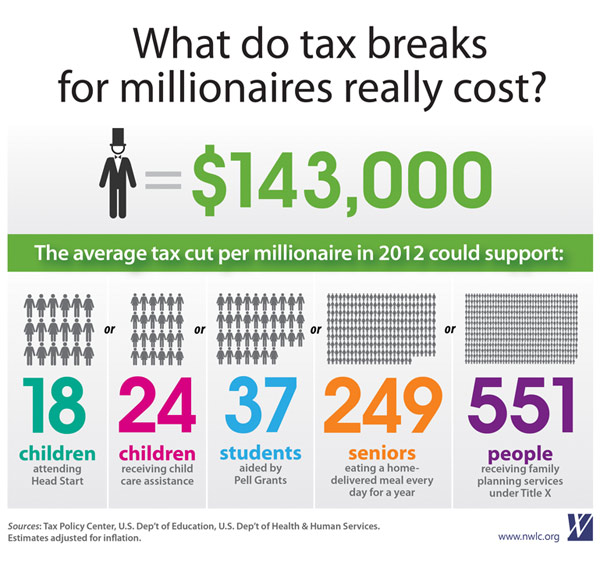
It’s time for this absurdity to stop. We can’t afford to continue lavish tax breaks for the wealthiest Americans. To help demonstrate the real cost of tax breaks for millionaires, we’ve put together a new infographic:

That’s right. This year, the average millionaire gets a tax break of $143,000 — enough to support child care assistance for 24 children, Pell Grants to 37 college students, or a home-delivered meal each day for 249 seniors.

This is a tradeoff we can’t afford to make any longer. Please share our infographic today and urge your Senators to support the Paying a Fair Share Act of 2012!

Sincerely,

Joan Entmacher Vice President,

Family Economic Security National Women’s Law Center

P.S. Please help us continue to advocate for policies that protect and improve economic security for women and their families by making a generous donation today.

Support Jay Inslee for Governor of Washington State …


Since I announced my jobs plan last week, people from across the state have been expressing their support for our commonsense approach to job creation — an approach that will create good-paying, middle-class jobs for all kinds of workers in every corner of our state.

They know, like I do, that building a working Washington requires us to identify industries where we can or do out-compete the rest of the world. And by focusing on building up those industries, we CAN out-compete the world. No place is better suited to pursue a bold, innovative, and forward-thinking approach than Washington state.

We’ve put together a short video with some of our favorite moments from last week’s events, and I wanted to share it with you. Do you have couple minutes to watch it?

Watch the highlights from the speech

Click here to see highlights from our jobs plan announcement, read the plan, and share Jay’s ideas for creating jobs throughout Washington!

This is the first of several proposals we’ll be releasing over the coming months. It means a lot to know that you’re with us as we start the discussion about the key policies we will enact during my administration.

I hope you’ll take a minute to watch our video and read my plan now, and then share it with your friends on Facebook and Twitter.

Thank you so much for your continued support.

Very truly yours,

Jay Inslee

Repost :: Right to Work for Less :: Repost


By ThinkProgress War Room

Sneak Attack on Unions All About Politics, Not Economics

As we discussed last week, Republicans in Michigan are ramming through so-called “right to work” legislation (along with several other highly controversial bills) during the final days of lame duck session.

A new report out today from our colleagues at the Center for American Progress underscores why right to work for less isn’t just bad for unions, it’s bad for everyone:

  • The average worker—unionized or not—working in a right-to-work state earns approximately $1,500 less per year than a similar worker in a state without such a law.
  • Workers in right-to-work states are also significantly less likely to receive employer-provided health insurance and pensions. If benefits coverage in non-right-to-work states were lowered to the levels of states with these laws, 2 million fewer workers would receive health insurance and 3.8 million fewer workers would receive pensions nationwide.
  • All of the states with the lowest percentage of workers in unions—Mississippi, Arkansas, South Carolina, North Carolina, Georgia, Virginia, Tennessee, Texas, South Dakota, and Oklahoma—are right-to-work states. They all have a relatively weak middle class, as the share of total state income going to the middle 60 percent of the population is below the national average.
  • Over the past several decades, unions in Michigan have weakened and the middle class has been hollowed out—a trend that would significantly worsen if right-to-work became law. As Figure 1 shows, Michigan’s middle class earned 53.6 percent of the state’s income in 1979, a year when over 37 percent of the state’s workers were in unions. Today less than 18 percent of Michigan’s workers are unionized, and the middle class receives only 47 percent of the state’s income.
  • Moreover, right-to-work does not reduce unemployment. Indeed, right-to-work states such as Nevada—which has the nation’s highest unemployment rate—and North Carolina both have higher unemployment rates than Michigan. Not surprisingly, researchers find that right-to-work has “no significant positive impact whatsoever on employment.”

As it happens, President Obama was in Michigan today to celebrate new jobs and investments in a Daimler diesel engine plant. The president came out swinging against this latest right-wing attack on unions and working people. He also explained that middle class consumers are the real engine of economic growth:

Watch it:

President Obama: And by the way, what we shouldn’t do — I just got to say this — what we shouldn’t be doing is trying to take away your rights to bargain for better wages and working conditions. (Applause.) We shouldn’t be doing that. (Applause.) These so-called “right to work” laws, they don’t have to do with economics; they have everything to do with politics. (Applause.) What they’re really talking about is giving you the right to work for less money. (Applause.)

You only have to look to Michigan — where workers were instrumental in reviving the auto industry — to see how unions have helped build not just a stronger middle class but a stronger America. (Applause.) So folks from our state’s capital, all the way to the nation’s capital, they should be focused on the same thing. They should be working to make sure companies like this manufacturer is able to make more great products. That’s what they should be focused on. (Applause.) We don’t want a race to the bottom. We want a race to the top. (Applause.)

America is not going to compete based on low-skill, low-wage, no workers’ rights. That’s not our competitive advantage. There’s always going to be some other country that can treat its workers even worse. Right?

Audience: Right!

The President: What’s going to make us succeed is we got the best workers — well trained, reliable, productive, low turnover, healthy. That’s what makes us strong. And it also is what allows our workers then to buy the products that we make because they got enough money in their pockets. (Applause.)

BOTTOM LINE: Instead of a race to the bottom pushed by right-wing billionaires, Michigan Gov. Rick Snyder (R) should focus on building an economy that works for everyone, including workers.

Washington State: : : Emergency Unemployment Compensation (EUC) is ending


unemploymnt

Under federal law, the Emergency Unemployment Compensation (EUC) program shuts off at the end of December. We cannot pay EUC benefits for any weeks after December 23-29, even if you have money remaining in your account.


If Congress votes to continue the program, we will automatically notify everyone who claimed EUC for one or more weeks in December.

We have posted some questions and answers on our website with additional information. You also may contact the EUC claims center at 877-558-8509 (toll-free) with questions about your claim.

If you need help finding a job, we strongly encourage you to contact WorkSource for assistance. WorkSource offers free workshops, job counseling, computers, Internet access, phones and other job-search resources aimed at helping you return to work.

If you need help with housing, food, medical care or other essentials, please dial 2-1-1 or visit www.211.org.