Tag Archives: Republican

African Americans in Full Color – in memory of Black History – a repost


NMAAHC -- National Museum of African American History and Culture

Lonnie Bunch, museum director, historian, lecturer, and author, is proud to present A Page from Our American Story, a regular on-line series for Museum supporters. It will showcase individuals and events in the African American experience, placing these stories in the context of a larger story — our American story.A Page From Our American Story

African Americans in Full Color

In the first half of the twentieth century, Americans became fascinated with photo journalism. Pictures were literally “worth a thousand words” as full-color magazines and tabloid newspapers became the rage.

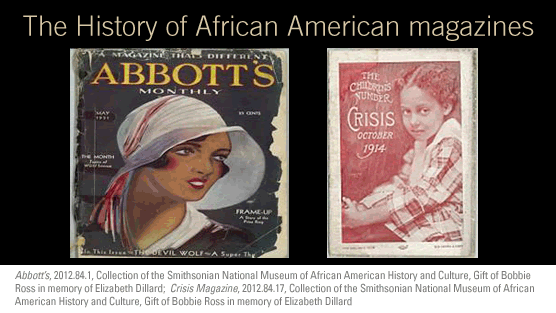
Publications targeted to African American audiences that featured illustrations and photographs began appearing in the early 1900s. One of the earliest to effectively use illustrations and photography was The Crisis, the official publication of the NAACP. Seeking to educate and inform its readers with scholarly articles, the covers of the journal and its entertainment section were designed to appeal to the masses of African Americans.

In the 1930s, we see pictorial magazines such as Abbott’s Monthly, published by Robert Sengstacke Abbott, the founder of the Chicago Defender newspaper, and Flash, which billed itself as a “weekly newspicture magazine.” Published in Washington, D.C., Flash contained a mixture of news, gossip and advertisements and articles on racial issues, providing an overview of the highs and the lows of Black life in the 1930’s.

In 1942, African American businessman John H. Johnson founded the Johnson Publishing Company, a corporation that would go on to publish the well-known magazines Ebony, Jet, Tan, and Ebony Jr. The magazines promoted African American achievements and affirmative black imagery in popular culture, which appealed to readers … and to advertisers. Mr. Johnson was a savvy businessman and used the statistics of a rising black middle class to persuade companies and businesses that it was in their economic “self-interest” to advertise in his magazines to reach African American consumers.

With the success of the Johnson Publishing Company’s magazines, other magazines targeted to African Americans quickly came on the scene. For example, in 1947 Horace J. Blackwell published Negro Achievements, a magazine highlighting African American success articles and featuring reader-submitted true confessions stories. After Blackwell died in 1949, a white businessman named George Levitan bought the company and renamed the publication Sepia. This publication featured columns by writer John Howard Griffin, a white man who darkened his skin and wrote about his treatment in the segregated South, that eventually became the best-selling book Black Like Me.

Whether featuring positive images of African Americans, inspiration stories, news features or commentaries on racism, the rise of African American magazines defied long-held racial stereotypes through rich storytelling, in-depth reporting, and stunning photography.

Due to a variety of economic, editorial, and other factors, most of these magazines have ceased being published. Yet today some African American magazines are still a thriving part of popular culture. Johnson Publishing Company’s Ebony and its digital sites reach nearly 72% of African Americans and have a following of over 20.4 million people.

 dd-enews-temp-lonnie-bunch-2.jpg All the best,

Lonnie Bunch
Director

P.S. We can only reach our $250 million goal with your help. I hope you will consider making a donation or becoming a Charter Member today.

To read past Our American Stories, visit our archives.

a sport not many focus on … Golf & Women of Colour – reminder – Black History


Wethepeople

So, I’m flipping through my newest 2015 Essence from back to front because of the horoscope section and as I’m looking I see a section called “trending topics” reporting that the USTA just appointed former tennis player Katrina Adams, President, CEO and chairman of the board and the first African American to fill the role. So, more things have changed in the World of Sports in which women of colour historically have not dominated.  While flipping through my 2014 issue of Essence with various fashions it was became obvious that this is not just about fashion, though the title gave me that impression and had to share given the history. In fact, it is about a Woman named Renee Powell and some young Women who were introduced to her and who have chosen her as their mentor. Now, the surprise to most would be that these brightly fashionable women are people of colour and that the article is about golf or as they say, “One of America’s favourite pastimes.”  In fact my family lived just a few blocks away from a golf course and while golf wasn’t my choice the history of golf was well known in our house, including a couple of good along with the bad and the really ugly stories of racism. It is a sad day to know that the practice is still alive and well, though tiger woods did shatter the glass ceiling some. The art of discrimination is subtle these days, while the stories of’ the good ‘olé boys club were worse, golf is a work in progress. The article tells us about the ups and downs of Powell’s life and daily experiences as a young girl to becoming one of four African-American women qualifying for golf’s top pro-circuit … The LPGA Tour that included Althea Gibson, LaRee Pearl Sugg, Shasta Avery Hardt and Renee Powell. Their legacy on the links is gone into in depth. They list the youngest pro at 17, four others including the niece of tiger woods who also has a great story, but what is even more exciting is that after Powell retired she now owns her own golf club, is the golf pro. She also teaches and mentors a new generation of girls/women of colour who love the game and are willing to take it as far as they can. Golfing is not cheap, so, if you have an opportunity to donate to your area’s youth sports club or make time to teach train and expose kids of colour to golf … do it!

Oh and the article on Golf is in Essence and was written by Connie Aitcheson

and … it’s in  “Trending Topics”  the February issue of Essence

Carter Woodson ~ American historian


Carter G. Woodson

To commemorate and celebrate the contributions to our nation made by people of African descent, American historian Carter G. Woodson established Black History Week. The first celebration occurred on Feb. 12, 1926. For many years, the second week of February was set aside for this celebration to coincide with the birthdays of abolitionist/editor Frederick Douglass and Abraham Lincoln. In 1976, as part of the nation’s bicentennial, the week was expanded to a month. Since then, U.S. presidents have proclaimed February as National African-American History Month.


In the fall of 1870, a handful of students made their way through the northwest quadrant of the nation’s capital, and through the doors of D.C.’s “Preparatory High School for Colored Youth,” the country’s first public high school for African American children. The students and teachers who graced its hallways would be heard through the years in the halls of Congress, in the highest ranks of the United States military, at the heart of our civil rights movement, and in the upper echelons of medical and scientific study.

One such voice was that of Carter G. Woodson; a journalist, author, historian, and co-founder of the Association for the Study of Negro Life and History (ASNLH). It was through his work with the ASNLH that Woodson spearheaded the celebration of “Negro History Week” in America, which served as the precursor to Black History Month, which was officially recognized by President Gerald Ford in 1976. Woodson taught us that, “those who have no record of what their forebears have accomplished lose the inspiration which comes from the teaching of biography and history.”

Find out more about Carter G. Woodson.


Islanders … diverse


 Islands People

People from the Virgin Islands are called Virgin Islanders and based on the island of residence are called St. Thomian, St. Johnian, Crucian and Water Islanders respectively.

The first people known to have inhabited what is today the Virgin Islands were the Carib, Arawak and Ciboney Indians. These indigenous people are believed to have left and/or been forcibly removed by the late 1500’s.

Between the early 1600s and mid-1800’s the residents of the islands were of European and African extraction. Settlers, mainly from Holland, England, Denmark, Ireland and France, came to the islands to operate plantations, to run shops and warehouses, as indentured servants and to live in the fledging new colonies. Outnumbering the European whites were African slaves that were forcibly brought to the islands as labor for the plantations. Whites and Blacks born in the islands were called Creoles. At the end of the plantation era many of the white planters and their families returned to Europe.

In 1917 the United States bought the Virgin Islands from Denmark. The population in the late 1800s and throughout the 1900s changed greatly. There was an influx of immigrants from neighboring Puerto Rico to St. Croix to work in agriculture. French immigrants from St. Barths and British immigrants from the British Virgin Islands came to St. Thomas and today are well established. As a new US territory American officials and military personal were sent to the islands. These five groups made up the majority of the population in the early 1900s. After Naval rule ended most of the military personal and officials returned to the mainland and a new group of US mainlanders began coming to the islands; tourist! With tourism came a boom in the economy and another influx of immigrants. This was the mid-1900s. More French from St. Barths and more British from the British Virgin Islands came to work in hotels and restaurants on St. Thomas. Americans from the mainland came to the islands to invest in hotels and property and to enjoy island living. As tourism grew and the prospect of better jobs and a better livelihood so did the population. Large numbers of immigrants from throughout the Caribbean came to the islands and while this migration is much smaller today it still continues. Presently almost every island in the Caribbean is represented in the Virgin Islands from St. Kitts to Trinidad and Dominca to Anguilla.

A small close knit Middle Eastern community established themselves in the Virgin Islands shortly after the 1967 war in which Israel occupied areas on the west bank of the Jordan river.

There is also a small but well established Indian community in the Virgin Islands, mostly on St. Thomas. The Indian community is made up primarily of Sindhis.

Today the population of the Virgin Islands is 78% black, 10% white and 12% other. While 81% of the population is of West Indian background only 49% were born in the Virgin Islands. The remaining 32% were born elsewhere in the Caribbean. Residents originally from the US Mainland make up 13% of the population and Puerto Ricans make up 4%. The remaining 2% is a mixture of immigrants from across the world including the middle east, India and Asia. (Source: US Census Bureau – 2000)

While the population of the Virgin Islands may seem largely the same and residents may outwardly express nationalistic pride as Americans and Virgin Islanders, residents do not forget where they and their neighbors are from.

A Virgin Islander will quickly differentiate themselves from other residents who are from neighboring Caribbean islands. Differentiations are also made between white Virgin Islanders from old families, from French families and ((white continentals). Differences between residents from St. Kitts, Dominica, Trinidad, Puerto Rico, Haiti, Santo Domingo, Tortola… are not forgotten and most residents can identify the various groups by differences in accent, slight differences in skin color and facial features and last names.

While the population is largely Black West Indian, it is still an ensemble of different groups living struggling pushing and shoving against and with each other .

Source: Internet

Redefining rape? a repost and reminder


when you vote! #VoteBlueToSaveYourRights

Dear MoveOn member,

Think “no” means “no”?

Well, 173 members of Congress don’t.

A far-reaching anti-choice bill, introduced by Republican Chris Smith and supported by 173 members of the House, includes a provision that could redefine rape and set women’s rights back by decades.1

Right now, federal dollars can’t be used for abortion except in cases of rape, incest, or when the woman’s life is in danger.

But according to the New York Times, the Smith bill would narrow that use to “cases of ‘forcible’ rape but not statutory or coerced rape.”2 This could mean cases where women are “drugged or given excessive amounts of alcohol, rapes of women with limited mental capacity, and many date rapes” would no longer count as rape.3

As far too many women know, bruises and broken bones do not define rape—a lack of consent does. The Smith bill is scary. And with 173 supporters it already has a frightening chance of passage—unless the public speaks up right away with an outcry that can’t be ignored.

Can you sign the petition to Congress today, demanding they oppose the sexist, anti-choice Smith bill? >> http://pol.moveon.org

Federal funds are already severely restricted when it comes to reproductive rights and women’s health care, a situation that ends up hurting lower-income women in particular, who tend to use federally-funded services more often than wealthy women. The last thing we ought to be doing is legislating to make these laws more stringent.

In addition, the Smith bill is full of dangerous anti-choice provisions as well as the rape redefinition. Called “Stupak on Steroids” by NARAL Pro-Choice America in reference to Rep. Bart Stupak‘s failed attempt to push stringent restrictions on insurance coverage for abortion during the health care debate, it would “force millions of American families to pay more taxes if their health plan covers abortion care, jeopardizing abortion coverage in the private market.”4

The Smith bill is just the first of many attacks on women’s rights to come in the new GOP-controlled House.5 If it moves forward, it would set an incredibly dangerous precedent for GOP action in the House for the next two years.

Can you sign the petition asking Congress to denounce the Smith bill to redefine rape?

http://pol.moveon.org

Thanks for all you do.

–Kat, Eli, Milan, Carrie, and the rest of the team

Sources:

1. “The House GOP’s Plan to Redefine Rape,” Mother Jones, January 28, 2011

http://www.moveon.org/r?r=205936&id=25965-9640874-dbC4j7x&t=5

“Stupak on Steroids,” The Hill, January 25, 2011

http://www.moveon.org/r?r=205938&id=25965-9640874-dbC4j7x&t=6

2. “The Two Abortion Wars: A Highly Intrusive Federal Bill,” New York Times, January 29, 2011

http://www.nytimes.com/2011/01/30/opinion/30sun1.html

3. “The House GOP’s Plan to Redefine Rape,” Mother Jones, January 28, 2011

http://www.moveon.org/r?r=205936&id=25965-9640874-dbC4j7x&t=7

“Stupak on Steroids,” The Hill, January 25, 2011

http://www.moveon.org/r?r=205938&id=25965-9640874-dbC4j7x&t=8

5. Ibid.