| Lonnie Bunch, museum director, historian, lecturer, and author, is proud to present A Page from Our American Story, a regular on-line series for Museum supporters. It will showcase individuals and events in the African American experience, placing these stories in the context of a larger story — our American story.
A Page From Our American Story
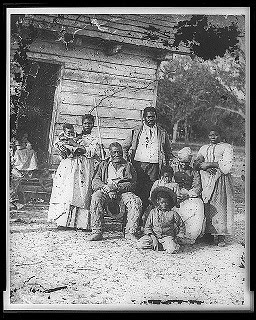 Family on Smith’s Plantation, Beaufort, South Carolina, circa 1862. Image courtesy of the Library of Congress. Family on Smith’s Plantation, Beaufort, South Carolina, circa 1862. Image courtesy of the Library of Congress. |
Slavery: perhaps the last, great unmentionable in public discourse. It is certainly a topic that even today makes people very uncomfortable, regardless of their race.
American society has often expressed its internal problems through its art. Perhaps the most powerful medium for important discussions since the turn of the last century has been the motion picture.
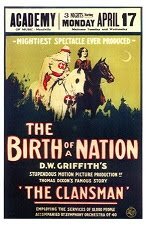
For decades Hollywood has attempted to address the issue of slavery. For the most part, films have represented the period of enslavement in a manner that reflected society’s comfort level with the issue at the time. Director D. W. Griffith’s 1915 silent drama, Birth of a Nation, for instance, depicted African Americans (white actors in black face) better off as slaves. Griffith’s movie showed the institution of slavery “civilizing” blacks. Birth even made it seem like slaves enjoyed their lives and were happy in servitude.
That wasn’t the case, of course, but it was what white society wanted to believe at the time.
More than two decades after Birth of a Nation, the portrayal of African Americans in films had changed only a little. 1939 saw the release of one of Hollywood’s most acclaimed movies, Gone with the Wind. Producer David O. Selznick believed he was serving the black community with respect — he made sure the novel’s positive portrayal of the Ku Klux Klan was eliminated from the film, for example. But Gone with the Wind nevertheless treated the enslaved as relatively happy, loyal servants, a depiction that continued to reflect America’s segregated society. History was made, however, when Hattie McDaniel became the first African American to win an Academy Award for her role as “Mammy.” Still, her part, and the parts of the other black actors drew harsh criticism from major African American newspapers and civil rights groups.
Nearly forty years later, one of Hollywood’s most meaningful attempts to portray the period of enslavement came in 1977 with the television blockbuster mini-series, Roots. Based on Alex Haley’s 1976 best-selling book, Roots: The Saga of an American Family, the mini-series was groundbreaking on many levels. It was a dramatic series with a predominantly African American ensemble that captured a record 37 Emmy nominations — television’s highest artistic award.
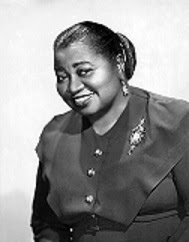 Promotional photograph of actor Hattie McDaniel (1939). Promotional photograph of actor Hattie McDaniel (1939). |
And Roots marked the first time America witnessed slavery portrayed in detail. Along with the scenes of transporting, selling, and trading men and women, were scenes showing the brutality African Americans often suffered at the hands of slave owners. The depictions of abuse and cruelty were limited, of course, by the medium and by what American society would accept at the time. In keeping with the series’ marketing campaign, the show focused heavily on the family’s ultimate triumphs. For all of Roots’ firsts, and there were many, it was ultimately a story of resiliency.
Fast forward three-plus decades — American society is undeniably changed. African Americans are regularly featured in movies and television shows. The nation elected, then re-elected, an African American president, Barack Obama.
Drawing critical acclaim today is the movie 12 Years a Slave. 12 Years is a watershed moment in filmmaking. Not only does it feature remarkable performances, excellent cinematography, and powerful direction; it also offers the first realistic depiction of enslavement.
Unlike prior motion pictures and television shows, 12 Years does not retreat from the brutality many blacks endured. The movie is not for the faint hearted, as the violence and cruelty it portrays is not the highly stylized violence found in films like Django Unchained. 12 Years is true to the reality that for years many Americans treated fellow human beings with ruthless brutality — and that reality is harder to face.
The film, however, is not only drawing praise from critics — it recently received nine Oscar nominations, including Best Picture — but enjoying audience appreciation, as well. With that appreciation comes an opportunity to bring the discussion of slavery to the mainstream.
This, then, is an exciting time for the Smithsonian’s National Museum of African American History and Culture. Among its many virtues, the Smithsonian is a great legitimizer with a long tradition of providing venues for Americans to examine their shared history. One of the over-arching goals of the National Museum of African American History and Culture is to create a place where issues like enslavement can be viewed through an unvarnished lens.
America today needs this discussion and I believe it is ready for it, a sentiment undergirded by a belief in the public’s ability to deal with and care about the issue. The great strength of history, and African American history, is its ability to draw inspiration from even the worst of times. No doubt people throughout the nation and around the world will find that inspiration when they visit the Museum and view our major exhibition on “Slavery and Freedom” when our doors open in late 2015.
Before I close, I want to recommend four insightful narratives written by African Americans during this period of American history. The first is Solomon Northup’s book, 12 Years a Slave. Next is Incidents in the Life of a Slave Girl, by Harriet Jacobs. One of the first books to describe the sexual abuse and torment that female slaves endured, Incidents became one of the most influential works of its time. Our Nig: Sketches from the Life of a Free Black, by Harriet Wilson, is believed to be the first novel published by an African American in North America. Though fictionalized, Wilson’s book is based on her life growing up in indentured servitude in New Hampshire. Finally, Narrative of the Life of Frederick Douglass, An American Slave, remains today one of the most important autobiographical works ever written by an American.
 12 Years a Slave by Solomon Northrup. 1853. 12 Years a Slave by Solomon Northrup. 1853. |
 Incidents in the Life of a Slave Girl by Harriet Jacobs. 1861. Incidents in the Life of a Slave Girl by Harriet Jacobs. 1861. |
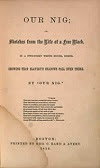 Our Nig: Sketches from the Life of a Free Black by Harriet Wilson. 1859. Our Nig: Sketches from the Life of a Free Black by Harriet Wilson. 1859. |
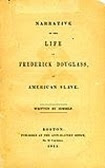 Narrative of the Life of Frederick Douglas, An American Slave by Frederick Douglass. 1845. Narrative of the Life of Frederick Douglas, An American Slave by Frederick Douglass. 1845. |
 |
All the best,  Lonnie Bunch Director Lonnie Bunch Director |
P.S. We can only reach our $250 million goal with your help. I hope you will consider making a donation or becoming a Charter Member today. |



 In 1917 the United States bought the Virgin Islands from Denmark. The population in the late 1800s and throughout the 1900s changed greatly. There was an influx of immigrants from neighboring Puerto Rico to St. Croix to work in agriculture. French immigrants from St. Barths and British immigrants from the British Virgin Islands came to St. Thomas and today are well established. As a new US territory American officials and military personal were sent to the islands. These five groups made up the majority of the population in the early 1900s. After Naval rule ended most of the military personal and officials returned to the mainland and a new group of US mainlanders began coming to the islands; tourist! With tourism came a boom in the economy and another influx of immigrants. This was the mid-1900s. More French from St. Barths and more British from the British Virgin Islands came to work in hotels and restaurants on St. Thomas. Americans from the mainland came to the islands to invest in hotels and property and to enjoy island living. As tourism grew and the prospect of better jobs and a better livelihood so did the population. Large numbers of immigrants from throughout the Caribbean came to the islands and while this migration is much smaller today it still continues. Presently almost every island in the Caribbean is represented in the Virgin Islands from St. Kitts to Trinidad and Dominca to Anguilla.





You must be logged in to post a comment.