Tag Archives: Saddam Hussein

Iraq …


Wethepeople

On March 19, 2003 then President Bush announces that America has invaded Iraq.

Over nine years have passed and Saddam gone.

Yet, Americans are still asking; where are the WMD , why weren’t our soldiers given state of the art equipment ,was there a real plan, why are Iraqis’ still having trouble with electricity, water, the military spoke little English, some say were improperly trained if at all and while we all know their leadership was difficult to communicate with. There are and will always be questions because the truth has yet to be uncovered and since we are now a full Administration ahead questions like:  why did they build such a humongous building(embassy) only to abandon it will probably go unanswered

As we honor and reflect upon the sacrifices that millions of Men and Women as well as their family’s made for this war, but bringing this war to a responsible end was a cause that sparked many Americans to get involved in the political process for the first time. Upon reflection of just what transpired before and since the Iraqis War, it is an important reminder that we all have a stake in our country’s future, and a say in the direction we choose

Early Sunday morning, the last of our troops left Iraq. 12/20/11

Thank you

President Barack Obama

BUSH LEGACY: Decision Points Of Failure


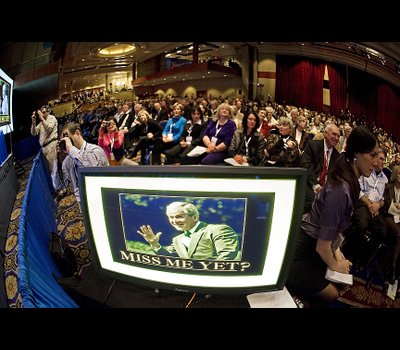
President  Bush’s new memoir, Decision Points, hits stores today. In a series of promotional interviews with mainstream and conservative news outlets, Bush opens up about his personal fight with alcoholism, his mother’s traumatic miscarriage, and some of the most defining moments of his presidency. Judging from press accounts, the memoir offers few substantive revelations. It is, as the Washington Post‘s book critic Jonathan Yardley describes it, “not a memoir as the term is commonly understood — an attempt to examine and interpret the writer’s life — but an attempt to write history  before the historians get their hands on it.” Indeed, Bush’s memoir is full of the kind of half truths, stubborn rationalizations, and outright misrepresentations that dominated his eight-year presidency. Throughout the book, Bush admits only to the most cursory of mistakes and communications failures, while defending his most unpopular decisions.

IRAQ — ‘I WAS A DISSENTING VOICE’:   Bush doubles down on the disastrous war in Iraq, writing, “Saddam Hussein didn’t just pursue weapons of mass destruction. He had used them.” “He deployed mustard gas and nerve agents against the Iranians and massacred more than five thousand innocent civilians,” Bush said, adding that he believed Hussein had weapons of mass destruction and was stunned to find out that he didn’t. It was “unbelievably frustrating,” Bush told Fox News‘ Sean Hannity. “Of course, it was frustrating. It — everybody thought he had WMD. Everybody being every intelligence service, everybody in the administration .” “No one was more shocked or angry than I was when we didn’t find the weapons.  I had a sickening feeling every time I thought about it. I still do,” Bush writes in his book. When asked by NBC’s Matt Lauer if he filtered out dissenting voices against the war, Bush retorted, “I was a dissenting voice. I didn’t want to use force. I mean force is the last option for a president. And I think it’s clear in the book that I gave diplomacy every chance to work. And I will also tell you the world’s better off without Saddam in power. And so are 25 million Iraqis.” Recently declassified documents and press accounts, however,  contradict Bush’s version of events and reveal that his administration was looking for a way to “decapitate” the Iraqi government since 2001. As Bush’s Treasury Secretary Paul O’Neill — who Bush fired for “disagreeing too many times” with him — puts it, Bush was “all about finding a way to [go to war]. That was the tone of it. The President saying ‘Go find me a way to do this.'” In 2002, Bush also reportedly told then-National Security Adviser Condoleezza Rice, while she was in a meeting with three U.S. Senators on how to approach Iraq diplomatically, “F— Saddam. We’re taking him out.” In “talking about why we needed this war,” Bush also later referenced an alleged Iraqi assassination plot against Bush’s father: “We need to get Saddam Hussein…that Mother F—– tried to take out my Dad.” Asked by Lauer if he ever considered apologizing to the American people over the war and the failure to find weapons of mass destruction,  Bush replied, “I mean, apologizing would basically say the decision was a wrong decision,” Bush replied. “And I don’t believe it was the wrong decision.”

TORTURE — ‘DAMN RIGHT’:   Bush writes that he also has no regrets about authorizing the CIA to use enhanced interrogation techniques on captured prisoners and admits  personally authorizing the illegal torture of Khalid Sheikh Mohammed, the self-professed 9/11 mastermind. When asked whether the partial drowning technique could be used, Bush’s answer was emphatic: “Damn right.” In his interview with Lauer, Bush said his lawyers told him waterboarding was legal. “Because the lawyer said it was legal,” Bush rationalized. “He said it did not fall within the Anti-Torture Act. I’m not a lawyer. But you gotta trust the judgment of people around you and I do,” Bush said. He also dismissed critics like former New Jersey Governor and co-head of the 9/11 Commission Thomas Kean, who has said that the administration simply shaped the legal opinions around their intended policy. [Kean] “obviously doesn’t know,” Bush replied. “I hope Mr. Kean reads the book. That’s why I’ve written the book. He can, they can draw whatever conclusion they want. But I will tell you this.   Using those techniques saved lives. My job is to protect America and I did.” It’s not clear that torture did, however. For instance, Mohammed told U.S. military officials that he gave false information to the CIA after withstanding torture, and as a former Special Operations interrogator who worked in Iraq argues, waterboarding has actually cost American lives: “The number of U.S. soldiers who have died because of our torture policy will never be definitively known, but it is fair to say that  it is close to the number of lives lost on Sept. 11, 2001,” he says. In his memoir, Bush also contends that he was “blindsided” by the photos of abused prisoners at the Abu Ghraib prison in Iraq and twice considered accepting Secretary of Defense Donald Rumsfeld’s resignation over the incident. Bush wrote, “I knew it would send a powerful signal. I seriously considered accepting his advice. I knew it would send a powerful signal to replace the leader of the Pentagon after such a grave mistake. But a big factor held me back.  There was no obvious replacement for Don.”

KATRINA — KANYE’S COMMENTS WERE ‘THE WORST’:   Bush did accept some responsibility for the government’s slow response to Hurricane Katrina, telling Lauer, “Yes. The lack of crisp response was a failure at all levels of government.” But he seemed most disappointed about the unfortunate picture taken of him in Air Force One, flying over New Orleans, and the criticism he received over the incident. Bush said he looked “detached and uncaring” in the photo, admitting, “It’s always my fault. I should have touched down in Baton Rouge, met with the governor, and, you know, walked out and said, ‘I hear you.’ I mean, ‘We know. We understand. And we’re gonna, you know, help the state and help the locals, governments with as much resources as needed.’ And — and then got back on a flight up to Washington. I did not do that and paid a price for it.” Bush also explained his now infamous “heck of a job” comments to FEMA director Mike Brown. “My intention was simply to say to somebody who’s workin’ hard, ‘Keep workin’ hard,'” Bush rationalized. “And it turns out that– those words became a club for people to say, ‘Wait, this guy’s out of touch .'” Unfortunately for Bush, the criticism is  far harsher than that. A 2006 report compiled by House Republicans slammed what it called “a failure of leadership,” saying that the federal government’s “blinding lack of situational awareness and disjointed decision making needlessly compounded and prolonged Katrina’s horror.” The report  specifically blamed Bush, noting that “earlier presidential involvement could have speeded the response” because the president alone could have cut through bureaucratic resistance. Still, for Bush, the worst moment of the disaster — and possibly his entire presidency — came when rapper Kanye West said “George Bush doesn’t care about black people” during an NBC telethon. “I faced a lot of criticism as President,” Bush writes in his book. “I didn’t like hearing people claim that I lied about Iraq’s weapons of mass destruction or cut taxes to benefit the rich. But the suggestion that I was racist because of the response to Katrina   represented an all time low.” When pressed by Lauer on why “the worst moment in your Presidency was [not] watching the misery in Louisiana, but rather when someone insulted you because of that,” Bush replied, “No, I — that — and I also make it clear that the misery in Louisiana affected me deeply as well. There’s a lot of tough moments in the book. And it was  a disgusting moment, pure and simple.”

Google …official blog


Trip report: Google and YouTube in Iraq

Posted: 26 Oct 2010 08:06 AM PDT

(Cross-posted from the YouTube Blog)

Earlier this month, a small team from Google and YouTube spent a week in Iraq on a trip arranged by the Department of Defense’s Task Force for Business and Stability Operations (TFBSO). Our goals were to explore opportunities for Google in Iraq, to understand the landscape of Internet access and connectivity in the country during this critical transition period and to bring top-voted questions from YouTube to Iraqi leaders in a series of interviews. We met with students, private sector companies, NGOs and Iraqi leadership in the Kurdish city of Erbil in the north, and in Baghdad.

Pictures taken by the Google/YouTube team in Iraq: Harry Wingo (Policy), Carrie Farrell (Google.org), Debu Purkayastha (Corp Dev), Olivia Ma (YouTube), Mary Himinkool (Business Development) and Steve Grove (YouTube).

Regardless of your feelings about the Iraq War, it’s immediately evident upon arrival just how completely the country missed the Internet boom during Saddam Hussein’s regime. Internet penetration rates in Iraq are among the lowest in the Middle East—somewhere between one and eight percent. Only 15 percent of Iraqis say they use the web, and the largest percentage of them live in Baghdad. There are no commercial data centers in Iraq and much more fiber connectivity is needed to meet consumer needs. Most connections are via satellite, and those who do have connections pay dearly for it—we heard estimates of up to $150 U.S. dollars per month for a 512kb connection. To incentivize and enable private companies to lay more fiber in Iraq, a complex set of roadblocks must be addressed—from security concerns to regulatory frameworks to licensing structures. As the country is still struggling to form a government more than seven months after its last election, much of this progress has been stalled.

There are signs of progress, however. Mobile penetration has skyrocketed in Iraq in the past seven years, from effectively zero percent in 2003 to over 70% today. And the Iraqi people are highly educated. We met with dozens of computer science students at Salahaddin University in Erbil and at Baghdad University, and though they lack equipment and resources, they’re highly motivated to innovate and believe the web is a critical component of their economy’s future.

Many young people in Iraq and around the world submitted questions in Arabic and English for three interviews we conducted in partnership with Middle Eastern news agency Al Arabiya. Google Translate enabled anyone to vote on their favorite questions regardless of language, and we brought the top five questions to current Iraqi Prime Minister Nouri al-Maliki, the Prime Minister of the Kurdish Regional Government in Erbil, Dr. Barham Salih and Iraqi politician and once the interim Prime Minister of Iraq, Ayad Allawi. Here is the television special that Al Arabiya produced showcasing their answers:

The Iraqis we met consistently expressed their desire for increased access to the web and for more access to content and tools in both Kurdish and Arabic. We believe access to information and high-speed connectivity to the cloud will be key to the future of the country. The power of the web to change people’s lives grows the further one gets from Silicon Valley, and we look forward to continuing our work with companies, governments and citizens in Iraq and other countries in transition.

Posted by Mary Himinkool, New Business Development, and Olivia Ma, YouTube News & Politics

A Milestone On The Road Out of Iraq


Yesterday evening, speaking to the nation from the Oval Office, President Obama “declared an end to the seven-year American combat mission in Iraq,” saying that “the United States has met its responsibility to that country and that it is now time to turn to pressing problems at home.” While around 50,000 U.S. troops remain in Iraq, and will still engage in combat while carrying out what is now primarily a training and advising mission, yesterday’s announcement by the President represents the fulfillment of a promise he made in February 2009, to have the majority of U.S. troops out of Iraq by the end of August 2010. The President noted that, over the last decade in Afghanistan and Iraq, “we have spent over a trillion dollars at war, often financed by borrowing from overseas,” and that “as we wind down the war in Iraq, we must tackle those challenges at home with as much energy and grit and sense of common purpose as our men and women in uniform who have served abroad.” Describing the new Iraq mission,  Vice President Biden said, “We have a written agreement with the Iraqi government, signed by George W. Bush, binding President Barack Obama to withdraw all troops by the end of next year. … But we have faith that the Iraqi troops who our sacrifices have allowed to be trained are in fact ready and will be increasingly able to supply total security to this country by the end of next year.” Biden adviser Tony Blinken told reporters, “We’re not disengaging from Iraq, and even as we draw down our troops, we are ramping up our engagement across the board.”

DEFINING THE WAR’S LEGACY: President Bush’s decision to invade and occupy Iraq remains controversial, though it’s now obvious that the main justifications for the war — Iraq’s possession of weapons of mass destruction and a substantive relationship between Saddam Hussein and al Qaeda — were false. Several key decisions the Bush administration made, such as disbanding the Iraq army and the de-Baathification of Iraq’s bureaucracy, fed a growing insurgency that was gathering steam even as President Bush prematurely declared in May 2003 that “major combat operations in Iraq have ended.” The ensuing insurgency led to years of sectarian strife and the near-collapse of the Iraqi state. With the U.S.’s attention and resources focused on dealing with the Iraq insurgency, Iran was able to extend its influence both with Shia parties in Iraq and throughout the region, the Taliban was able to retrench in Afghanistan, and anti-American extremists throughout the Middle East drew strength from the constant images of death and destruction beamed out of Iraq via satellite. Many of these radicals gained expertise from tactics honed against American forces in Iraq.

COUNTING THE COST: While the ultimate legacy of the U.S. intervention in Iraq is still to be determined, it is possible — and necessary, given the implications for future interventions —  to attempt to tally the war’s costs and benefits to the national security of the United States. In May 2010, Center for American Progress analysts Matt Duss, Brian Katulis, and Peter Juul quantified the costs in their report, The Iraq War Ledger. While recognizing that the end of Saddam Hussein’s brutal regime represents a considerable global good, the authors note that most of the war’s other benefits very much remain in the realm of conjecture. A nascent democratic Iraqi republic allied with the United States could potentially yield benefits in the future, but the war’s costs are very real in the here and now, with the current cost of Operation Iraqi Freedom hovering around $748.2 billion, and the projected total cost of veterans’ health care and disability at $422 billion to $717 billion. As of yesterday, 4,416 American troops had lost their lives in Iraq, with more than 30,000 wounded and more than 39,000 diagnosed with post-traumatic stress disorder. Low-end estimates of Iraqi civilian deaths are around 100,000, with many more wounded, and over 4 million displaced both within and outside Iraq.

THE IMPORTANCE OF TIMETABLES: While the U.S. was bound by the terms of the withdrawal agreement signed by the Bush administration and Iraq, setting August 31, 2010 as an official date for the change in mission was President Obama’s decision, and one with important implications for Afghanistan. It sends the signal that the U.S.’s deployments will not be determined by events outside of U.S. control, and that the U.S. will make the decision when it leaves. CAP’s Larry Korb and Brian Katulis observed that, while the conventional wisdom holds that Bush’s open-ended commitment of troops to Iraq created conditions for the U.S. withdrawal, “a closer examination of the facts demonstrates that the opposite is true — in Iraq, violence declined because more Iraqis perceived that U.S. troops were leaving and took appropriate action.” Sticking to a timetable for Afghanistan, Korb and Katulis write, “offers the best hope for us and the Afghan people because it will motivate them to take control of their own affairs and increase their own security forces.”