Tag Archives: United States

Jefferson Thomas and the courage of Children ~ Black History


Jefferson Thomas and the Courage of Children

by Marian Wright Edelman

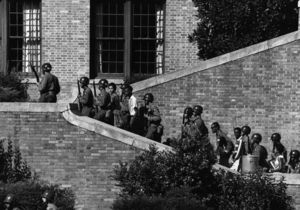
In 1957, Jefferson Thomas and eight fellow black students known as the Little Rock Nine stood up to institutionalized segregation in America‘s education system and helped our nation live up to the promise of Brown v. Board of Education. Thomas passed away, but Change.org Changemaker Marian Wright Edelman writes that his legacy will live on in all who fight for equality.

for the complete article … use the link below

https://www.huffingtonpost.com/marian-wright-edelman/jefferson-thomas-and-the_b_714390.html?ncid=engmodushpmg00000004 via huffingtonpost.com


A Picture Worth a Thousand More …Lonnie G. Bunch at The NMAAHC- Black History


a repost … 2011

Lonnie Bunch, museum director, historian, lecturer, and author, is proud to present A Page from Our American Story, a regular on-line series for Museum supporters. It will showcase individuals and events in the African American experience, placing these stories in the context of a larger story — our American story

Few things date history as readily as fashion. The caveat “that was the fashion of the times” can be applied to everything from bustles and corsets to micro-mini skirts and polyester pants suits — fashions at the turn of the twentieth century and styles created during the 1960s-’70s.

While designs have changed over the years, one thing remained the same: from department store catalogs to high-end fashion magazines, the models dressed in the latest fashions were white.

So it was a major event when Katiti Kironde appeared in the August 1968 issue of Glamour College, the first African American to appear on a American fashion magazine’s cover. Six years later, in August 1974, Beverly Johnson became the first African American woman featured on the cover of Vogue magazine — the industry’s supreme publication. It was another landmark.

Like virtually everything else on the path to equal opportunity for African Americans, progress was slow and came in steps, not leaps. So when an African American woman first appeared in one of the fashion industry’s premier magazines, it was not on a cover or with a huge, multi-page layout.

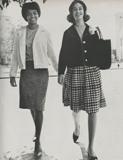
Instead, seven years before Kironde’s Glamour cover, a coed at the University of California at Los Angeles (UCLA), Willette Murphy, quietly appeared on the pages of the August 1961 issue of another hugely popular magazine, Mademoiselle.

Murphy, now Willette Klausner, was pictured wearing a simple skirt, top and jacket, and walking on the UCLA campus. Initially, she viewed the moment as “just another thing I’d done.”

Far from it: Willette Murphy’s appearance in the magazine was not merely “just another thing.” Her Mademoiselle photograph was groundbreaking. Yet, Murphy was unaware of her place in history, until a New York Times’ reporter contacted her family. “I guess my sister found out when the New York Times called my parents,” Klausner said in a published interview.

Her family was used to Willette achieving things African Americans rarely experienced at that time — she was UCLA’s first black senior class president, for example — but the call from the Times made the family realize that their daughter had made history.

For decades, in high powered fashion magazines like Vogue, Glamour and Mademoiselle, to the Sears and Roebuck and other mail order catalogs, to models walking runways in Paris and New York, the face of fashion had been white.

Images of African Americans were scarce even in popular, mainstream American magazines. Many white Americans were shocked when Dorothy Dandridge became the first African American female to appear on the cover of LIFE in November, 1954. It would be nearly four years later before another black American, boxer Sugar Ray Robinson, would find his way onto that magazine’s front page. Another African American female celebrity would not grace LIFE’s cover again until the December 8, 1967 issue which featured Pearl Bailey.

Imagine growing up black and female and seeing dress after dress, swimsuit after swimsuit, shoe after shoe — all pictured only on white women. Along with every other message sent to African Americans, this underscored the sense that African Americans were, to a great degree, nonexistent — even when it came to buying clothes.

Today fashion marketers, like marketers from every other industry, recognize that the face of America is as diverse as its people. They also recognize that African Americans’ buying power was estimated at $913 billion in 2009. A University of Georgia economics study projects that figure will rise to $1.2 trillion in 2013 — nearly 9% of the country’s estimated purchasing strength.

Today the power of the African American pocketbook is reflected on the covers of countless magazines — fashion, entertainment, and political publications which routinely feature black models, entertainers, authors, politicians and more.

Willette Murphy Klausner
Photo Courtesy of Ms. Klausner

Today, it is no longer shocking to walk into a supermarket and find an African American on a magazine cover. In March 2009, First Lady Michelle Obama appeared on the cover of Vogue, only the second first lady to do so. In recent years Vogue has seen a number of black women grace its cover.

Sometimes history is made in giant leaps. More often, however, it is made in smaller, sometimes unexpected steps. Willette Murphy Klausner would become the first black merchandising executive at Bloomingdale’s, later the first female corporate vice president at MCA Universal Studios and, together with Julia Child and Robert Mondavi, the co-founder of the American Institute of Wine and Food in 1981. Today, she is a successful theater producer.

It is her photo in Mademoiselle that we celebrate today. A picture that would launch thousands more.


Lonnie Bunch, Director

All the best,
Lonnie Bunch
Director
P.S. We can only reach our $250 million goal with your help. I hope you will consider making a donation or becoming a Charter Member today.

Dred Scott and Roger B. Taney – The human factor in history


Lonnie Bunch, museum director, historian, lecturer, and author, is proud to present A Page from Our American Story, a regular on-line series for Museum supporters. It will showcase individuals and events in the African American experience, placing these stories in the context of a larger story — our American story.

A Page From Our American Story

On March 6, 1857, in the case of Dred Scott v. John Sanford, United States Supreme Court Chief Justice Roger B. Taney ruled that African Americans were not and could not be citizens. Taney wrote that the Founders’ words in the Declaration of Independence, “all men were created equal,” were never intended to apply to blacks. Blacks could not vote, travel, or even fall in love and marry of their own free will — rights granted, according to the Declaration, by God to all. It was the culmination of ten years of court battles — Dred Scott’s fight to live and be recognized as a free man.

The High Court’s decision went even further, declaring laws that restricted slavery in new states or sought to keep a balance between free and slave states, such as the Missouri Compromise, were unconstitutional. In essence, Black Americans, regardless of where they lived, were believed to be nothing more than commodities.

The Taney court was dominated by pro-slavery judges from the South. Of the nine, seven judges had been appointed by pro-slavery Presidents — five, in fact, came from slave-holding families. The decision was viewed by many as a victory for the Southern “Slavocracy,” and a symbol of the power the South had over the highest court.

The dramatic ripple effect of Dred Scott — a ruling historians widely agree was one of the worst racially-based decisions ever handed down by the United States Supreme Court — reached across the states and territories. It sent shivers through the North and the free African-American community. Technically, no black was free of re-enslavement.

Free Blacks, many of whom had been in Northern states for years, once again lived in fear of being hunted down and taken back to the South in servitude. Southern slave laws allowed marshals to travel north in search of escaped slaves. The ruling was such a concern to Free Blacks, that many seriously considered leaving the United States for Canada or Liberia.

The decision played a role in propelling Abraham Lincoln — an outspoken anti-slavery voice — into the White House. The slavery issue had already created a turbulent, volatile atmosphere throughout the nation. Dred Scott, like kerosene tossed onto a simmering fire, played a significant role in igniting the Civil War. The North became ready to combat what it viewed as the South’s disproportionate influence in government.

The court case lives in infamy today, but few people know much about the actual people involved. I suspect Scott and Taney never imagined they would play such powerful roles in our great American story.

Taney was from Maryland, a slave state, but had long before emancipated his slaves and reportedly paid pensions to his older slaves, as well. As a young lawyer he called slavery a “blot on our national character.” What turned Taney into a pro-slavery advocate is not clear, but by 1857, Taney had hardened, going as far as to declare the abolitionist movement “northern aggression.”

It is reported that Dred Scott was originally named “Sam” but took the name of an older brother when that brother died at a young age. Scott was born into slavery in Virginia around 1800 (birth dates for slaves were often unrecorded), and made his way westward with his master, Peter Blow. By 1830, Scott was living in St. Louis, still a slave to Blow. He was sold to Army doctor John Emerson in 1831 and accompanied him to his various postings — including stations in Illinois and the Wisconsin Territory (what is now Minnesota).

In 1836, Scott married Harriett Robinson. Reports vary on whether she was a slave of Emerson’s prior to the marriage or Emerson purchased her from another military officer after she and Scott had fallen in love. The series of events underscored the painful and difficult lives slaves led. Love, like everything else, was subject to the vagaries of their owners’ dispositions.

Emerson died in 1843, leaving the Scott family to his wife, Irene. Three years later, Scott tried to buy his freedom, but to no avail. Scott’s only recourse was to file suit against Mrs. Emerson. He did so on April 6, 1846, and the case went to a Missouri court the following year. He would lose this case, but win on appeal in 1850. Emerson won her appeal in 1852, and shortly afterward gave the Scotts to her son, John Sanford, a legal resident of New York. Because two states were now involved, Scott’s appeal was filed in federal court in 1854 under the case name of Dred Scott v. John Sanford, the name that came before Taney in 1857.

History is filled with dramatic and strange twists of irony and fate. Those factors can be found throughout Scott’s battle for freedom. Peter Blow’s sons, childhood friends of Scott’s, paid his legal fees. Irene Emerson had remarried in 1850. Her new husband, Massachusetts Congressman Calvin Chaffee, was anti-slavery. Following Taney’s ruling, the now-Mrs. Calvin Chaffee, took possession of Dred, Harriett and their two daughters and either sold or simply returned the family to the Blows. In turn, the Blows freed the Scotts in May, 1857.

Dred Scott, a man whose name is so deeply-rooted in our history, so linked to the war that would end slavery, would die just five months later of tuberculosis. However, he died a free man.

All the best,

Freddie Stowers ~ Honor and recognition Long Overdue – Black History


NMAAHC -- National Museum of African American History and Culture

Lonnie Bunch, museum director, historian, lecturer, and author, is proud to present A Page from Our American Story, a regular on-line series for Museum supporters. It will showcase individuals and events in the African American experience, placing these stories in the context of a larger story — our American story.

A Page From Our American Story

Grave of Cpl Freddie Stowers
Grave of CPL Freddie Stowers
at Meuse-Argonne American Cemetery
in France.

Freddie Stowers, the grandson of a South Carolina slave, holds a unique spot in America’s pantheon of war heroes — as the only African American awarded the Medal of Honor for service in World War I. Stowers’ story, however, must be told in two parts.

The first part of the story is his act of heroism in 1918; the second part is that it took more than 72 years before Stowers finally received the recognition he was due.

The United States was the last major combatant to enter World War I, the “war to end all wars.” The conflict began in Europe in 1914, but in the U.S., isolationist sentiments were strong resulting in a foreign policy of non-intervention. However, in April 1917, after a German U-boat sank the British ship Lusitania, killing 128 Americans on board, President Woodrow Wilson asked Congress to declare war on Germany. Three months later, on July 3, 1917, American troops landed in France.

Corporal Freddie Stowers came to France as part of the all-black Company C, 371st Regiment, 93rd Division that deployed in September, 1918. His service in France was short but courageous and memorable.

More than 50 years after the Civil War, America’s military was still segregated. The French, however, had no such rules, and Stowers and Company C were sent to the front lines to serve alongside French troops.

On September 28, just days after arriving in France, Stowers’ company was in the midst of an attack on Hill 188, Champagne Marne Sector, France, when enemy forces appeared to be giving up.

According to the War Department, German soldiers emerged from their trenches waving a white flag, arms in the air — military actions that signal surrender. It was a ruse, however. As Americans, including Cpl. Stowers, went to capture the “surrendering” Germans, another wave of the enemy arose and opened fire.

Very quickly, Company C’s lieutenant and non-commissioned officers were killed in the fight. This left the 21-year-old Stowers in command. Without hesitation, he implored his men to advance on the Germans.

Stowers would be mortally shot during the exchange. Wounded and dying, Stowers continued to fight on, inspiring his men to push the enemy back. With Stowers leading the counter-attack, Americans took out an enemy machine gun position and went on to capture Hill 188.

Following the battle, Stowers’ commanding officer nominated him for the Medal of Honor, but the nomination was never processed. The Pentagon said the paperwork was misplaced. Some raise the possibility that the nomination wasn’t misplaced at all, but deliberately lost. They point to the fact that American troops were segregated and suggest that racial bias in the military might be the reason for Stowers’ missing paperwork.

The final part of Freddie Stowers’ story begins in 1990. As the Department of Defense began to modernize its data systems, it ordered a review of all battlefield medal nominations. When Stowers’ recommendation was found, the Pentagon quickly took action to give the corporal the long overdue recognition and honor he deserved.

Freddie Stowers MOH Ceremony in 1991.
After the posthumous presentation of the Medal of Honor
to the sisters of Corporal (CPL) Freddie Stowers by
President George H. W. Bush, Mrs. Barbara Bush and
Mary Bowens admire the Medal of Honor certificate.
Ms Bowens is CPL Stowers’ sister. His other sister
Georgina Palmer (far left) looks on. CPL Stowers is the
only Black American to receive the Medal for action during
World War I. Photo: Robert Ward, DOD PA, April 4, 1991.

On April 24, 1991, more than 72 years after Stowers made the ultimate sacrifice for his nation, his sisters Georgiana Palmer and Mary Bowens, 88- and 77-years-old at the time, were presented his Medal of Honor by President George H. W. Bush.

Long before Stowers was honored by his nation, he, along with other members of Company C, received recognition from the French government: “For extraordinary heroism under fire.” Stowers and his unit received the Croix de Guerre – the French War Cross — the highest military medal France awards to allied soldiers.

Prior to World War I, 49 African Americans had been awarded the Medal of Honor, including 25 men who fought for the Union in the Civil War. There were 119 Medals of Honor recipients in World War I, with Stowers being the only African American. His long overdue recognition in 1991 is a small but important sign of the progress we as a nation have made.

Lonnie Bunch, Director All the best,
Lonnie Bunch
Director

P.S. We can only reach our $250 million goal with your help. I hope you will consider making a donation or becoming a Charter Member today.

The National Museum of African American History and Culture is the newest member of the Smithsonian Institution’s family of extraordinary museums.


The museum will be far more than a collection of objects. The Museum will be a powerful, positive force in the national discussion about race and the important role African Americans have played in the American story — a museum that will make all Americans proud.

February: Heritage Month


thefaces

February is African American History Month

The Library of Congress, National Archives and Records Administration, National Endowment for the Humanities, National Gallery of Art, National Park Service, Smithsonian Institution and United States Holocaust Memorial Museum join in paying tribute to the generations of African Americans who struggled with adversity to achieve full citizenship in American society.

Read More »

Art in the Kinsey Collection includes this 1990 woodcut ‘The Faces of My People’ by artist Margaret Burroughs