
Tag Archives: United States

Silicon Valley’s narrative ~~~ On Black folks …ColorOfChange team


In memory …

Silicon Valley has a problem.

Black Twitter

Tell Twitter to disclose its diversity data and host a public forum on making Silicon Valley more inclusive.

Take Action


Last year, when confronted with criticism about his appointment of an all-white, all-male Board of Directors, Dick Costolo – the CEO of Twitter – responded with a dismissive, joking tweet. 

“The whole thing has to be about more than checking a box & saying ‘we did it!’,” he later typed.1

It’s been months now since Costolo’s defensive response and although Twitter later added a white woman to its Board,2 the company has yet to publicly address the failure to appoint a single Black person despite data that confirms that Black folks make up a disproportionate share of Twitter’s user-base.

Much worse, in recent weeks as other Silicon Valley tech companies like Facebook, Yahoo, Google, and LinkedIn took the historic first step to release depressing data about the racial and gender composition of their staffs, Twitter has remained silent — refusing to jump on the data-release-bandwagon.3

That’s why we’re joining with Rev. Jesse Jackson and the Rainbow Push Coalition to call on Twitter to do two things: 1) release its employee diversity numbers immediately and 2) signal its commitment to real inclusion by hosting a public community forum that addresses the company’s plan to recruit and retain more Black talent. Will you join us? It only takes a minute.

Twitter is unlikely to break any trends

To date, most of the data disclosures have confirmed that Silicon Valley prefers its workers to be male and either white or Asian.4, 5 And although Twitter is unlikely to break any diversity trends that have emerged, transparency and a public commitment to improving the recruitment and retention of Black employees are critical first steps.

Though its minority representation numbers may mirror other Silicon Valley tech companies, Twitter has a unique role to play in this national conversation about hiring discrimination. Via the cultural force known as “Black Twitter,” Twitter has been built off the creativity of Black people, though they’re not on the payroll. 6, 7, 8 As such, the company owes our community more — more transparency, and a more thoughtful, solutions-oriented approach that addresses its failure to be more inclusive without blaming Black people.

Shifting the blame

Unfortunately, many of the tech companies (and their pundits) have been quick to incorrectly blame a leaky “talent pipeline” for the extreme racial hiring disparities revealed by these disclosures; pointing to statistics about the dearth of computer science degrees awarded to Black men and women, and bragging about their own philanthropic-investments in tech education for minorities.  Silicon Valley apologists are working to divert blame. 

Completely ignoring the fact that Black people are also severely underrepresented in nontechnical Silicon Valley roles, these blame-shifting tactics are not only misleading, they also serve to reinforce the false and problematic narrative that Black people are simply “unqualified,” undeserving and not valuable — that Black-thought is unqualified, underserving, and not valuable.

We cannot allow a corporate culture that seems hell-bent on making excuses for its replication of tired “good ol’ boy” networks to malign the intellectual and creative capacities of Black people in the process. 

Will you join us in this fight?

Thanks and Peace,

–Rashad, Arisha, Matt, Aimee, Bhavik, and the rest of the ColorOfChange team.
July 17, 2014

References

1.”Twitter CEO Takes Fire Over All Male Board”, ValleyWag, 2013-07-10

2. “Twitter appoints first woman, Marjorie Scardino, to board of directors“, The Washington Post, 2013-11-15

3. “Some in Silicon Valley Publicize Diversity, While Others Shy Away“, U.S. News, 2014-06-18 

4.”Silicon Valley Firms Are Even Whiter and More Male Than You Thought“, Mother Jones, 2014-05-29 

5. “Status Update: Facebook not so diverse“, USA Today, 2014-06-26 

6. “Black Twitter: A virtual community ready to hashtag out a response to cultural issues“, The Washington Post, 2014-01-20. 

7. “Mama I Made It: Pew Poll Study Confirms The Existence of Black Twitter“, okayplayer, 2014-01-01

8. “Black Twitter FINALLY Gets Recognized…so that Twitter can Sell Ads“, ValleyWag, 2014-21-01 

Nativegrl77's avatar

Nativegrl77nativegrl77Edit Profile

Dodd-Frank – The history


By CAP Action War Room

 Congress’ Financial Reform Law Is Doing Important Work

The Dodd–Frank Wall Street Reform and Consumer Protection Act was enacted on July 21, 2010, and signed into law by President Barack Obama

In 2015, Congress’s financial reform law turned five. Dodd-Frank, the massive package of Wall Street reforms passed in the wake of the Great Recession, is massively underrated. The package overhauled the financial sector with the goals of tightening up enforcement and increasing consumer protections.

One major component of the law was the establishment of the Consumer Financial Protection Bureau, or CFPB—the only financial regulator dedicated to protecting consumers. In its four years of existence, the CFPB has helped return more than $10.1 billion to more than 17 million consumers in addition to protecting Americans from predatory lenders and deceptive mortgage practices.

Despite this extraordinary success at keeping Wall Street responsible and protecting hard-working Americans, the law continues to be under attack. In fact, even though Dodd-Frank isn’t even fully in place yet, Congress has tried 139 times to either amend or repeal parts of the law. And the financial industry has spent $3.25 billion to influence the government in the five years since the law was passed. That means that if financial industry spending in the last five years were a country, it would be the 158th largest economy—bigger than 30 developing nations.

The powerful lobby against the rule has been successful in hamstringing the full implementation of the law. As a part of the package, many regulatory agencies were tasked with creating separate rules and because of the excessive lobbying and infighting, there are still 83 separate rules that haven’t been written yet. Included in the unfinished laws, are important rules like mandating disclosure of CEO-to-worker pay ratios and strengthening the controversial “Volcker Rule.”

BOTTOM LINE: We have Dodd-Frank to thank for the common sense reforms that have helped keep Wall Street accountable and level the playing field between consumers and the financial industry. But despite Dodd-Frank’s success, powerful lobby groups and conservative lawmakers have continued to thwart the law’s implementation.


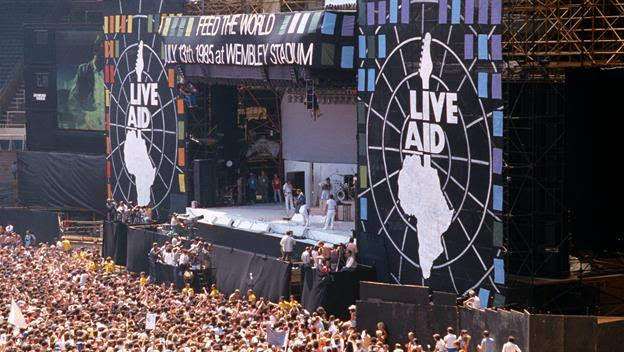
1985 ~On this day ~ Live Aid


On July 13, 1985, at Wembley Stadium in London, Prince Charles and Princess Diana officially open Live Aid, a worldwide rock concert organized to raise money for the relief of famine-stricken Africans. Continued at JFK Stadium in Philadelphia and at other arenas around the world, the 16-hour… read more »

Congress enacts the Northwest Ordinance »

Rockefeller announces new peace proposal »

Live Aid is held simultaneously in London and Philadelphia and broadcast live throughout the world »

Discrimination Beyond Marriage


By

Despite Victory At The Supreme Court, Discrimination Remains Beyond Marriage

It has been less than two weeks since the Supreme Court handed down its landmark decision in Obergefell v. Hodges, granting same-sex couples the freedom to marry nationwide. But despite our progress on marriage equality, LGBT discrimination persists. In 28 states, same-sex couples can now be legally married one day, and then legally fired from their jobs, evicted from their homes, denied credit, or refused services or goods simply because of their sexual orientation. Similarly 31 states lack explicit protections from discrimination based on gender identity in employment, housing, credit and public accommodations. Check out this infographic below for more details. To find out more about the need for nationwide, explicit protections from discrimination for LGBT Americans, check out the infographic below and this report from the Center for American Progress.

BOTTOM LINE: The Court’s decision was a huge step forward for LGBT rights, but the fight is not over. All Americans deserve the opportunity to live free from fear of discrimination.

History ~ July 5, 1852 – What to the American slave is your Fourth of July? … in memory


NMAAHC

Lonnie Bunch, museum director, historian, lecturer, and author, is proud to present A Page from Our American Story, a regular on-line series for Museum supporters. It will showcase individuals and events in the African American experience, placing these stories in the context of a larger story — our American story.

A Page From Our American Story

On July 5, 1852 approximately 3.5 million African Americans were enslaved — roughly 14% of the total population of the United States. That was the state of the nation when Frederick Douglass was asked to deliver a keynote address at an Independence Day celebration.

He accepted and, on a day white Americans celebrated their independence and freedom from the oppression of the British crown, Douglass delivered his now-famous speech What to the Slave is the Fourth of July. In it, Douglass offered one of the most thought provoking and powerful testaments to the hypocrisy, bigotry and inhumanity of slavery ever given.

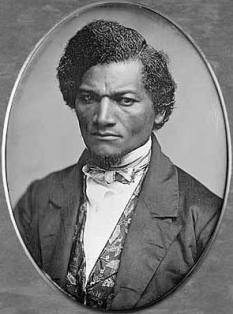
Daguerreotype of Frederick Douglass
(1847-1852) by Samuel J. Miller.
The Art Institute of Chicago

Douglass told the crowd that the arguments against slavery were well understood. What was needed was “fire” not light on the subject; “thunder” not a gentle “shower” of reason. Douglass would tell the audience:

The feeling of the nation must be quickened; the conscience of the nation must be roused; the propriety of the nation must be startled; the hypocrisy of the nation must be exposed; and its crimes against God and man must be denounced.

Frederick Douglass was born into slavery, most likely in February 1818 — birth dates of slaves were rarely recorded. He was put to work full-time at age six, and his life as a young man was a litany of savage beatings and whippings. At age twenty, he successfully escaped to the North. In Massachusetts he became known as a voice against slavery, but that also brought to light his status as an escaped slave. Fearing capture and re-enslavement, Douglass went to England and continued speaking out against slavery.

He eventually raised enough money to buy his freedom and returned to America. He settled in Rochester, New York in 1847 and began to champion equality and freedom for slaves in earnest. By then, his renown extended far beyond America’s boundaries. He had become a man of international stature.

One suspects that Rochester city leaders had Douglass’ fame and reputation as a brilliant orator in mind when they approached him to speak at their Independence Day festivities. But with his opening words, Douglass’ intent became clear — decry the hypocrisy of the day as it played out in the lives of the slaves:

Fellow citizens, pardon me, and allow me to ask, why am I called upon to speak here today? What have I or those I represent to do with your national independence? Are the great principles of political freedom and of natural justice, embodied in that Declaration of Independence, extended to us? And am I, therefore, called upon to bring our humble offering to the national altar, and to confess the benefits, and express devout gratitude for the blessings resulting from your independence to us?

You can easily imagine the wave of unease that settled over his audience. The speech was long, as was the fashion of the day. A link to the entire address can be found at the end of this Our American Story. When you read it you will discover that, to his credit, Douglass was uncompromising and truthful:

This Fourth of July is yours, not mine. You may rejoice, I must mourn … What to the American slave is your Fourth of July? … a day that reveals to him more than all other days of the year, the gross injustice and cruelty to which he is the constant victim. To him your celebration is a sham … your shouts of liberty and equality, hollow mock; your prayers and hymns, your sermons and thanksgivings … hypocrisy — a thin veil to cover up crimes which would disgrace a nation of savages.

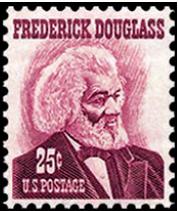
US Stamp honoring
Frederick Douglass, 1967.
US Postal Service

Reaction to the speech was strong, but mixed. Some were angered, others appreciative. What I’ve always thought most impressive about Douglass’ speech that day was the discussion it provoked immediately and in the weeks and months that followed.

Certainly much has changed since Douglass’ speech. Yet the opportunity to discuss and debate the important impact of America’s racial history is very much a part of the National Museum of African American History and Culture. Douglass’ words remind us that many have struggled to ensure that the promise of liberty be applied equally to all Americans — regardless of race, gender or ethnicity. And that the struggle for equality is never over.

So, as we gather together at picnics, parades, and fireworks to celebrate the 4th of July, let us remember those, like Frederick Douglass, who fought and sacrificed to help America live up to its ideals of equality, fair play and justice.

Frederick Douglass’ life and words have left us a powerful legacy. His story, and the African American story, is part of us all.

To you and your family, have a joyous and safe Fourth of July and thank you for your interest in the National Museum of African American History and Culture.

All the best,

Lonnie Bunch
Director

P.S. To read the full text Frederick Douglass’ speech of July 5, 1852, click here: http://teachingamericanhistory.org/library/index.asp?document=162

We hope you will consider making a contribution to the Museum.

a repost – in memory