This post had to be reposted as we count down to the 2022 midterms


|
|

This post had to be reposted as we count down to the 2022 midterms
|
|
First March from Selma
When You Pray, Move Your Feet.
— African Proverb.
Charles White(?), photographer, Selma, Alabama, March 1965.
photo courtesy of Representative John Lewis

John Lewis (on right in trench coat) and Hosea Williams (on the left) lead marchers across the Edmund Pettus Bridge.
On Sunday March 1965, about six hundred people began a fifty-four mile march from Selma, Alabama to the state capitol in Montgomery. They were demonstrating for African American voting rights and to commemorate the death of Jimmie Lee Jackson, shot three weeks earlier by an state trooper while trying to protect his mother at a civil rights demonstration. On the outskirts of Selma, after they crossed the Edmund Pettus Bridge, the marchers, in plain sight of photographers and journalists, were brutally assaulted by heavily armed state troopers and deputies.
One hundred years after the Civil War, in many parts of the nation, the 15th Amendment had been nullified by discriminatory laws, ordinances, intimidation, violence, and fear which kept a majority of African Americans from the polls. The situation was particularly egregious in the city of Selma, in Dallas County, Alabama, where African Americans made up more than half the population yet comprised only about 2 percent of the registered voters. As far back as 1896, when the U.S. House of Representatives adjudicated the contested results of a congressional election held in Dallas County, it was stated on the floor of Congress:
…I need only appeal to the memory of members who have served in this House for years and who have witnessed the contests that time and time again have come up from the black belt of Alabama—since 1880 there has not been an honest election in the county of Dallas…
Hon. W. H. Moody, of Massachusetts
Contested Election Case, Aldrich vs. Robbins, Fourth District, Alabama: Speeches of Hon. W.H. Moody, of Massachusetts [et al.] in the House of Representatives, 3 (2239),
March 12 and 13, 1896.
From Slavery to Freedom, 1824-1909
However, by March 1965, the Dallas County Voters League, the Southern Christian Leadership Council (SCLC), and the Student Nonviolent Coordinating Committee (SNCC) were all working for voting rights in Alabama. John Lewis headed SNCC’s voter registration effort and, in March , he and fellow activist Hosea Williams led the group of silent marchers from the Brown Chapel AME Church to the foot of the Pettus bridge and into the event soon known as “Bloody Sunday.”
Alabama Police Attack Selma-to-Montgomery Marchers,
 Federal Bureau of Investigation photograph
Selma, Alabama, March 7, 1965. — http://www.nps.gov/history/nr/travel/civilrights/al4.htm
“We Shall Overcome”: Historic Places of the Civil Rights Movement — http://www.cr.nps.gov/nr/travel/civilrights/index.htm
When ABC television interrupted a Nazi war crimes documentary, Judgement in Nuremberg, to show footage of violence in Selma a powerful metaphor was presented to the nation. Within forty-eight hours, demonstrations in support of the marchers were held in eighty cities and thousands of religious and lay leaders, including Dr. Martin Luther King, flew to Selma. On March 9, Dr. King led a group again to the Pettus Bridge where they knelt, prayed, and, to the consternation of some, returned to Brown Chapel. That night a Northern minister, who was in Selma to march, was killed by white vigilantes.
Outraged citizens continued to inundate the White House and the Congress with letters and phone calls. On March 9, for example, Jackie Robinson, the baseball hero, sent a telegram to the President:
“IMPORTANT YOU TAKE IMMEDIATE ACTION IN ALABAMA ONE MORE DAY OF SAVAGE TREATMENT BY LEGALIZED HATCHET MEN COULD LEAD TO OPEN WARFARE BY AROUSED NEGROES AMERICA CANNOT AFFORD THIS IN 1965”
In Montgomery, Federal Judge Frank Johnson, Jr. temporarily restrained all parties in order to review the case. And, President Lyndon Johnson addressed the American people before a televised Joint Session of Congress, saying, “There is no issue of States rights or national rights. There is only the struggle for human rights…We have already waited a hundred years and more, and the time for waiting is gone…”
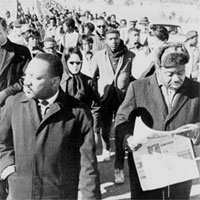
Rev. Ralph Abernathy walking with Dr. Martin Luther King, Jr., as They Lead Civil Rights Marchers out of Camp to Resume Their March
United Press International — http://www.loc.gov/pictures/item/94505571/
Selma to Montgomery, Alabama, March 21-25, 1965.
 New York World-Telegram & Sun Collection,
Prints & Photographs Division — http://www.loc.gov/rr/print/
Allowing CBS footage of “Bloody Sunday” as evidence in court, Judge Johnson ruled on March 17, that the demonstrators be permitted to march. Under protection of a federalized National Guard, voting rights advocates left Selma on March 21 and stood 25,000 strong on March 25 before the state capitol in Montgomery. As a direct consequence of these events, the U.S. Congress passed the Voting Rights Act of 1965, guaranteeing every American twenty-one and over the right to register to vote. During the next four years the number of U.S. blacks eligible to vote rose from 23 to 61 percent.
John Lewis went on to serve as Director of the Voter Education Project, a program that eventually added nearly four million minorities to the voter rolls. To mark the thirty-fifth anniversary of “Bloody Sunday,” on March 7, 2000, Lewis, a U.S. Congressman from Atlanta’s 5th District, and Hosea Williams crossed the Pettus Bridge accompanied by President William Clinton, Coretta Scott King, and others. Asked to contrast this experience with that of 1965 the Congressman responded, “This time when I looked there were women’s faces and there were black faces among the troopers. And this time when we faced them, they saluted.”
•American Treasures is an exhibition of special items in the Library of Congress collections. The exhibition is divided into four sections: Top Treasures, Memory, Imagination, and Reason. The latter includes images taken about 1963 by Danny Lyon, staff photographer for SNCC, a key organizing body during the Civil Rights Movement.
•Search on the term Selma, Alabama in the black and white photos of the Farm Services Administration collection, FSA/OWI Photographs, 1935-1945 to see images of the city taken during the 1930s by the photographer Walker Evans. Search on Alabama to see images taken by the FSA photographers Dorothea Lange, Arthur Rothstein, Marion Post Wolcott, and Carl Mydans.
•The Great Migration made northerners more aware of disenfranchisement in the Deep South and newspapers like The Gazette and The Advocate fostered awareness within the black community. Search on the term vote in African-American Experience in Ohio, 1850-1920 to view about 100 items that address the issue. See, for example, the 1887 article “Negro Voting Power” and the 1888 article “First Colored Voter.” The poet Paul Lawrence Dunbar mentions Alabama disenfranchisement in his article “Paul Dunbar’s Protest.”
•Music drawn from a tradition of Southern spirituals helped sustain the Civil Rights Movement. Search on the term spiritual in the John Lomax and Ruby Terrel Lomax collection Southern Mosaic to hear some of the tunes which comprise that tradition. Listen, for example, to versions of “This Little Light of Mine,” “Long Way to Travel,” and “Great Day” as they were rendered in the South back in 1939.
•Images of 20th Century African American Activists: A Select List presents frequently requested images from the Prints & Photographs Division of the Library. Except where otherwise noted in the “Reproduction Number” line, images are considered to be in the public domain. The selection includes images of Martin Luther King, John Lewis, and Ralph Abernathy.
•Search the Today in History Archive on the term states rights to learn more about an issue which lay at the heart of the American system. Ironically, on March 7, 1850, (exactly 115 years before “Bloody Sunday”) Daniel Webster gave his famous “Seventh of March speech” in favor of the Compromise of 1850, which, while it postponed the Civil War, strengthened states’ rights at the cost of African-American freedom. Search on the term Alabama to learn more about events in the state, such as the arrest of Rosa Parks.
•With the exception of Concord Bridge, where the American Revolution began, no bridge in America marks an event as historically momentous as that marked by the Edmund Pettus Bridge. Nevertheless, search across the Photos and Prints section of American Memory on the term bridge to see a wide array of other bridges. See, for example, Burnside’s Bridge (fought over during the Battle of Antietam), a Covered Bridge in Vermont, and the Locust St. Bridge in Des Moines, Iowa. Also search the Today in History Archive on the term bridge to read features on the Brooklyn Bridge, Williamsburg Bridge, and Golden Gate Bridge.
 Daniel Webster
I wish to speak today; not as a Mass[achusetts] man – nor a Northern man – but as an American, & a member of the Senate of the U[nited] S[tate]s.
Daniel Webster’s notes for his speech to the United States Senate favoring the Compromise of 1850, March 7, 1850.
Words and Deeds in American History: Selected Documents Celebrating the Manuscript Division’s First 100 Years
Daniel Webster
produced by Mathew Brady’s studio, circa 1851-1860.
America’s First Look into the Camera: Daguerrotype Portraits and Views, 1839-1864
The acquisition of territory following the U.S. victory in the Mexican War revived concerns about the balance of free and slave states in the Union. On March 7, 1850, Senator Daniel Webster delivered his famous “Seventh of March” speech urging sectional compromise on the issue of slavery. Advising abolition-minded Northerners to forgo antislavery measures, he simultaneously cautioned Southerners that disunion inevitably would lead to war.
Following the lead of senators Henry Clay and Stephen Douglas, Webster endorsed Clay’s plan to assure sectional equilibrium in Congress. Passed after eight months of congressional wrangling, the legislation admitted California to the Union as a free state, permitted the question of slavery in Utah and New Mexico territories to be decided by popular sovereignty, settled Texas border disputes, and abolished slave trading in the District of Columbia while strengthening the Fugitive Slave Act.
The legislative package known as the Compromise of 1850 postponed the Civil War by a decade. However, like the 1820 Missouri Compromise, the Compromise of 1850 failed to resolve the question of slavery in a meaningful way. Over the course of the 1850s, the inadequacies of both measures were made painfully clear. “Popular sovereignty” undermined the Missouri compromise by suggesting the earlier division of the country along the thirty-sixth parallel into free states and slave states no longer applied. Indeed, the Kansas-Nebraska Act of 1854 permitted slavery. The resulting bloodshed in Kansas, like later incidents at Harper’s Ferry, presaged the violent conflict of the Civil War.
 Henry Clay
produced by Mathew Brady’s studio, circa 1850-1852.
America’s First Look into the Camera: Daguerrotype Portraits and Views, 1839-1864
Incidents of the War. A Harvest of Death, Gettysburg, July 1863.
Timothy H. O’Sullivan, photographer.
Selected Civil War Photographs
•Words and Deeds in American History: Selected Documents Celebrating the Manuscript Division’s First 100 Years , an online display of approximately ninety representative documents preserved by the Manuscripts Division, Library of Congress, includes features on John C. Calhoun’s speech to the United States Senate against the Compromise of 1850 and Henry Clay’s appointment as secretary of state on March 7, 1825.
•Read the Documentary History of Slavery in the United States by John Larkin Dorsey. A contemporary of Webster and Clay, Dorsey reviews slavery in the U.S. from 1774 and the Continental Congress to 1850 with special attention to the Fugitive Slave Law of 1850 and the probable dissolution of the Union. Search African American Perspectives: Pamphlets from the Daniel A. P. Murray Collection, 1818-1907 on slavery to access this document and many more.
•For more information about the movement to abolish slavery, visit the Abolition section of African American Odyssey, and the Abolition section of The African-American Mosaic as well. Also, read the Today in History features on Abolition in the District of Columbia , and on the abolitionists Lucretia Coffin Mott, and Elijah Parish Lovejoy.
•Browse The Frederick Douglass Papers. Many remarkable items are included in the papers of this nineteenth-century African-American abolitionist who escaped from slavery and then risked his own freedom by becoming an outspoken antislavery lecturer, writer, and publisher. The papers are divided into a series of nine sets. Set nine, for example, contains a booklet entitled Two Speeches by Frederick Douglass (on West Indian Emancipation and the Dred Scott Decision).
•A search on Daniel Webster in American Memory collections yields more than 2,000 items—including correspondence, speeches, images of statues, and even sheet music.
* Developed by the U.S. Department of Interior, National Park Service, U.S. Department of Transportation, The Federal Highway Administration, and the National Conference of State Historic Preservation Officers.
Black History Month
 the Senate Convened at 10:00amET October 13, 2011
Upon the use or yielding back of time (at approximately 2:00pm), the Senate proceed to vote on confirmation of the nominations. The Forrest nomination is expected to be confirmed by voice vote. Therefore, 2 roll call votes are expected at approximately 2:00pm on confirmation of the Nathan and Hickey nominations.
VOTES
2:00pm The Senate began a roll call vote on confirmation of the nomination of
Alison Nathan, of New York, to be U.S. District Judge for the Southern District
of New York; Confirmed: 48-44
2:25pm The Senate began a roll call vote on confirmation of the nomination of
Susan Owen Hickey, of Arkansas, to be U.S. District Judge for the Western
District of Arkansas. Confirmed: 83-8
LEGISLATIVE
ITEMS
Adopted S.Con.Res.31, Directing the Secretary of the Senate to make a
correction in the enrollment of S.1280.
Adopted S.Res.293, celebrating the 10-year commemoration of the Underground
Railroad Memorial, comprised of the Gateway to Freedom Monument in Detroit,
Michigan and the Tower of Freedom Monument in Windsor, Ontario, Canada.
EXECUTIVE
ITEMS
Confirmed Calendar #253, Katherine B. Forrest, of NY, to be US District Judge
for the Southern District of New York by voice vote
Confirmed #287 Sung Y. Kim – to be Ambassador Extraordinary and
Plenipotentiary of the United States of America to the Republic of Korea
—————–
CURRENT HOUSE FLOOR PROCEEDINGS
LEGISLATIVE DAY OF OCTOBER 13,
2011 112TH CONGRESS – FIRST SESSION
-The House adjourned. The next meeting is scheduled for 9:00 a.m. on October 14, 2011.9:59:29 P.M. -On motion to adjourn Agreed to by voice vote.9:59:11 P.M. -Mr. Gohmert moved that the House do now adjourn.7:59:52 P.M. -SPECIAL ORDER SPEECHES – The House has concluded all anticipated legislative business and has proceeded to Special Order speeches.7:56:37 P.M. -ONE MINUTE SPEECHES – The House proceeded with further one minute speeches.7:55:35 P.M. -H.R. 2250Motion to reconsider laid on the table Agreed to without objection.7:55:35 P.M. -H.R. 2250On passage Passed by recorded vote: 275 – 142 (Roll no. 791).7:48:27 P.M. -H.R. 2250On motion to recommit with instructions Failed by recorded vote: 170 – 246 (Roll no. 790).7:32:01 P.M. -H.R. 2250The previous question on the motion to recommit with instructions was ordered without objection.7:22:05 P.M. -H.R. 2250DEBATE – The House proceeded with 10 minutes of debate on the Castor motion to recommit. The instructions in the motion seek to report the same back to the House with an amendment to require the EPA Administrator not delay action to reduce air pollution from waste incinerators that are within 5 miles of any nursing home, assisted living facility or hospital. The amendment also states that any facility that will have regulation of its air pollutant emissions delayed is required to notify affected communities no later than 90 days after the date of enactment.7:20:43 P.M. -H.R. 2250Ms. Castor (FL) moved to recommit with instructions to Energy and Commerce.7:19:06 P.M. -H.R. 2250Considered as unfinished business. H.R. 2250 — “To provide additional time for the Administrator of the Environmental Protection Agency to issue achievable standards for industrial, commercial, and institutional boilers, process heaters, and incinerators, and for other purposes.”7:18:51 P.M. -H.R. 358Motion to reconsider laid on the table Agreed to without objection.7:18:50 P.M. -H.R. 358On passage Passed by recorded vote: 251 – 172 (Roll no. 789).7:12:12 P.M. -H.R. 358On motion to recommit with instructions Failed by the Yeas and Nays: 173 – 249 (Roll no. 788).6:47:55 P.M. -H.R. 358The previous question on the motion to recommit with instructions was ordered without objection.6:40:17 P.M. -H.R. 358DEBATE – The House proceeded with 10 minutes of debate on the Capps motion to recommit with instructions. The instructions in the motion seek to report the same to the House with an amendment to add language stating that no hospital or health care provider can be exempted from any Federal or State law that requires them to provide any medical examination, treatment, referral, or transfer to prevent the death of a pregnant woman with an emergency medical condition.6:39:54 P.M. -H.R. 358Mrs. Capps moved to recommit with instructions to Energy and Commerce.6:39:31 P.M. -H.R. 358The previous question was ordered pursuant to the rule.5:20:54 P.M. -H.R. 358DEBATE – The House proceeded with one hour of debate on H.R. 358.5:20:15 P.M. -H.R. 358Rule provides for consideration of H.R. 358 with 1 hour of general debate. Previous question shall be considered as ordered without intervening motions except motion to recommit with or without instructions. Measure will be considered read. Bill is closed to amendments. The resolution provides that the amendment in the nature of a substitute recommended by the Committee on Energy and Commerce now printed in the bill shall be considered as adopted.5:20:10 P.M. -H.R. 358Considered under the provisions of rule H. Res. 430. H.R. 358 — “To amend the Patient Protection and Affordable Care Act to modify special rules relating to coverage of abortion services under such Act.”5:19:50 P.M. -PRINTING OF PROCEEDINGS IN RECORD – Mr. Pitts asked unanimous consent that the proceedings had during the recess be printed in the Congressional Record of today. Agreed to without objection.5:19:40 P.M. -The House convened, returning from a recess continuing the legislative day of October 13.4:53:59 P.M. -The Speaker announced that the House do now recess. The next meeting is subject to the call of the Chair.4:53:34 P.M. -JOINT MEETING DISSOLVED – The Speaker announced that the Joint Meeting was dissolved. The House remains in recess subject to the call of the Chair.3:49:33 P.M. -JOINT MEETING – The House has reconvened in Joint Meeting with the Senate to receive an address by His Excellency Lee Myung-bak, President of Republic of Korea.3:48:00 P.M. -The House convened, returning from a recess continuing the legislative day of October 13.2:27:32 P.M. -The Speaker announced that the House do now recess The House will reconvene in Joint Meeting with the Senate for the purpose of receiving His Excellency Lee Myung-bak, President of the Republic of Korea. The next meeting is subject to the call of the Chair.2:26:50 P.M. -H.R. 2250POSTPONED PROCEEDINGS – Pursuant to clause 1(c) of Rule 19, further proceedings on H.R. 2250 were postponed.2:25:38 P.M. -H.R. 2250The House adopted the amendment in the nature of a substitute as agreed to by the Committee of the Whole House on the state of the Union.2:25:24 P.M. -H.R. 2250The House rose from the Committee of the Whole House on the state of the Union to report H.R. 2250.2:25:00 P.M. -H.R. 2250On agreeing to the Energy and Commerce amendment; Agreed to by voice vote.2:25:00 P.M. -H.R. 2250Amendment in the nature of a substitute reported by the House Committee on Energy and Commerce.2:24:23 P.M. -H.R. 2250On agreeing to the Cohen amendment; Failed by recorded vote: 174 – 250 (Roll no. 787).2:07:59 P.M. -UNFINISHED BUSINESS – The Chair announced that the unfinished business was on the adoption of an amendment which had been debated earlier and on which further proceedings had been postponed.2:07:19 P.M. -H.R. 2250The House resolved into Committee of the Whole House on the state of the Union for further consideration.2:07:08 P.M. -H.R. 2250Considered as unfinished business. H.R. 2250 — “To provide additional time for the Administrator of the Environmental Protection Agency to issue achievable standards for industrial, commercial, and institutional boilers, process heaters, and incinerators, and for other purposes.”2:06:20 P.M. -H. Res. 430Motion to reconsider laid on the table Agreed to without objection.2:06:18 P.M. -H. Res. 430On agreeing to the resolution Agreed to by the Yeas and Nays: 248 – 173 (Roll no. 786).1:43:01 P.M. -H. Res. 430The previous question was ordered without objection.12:24:59 P.M. -H. Res. 430DEBATE – The House proceeded with one hour of debate on H. Res. 430.12:24:58 P.M. -H. Res. 430Considered as privileged matter. H. Res. 430 — “Providing for consideration of the bill (H.R. 358) to amend the Patient Protection and Affordable Care Act to modify special rules relating to coverage of abortion services under such Act.”12:23:12 P.M. -H. Res. 430On motion to consider the resolution Agreed to by voice vote.12:22:09 P.M. -H. Res. 430At the conclusion of debate on the Moore point of order, the Chair put the question on consideration of the resolution.12:01:48 P.M. -H. Res. 430POINT OF ORDER AGAINST CONSIDERATION – Ms. Moore stated that the provisions of H. Res. 430 violate section 426(a) of the Congressional Budget Act of 1974 by imposing an unfunded mandate and made a point of order against consideration of the resolution. Subsequently, the Chair noted that the required threshold of identifying the specific language in question had been met, and the House proceeded with 20 minutes of debate on the question of consideration. At the conclusion of debate on the question of consideration, the Chair will put the question to wit: Will the House now consider the resolution?12:00:48 P.M. -H. Res. 430By direction of the Committee on Rules, Ms. Foxx called up the resolution, H. Res. 430, and asked for its immediate consideration.11:33:47 A.M. -ONE MINUTE SPEECHES – The House proceeded with one minute speeches which by direction of the Chair, would be limited to 15 per side of the aisle.11:33:37 A.M. -The House received a message from the Clerk. Pursuant to the permission granted in Clause 2(h) of Rule II of the Rules of the U.S. House of Representatives, the Clerk notified the House that she had received the following message from the Secretary of the Senate on October 13, 2011 at 9:20 a.m.: That the Senate passed H.R. 3078, H.R. 3079, and H.R. 3080.11:32:21 A.M. -The Speaker recognized Rep. Gregorio Kilili Camacho Sablan for one minute for the purpose of introducing the guest Chaplain.11:31:39 A.M. -PLEDGE OF ALLEGIANCE – The Chair designated Ms. Hochul to lead the Members in reciting the Pledge of Allegiance to the Flag.11:31:34 A.M. -The Speaker announced approval of the Journal. Pursuant to clause 1, rule I, the Journal stands approved.11:31:23 A.M. -Today’s prayer was offered by Reverend Jesse Reyes, San Jose Catholic Church, Saipan, Northern Mariana Islands.11:30:17 A.M. -The House convened, returning from a recess continuing the legislative day of October 13.10:44:00 A.M. -The Speaker announced that the House do now recess. The next meeting is scheduled for 11:30 a.m. today.9:30:42 A.M. -MORNING-HOUR DEBATE – The House proceeded with Morning-Hour Debate. At the conclusion of Morning-Hour, the House will recess until 11:30 a.m. for the start of legislative business.9:30:27 A.M. -The Speaker designated the Honorable Steven M. Palazzo to act as Speaker pro tempore for today.9:30:14 A.M. -The House convened, starting a new legislative day.

yep, just another rant … Please Vote to keep #BidenHarris intact in 2022! This is a post from 2013 tweaked
The 113th-116th Congress’ are long gone, but it should be noted they were “in session” or “at work” fewer days than most of their constituents, even with the attack of #Covid-19 … the people they seem to keep saying depend on,” the government tit for entitlements,” then without remorse proceed to vote against the average voter and their lives … some Republicans call “average voter” their constituents lazy and these constituents continue to vote against their best interests? I still cannot understand this. The nonsense continued with the 114th, 115th, 116th Congress, and now here we are with the 117th Congress. Thank goodness, the 117th Congress is mostly a predominantly Democratic Party. We have a slim but winning trifecta. We all must support trust and push for great policies that help ALL, Not a select few, in America.
Furthermore, we the people were governed by a guy with no political experience; seemingly no sense of real loyalty to what most of us call #AmericanValues, doesn’t seem to be a true Republican or a person who leans left though the fact is he has given $$ to both, he said a lot, done little though the executive orders he once hated when President Obama was in office came fast hard and against We The People. His comments for the action are incoherent at times and a lot of those policies will be doing some damage shortly… btw, can somebody tell this to trump voters, who while now possibly are all insurrectionists; most will still reap the benefits the rest of us vote for and that is offensive. The trifecta he held, aka our 3 branches of government, was capable of doing the right thing, but they decided slashing, burning, cutting average voter lives to shreds, stalled CHIP, and holding DACA/Dreamers politically hostage was better for their agenda. This group once called DACA kids #incrediblekids now saying on every platform possible that they are bad folks, illegals, criminals, and murderers. This trifecta government held a lot of secret meetings, seemingly making secret deals constantly; lest we understand or accept that all of this talk is not only cheap … The truth is being manipulated and what most of us know as the truth has officially become known as “alternative facts” … sigh
What happened to Congress?
It should make Americans all wonder if $175K for members of Congress is just too much for public servants that work less than 120 days a year as members of Congress, led by Republicans. The thing is they seem to think the rest of us need 2 maybe 3 jobs, and deserve less social services among some other stupid things like fewer migrant families, though reports are that the Trump administration has requested foreign workers for Mar-a-Lago numerous times a year. I am SMH. While I am not an expert, it is certainly important to know our GDP will suffer if he goes full out to ban the browns and blacks
Yes, it is time to breathe in slowly and slowly release your breath … be still, then repeat the process when needed as insanity in the News, and Politics begins to try and make viewers accept the trump era as valid that “alternative facts” are real while the extreme right puts it on loop mode. The idea that Americans should just trust anyone on a news platform and or in the highest office or a member of Congress at face value is a joke especially when that looks like “performance art” seeming not only like they believe what they are saying but assume that no one is paying attention to their behavior on the floor of Congress because they certainly act like we all have amnesia every time they get a chance to be hooked up to a mic!
So, again … Congress, if led by republicans will say one thing while in front of the camera while planning a takedown in secret rooms; tossing their titles of Public Servant down the nearest sewer which makes you wonder how we will ever pass the Voters Right Act, immigration reform and other bills For Americans when a good faith effort is kept off the floor of Congress because of political competition and poison pill amendments added. There was a time when we would tell the Republican Party they need to be more inclusive because trust, respect, and future votes are not seasonal or easily earned, nor should they be. The current Republican Party has many leaving, stating this party is no longer worthy … due to white nationalism or something even worse.
Who else felt like the era of trump while not over per se, his reign as POTUS felt so much longer than four years
on 1/6/21, the ugly happened
The fact is, the era of trump created misguided, awful people gullible to false misleading information and some were just waiting for this guy to finally arrive. We have seen a lot of divisive behavior since 2016, which makes a left-leaning voter wonder, can Republicans continue on this path, continue to get away with so much, and not pay for the BS that happened in the 2016 or 2020 elections and at the DC Mall? Okay, I don’t know about you, but the number of times I actually had to stop and take a deep breath as we watched the government of trump try to take our country beyond the extreme right rivals the number of times we had to listen to Republicans continue to say one thing in front of the camera while voting the opposite on the floor of Congress. Some of us watched in horror as they acted; remember (acted) like they plan to be bipartisan, but they continued to show themselves to be less than trustworthy, less than bipartisan and their votes … Please check any and all republican members voting records! This is proof of how they actually feel about constituents that cannot be denied or overlooked.
Republicans have been waiting for a trifecta that allows them to vote and pass bills without hearings or much debate. So, folks must call your member of Congress because the next generation is counting on us because climate change is real, Women deserve reproductive rights, the voting rights act should be permanent, immigration reform and a real jobs act is the American path toward Stability, not Austerity though Republicans seem to keep pushing or that 2007 financial collapse just didn’t impact them enough
– When you’re a rich member of Congress; you tend to say, do as We say Not as we do, and they continue to Vote as they want or get paid to vote NOT the way they sold/ran their campaign on
I want America to wake up, push back, and demand all members of Congress do the People’s business
#VotingMatters
Republicans see themselves as stewards of the purse strings in the House of Representatives, but it does not give them the right to toss #WeThePeople under the bus, who as taxpayers give them not only a salary but government healthcare?
All elections from here on will decide what kind of life we all want our next generation to navigate through … please take the time to understand what and who is causing America to decline at this time … The House of Representatives holds the American #PurseStrings which is why Americans have been held, hostage when Republicans are given that task to govern… try leaning left
Nativegrl77


 Be a Seed for Change
You must be logged in to post a comment.