|
||||||||||||||
|
Tag Archives: United States
Civil Rights Groups Expect Swell of Support ~Black History Month

Rights Act decision and Trayvon Martin case have galvanized many
By Elizabeth Flock
The Rev. Dr. Martin Luther King Jr. gestures during his “I Have a Dream” speech at the March on Washington on Aug. 28, 1963. Some at the National Urban League conference have called for another such march in the wake of the Trayvon Martin verdict and the Supreme Court’s decision on the Voting Rights Act.
PHILADELPHIA – The 50th anniversary of the March on Washington was intended to be a look back on the historic march of 1963 and Dr. Martin Luther King Jr.’s “I Have a Dream” speech during the height of the civil rights movement.
But the recent Supreme Court decision that struck down a key provision of the Voting Rights Act coupled with the “not guilty” verdict in the shooting death of Trayvon Martin has lent new urgency and more participants to the anniversary event, according to groups involved.
[PHOTOS: Joe Biden Leads Re-enactment of Voting Rights March]
In Philadelphia, where the National Urban League is holding its annual conference on Thursday and Friday, president Marc Morial says that both the conference and march have changed in focus and in tenor because of “what’s happened in the last 30 days.”
“The Voting Rights Act decision [and] the Trayvon Martin tragedy [have] created a different mood among the people who are here. It’s a different kind of focus in their hearts and minds,” he says. “It’s a different enthusiasm.”
Some of that emotion, he says, has shown itself in the form of renewed distrust in the criminal justice system. Several panels at the conference also expressed frustration with the Supreme Court. And in a speech at the conference Thursday morning, Barbara Arnwine, executive director of the Lawyers Committee for Civil Rights Under Law, was greeted by frustrated cheers when she told the crowd she’d better see them at the 50th anniversary march next month.
[READ: Holder Says Texas Must Get Pre-Approval Before Changing Voting Laws]
But Morial hopes those frustrations can be channeled into calls for action at the march: for a congressional fix to the Voting Rights Act, a hard look at the criminal justice system after the Trayvon Martin case and a plan for dealing with the lack of employment in minority communities.
The National Urban League is just one of some two dozen civil and human rights groups involved in the event. Five participating groups took part in the original 1963 march, but many more are new, including Rev. Al Sharpton‘s National Action Network, which has 40 chapters across the country, the National Council of Churches, which includes 100,000 local congregations, and the National Park Service.
“There were 250,000 people in 1963,” says Morial. “It remains to be seen this time… [But] these recent events have been encouragement for more people to attend.”
Black History Month …a repost
by whitehouseon Feb 9, 2012 still rings true
African American History Month honors the rich legacy of African Americans throughout our nation’s history. This year’s theme recognizes the unique contributions of African American women. February 9, 2012.
The Only African American Automobile Company! ~~ Lonnie G. Bunch at The NMAAHC- in memory of Black History
| Lonnie Bunch, museum director, historian, lecturer, and author, is proud to present A Page from Our American Story, a regular on-line series for Museum supporters. It will showcase individuals and events in the African American experience, placing these stories in the context of a larger story — our American story. | ||||
| A Page From Our American Story | ||||
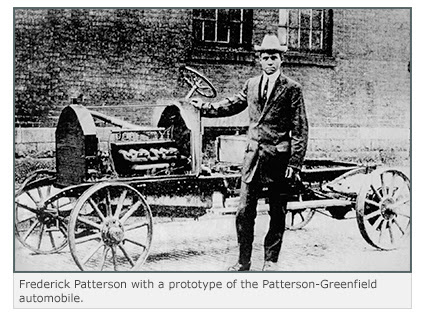
At the dawn of the Automobile Age in the early 20th century, hundreds of small auto companies sprouted up across America as entrepreneurs recognized that society was transitioning from horse-drawn carriages to transportation powered by the internal combustion engine. Some of these early companies grew to become giants that are still with us today, such as Ford and Chevrolet. Many others remained small, struggling to compete against the assembly lines of the larger manufacturers.One such company was C.R. Patterson & Sons of Greenfield, Ohio, makers of the Patterson-Greenfield automobile from 1915 to 1918. Though its name is little recognized today, there is in fact a very important reason to ensure that it is not lost to history: it was, and remains to this day,the only African American owned and operated automobile company.
Charles Richard Patterson was born into slavery on a Virginia plantation in 1833. Not much is known about his life on the plantation, and historians have to sift through conflicting reports about how he came to settle in Greenfield, Ohio, a town with strong abolitionist sympathies. Some say his family arrived in the 1840s, possibly after purchasing their freedom; others suggest Patterson alone escaped in 1861. In any case, he learned the skills of the blacksmith and found work in the carriage-making trade, where he developed a reputation for building a high quality product. In 1873, he formed a business partnership with another carriage maker in town, J.P. Lowe, who was white, and eventually became sole proprietor of the renamed C.R. Patterson & Sons in 1893. It was a successful business employing an integrated workforce of 35-50 by the turn of the century, and Charles Patterson became a prominent and respected citizen in Greenfield. His catalog listed some 28 models, from simple open buggies to larger and more expensive closed carriages for doctors and other professionals. When Patterson died in 1910, the business passed to his son Frederick, who was already something of a pioneer. He was college-educated and was the first black athlete to play football for Ohio State University. He was also an early member and vice president of the National Negro Business League founded by Booker T. Washington. Now, as owner and operator of the enterprise his father started, Frederick Patterson began to see the handwriting on the wall: the days of carriages and horse-drawn buggies were nearing an end.
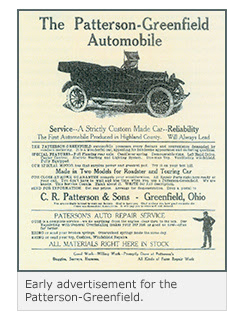
This valuable experience allowed C.R. Patterson & Sons to take the next great step in its own story as well as in African American history: in 1915, it announced the availability of the Patterson-Greenfield automobile at a price of $685. From the company’s publicity efforts, it is evident they were bursting with pride: “Our car is made with three distinct purposes in mind. First — It is not intended for a large car. It is designed to take the place originally held by the family surrey. It is a 5-passenger vehicle, ample and luxurious. Second — It is intended to meet the requirements of that class of users, who, though perfectly able to spend twice the amount, yet feel that a machine should not engross a disproportionate share of expenditure, and especially it should not do so to the exclusion of proper provisions for home and home comfort, and the travel of varied other pleasurable and beneficial entertainment. It is a sensibly priced car. Third — It is intended to carry with it (and it does so to perfection) every conceivable convenience and every luxury known to car manufacture. There is absolutely nothing shoddy about it. Nothing skimp and stingy.”
The initial hope and optimism, however, proved to be fairly short-lived. In an age of increased mechanization and production lines, small independent shops featuring hand-built, high quality products weren’t able to scale up production or compete on price against the rapidly growing car companies out of Detroit. In small quantities, parts and supplies were expensive and hard to come by when major manufacturers were buying them by the trainload at greatly reduced costs. Plus, the labor hours per car were much higher than that of assembly line manufacturers. As a result, the profit margin on each Patterson-Greenfield was low.
Sadly, no Patterson-Greenfield automobiles are known to survive today. But we should not let that dim the fact that two great entrepreneurs, Charles Richard Patterson and his son Frederick Patterson built and sustained a business that lasted several generations and earned a place not just in African American history, but in automotive history as well.
The National Museum of African American History and Culture is the newest member of the Smithsonian Institution’s family of extraordinary museums. The museum will be far more than a collection of objects. The Museum will be a powerful, positive force in the national discussion about race and the important role African Americans have played in the American story — a museum that will make all Americans proud. P.S. We can only reach our $250 million goal with your help. I hope you will consider making a donation or becoming a Charter Member today. |
||||
The March on Washington by Linda Lacina …Black History is American History

This week marks the 50th anniversary of the March on Washington where Martin Luther King Jr. made his now legendary “I Have a Dream” speech.
That event on Aug. 28, 1963, drew 200,000 people to the National Mall in Washington, D.C., to press for issues that are just as relevant today, including civil liberties and a rise in the minimum wage. This week’s milestone gives us a chance to reacquaint ourselves with the great steps taken at this event as well as the inspiring words spoken and sung on that historic day. Below is a selection of inspiring excerpts from that day’s speeches and performances.

Josephine Baker, the world-renowned singer and actress, had long since adopted France as her homeland and had even joined the French Resistance. Still, she was an active supporter of the American civil rights movement and was the only woman to address the crowd at the National Mall. An excerpt of her remarks is below.
“You know, friends, that I do not lie to you when I tell you I have walked into the palaces of kings and queens and into the houses of presidents. And much more. But I could not walk into a hotel in America and get a cup of coffee, and that made me mad. And when I get mad, you know that I open my big mouth. And then look out, ’cause when Josephine opens her mouth, they hear it all over the world.”

John Lewis, currently a U.S. Representative for Georgia’s 5th congressional district, was 23 at the time of the March on Washington and the youngest speaker to come to the podium. He represented the Student Non-violent Coordinating Committee as its chairman and was one of the original “big six” organizers of the march. An excerpt is below.
“To those who have said, “Be patient and wait,” we must say that we cannot be patient. We do not want our freedom gradually but we want to be free now. We are tired. We are tired of being beat by policemen. We are tired of seeing our people locked up in jail over and over again, and then you holler ‘Be patient.’ How long can we be patient? We want our freedom and we want it now.”
For a full transcript and audio, visit Open Vault.

Walter P. Reuther, the UAW president, was no stranger to the era’s civil rights rallies. He’d accompanied Martin Luther King Jr. to events including one in Alabama where the crowd was doused by the police with fire hoses and King was placed in jail. After the demonstration, Reuther bailed him out.
Many civil rights mobilizers were labor activists and the UAW let planners for the March on Washington work out of its union halls and even paid for the event’s sound system. Below is an excerpt from Reuther’s remarks.
“I am for civil rights, as a matter of human decency, as a matter of common morality. But I am also for civil rights because I believe that freedom is an indivisible value that no one can be free unto himself. And when Bull Connor with his police dogs and fire hoses destroys freedom in Birmingham, he is destroying my freedom in Detroit. And let us keep in mind, since we are the strongest of the free nations of the world, since you cannot make your freedom secure, accepting as we make freedom universal, so all may enjoy its blessings, let us understand that we cannot defend freedom in Berlin, so long as we deny freedom in Birmingham.”
For a full transcript and audio, visit Open Vault.

James Farmer was a prominent activist who organized the first 1961 Freedom Ride for desegregation and founded the Committee for Racial Equality. Like many protesters, Farmer was often arrested for his activist work and could not attend the March on Washington because he had been imprisoned for “disturbing the peace” in Plaquemine, La. In his absence, Floyd McKissick, the National Chairman of the Congress on Racial Equality, read Farmer’s prepared remarks. An excerpt is below.
“By marching on Washington, your trampin’ feet have spoken the message, the message of our struggle in Louisiana. You have given notice of the struggles of our people in Mississippi and Alabama too, and in California, and in New York, and Chicago, and in Brooklyn. You have come from all over the nation, and in one mighty voice, you have spoken to the nation.
You have also spoken to the world. You have said to the world by your presence here, as our successful direct action in numberless citizens has said that in the age of thermal nuclear bombs, violence is outmoded to the solution of the problems of men.”
A full transcript can be found in the archives at The King Center.

Singers Bob Dylan and Joan Baez were both prominent in the Civil Rights movement and performed a number of folk songs at the march. As a solo, Dylan performed his then unreleased Only a Pawn in Their Game, about the assassination of activist Medgar Evans.
Below is an excerpt from “Keep Your Eyes on the Prize,” performed by Baez and Dylan with its songwriter, Len Chandler.
“Got my hand on the freedom plow
Wouldn’t take nothing for my journey now
Keep your eyes on the prize
Hold on!”
Watch the performance on this compilation video at the 16:30 mark.

Mahalia Jackson was considered the greatest gospel singer in the world in her time. She was active in the civil rights movement performing at events that served as percursors to the March on Washington, including the Prayer Pilgrimage for Freedom in 1957 where the above photo was taken. She addressed the crowd at the March on Washington with two songs, “I’ve Been ‘Buked, and I’ve Been Scorned” and “How I Got Over,” an excerpt of which is below.
“Coming from the north, south, east, and west
On their way to a land of rest
Lord, we gonna join the heavenly choir
We gon’ sing and never get tired”
To watch video of the performance, refer to this YouTube video.

Rabbi Joachim Prinz, who arrived in the U.S. after being expelled from Germany by the Nazi Government, became president of the American Jewish Congress and active in civil rights issues. He was a founding leader of the March on Washington and one of several religious leaders to speak at the Lincoln Memorial that day. He spoke just minutes before Martin Luther King Jr. took the podium. An excerpt is below.
“As Jews, we recall our own history of slavery, our own experience of life in the ghetto. Like the Negro, we learned that a proclamation of emancipation was not enough.To know freedom, we had to free ourselves. To enjoy the blessings of liberty we had to liberate ourselves.”
A full transcript can be read in the archives of The King Center.

Eva Jessye was a composer and conductor who worked for Gertrude Stein and was the music director for George Gershwin’s Porgy and Bess. She used spirituals often in her work including at the March on Washington. An excerpt of the song Freedom that she and her choir performed that day is below.
[Chorus] Freedom is a thing worth singing about
Spread the message far and near
[Chorus] Freedom is a thing worth shouting about
The time is now. The place is here.
An excerpt of the perfomance can be seen on this complilation video at the 21:45 mark.

Martin Luther King Jr. was a clergyman and civil rights leader who supported non-violent activism. Versions of his “I Have a Dream” speech at the March on Washington had been presented at other rallies, including one in Detroit just two months earlier. However, a prompting by Mahalia Jackson to “Tell them about the dream!” encouraged King to shift from his prepared remarks, contributing to what is arguably one of the most famous speeches in American history. An excerpt is below.
“I have a dream that my four little children will one day live in a nation where they will not be judged by the color of their skin but by the content of their character.
I have a dream today.
I have a dream that one day, down in Alabama, with its vicious racists, with its governor having his lips dripping with the words of interposition and nullification; one day right there in Alabama, little black boys and black girls will be able to join hands with little white boys and white girls as sisters and brothers.
I have a dream today.”
For a full transcript of the speech and audio, refer to Open Vault.

Bayard Rustin was instrumental in pulling together in less than eight weeks one of the largest protest marches of its time. His remarks at the March on Washington listed the event’s demands, such as school desegregation and a ban on housing discrimination, a list that would later be brought to President John F. Kennedy. Below is an excerpt of the pledge he asked event-goers to make to carry the movement’s momentum to their hometowns.
“I pledge that I will not relax until victory is won. I pledge that I will join and support all actions undertaken in good faith in accord with the time-honored Democratic tradition of non-violent protest, of peaceful assembly, and petition, and of redress through the courts and the legislative process.”
Refer to Open Vault for audio and a complete transcript of the speech.

Mays was the president of Morehouse College and a mentor to Martin Luther King Jr. He was also a minister and read the benediction, or blessing, at the event’s closing. An excerpt is below.
“In peace and in war thou hast blessed America as the nations of the earth look to the United States for moral and democratic leadership. May we not fail them, nor thee. Please God, in this moment of crisis and indecision give the United States wisdom, give her courage, give her faith to meet the challenge of this hour. Guide, teach, sustain and bless the United States, and help the weary travelers to overcome, someday soon. Amen.”
A complete transcript of the benediction can be found on Open Vault.
Black History Month


At first, the company offered repair and restoration services for the “horseless carriages” that were beginning to proliferate on the streets of Greenfield. No doubt this gave workers the opportunity to gain some hands-on knowledge about these noisy, smoky and often unreliable contraptions. Like his father, Frederick was a strong believer in advertising and placed his first ad for auto repair services in the local paper in 1913. Initially, the work mostly involved repainting bodies and reupholstering interiors, but as the shop gained more experience with engines and drivetrains, they began to offer sophisticated upgrades and improvements to electrical and mechanical systems as well.
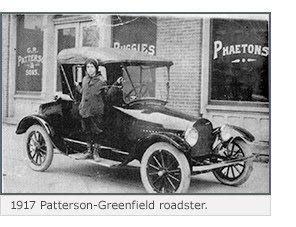
Orders began to come in, and C.R. Patterson & Sons officially entered the ranks of American auto manufacturers. Over the years, several models of coupes and sedans were offered, including a stylish “Red Devil” speedster. Ads featured the car’s 30hp Continental 4-cylinder engine, full floating rear axle, cantilever springs, electric starting and lighting, and a split windshield for ventilation. The build quality of the Patterson-Greenfield automobile was as highly regarded as it had been with their carriages.
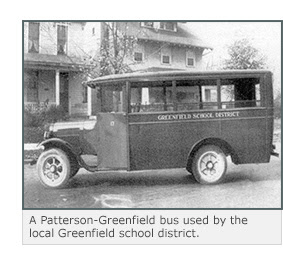
In 1918, having built by some estimates between 30 and 150 vehicles, C.R. Patterson & Sons halted auto production and concentrated once again on the repair side of the business. But they weren’t done yet. In the 1920s, the company began building truck and bus bodies to be fitted on chassis made by other manufacturers. It was in a sense a return to their original skills in building carriage bodies without engines and drivetrains and, for a period of time, the company was quite profitable. Then in 1929, the stock market crashed and the Great Depression set in. As with many small businesses, sales dried up and loans were hard to obtain. The company, now run by the sons of Frederick Patterson, soldiered on until 1939 when, after 74 years, C.R. Patterson & Sons closed its doors forever.

You must be logged in to post a comment.