Tag Archives: Washington Post

WWII veterans mark Iwo Jima anniversary


More than 30 veterans toured the black sand beaches where they invaded Japan in early 1945. They were bused to the top of Mount Suribachi, where the iconic Associated Press photo of the raising of the American flag was taken.

 From Christian Monitor csmonitor.com

Dozens of aging U.S. veterans, many in their early 90s and some in wheelchairs, gathered on the tiny, barren island of Iwo Jima on Saturday to mark the 70th anniversary of one of the bloodiest and most iconic battles of World War II.

More than 30 veterans flown in from the U.S. island territory of Guam toured the black sand beaches where they invaded the deeply dug-in forces of the island’s Japanese defenders in early 1945.

They were bused to the top of Mount Suribachi, an active volcano, where an Associated Press photo of the raising of the American flag while the battle was still raging became a potent symbol of hope and valor to a war-weary public back home that was growing increasingly disillusioned with the seemingly unending battle in the Pacific.

Recommended: Think you know Japan? Take our quiz to find out.

For some of the veterans, the return to the island where many of their comrades died, and which is still inhabited only by a contingent of Japanese military troops, brought out difficult emotions.

“I hated them,” said former Sgt. John Roy Coltrane, 93, of Siler City, North Carolina. “For 40 years, I wouldn’t even buy anything made in Japan. But now I drive a Honda.”

Speeches at the Reunion of Honor ceremony held near the invasion beach were made by senior Japanese politicians and descendants of the few Japanese who survived the battle. Also speaking were U.S. Secretary of the Navy Ray Mabus and Gen. Joseph Dunford, the commandant of the Marine Corps, who noted that the battle for Iwo Jima remains the “very ethos” of the Marine Corps today.

“We should never forget that the peace and prosperity of Japan and the United States at present has been built on the sacrifice of precious lives,” Japanese Defense Minister Gen Nakatani said in his remarks.

This was the first time that Japanese Cabinet officials attended the anniversary ceremony, now in its 16th year. And while the presence of veterans able to make the grueling trip has been steadily dwindling, the number of participants — about 500 — was double that of last year because of the significance of the 70th year since Japan’s surrender ended World War II.

After the joint memorial, the U.S. and Japanese dignitaries and guests went their separate ways to visit the parts of the island that were of the most significance to their own troops. The Japanese have erected several memorials to their dead, and in a traditional way of placating their souls poured water and placed flowers on the memorial sites.

The Marines invaded Iwo Jima in February 1945, and it was only declared secured after more than a month of fighting. About 70,000 U.S. troops fought more than 20,000 Japanese — only 216 Japanese were captured as POWs and the rest are believed to have been either killed in action or to have taken their own lives.

The island was declared secure on March 16, 1945, but skirmishes continued. In about 36 days of battle, nearly 7,000 U.S. Marines were killed and 20,000 wounded.

It is to this day considered sacred ground to many Japanese. As a haunting reminder of the ferocity of the fighting, search teams continue to dig up more and more Japanese remains each year — it’s estimated that 12,000 have yet to be found.

The United States returned the island to Japan in 1968. Wreckage of military equipment can still be seen dotting some of the beach areas, along with pill boxes and extensive mazes of caves.

Though the idea of developing the island for tourism has been mulled for decades, and possibly using its natural hot springs as an attraction, the island is virtually untouched other than the small airfield used by the Japanese.

Though a tiny volcanic crag, the island — now called Ioto or Iwoto on Japanese maps — was deemed strategically important because it was being used by the Japanese to launch air attacks on American bombers. After its capture, it was used by the U.S. as an emergency landing site for B-29s, which eventually made 2,900 emergency landings there that are estimated to have saved the lives of 24,000 airmen who would have otherwise had to crash at sea.

Twenty-seven Medals of Honor were awarded for action in the battle, more than any other in U.S. military history.

The only surviving Medal of Honor recipient from Iwo Jima, Hershel “Woody” Williams, 91, attended the ceremony. Afterward, he said his feelings toward the Japanese had not changed in the decades since the battle.

“They were just doing their jobs, just like we were,” he said. “We tried to kill them before they could kill us. But that’s war.”


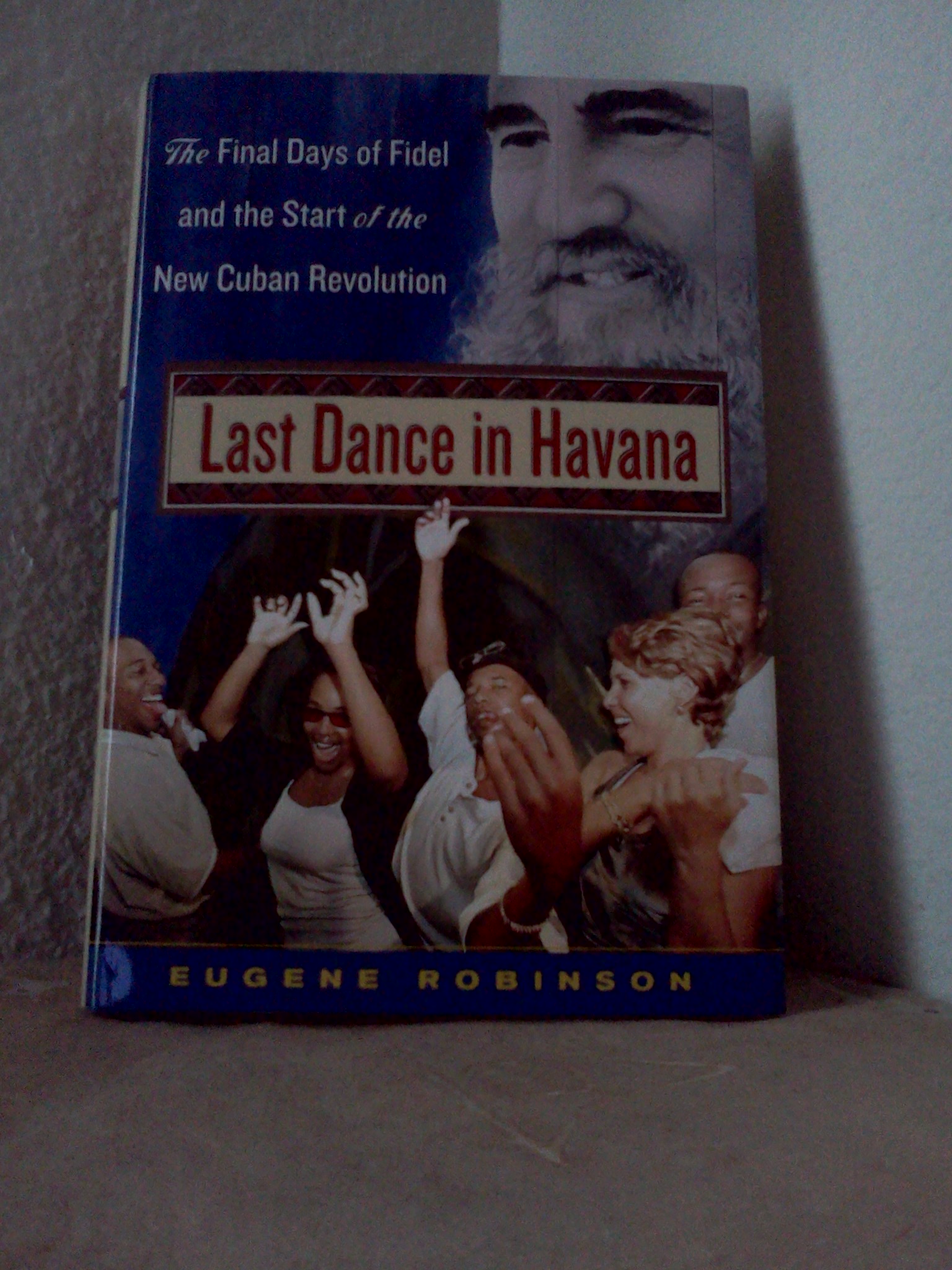
In the Library: Last Dance in Havana by Eugene Robinson


In power for forty-four years and counting, Fidel Castro has done everything possible to define Cuba to the world and to itself — yet not even he has been able to control the thoughts and dreams of his people. Those thoughts and dreams are the basis for what may become a post-Castro Cuba. To more fully understand the future of America’s near neighbor, veteran reporter Eug…moreIn power for forty-four years and counting, Fidel Castro has done everything possible to define Cuba to the world and to itself — yet not even he has been able to control the thoughts and dreams of his people. Those thoughts and dreams are the basis for what may become a post-Castro Cuba. To more fully understand the future of America’s near neighbor, veteran reporter Eugene Robinson knew exactly where to look — or rather, to listen. In this provocative work, Robinson takes us on a sweaty, pulsating, and lyrical tour of a country on the verge of revolution, using its musicians as a window into its present and future.

Music is the mother’s milk of Cuban culture. Cubans express their fondest hopes, their frustrations, even their political dissent, through music. Most Americans think only of salsa and the “Buena Vista Social Club” when they think of the music of Cuba, yet those styles are but a piece of a broad musical spectrum. Just as the West learned more about China after the Cultural Revolution by watching “From Mao to Mozart,” so will readers discover the real Cuba — the living, breathing, dying, yet striving Cuba.

Cuban music is both wildly exuberant and achingly melancholy. A thick stew of African and European elements, it is astoundingly rich and influential to have come from such a tiny island. From rap stars who defy the government in their lyrics to violinists and pianists who attend the world’s last Soviet-style conservatory to international pop stars who could make millions abroad yet choose to stay and work for peanuts, Robinson introduces us to unforgettable characters who happily bring him into their homes and backstage discussions.

Despite Castro’s attemptsto shut down nightclubs, obstruct artists, and subsidize only what he wants, the musicians and dancers of Cuba cannot stop, much less behave. Cubans move through their complicated lives the way they move on the dance floor, dashing and darting and spinning on a dime, seducing joy and fulfillment and next week’s supply of food out of a broken system. Then at night they take to the real dance floors and invent fantastic new steps. “Last Dance in Havana” is heartwrenching, yet ultimately as joyous and hopeful as a rocking club late on a Saturday night.


Erich Von Daniken: Asks young researchers to continue his legacy


https://youtu.be/ULy5Jaqm4nI

Erich Von Daniken tells other researchers that we need professors to learn the old languages …learn Sumerian Egyptian language use your new knowledge and apply it to the old text to get better translations … use your eyes in archaeology ~ seek new information from tribes, paintings, stone … compare it, use new eyes and get a new prospective

New NMAAHC Exhibition ~~~ Permanent Collection


NMAAHC -- National Museum of African American History and Culture

“Through the African American Lens: Selections from the Permanent Collection” Opens May 8th
 
 
Photograph by Eliot Elisofon

Where: National Museum of American History, Level 2
14th and Constitition Ave. NW
Washington, DC 20001

When: Exhibition opens Friday, May 8th 2015

Hours: 10:00 AM to 5:30 PM

Metro: Take Orange, Blue, or Silver line and exit at Smithsonian Station or Federal Triangle Station

Admission is free!

African Americans have survived slavery, fought for their freedom in the Civil War, for the freedom of others in subsequent wars and created lives of meaning for themselves, their families and their country. Since its creation in 2003, the Smithsonian’s National Museum of African American History and Culture (NMAAHC) has been collecting items—large and small—to tell the story of expanding America’s freedom from the African American perspective. The museum’s eighth exhibition, “Through the African American Lens: Selections from the Permanent Collection,” will showcase stories of trailblazers, innovators, visionaries and history makers who helped to shape this great nation. The exhibition will open May 8 in the NMAAHC Gallery at the Smithsonian’s National Museum of American History.

“Through the African American Lens” will use the museum’s collection to show how the African American story is quintessentially an American one. This exhibition was made possible in large part by more than two dozen families of well-known and lesser-known history makers who graciously donated their family treasures, establishing the building blocks of the museum’s collection.

Visitors will see approximately 140 collection items belonging to freedom fighters, unsung activists and servicemen, sports and entertainment legends and prominent artists and designers.

James Brown Suit

Among the artifacts on display will be the following:

  • Personal items belonging to Harriet Tubman
  • Prints from “The Life of Toussaint L’Ouverture” by Jacob Lawrence (1986)
  • Uniform of a Pullman Porter worn by a member of the Brotherhood of Sleeping Car Porters, the first African American labor union established in 1925
  • School desks from the Hope School, a Rosenwald school in South Carolina
  • Dining room table owned by Lucinda Todd that was used by Brown family and NAACP Legal Defense Fund during preparation for the Supreme Court Case, Brown v. the Board of Education of Topeka
  • Dresses designed by renowned fashion designer, Ann Lowe
  • James Brown’s electric organ and red jumpsuit
  • Dresses worn by R&B musical group, En Vogue
  • Carl Lewis’ 1989 Santa Monica Track Club speed suit
  • Althea Gibson’s tennis racket

For more information, please read the press release.

Here’s Why You Might Be Kissing Your Social Security Check Goodbye … a repost


by sean Williams

an opinion


Source: Flickr user wonderlane

Social Security is a financial backdrop that’s been in place for nearly eight decades in order to help low-income retirees upon their retirement, as well as the disabled and surviving family members of qualified deceased workers. It’s also a program that covers 167.5 million current workers and is expected to pay benefits to countless millions in the future.

According to the latest data from the Social Security Administration, the average retired worker is pulling in $1,328 a month in benefits income, while retired workers with a full-retirement aged spouse are earning an average of $2,176 per month. Optimally, Social Security wasn’t designed to replace more than 40% of a worker’s salary in retirement, although this figure is higher for low-income individuals (55%) than it is for maximum earners (27%).

But based on a terrifying new report released by HealthView Services, the majority of your Social Security income will likely be used to help pay for healthcare expenses in the future if you’re unprepared for retirement.


Source: Flickr user frankleleon

Kiss your Social Security check goodbye
HealthView’s 2015 Retirement healthcare Cost Data Report derived data from some 50 million healthcare cases and took into consideration a number of factors that include age, gender, income, and even state of residence in order to calculate a person’s potential lifetime healthcare costs.

Per HealthView, retirees will have to cope with the costs for Medicare Part B and D (Part B covers medically necessary and preventative services, while Part D helps cover the cost of prescription drugs), as well as supplemental insurance. Additionally some individuals and couples will purchase variable health expenses such as vision, dental, hearing, as well as other co-pays and other out-of-pocket expenses that aren’t already included in Medicare Part B & D or covered by supplemental insurance.

Source: AARP, Facebook

Based on its retirement study, HealthView suggests that a 66-year-old couple today can expect healthcare costs to consume 67% of their lifetime Social Security benefits. For a couple that’s currently 55 years old and planning to retire at age 65, HealthView’s data suggests that 90% of their Social Security income will be used to pay healthcare expenses.

Assuming the laundry list of expected and variable expenses listed above, a couple of full retirement age retiring today could expect $394,954 in lifetime healthcare expenses, while a couple expecting to retire in 10 years at age 65 could see healthcare expenses of $463,849. In monthly dollar terms it means the average 55-year-old couple would need to sock away $1,206 per month if their goal were merely to pay for Medicare Part D and supplemental insurance.

Source: AARP, Facebook

If these figures weren’t scary enough, HealthView’s assessment assumes that couples will maximize their Social Security benefits, which is not always the case, and that medical cost inflation averages about 6% per year, which isn’t out of the question considering the history of medical cost inflation over the past 45 years. Also, these cost estimates could be conservative as the state you live in could inflate your medical costs, and pressure on the Medicare Trust Fund could adversely impact retirees’ out-of-pocket costs.

3 keys to retirement bliss
If HealthView Services study has taught us anything, it’s that the younger generation needs to start saving for retirement as early as possible in order to avoid being “surprised” later in life by medical expenses. I’d suggest there are three actions young Americans need to take to lessen their chances of falling victim to HealthView Services scary scenario.

First, young and middle-aged Americans need to trust in the long-term returns of the stock market. I fully understand the shock and awe of the 2008-2009 market collapse is still ingrained in the minds of millions of Americans, but all market indexes are now well beyond their 2007 highs now, meaning investors who stayed the course, or perhaps even bought more, came out ahead.


Source: Flickr user Celestine Chua

Historically the stock market has returned 8% per year, which is a far better return than you’re going to find by purchasing a bank CD, putting your money in a money market account, buying a U.S. Treasury bond, or putting your money under the mattress. It’s really one of the few ways you have to outpace inflation over the long run. Plus, if you add healthy dividend stocks to your portfolio and consider reinvesting your payout back into the stocks you own you could really supercharge your returns.

For example, using Bankrate‘s investment calculator I assumed an individual at age 18 could start their investment portfolio with $2,000 and add $2,500 annually, or a little less than $210 per month. Assuming a tax rate of 15%, a full retirement age of 67 (so, 49 years of work history), and an annual rate of return of 8% (note, I’m not even including dividends here), our fictitious investors would essentially have $1 million upon retirement. What’s more, if their portfolio averaged an annual yield of 2% from dividends, their $1 million could easily double to $2 million or more. That would more than likely cover your medical expenses in retirement.

Source: Roth IRA, Facebook

Secondly, Americans need to think long term by taking advantage of tax-advantaged retirement accounts.

For America’s youth there may not be a better deal available than a Roth IRA, which currently allows for a contribution of up to $5,500 per year (persons aged 50 and up can contribute up to $6,500 annually). On the downside you’ll see no upfront tax benefit from contributing to a Roth IRA, but the back-end benefits can be astronomical since any and all capital gains and dividend payments are completely free of taxation as long as you don’t withdraw funds from your Roth IRA before age 59 1/2 for an unqualified reason.

Finally, Americans of all ages need to understand the intricacies of the Social Security program so they can maximize their benefits in retirement. For some this could mean simply waiting until age 70 to claim their benefits in order to maximize their Social Security payout. For couples it could mean a number of strategies, such as “File As a Spouse First.”

This strategy, as long as both members of the couple are of full retirement age, allows a spouse to file an application for benefits with the Social Security Administration, but restricts the application to just spousal benefits. This way the retirement benefits of the filer can continue to grow until they claim their own benefits at age 70 and they’ll get spousal income in the meantime.

Long story short, the way to maximize your Social Security benefits may not always be readily apparent, so it pays to familiarize yourself with the ins and outs of the Social Security program.

How one Seattle couple secured a $60K Social Security bonus — and you can too
A Seattle couple recently discovered some little-known Social Security secrets that can boost many retirees’ income by as much as $60,000. They were shocked by how easy it was to actually take advantage of these loopholes. And although it may seem too good to be true, it’s 100% real. In fact, one MarketWatch reporter argues that if more Americans used them, the government would have to shell out an extra $10 billion… every year! So once you learn how to take advantage of these loopholes, you could retire confidently with the peace of mind we’re all after, even if you’re woefully unprepared. Simply click here to receive your free copy of our new report that details how you can take advantage of these strategies.