
Tag Archives: white people

Southern Rites: The Heartbreaking Story of Justin Patterson’s Death


Wh<i>Best viewed in full screen mode</i><br>Julie and Bubba, 2002en Gillian Laub started photographing the racially divided town of Mount Vernon, Ga. — with its segregated homecomings and proms — she stumbled onto the story of Justin Patterson, a 22-year-old black man who was killed, on Jan. 29, 2011, by Norman Neesmith, a 62-year-old white man.

posted in Time

Patterson’s story, which further divided Mount Vernon, is the subject of Southern Rites, a HBO documentary premiering on May 18.

Dedee Clarke, Justin’s mother, spoke to TIME.

In HBO’s Southern Rites, photographer Gillian Laub goes to Mount Vernon, Ga., a racially divided town

Gillian Laub:Sha’von, Justin and Santa, 2012

“When I got the call, it was around 3.45 in the morning and my youngest son, Sha’von, said that Justin had been shot and he was dead… For a long time, Sha’von wouldn’t talk about it, he would only tell me things in bits and pieces. It wasn’t until 2013 that he told me the whole story. I think that the thing that bothered him the most was that the gun was actually aimed at him. Justin looked back, saw that and pushed Sha’von out of the way and took the shot himself. It’s something I don’t think he’ll really recover from. He just has to learn to live with it. It’s a day-by-day process, but I don’t think anybody can ever be the same.

The first time I met Gillian was in 2010. My youngest son, Sha’von, was attending the prom that year, and she was photographing it. I thought the work she was doing was great. But I didn’t know that much about her, I just knew that the pictures that she was taking were important. I didn’t get to know her on a deeper level until my son, Justin, died.

[When Gillian shifted her focus to what had happened to Justin], I was, at first, a little reluctant. But I could just see her passion and drive as she talked to me and I knew at that point that she really cared. I was more relaxed around her and I began to open up. But I just remember saying that it wasn’t going to be pretty sight because I was just not in the right state of mind, and she understood that.

You have to feel some kind of compassion when you do this. And Gillian had that; she felt it. And because she felt it, I believed that shows in her work.

Of course, it was very difficult to see Norman Neesmith in Gillian’s film. I had always made it a point not to really look directly at him. And to see him up close and personal in the film, it was very hard. It was hard to watch some of the things that he said. It’s just hard to hear that he never really acknowledged that his daughter invited them into his home. I felt that he thought he was a victim. I don’t think he understands that Justin had a life. He had a daughter. And she will never have her father.

Gillian’s work makes me feel that my son’s death was not in vain. That’s the one thing that I can hope for. I’m hoping that it will help someone. It’s too late for my son, but maybe it can help somebody else.

I’m hoping it will help other mothers to see that you can still survive that kind of pain and. I’m a survivor because God says I am. Everything that I believe in is because of God. He’s the reason that I’m here because there’s no way I could have done any of this by myself. I felt like nobody really cared because the story wasn’t out. It was a while before it was even in a paper. To see it now and to know that people really care, it does make me feel supported. It definitely does. I’m thinking that everyone will have an idea of what happened. This is real life. These people are real people; they feel that pain continuously every day.

My goal here is for people to know and understand that there’s still, very much so, a lot of injustice in this world and something has to be done about it.”

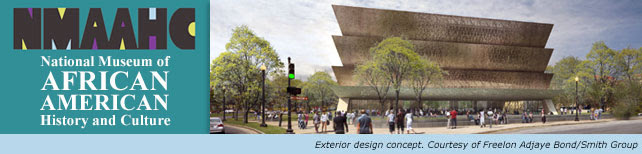
NMAAHC: Edison R. Wato, Jr., Membership Program Manager


NMAAHC -- National Museum of African American History and Culture

NMAAHC involved in the historic Slave Wrecks Project 
Iron ballast used to weigh down the ship

Objects from a slave ship that sank off the coast of Cape Town in 1794 will be on long-term loan to the Smithsonian’s National Museum of African American History and Culture (NMAAHC). The announcement, took place at a historic ceremony at Iziko Museums of South Africa. The discovery of the ship marks a milestone in the study of the trans-Atlantic slave trade and showcases the results of the Slave Wrecks Project, a unique global partnership among museums and research institutions, including the NMAAHC and six partners in the U.S. and Africa.

Objects from the shipwreck—iron ballast to weigh down the ship and its human cargo and a wooden pulley block—were retrieved this year from the wreck site of the São José-Paquete de Africa, a Portuguese slave ship that sank off the coast of Cape Town on its way to Brazil while carrying more than 400 enslaved Africans from Mozambique.

Lonnie G. Bunch III, founding director of NMAAHC, and Rooksana Omar, CEO of Iziko Museums, joined in the announcement of the shipwreck’s discovery and the artifact loan agreement.


Underwater  Archeology

Founded in 2008, Slave Wrecks Project (SWP) brings together partners who have been investigating the impact of the slave trade on world history. It spearheaded the recent discovery of the São José wreck and the ongoing documentation and retrieval of select artifacts. In addition, extensive archival research was conducted on four continents in six countries that ultimately uncovered the ship captain’s account of the wrecking in the Cape archives as well as the ship’s manifest in Portuguese archives.

SWP, established with funding from the Ford Foundation, set a new model for international collaboration among museums and research institutions. It has been combining groundbreaking slave shipwreck investigation, maritime and historical archeological training, capacity building, heritage tourism and protection, and education to build new scholarship and knowledge about the study of the global slave trade.

The São José’s voyage was one of the earliest in the trans-Atlantic slave trade from East Africa to the Americas, which continued well into the 19th century. More than 400,000 East Africans are estimated to have made the Mozambique-to-Brazil journey between 1800 and 1865. The ship’s crew and some of the more than 400 enslaved on board were rescued after the ship ran into submerged rocks about 100 meters (328 feet) from shore. Tragically, more than half of the enslaved people perished in the violent waves and those who were saved were resold into slavery in the Western Cape.

The São José wreck site is located between two reefs, a location that creates a difficult environment to work in because it is prone to strong swells creating challenging conditions for the archaeologists. To date, only a small percentage of the site has been excavated; fully exploring the site will take time.

Sincerely,
edison signature
Edison R. Wato, Jr.
Membership Program Manager

P.S. Follow any of the links below for more information on the NMAAHCs involvement in this historic project. Follow this link to watch a video about the project.

Washington Post: Humble Objects that Tell a Powerful Story
New York Times: Grim History Traced in Sunken Slave Ship Found Off South Africa
New York Times: Finding a Slave Ship, Uncovering History
CNN: Wreck of 18th Century Slave Ship Discovered
SI Press Release: NMAAHC To Display Objects from Slave Shipwreck Found Near Cape Town, South Africa

The Latest GOP Health Care Ploy


By

a repost

The GOP “Alternative” To The ACA Is A Political Ploy, Not A Real Plan

News broke last night of a health care proposal from a group of influential Republicans. Mainstream media outlets from The New York Times to The Washington Post billed it as an “alternative to Obamacare” and the GOP’s plan to “repeal and replace” the law. While that is certainly what the GOP would like the public to think, those evaluations are misleading and incorrect. In fact, this is not a real plan, but rather a political ploy to influence the Supreme Court in their upcoming decision in King v. Burwell .

Let’s take the so-called “alternative” on its face. First of all, three people writing an op-ed and a memo is not a plan to replace a law that is working and providing benefits and protections to hundreds of millions of Americans, including nearly 10 million Americans who have obtained quality, affordable coverage through the marketplaces.

Second, the contents of the proposal demonstrate that its not a serious alternative, because it will dramatically increase costs for lower-income people who can least afford care. The proposal has no essential health benefits, no minimum plan value, no out of pocket limits, no subsidies for cost sharing, and meager tax credits. It would eliminate the ACA’s Medicaid expansion and gut the pre-existing Medicaid program, leaving millions of low-income people currently covered by Medicaid uninsured. And it would go back to the days where insurers could charge women more than men.

Third, we’ve heard this tune before. GOP leaders have promised their own replacement plans dozens of times, and in none of those circumstances has the party passed one of them — let alone voted on, held hearings for, or even coalesced around one. After five years of promises, there is no reason to think that this time will be any different.

Ultimately, factoring in the context of the current health care debate is where the true strategy of Republicans in Congress becomes clear. As the Supreme Court considers the latest attack on the Affordable Care Act in King v. Burwell, opponents of the law are convinced that the high court will be more likely to strike it down if they have a replacement plan at the ready to mitigate the chaos and meltdown of the health care system. One of the intellectual architects of the 2012 Supreme Court challenge to the ACA has shared the belief that the justices would be more likely to rule against the law if they knew there would a “viable alternative.” And since Republicans have shut down the option of an easy legislative fix if it were necessary, that means they need to create the aura that there’s something else.

Regardless of whatever proposals House and Senate Republicans want to talk about, the fact is that the fate of the health care system rests solely in the hands of nine Supreme Court Justices. To reject the government’s defense of the law, which was commonly accepted just a few years ago by many of the current opponents, would cripple the high court’s reputation as an institution above politics. As Linda Greenhouse writes in a must-read opinion piece for the New York Times, “overturning Obamacare would change the nature of the Supreme Court.” Sen. Chris Murphy (D-CT) has said it would be a “stunning act of judicial overreach.”

BOTTOM LINE: The latest GOP health care proposal is just another tactic to accomplish what has been the party’s real goal for years: to repeal the Affordable Care Act. Republicans have not been able to do it electorally or legislatively, so now they are turning to the Courts. No amount of political posturing from congressional Republicans is going to change the very real stakes facing the Supreme Court justices. A ruling for the plaintiffs in King v. Burwell would not only fly in the face of the ACA and legal precedent, but the entire U.S. health care system and the millions of Americans benefiting from the ACA — click here to see the profiles of several of them.

A Tale of Two Recoveries


By

Recession-Era Austerity Has Led to Weak Public Jobs Growth And Fragile Economic Recovery

Today’s job report brought positive news: the economy added 280,000 jobs and wages grew at an annual rate of 2.3 percent. This month marks six years since the end of the Great Recession, but the economy still has significant recovering to do. The graphic below shows that while the private sector is recovering, austerity remains a major drag on job growth.

JobsDay_June

(Para verlo en español clique aquí)

According to an analysis by the Center for American Progress, slow growth in public sector employment is dragging down our overall economic recovery. Washington’s self-imposed budget sequestration and strict austerity measures at the state and local level have contributed to slow public sector growth, and as a result we have fewer public school teachers, poorly maintained infrastructure, and higher tuition at public universities.

On the other hand, the private sector has enjoyed robust growth since the end of the recession. Between June 2009 and May 2015, the private sector added 11.4 million jobs, while the public sector lost some 559,000 state and local government jobs over the same period. Budget cuts have reduced the number of teachers, bus drivers, firefighters and police officers, to name just a few. At this stage in the recovery, the public sector isn’t keeping up with the needs of our growing population, and the shortfall of public sector employees not only highlights this deficit, but also slows down our recovery.

BOTTOM LINE: Reinvesting in public sector employment would create reliable, good-paying, middle-class jobs and help speed up our economic recovery. Rather than continue down the damaging path of sequestration, which reduces the federal government’s ability to respond to the struggling economy, Congress should be doing more to invest in the economy and support state and local government functions that are essential to the lives of everyday Americans.

The EPA ignored its own science?


Union of Concerned Scientists

The EPA ignored its own scientists on water contamination.

UCS members need to make sure federal agencies put science and safety ahead of politics.

Be one of 750 new donors needed this month to keep our campaigns strong.

The Environmental Protection Agency (EPA) exists to protect our environment and keep our land, water, air, and health safe.

But when the EPA’s own scientists found evidence that fracking was contaminating water, the EPA stopped or slowed down its scientists’ work in three states.1

Why would the EPA back away from its own science?

Simple. Fierce pressure from industry and politicians interfering at every step—from a former Democratic governor reportedly hired by drilling industries to pressure the agency, to a U.S. Senator delaying scientists by demanding constant financial reports, even asking how many dollars were spent on individual lab tests.2

As the fracking boom continues, the EPA can expect even more interference. We can’t sit by and watch. We’re looking for 750 new UCS members to stand up this month to help counter misinformation, demand accountability, protect whistleblowers, and defend our health.

Become a UCS member now.

The future of fracking isn’t our only concern. UCS members are standing up for science on multiple fronts:

Stopping the attacks on clean vehicles. The Obama administration has proposed aggressive reductions in vehicle pollutants, but the oil and gas industry is trying to stall them, spreading misinformation about the costs of cleaner fuels.3 UCS’s efforts have already generated more than 50,000 letters this year to the EPA and Congress from members and supporters on the issue.

Fighting back against Big Coal. Coal companies and Fox News are up in arms about the Obama administration’s proposed carbon standards, which would finally retire most of the oldest coal-fired plants. As climate deniers spread misinformation about a “War on Coal,” UCS members and experts are spreading the facts about clean energy’s environmental and economic benefits—while pushing the Obama Administration to stand strong.4

We’re also making waves with our groundbreaking Ripe for Retirement report, which makes the economic case for closing 353 coal-fired power plants. Since November, when we released our first report, 45 plants already have been slated for closure—we’re on the right track!

Whether it’s fracking, vehicle pollution, or coal, the Obama Administration and the EPA are often ready to do the right thing—but they need vocal support from scientists and the public at large. They need people like you to refute lies from the fossil fuel industry and fact-denying politicians. They need you to counteract the millions of dollars being spent to convince the public that a future with clean energy isn’t possible.

Carmen, we need 750 people to stand up for transparency, accountability, and the sound use of science before September 30. Become a member now.

Help make sure all of our leaders—friend and foe—put science first in the national conversation about our energy and our health.

Thank you for being such a strong advocate for science—and for recommitting yourself with a gift to UCS today.

Kathleen Rest Sincerely,
Kathleen Rest
Kathleen Rest, PhD, MPA
Executive Director

1. http://www.propublica.org/article/epas-abandoned-wyoming-fracking-study-one-retreat-of-many
2. Ibid.
3. http://usnews.nbcnews.com/_news/2013/03/29/17518351-epa-proposes-tighter-fuel-emissions-standards-could-push-price-of-gas-higher?lite
4. http://www.foxnews.com/opinion/2013/06/25/obama-declares-war-on-coal/