OFA …


This movement was founded on a simple but game-changing idea:

That grassroots, on-the-ground organizing is the most powerful force in politics.

Powerful enough to win a historic presidential election and bring the country together after eight years of division — powerful enough to achieve health reform 100 years in the making.

But we got here because millions of people committed to this idea in the years and months that came before these victories — and President Obama will be the first to tell you that our work is not done.

Right now, Organizing for America is reinvesting in key states and districts, rebuilding our grassroots infrastructure, and preparing for the fights ahead.

Over the next few days, we’ll be deciding where and exactly how much we can invest — and with your help, we can be in the strongest position possible.

Will you donate $25 or more today to support Organizing for America?

When the President was elected on November 4th, 2008, it felt like the world had changed almost overnight.

After eight years of out-of-touch policies that drove our economy into a ditch, we had elected a leader with a new vision for government, a mandate for reforming Washington, and a personal story possible only in America.

But the truth is that nothing happened overnight.

That victory — and every victory that followed — is a credit to the power of this grassroots movement.

From the very first days of the presidential campaign in 2007 through the repeal of “Don’t Ask, Don’t Tell” in December — the relationships you developed on the ground took root in unprecedented ways, and together, we made history.

We have to do it again.

President Obama has laid out an ambitious agenda for winning the future, calling on Congress to come together to make key investments in innovation, education, and infrastructure. To reform government, confront the deficit, and make sure the economy works for all Americans.

He can’t do it alone. The challenges we’ll face over the next months will call on each of us to remember why we are a part of this movement: because we believe in something bigger than politics. Because we now know what is possible when we invest not just in a campaign, but in one another.

Your support will help us make key decisions about where we can place staff and resources as we rebuild and plan the next phase of this movement.

Please donate $25 or more today:

https://donate.barackobama.com/Reinvesting

Thanks,

Mitch

Mitch Stewart

Director

Organizing for America

Labor: What The NFL Lockout Teaches Us


Last Sunday, the National Football League’s Green Bay Packers celebrated their fourth Super Bowl victory in franchise history, defeating the Pittsburgh Steelers 31-25. Yet now that the Super Bowl media circus has subsided, and Packers quarterback and game MVP Aaron Rodgers has taken his obligatory march in a Disney World parade, a labor dispute between the league’s team owners and the NFL Players Association is receiving greater visibility. The NFL’s collective bargaining agreement is set to expire on March 3. The owners opted out of the current agreement two years early, arguing that the players’ cut of the profits is too large (59.5 percent after a $1 billion credit is given to the owners). The owners are also pushing to extend the regular season by two games, to 18. But unless a deal gets done soon, the NFLPA expects the owners to impose a lockout, thus suspending next season indefinitely. In fact, the NFL owners‘ attempt to squeeze more profits from players is emblematic of what is happening to workers across the country, most of whom do not have anywhere near the amount of bargaining power as the NFLPA. As CAP’s David Madland and Nick Bunker wrote, “These negotiations are important not just to NFL fans but to all Americans because they show that collective bargaining — the process where unionized workers and management negotiate wages, benefits, and working conditions — can create significant benefits for both workers and owners.”

COLLECTIVE BARGAINING WORKS: Despite the owners’ complaints, teams and players have both prospered under the current agreement. The median player salary in 2009 stood at nearly $800,000 per year, an increase of 9.4 percent since 2006. While NFL teams are reluctant to open their financial books to the public, according to Forbes Magazine, the average NFL franchise is worth just over $1 billion (although these figures have been disputed). If true, an NFL franchise’s value has increased 16.2 percent, which Madland and Bunker point out is “a growth rate that is faster than the median player salary increase.” Anti-trust exemptions have also benefited the NFL’s owners, allowing them to maximize profits from marketing. As Time Magazine notes, “Public indicators of the game’s overall health are overwhelmingly positive. The sport is setting ratings records every week, revenues are strong, and ESPN is reportedly close to agreeing to increase the fee it pays the NFL to telecast Monday Night Football to around $2 billion annually, an increase of at least 65%.” In a statement, a representative for the NFL told The Progress Report that “the teams agree wholeheartedly that collective bargaining is critical, which is why they are committed to negotiating as much and as often as possible to get a deal that works for all sides. Each side bears responsibility for working as hard as they can to get a deal and avoid a work stoppage.

SO WHAT’S THE PROBLEM?: “What happens in these disputes is that economic issues are presented as moral issues — good versus evil,” said Fay Vincent, a former commissioner of Major League Baseball who presided over the sport’s 1990 lockout. “But it’s hard to look at these circumstances and not see a case of owners’ wanting their cake and eating it, too.” Why should progressives care about wealthy NFL players? “Liberals should care and side with labor, even if some of the players do make a lot of money,” progressive blogger and economist Duncan Black wrote this week, adding, “This is about how the pie gets split, and that matters even if it is a really big pie.” Indeed, it does matter. High-profile NFL players are privileged multi-millionaires, but this is not the case for most players in the league, many of whom make the league minimum $300,000 and only stay in the league for just under four years on average before retiring. The wear and tear on the player’s body in an increasingly violent sport often leads to early retirement. A recent independent study found that, as Esquire reported, “Not only are pro-football injuries and concussions at a nine-year high, but brain-related injuries are the most common specified type of injury in NFL games.” And the New Yorker noted last week that retired NFL players “are five to nineteen times as likely as the general population to have received a dementia-related diagnosis” due to brain injuries. Steelers star receiver Hines Ward said of the NFL, “They don’t give a fuck about concussions. And now they want to add on two extra games? Are you kidding? Come on, let’s be real.” Citing health issues, Cleveland Browns linebacker Scott Fujita said adding two games to the regular season “is completely unacceptable.” It “feels like a slap in the face,” he said.

WHAT ABOUT THE FANS?: NFL football has grown to be America’s most popular and most lucrative sport, thus, the party in the dispute most often ignored is the fans. The New York Times reports that “[c]urrently, 10 N.F.L. stadiums are 100 percent publicly financed and 19 are at least 75 percent publicly financed.” As Brian Frederick, executive director of the pro-fan lobby group Sports Fans Coalition, wrote this week, “Taxpayers (most of whom are NFL fans) have spent over $6.5 billion subsidizing NFL stadiums around the country, with nearly $4.5 billion of that coming in just the last 10 years” — a fact that has increased profits for both players and owners. “These stadium subsidies are important because they are what give the fans leverage and why this all matters in the political realm,” said Frederick, who is promoting a petition to “Save Next Season.” And while cities with NFL franchises stand to lose money if a lockout were to take effect, there is no doubt that thousands of those working in and around the stadiums will be out of a job and many local economies will suffer as a result. As Philadelphia Eagles lineman Winston Justice noted, “It will hurt local business owners, employees at restaurants, hotels, and all of the great people who work at Lincoln Financial Field [in Philadelphia], on game day, just to name a few.”

The real scoop on …Groupon


So did you catch the Super Bowl?

You might be surprised that the staff at Rainforest Action Network had our eyes glued to the game. Actually, the post-game. Okay, really just the post-game ads.

Why? The folks at Groupon (you know, the online coupon people) ran a post-game Super Bowl ad where Elizabeth Hurley talks about the problem of deforestation in the Brazilian rainforest.

If you haven’t seen the ad yet, don’t get excited about the rapid evolution of Super Bowl ads. Liz also talked about her need for a Brazilian wax: “Not all deforestation is bad.” Painful, I know.

The part we’re excited about is that the ad directs viewers to Groupon’s Save The Money campaign where you can save money by giving money to RAN. http://salsa.wiredforchange.com/dia/track.jsp?v=2&c=tPaxzQs%2FrS9X8bzY0G6QO2tLL4WBA8kG  

That’s right, when you give $15 Groupon will turn it into $30. Poof! It’s magic. http://salsa.wiredforchange.com/dia/track.jsp?v=2&c=hB9HFHRKENECygth1bjE3GtLL4WBA8kG  

Since Groupon started out as a platform for social change (called The Point), even though they run a multimillion dollar coupon cash cow and made some seriously flawed Super Bowl ads, they still have hearts and want to do good in the world.

Why do we need YOU to jump on this? Groupon uses group buying power—or in this case, group giving power—which means it takes 1000 wonderful people like you giving $15 to “activate” the deal or we don’t get a dime. Nada. Zero. Zilch. Bupkis. 

  http://salsa.wiredforchange.com/dia/track.jsp?v=2&c=mAExMwa0shGfAc2KQ1QUv2tLL4WBA8kG 

That’s why you’ve got to give today, and then tell ALL your friends!

Once the deal tips, Groupon will double donations up to $100,000, which means more awesome RAN actions to protect rainforests, defend human rights, halt climate change and kick corporate butt.

If you’re the kind of person who wants your money to make the biggest impact possible, now’s the time—Groupon it!

http://salsa.wiredforchange.com/dia/track.jsp?v=2&c=%2B4DJhTQJmjZwq7DG1W3m%2BmtLL4WBA8kG

For the planet,

David Taylor

Online Director

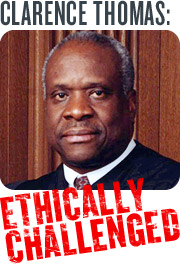
Tell Clarence Thomas: Recuse yourself


A case challenging the constitutionality of the health care reform bill passed by Congress is headed to the Supreme Court, and Justice Clarence Thomas has a supreme ethical conflict.

It’s been widely reported that the Thomas family has financial ties to the conservative organizations leading the campaign to bring down our new health care law — the Patient Protection and Affordable Care Act.

Rep. Anthony Weiner and 73 other members of Congress have signed a letter detailing the appearance of ethical conflict and asking Justice Thomas to recuse himself from deliberations on the constitutionality of health care reform.

We’re asking you to sign a companion letter that Rep. Weiner — a champion of progressive issues — will deliver to the Supreme Court along with the letter signed by members of Congress.

Tell Justice Clarence Thomas: Recuse yourself from deliberations on the constitutionality of health care reform. Click here to automatically sign the letter below.

The letter to Justice Thomas reads: http://act.credoaction.com/r/?r=7064&id=16386-2591629-BPS9vgx&t=9

As an Associate Justice, you are entrusted with the responsibility to exercise the highest degree of discretion and impartiality when deciding a case. We join Rep. Anthony Weiner and other members of Congress in writing to note our surprise at recent revelations of your financial ties to leading organizations dedicated to lobbying against the Patient Protection and Affordable Care Act. We write today to respectfully ask that you maintain the integrity of this court and recuse yourself from any deliberations on the constitutionality of this act.

The appearance of a conflict of interest merits recusal under federal law. From what we have already seen, the line between your impartiality and you and your wife’s financial stake in the overturn of health care reform is blurred. Your spouse is advertising herself as a lobbyist who has “experience and connections” and appeals to clients who want a particular decision — they want to overturn health care reform. Moreover, your failure to disclose Ginni Thomas‘s receipt of $686,589 from the Heritage Foundation, a prominent opponent of health care reform, between 2003 and 2007 has raised great concern.

This is not the first case where your impartiality was in question. As Common Cause points out, you “participated in secretive political strategy sessions, perhaps while the case was pending, with corporate leaders whose political aims were advanced by the [5-4] decision” on the Citizens United case. Your spouse also received an undisclosed salary paid for by undisclosed donors as CEO of Liberty Central, a 501(c)(4) organization that stood to benefit from the decision and played an active role in the 2010 elections.

Given these facts, there is a strong conflict between the Thomas household’s financial gain through your spouse’s activities and your role as an Associate Justice of the United States Supreme Court. We urge you to recuse yourself from this case. If the US Supreme Court‘s decision is to be viewed as legitimate by the American people, this is the only correct path.

We appreciate your thoughtful consideration of this request. http://act.credoaction.com/r/?r=7064&id=16386-2591629-BPS9vgx&t=10

Click here to automatically sign your name to our letter to Justice Thomas that will be delivered to the Supreme Court by progressive champion Rep. Anthony Weiner.

Thomas failed to disclose that his wife Ginni Thomas received a total of $686,589 in compensation from the Heritage Foundation.1 Furthermore his wife is currently advertising herself as a lobbyist who has “experience and connections” to conservative groups who have an explicit agenda to overturn health care reform — by repeal in the Congress or overturning the law in the courts.2

Justice Thomas is no stranger to questions of ethics. Along with Justice Antonin Scalia he attended meetings organized by the secretive, Tea Party-funding billionaire Koch brothers. The Koch brothers have been key players in rewriting the political landscape after the Citizens United Supreme Court decision unleashed the floodgates of corporate money in federal politics.3 And Thomas’ wife has received an undisclosed salary paid for by undisclosed donors as CEO of Liberty Central, a 501(c)(4) organization that was formed to take advantage of Citizens United rules and to play an active role in the 2010 elections.

Unlike other members of the federal judiciary, Supreme Court Justices have no specific code of ethics to which they may be held accountable. But there is a clear appearance of a conflict of interest between his wife’s clear financial stake in overturning the health care law and Justice Thomas’ personal duty to exhibit the highest degree of discretion and impartiality. To protect the honor of the highest court in the land, Thomas must recuse himself from deliberations on the constitutionality of the Patient Protection and Affordable Care Act.

Tell Justice Clarence Thomas: Recuse yourself from deliberations on the constitutionality of health care reform. Clicking here will automatically sign your name to the above letter.

Sincerely,

Becky Bond, Political Director

CREDO Action from Working Assets

Notes:

1″What else haven’t they told us?” Common Cause, Jan. 21, 2011.

2″Adventures of Ginni Thomas,” Ben Smith, Politico, Feb. 4, 2011.

3″Justices Scalia And Thomas’s Attendance At Koch Event Sparks Judicial Ethics Debate,” Sam Stein, Huffington Post, Oct. 20, 2010.

Party time for Orangutans


The palm oil branch of Sinar Mas, Golden Agri-Resources (GAR), just unveiled a plan to stop destroying forests and peatlands in Indonesia. For years their plantations fueled rainforest destruction across Indonesia, but this week they promised to change all of that.

A giant palm oil company in Indonesia just unveiled a plan to stop destroying the forests. We need to make sure they keep their word. Help Greenpeace make sure they follow through with their plan by making your most generous contribution right now.

I honestly can’t believe I just wrote that sentence. This is something that a year ago would have been unimaginable. But here we are. If properly implemented, the plan announced by GAR could be an historic step toward full forest and peatland protection in Indonesia and could also mean the survival of endangered wildlife like the orangutan.

For the last three years Greenpeace has been pressuring GAR by convincing large palm oil buyers to cancel their contracts. It worked. Together we got the world’s largest food company (Nestle) and the world’s largest bank (HSBC), a global restaurant brand (Burger King) and one of the largest buyers of palm oil on the planet (Unilever) to take action. Thanks to supporters around the world, we now have a ground-breaking commitment from GAR.

However, this commitment will mean nothing without implementation. Help Greenpeace make sure Sinar Mas follows through with their plan to save the forests by making your most generous contribution right now.

In many ways, our work has just begun. We can’t protect the orangutan and other endangered species and achieve our goal of zero deforestation in Indonesia by 2015 if Sinar Mas doesn’t follow through with their plan. That’s why we have to make sure they do it. This piece of the work is every bit as important as the campaign that got us here.

And while this is a moment to celebrate, we aren’t out of the woods just yet with Sinar Mas. It’s a massive conglomerate and this deal is only with its palm oil branch. Their paper arm — Asia Pulp & Paper — is still destroying the forest unabated. That is unacceptable, and it is something we intend to change with your help.

Without your support to we cannot continue our work in Indonesia and keep the pressure up on Sinar Mas. Please send us your most generous contribution right now. Together we can save these precious forests and the amazing creatures and people who depend on them.

For the forests,

Rolf Skar

Greenpeace Forest Campaigner