July 16, 1945 – The experimental Atomic bomb “Fat Boy” was set off at 5:30 a.m. in the desert of New Mexico desert, creating a mushroom cloud rising 41,000 ft. The bomb emitted heat three times the temperature of the interior of the sun and wiped out all plant and animal life within a mile.
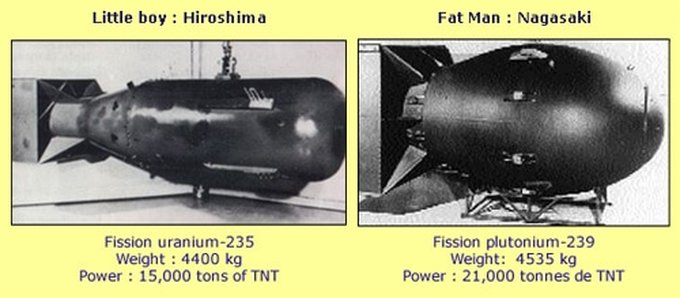
The end product was two bombs, both very different. Little boy triggered a nuclear explosion by firing one piece of uranium 235 into another. When enough U235 is brought together, the resulting fission chain reaction can produce a nuclear explosion. Fat Man however, was made out of plutonium. Fat Man was the more complex of the two, with a 10-ft sphere of the metal plutonium 239, it was designed to produce a highly accurate and symmetrical implosion. This would compress the plutonium sphere to a critical density and set off a nuclear chain-reaction.
The Trinity Test
At 5:29:45 a.m., July 16, 1945, a blinding flash and unbelievable heat seared the New Mexico desert. It was the first nuclear explosion that the world had ever seen. The explosion was a test, code-named Trinity, the Manhattan Project’s test was of the plutonium implosion bomb. It was a stunning success. The explosion almost equaled 20,000 tons of TNT, many times what some had expected. For some, the explosion was a wake up call. Robert Oppenheimer later said he thought of the lines from the Hindu scripture, the Bhagavad Gita, “I am become Death, Destroyer of Worlds.”
Although the first moon landing was an amazing feat within itself, there is also a fascinating amount of trivia that surrounds the landing.
The first humans left Florida on July 16, 1969, to walk on the Earth’s Moon and landed on July 20, 1969.
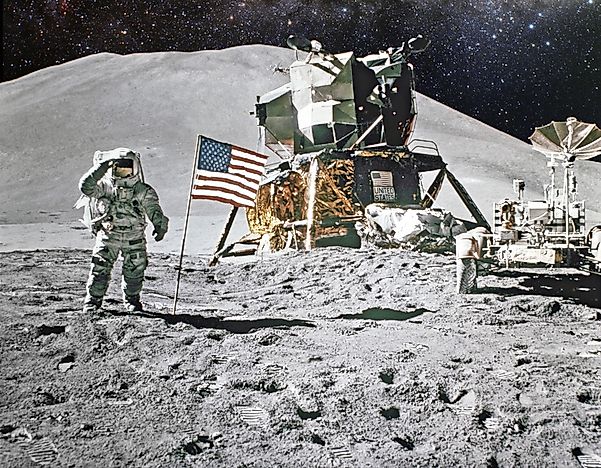
“That’s one small step for (a) man, one giant leap for mankind.” Those were the famous remarks made by astronaut Neil Armstrong as he made the first human footprints on the Moon. The Apollo 11 was the government mission that aimed to have a manned lunar landing which featured the spacecraft “Eagle” launched from the “Saturn V” rocket. The Moon landing was arguably one of the most critical landmarks of human civilization and its significance still resonates today. While the event remains to be hugely popular both in the scientific world as well as in pop culture, several fun facts about the mission still remain relatively unknown.
10. Armstrong carried with him a piece of wood from an airplane that belonged to the Wright brothers.
The first recorded flight was achieved by the Wright Brothers in 1903, 66 years before the first manned lunar mission. Thus, Neil Armstrong saw it fit to take with him pieces of wood from the pioneering Wright plane as well as a piece of fabric from the plane to symbolize the great progress made in aviation. Armstrong held these in his “personal preference kit” (PPK). The Wright Brothers, like Neil, were from the state of Ohio. The artefacts now sit in the Smithsonian museum in Washington, D.C.
9. If Apollo 11 had failed, President Nixon had a speech ready.
Although the Apollo 11 now has a cemented place in world history, at the time of its launch its success was not so certain. The mission had such a large risk of failing, in fact, that President Richard Nixon had a speech at the ready in case of catastrophe. As nobody had ever once landed on the Moon, it was not known whether or not it was even possible to takeoff from the Moon in order to return back to Earth. Thankfully, there was never occasion for the use of the speech, although copies of the text have since surfaced.
8. Armstrong and Aldrin spent almost a full day on the Moon’s surface.
The period spent outside the probe while on the Moon is known as “extravehicular activity”, or EVA, a term that covers any astronaut activity performed beyond the Earth’s atmosphere. Due to the many experiments the astronauts conducted on the Moon as well as placement of the many instruments involved, the total EVA lasted 21 hours and 36 minutes. However, only a few hours of time was spent on the lunar surface itself, as the astronauts took breaks in the probe as well.
7. After returning to earth, the astronauts had to be placed into quarantine.
After landing on Earth, the three astronauts were promptly taken to a quarantine facility where they remained for 21 days. The reason behind this strange action was to prevent contamination of any micro-organisms carried by the crew from the Moon, as the astronauts were returning from very uncharted territory. Nobody in the space program was sure whether or not the lunar surface was sterile. Of course, later studies confirmed the Moon to be void of any forms of life.
6. The astronauts left pictures of human beings and the recordings of many languages on the Moon’s surface.
The astronauts left several items on the surface of the Moon, including pictures of human beings as well as audio recordings of several different languages to represent the global significance of the mission. Medallions bearing names of the three astronauts who perished in Apollo 1 on the launch pad and the two cosmonauts who perished in a similar accident were all left on the surface of the Moon as well.
5. The astronauts declared “moon rock and moon dust samples” to customs when they returned to Earth.
In 2015, Buzz Aldrin tweeted a “travel voucher” that outlined the nature of expenses incurred from his trip out of the atmosphere, just like somebody would for a trip of a more Earthly nature. In addition, he revealed that the astronauts were required to sign customs forms upon their return to Earth, upon which they declared to be carrying “moon rock and moon dust samples”.
4. The astronauts landed with only 25 seconds of fuel to spare.
In vein with the intricate planning of the Apollo 11 mission, a site on the Moon was picked as the landing site that was thought to be a clear choice. However, while the Apollo probe was descending, the two astronauts realized the site was filled with boulders and knew it would be hazardous to attempt their descent. Therefore, Armstrong began to manually navigate the probe which involved skimming over the risky site, a decision which meant more fuel would be consumed while skimming over the location. The probe had a fuel limit set where upon reaching it, automatic abort of the landing would begin. The probe landed 25 seconds before reaching this point. What this means is that if the probe were 25 seconds late on its landing, automatic abortion of the mission would have occurred, forcing them to travel back to the Columbia that was orbiting the Moon.
3. The exact phrase uttered by Armstrong has been disputed.
“That’s one small step for man, one giant leap for mankind” is a phrase familiar to many, but did you know that its accuracy has been disputed by Armstrong himself? The exact quote, Armstrong claimed, is actually “that’s one small step for aman, one giant leap for mankind.” Although many claimed to not hear this subtle variation, linguists have confirmed that Armstong does in fact utter “a”, leading to the quote to most officially be presented with the article in brackets.
2. The landing was watched on television by an estimated 600 million people.
The record-breaking event was seen by millions of viewers around the planet. In the days preceding the mission, media outlets all over spoke extensively of the mission, leading to widespread public anticipation. There was a great amount media coverage of the event in the United States, and it is estimated that over 53 million families watched the mission on television. Global viewership was estimated to be more than 550 million viewers, a world record at the time.
1. Although there were three astronauts sent to the Moon, only two of them actually stepped on it.
Many people who have knowledge of the Apollo mission believe that the probe carried only two astronauts, Neil Armstrong and Buzz Aldrin, with Armstrong being more famous of the two. While it is true that the module that landed on the Moon carried the two astronauts, they were three in total when they left the Kennedy Space Center, Florida on July 16th, 1969. When the Apollo spacecraft approached the Moon, one module was left orbiting around the Moon and was piloted by the third astronaut named Michael Collins. Although Collins did not experience the glory of stepping on the Moon’s surface firsthand, the mission would not have been possible without him.
Washington D.C., Became the Capital July 16, 1790 Where are the White House, the Capitol, and the Washington Monument? Just where they should be–in the capital of the United States. On July 16, 1790, Congress declared the city of Washington in the District of Columbia, the permanent capital of the United States. Who decided how the new city should look?
President George Washington commissioned French engineer Pierre-Charles L’Enfant to create a plan for the city.
What did L’Enfant do to make the new capital different from other cities?
L’Enfant designed wide avenues and open spaces so that the capital would not become a city of crowded buildings. He knew that people would need parks where they could walk and relax. The streets of the capital were oriented in a north, south, east, and west grid pattern. Because of L’Enfant’s careful planning, when you stand on the steps of the U.S. Capitol today you can look down the mall and see all the way to the Washington Monument and the Lincoln Memorial. When you see the beautiful views and dramatic landscapes of your nation’s capital you can thank Pierre-Charles L’Enfant.
Congresswoman Barbara Jordan Delivers The Keynote Address At The 1976 Democratic ConventionOn July 12, 1976, Barbara Jordan became the first African American to deliver a Keynote Address at the Democratic National Convention. Jordan also gave a keynote address at the 1992 Democratic Convention.
Congresswoman Barbara Charline Jordan was the first African American woman elected to the United States House of Representatives from the south in 1972. Prior to entering national politics, in 1966 Jordan became the first African American elected to the Texas Senate since reconstruction. Jordan became a professor at the University of Texas at Austin after leaving politics in 1979. She also served as Chairperson of the U.S. Commission on Immigration Reform from 1994 until 1996.
Jordan was born on February 21, 1936 in Houston, Texas and died on January 17, 1996 in Austin, Texas at age 59.
“The President in Washington sends word that he wishes to buy our land. But how can you buy or sell the sky? the land? The idea is strange to us. If we do not own the freshness of the air and the sparkle of the water, how can you buy them?
Every part of the earth is sacred to my people. Every shining pine needle, every sandy shore, every mist in the dark woods, every meadow, every humming insect. All are Holy in the memory and experience of my people.
We know the sap which courses through the trees as we know the blood that courses through our veins. We are part of the earth and it is part of us. The perfumed flowers are our sisters. The bear, the deer, the great eagle, these are our brothers. The rocky crests, the dew in the meadow, the body heat of the pony, and man all belong to the same family.
The shining water that moves in the streams and rivers is not just water, but the blood of our ancestors. If we sell you our land, you must remember that it is sacred. Each glossy reflection in the clear waters of the lakes tells of events and memories in the life of my people. The water’s murmur is the voice of my father’s father.
The rivers are our brothers. They quench our thirst. They carry our canoes and feed our children. So you must give the rivers the kindness that you would give any brother.
If we sell you our land, remember that the air is precious to us, that the air shares its spirit with all the life that it supports. The wind that gave our grandfather his first breath also received his last sigh. The wind also gives our children the spirit of life. So if we sell our land, you must keep it apart and sacred, as a place where man can go to taste the wind that is sweetened by the meadow flowers.
Will you teach your children what we have taught our children? That the earth is our mother? What befalls the earth befalls all the sons of the earth.
This we know: the earth does not belong to man, man belongs to the earth. All things are connected like the blood that unites us all. Man did not weave the web of life, he is merely a strand in it. Whatever he does to the web, he does to himself.
One thing we know: our God is also your God. The earth is precious to him and to harm the earth is to heap contempt on its creator.
Your destiny is a mystery to us. What will happen when the buffalo are all slaughtered? The wild horses tamed? What will happen when the secret corners of the forest are heavy with the scent of many men and the view of the ripe hills is blotted with talking wires? Where will the thicket be? Gone! Where will the eagle be? Gone! And what is to say goodbye to the swift pony and then hunt? The end of living and the beginning of survival.
When the last red man has vanished with this wilderness, and his memory is only the shadow of a cloud moving across the prairie, will these shores and forests still be here? Will there be any of the spirit of my people left?
We love this earth as a newborn loves its mother’s heartbeat. So, if we sell you our land, love it as we have loved it. Care for it, as we have cared for it. Hold in your mind the memory of the land as it is when you receive it. Preserve the land for all children, and love it, as God loves us.
As we are part of the land, you too are part of the land. This earth is precious to us. It is also precious to you.




 CHIEF SEATTLE’S LETTER to All
 Be a Seed for Change
You must be logged in to post a comment.