
1913 – – The 16th Amendment to the U.S. Constitution was ratified, granting Congress the authority to collect income taxes.


Historical Highlights

The Ratification of the Sixteenth Amendment

February 03, 1913The Ratification of the Sixteenth AmendmentCollection of the U.S. House of Representatives
About this objectA long-serving Member, Sereno Payne of New York chaired the Committee on Ways and Means and the Committee on Merchant Marine and Fisheries.On this date, the states of Delaware, Wyoming, and New Mexico approved the Sixteenth Amendment to the U.S. Constitution, ratifying it into law. The amendment empowered Congress to impose an income tax on individuals and corporations. During the House debates of S.J. Res. 40, Members had debated the merits of collecting income taxes. Representatives Sereno Payne of New York and Samuel McCall of Massachusetts argued that income taxes should only be levied to raise revenue during times of war. Congressman Ebenezer Hill of Connecticut also worried that the tax could be unfairly levied on constituents in poorer states: “We are ready to vote for an income tax to meet any emergencies which may arise…and to stand by the Government in time of war; but do not ask us…without consultation with our people at home, to put this burden on them in addition to one already severe because of local expenditures… ” Representative William Sulzer of New York, a supporter of the tax, said, “I have been the constant advocate of an income tax along constitutional lines… I reiterate that through it only…will it ever be possible for the Government to be able to make idle wealth pay its just share of the ever-increasing burdens of taxation.” After a brisk debate on July 12, 1909, lasting for five hours, the bill passed 318–14, with 1 voting “present,” and 55 not voting. The Sixteenth Amendment was the first change to the Constitution since the passage of the Fifteenth Amendment, which guaranteed African-American male suffrage, 43 years earlier, in 1870.

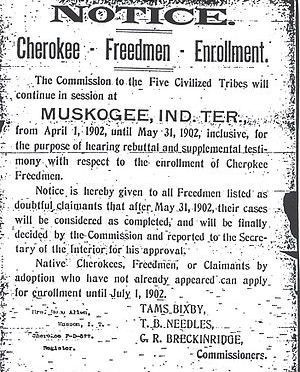
Cherokee Freedmen Facts – by Marilyn Vann – Black History


Cherokee Freedmen Facts – by Marilyn Vann – President – Descendants of Freedmen

www.freedmen5tribes.com

1) Who are Cherokee freedmen and their descendants?
Cherokee freedmen are people of African descent who have rights to Cherokee citizenship since 1866 (and in some cases
prior) based under a treaty between the US government and the Cherokee nation, the amended 1839 constitution and the
present 1976 constitution. The freedmen were either former slaves of the Cherokees or were free mixed black Cherokees who
generally did not have citizenship rights prior to 1866.

******
2) Who has the right to Cherokee citizenship now?
All persons who were listed on the Dawes Rolls and their descendants, during the early 1900s have the right to Cherokee
citizenship based on the 1976 constitution. The Dawes rolls of the Cherokee nation have several sections – Delaware,
Cherokee by blood, Cherokee Freedmen, etc.

******
3) Didn’t the Freedmen lose their tribal membership and voting rights for a few years?
In 1983, the freedmen people were voting against Chief Swimmer, the registrar sent out letters canceling their tribal
membership cards and the freedmen were blocked from voting at the polls. In 1988, under Chief Mankiller, the tribal council
approved the registration policy of requiring all tribal members to have a CDIB card to keep tribal membership. A tribal
court in 2006 ruled that the tribal council could not pass additional requirements to bar any segment of Dawes enrollees from
receiving tribal membership cards or voting.

******
4) If most of the freedmen have Cherokee blood, why cant they get a cdib card?
The current BIA policy is to only give the card based on the blood degree listed on the Dawes Rolls. The Dawes
Commissioners had the sole authority to place people on any part of the Dawes rolls they wanted to. Because Congress had
decided that people listed as Freedmen would have unrestricted allotments, Commissioners were encouraged to list as many
people as possible as Freedmen with no blood degrees listed rather than as Cherokees with blood degrees even if the person
was listed on previous rolls as blood Cherokee or received payments earlier from the US government as a Cherokee by
blood. An example was Perry Ross who had a Cherokee mother and black father. Perry Ross, was listed on the 1852 Drennan
Roll proving Cherokee by blood, received a 1908 Guion Miller payment for having Cherokee blood, but yet was listed as a
freedmen citizen on the Dawes Rolls. Some Freedmen did get CDIB cards in the past based on other records, but they
stopped giving them out. The tribe never kept degrees of blood records and anything on the Dawes Roll is just guesswork so
far as a true degree of blood. To determine blood degrees for freedmen one must look at Dawes testimony and other records.

******
5) Chief Smith and Councilman Jackie Bob Martin have called for a special election to see if the freedmen people
should keep their tribal membership rights. What’s wrong with that?
Whats right about it? There something wrong about trying to take away the rights of people who have had them for more than
100 years. The court held that the people had been wronged, and now, instead of accepting that, these people are to be more
wronged? Would you not fight a president who wanted to put the US citizenship rights of Cherokee people on a ballot to the
people? Whose next to lose rights? Also, the people who are being asked to vote on the freedmen citizenship rights are not
being told that the freedmen have had rights since at least 1866, have served on the tribal council, generally have Cherokee
blood, and voted between 1971 and 1983 (between 1907 and 1971 there were no elections at all). When did Cherokee people
ever kick people out of the tribe? And why kick out only freedmen who came before Delaware and Shawnee – all 3 have
treaty rights to citizenship? Does anyone sitting here wonder if the movement to kick out the freedmen is fear that they may
not vote for some people now serving in office? Hardly any freedmen will be able to vote in such election because of the
slow process to register tribal members and even freedmen people with old 1970s membership cards must reregister. Is this
justice? Is it right for Cherokee leaders to break the promises made to these people by previous chiefs such as Lewis
Downing and WP Ross – just as the whites have broken their word to the Cherokee people time after time? What if the white
people say, if the Cherokees can break their treaty at will, we will do so too and demand back the Arkansas Riverbed money?

******
6) Won’t the freedmen take away from the rest of the Cherokees so far as benefits?
The Chief and the tribal council can request additional funds from the US government and supposedly are working hard on
economic development. Stop and think – Would you want your US citizenship rights to be taken away because white people
don’t want you to have rental assistance or such the same as them? Freedmen wont cancel medical insurance to go to I H S.

******

7) Did Freedmen get the same rights as Cherokees by blood previously?
Yes, all citizens including freedmen received 110 acres of tribal land equivalent when tribal lands were allotted, they received
the 1912 payroll, and the per capita payment given out in 1962. Freedmen held office between 1866 and 1907 – One
freedman Frank Vann even served with Redbird Smith on the council. Another freedmen councilman was Stick Ross.

1855 Wisconsin Supreme Court declares US Fugitive Slave Law unconstitutional – Black History


n 1855, the Wisconsin Supreme Court became the only state high court to declare the Fugitive Slave Act unconstitutional, as a result of a case involving fugitive slave Joshua Glover and Sherman Booth, who led efforts that thwarted Glover’s recapture. In 1859 in Ableman v. Booth, the U.S. Supreme Court overruled the state court.

Source: wiki

Unconstitutionality of the Fugitive Slave Act : decisions of the Supreme Court of Wisconsin in the cases of Booth and Rycraft.Other TitleWisconsin reportsContributor NamesWisconsin. Supreme Court.Booth, Sherman M.Rycraft, John.Smith, A. D. (Albert Daniel), 1811-1865.Cushing, Caleb, 1800-1879, former owner.Joseph Meredith Toner Collection (Library of Congress)Created / PublishedMilwaukee : R. King & Co., printers, 1855.Subject Headings-  Booth, Sherman M.–Trials, litigation, etc-  Rycraft, John–Trials, litigation, etc-  United States.–Fugitive slave law (1850)-  Slavery–United States-  Glover, Joshua

Source: Library of Congress

There are over 200 pages to read through

on this day … 2/3 Eric Holder was sworn in as attorney general,the first African-American to hold the post.


World1488 – The Portuguese navigator Bartholomeu Diaz landed at Mossal Bay in the Cape, the first European known to have landed on the southern extremity of Africa.

1690 – The first paper money in America was issued by the Massachusetts colony. The currency was used to pay soldiers that were fighting in the war against Quebec.

1783 – Spain recognized the independence of the United States.

1809 – The territory of Illinois was created.

1815 – The world’s first commercial cheese factory was established in Switzerland.

1862 – Thomas Edison printed the “Weekly Herald” and distributed it to train passengers traveling between Port Huron and Detroit, MI. It was the first time a newspaper had been printed on a train.

1869 – Edwin Booth opened his new theatre in New York City. The first production was “Romeo and Juliet”.

1900 – In Frankfort, KY, gubernatorial candidate William Goebels died from an assasin’s bullet wounds. On August 18, 1900, Ex-Sec. of State Caleb Powers was found guilt of conspiracy to murder Gov. Goebels.

1913 – The 16th Amendment to the U.S. Constitution was ratified. It authorized the power to impose and collect income tax.

1916 – In Ottawa, Canada’s original parliament buildings burned down.

1917 – The U.S. broke off diplomatic relations with Germany, which had announced a policy of unrestricted submarine warfare.

1918 – The Twin Peaks Tunnel began service. It is the longest streetcar tunnel in the world at 11,920 feet.

1927 – The Federal Radio Commission was created when U.S. President Calvin Coolidge signed a bill.

1941 – In Vichy, France, the Nazis used force to restore Pierre Laval to office.

1945 – Russia agreed to enter World War II against Japan.

1946 – The first issue of “Holiday” magazine appeared.

1947 – Percival Prattis became the first black news correspondent admitted to the House and Senate press gallery in Washington, DC. He worked for “Our World” in New York City.

1951 – Dick Button won the U.S. figure skating title for the sixth time.

1951 – The Tennessee Williams play, “The Rose Tattoo”, opened on Broadway in New York.

1966 – The first rocket-assisted controlled landing on the Moon was made by the Soviet space vehicle Luna IX.

1969 – At the Palestinian National Congress in Cairo, Yasser Arafat was appointed leader of the PLO.

1972 – The first Winter Olympics in Asia were held at Sapporo, Japan.

1984 – Challenger 4 was launched as the tenth space shuttle mission.

1989 – South African politician P.W. Botha unwillingly resigned both party leadership and the presidency after suffering a stroke.

1998 – Texas executed Karla Faye Tucker. She was the first woman executed in the U.S. since 1984.

1998 – In Italy, a U.S. Military plane hit a cable causing the death of 20 skiers on a lift.

2009 – Eric Holder was sworn in as attorney general. He was the first African-American to hold the post.

2010 – The Alberto Giacometti sculpture L’Homme qui marche sold for $103.7 million.

2015 – The British House of Commons voted to approve letting scientist create babies from the DNA of three people.