
Monthly Archives: February 2023

Equal Rights Amendment Passed by House, 354‐23 – Black History
About the Archive
By EILEEN SHANAHAN OCT. 13, 1971

October 13, 1971, Page 1 The New York Times Archives
This is a digitized version of an article from The Times’s print archive. To preserve articles as they originally appeared in print — before the start of online publication in 1996 — The Times does not alter, edit or update these articles.
Occasionally the digitization process introduces transcription errors or other problems. Please send reports of such problems — along with other suggestions or feedback — to archive_feedback@nytimes.com.]
WASHINGTON, Oct. 12—The House of Representatives passed today, 354 to 23, a constitutional amendment prohibiting discrimination based on sex.
The amendment was passed in the form long favored by women’s rights advocates.
The key vote was on the issue of including in the amendment provisions that would continue the legality of drafting men, but not women, into the armed forces and provisions asserting the validity of many existing laws that treat men and women differently.
Women’s rights advocates said that these provisions nullified the intention of the Equal Rights Amendment, as it is known. They were stricken from the amendment by a vote of 265 to 87.
Today’s vote marked the second time in two years that the House has passed the amendment in the form advocated by women’s rights activists. Last year, there were only 15 votes against.
The amendment will now go to the Senate, which has never passed it in the version that feminists want, although it has passed amended versions three times.Continue reading the main story
AdvertisementContinue reading the main story
The fate of the amendment in the Senate in the current Congress is uncertain. If the Senate does pass it, it must be ratified by 38 states to become effective. The Senate majority leader, Mike Mansfield of Montana, has placed the bill on the Senate calendar so it can legally be called up for a vote at any time. This was a device to keep the Senate Judiciary Committee, where there is strong apposition to the amendment, from burying it there.
Since Mr. Mansfield can bring up the bill at any time, the Judiciary Committee is expected to act on it.
But there appeared to be strong probability that Senator Sam J. Ervin Jr. of North Carolina, the commitee’s leading opponent of the amendment, would be able to attach provisions similar to those that feminists find unacceptable and that were defeated in the House today.
Whether these provisions could then be eliminated on the Senate floor was questionable. Women’s rights groups expressed optimism that they would pick up more and more votes for their position as the 1972 elections drew closer.
The day’s debate in the House was long and conducted before galleries that were two‐thirds full of women of all ages, —ranging from elderly veterans of the fight for the women’s suffrage amendment, which was adopted in 1920, to college and high‐school girls.
At one point in the debate, Representative Thomas G. Abernethy, Democrat of Mississippi, said that enactment of the amendment would mean that there was no way of compelling a man to support his family. And he said that his wife had instructed him to vote against the amendment “because she doesn’t want to lose her home.”
Mr. Abernethy was followed to the rostrum by Representative Bella S. Abzug, Democrat of Manhattan, who started her speech with the announcement, “I do not come here under instructions from my husband as to how to vote.”
The galleries applauded and cheered—which is forbidden by the rules of the House.
Of the 11 women members of the House, nine, including Mrs. Abzug, voted for the amendment today. One absentee, Representative Edith Green, Democrat of Oregon, has supported it in the past. The lone opponent among the women members was Representative Leonor K. Sullivan, Democrat of Missouri.
The text of the amendment, H. J. Res. 208, is as follows:
Section 1. Equality of rights shall not be denied or abridged by the United States or by any state on account of sex.
Section 2. The Congress shall have the power to enforce, by appropriate legislation, the provisions of this article.
Section 3. This amendment shall take effect two years after the date of ratification.
Most of the debate focused on the question of whether women would have to he drafted, if men were, if the amendment were adopted.
The sponsor of the modirication of the amendment that would have exempted women from compulsory military service, Representative Charles. E. Wiggins, Republican of California, said that the general counsel of the Department of Defense had told him it would be “impossible for the military to operate” If the amendment were adopted.
Not only would the services be forced to draft more women than they wanted, he said, but separate barracks and other separate facilities would not be permitted.
Representative John Conyers Jr., Democrat of Michigan, demanded to know why, if the military was concerned, it had not asked to testify at the hearings on the amendment. Mr. Wiggins said that he could not answer that question.
A version of this archives appears in print on October 13, 1971, on Page 1 of the New York edition with the headline: Equal Rights Amendment Passed by House, 354‐23. Order Reprints| Today’s Paper|Subscribe
Share this:

Impeachment l US House of Representatives

“The President, Vice President and all Civil Officers of the United States, shall be removed from Office on Impeachment for, and Conviction of, Treason, Bribery, or other high Crimes and Misdemeanors.”
— U.S. Constitution, Article II, section 4

Collection of the U.S. House of Representatives
Representative Thaddeus Stevens of Pennsylvania, a Radical Republican, gave the last speech during House debate on articles of impeachment against President Andrew Johnson on March 2, 1868. Johnson became the first president impeached by the House, but he was later acquitted by the Senate by one vote.
The Constitution gives the House of Representatives the sole power to impeach an official, and it makes the Senate the sole court for impeachment trials. The power of impeachment is limited to removal from office but also provides for a removed officer to be disqualified from holding future office. Fines and potential jail time for crimes committed while in office are left to civil courts.
Origins
Impeachment comes from British constitutional history. The process evolved from the 14th century as a way for parliament to hold the king’s ministers accountable for their public actions. Impeachment, as Alexander Hamilton of New York explained in Federalist 65, varies from civil or criminal courts in that it strictly involves the “misconduct of public men, or in other words from the abuse or violation of some public trust.” Individual state constitutions had provided for impeachment for “maladministration” or “corruption” before the U.S. Constitution was written. And the founders, fearing the potential for abuse of executive power, considered impeachment so important that they made it part of the Constitution even before they defined the contours of the presidency.
Constitutional Framing
During the Federal Constitutional Convention, the framers addressed whether even to include impeachment trials in the Constitution, the venue and process for such trials, what crimes should warrant impeachment, and the likelihood of conviction. Rufus King of Massachusetts argued that having the legislative branch pass judgment on the executive would undermine the separation of powers; better to let elections punish a President. “The Executive was to hold his place for a limited term like the members of the Legislature,” King said, so “he would periodically be tried for his behaviour by his electors.” Massachusetts’s Elbridge Gerry, however, said impeachment was a way to keep the executive in check: “A good magistrate will not fear [impeachments]. A bad one ought to be kept in fear of them.”
Another issue arose regarding whether Congress might lack the resolve to try and convict a sitting President. Presidents, some delegates observed, controlled executive appointments which ambitious Members of Congress might find desirable. Delegates to the Convention also remained undecided on the venue for impeachment trials. The Virginia Plan, which set the agenda for the Convention, initially contemplated using the judicial branch. Again, though, the founders chose to follow the British example, where the House of Commons brought charges against officers and the House of Lords considered them at trial. Ultimately, the founders decided that during presidential impeachment trials, the House would manage the prosecution, while the Chief Justice would preside over the Senate during the trial.
The founders also addressed what crimes constituted grounds for impeachment. Treason and bribery were obvious choices, but George Mason of Virginia thought those crimes did not include a large number of punishable offenses against the state. James Madison of Virginia objected to using the term “maladministration” because it was too vague. Mason then substituted “other high Crimes and Misdemeanors” in addition to treason and bribery. The term “high Crimes and Misdemeanors” was a technical term—again borrowed from British legal practice—that denoted crimes by public officials against the government. Mason’s revision was accepted without further debate. But subsequent experience demonstrated the revised phrase failed to clarify what constituted impeachable offenses.
The House’s Role
The House brings impeachment charges against federal officials as part of its oversight and investigatory responsibilities. Individual Members of the House can introduce impeachment resolutions like ordinary bills, or the House could initiate proceedings by passing a resolution authorizing an inquiry. The Committee on the Judiciary ordinarily has jurisdiction over impeachments, but special committees investigated charges before the Judiciary Committee was created in 1813. The committee then chooses whether to pursue articles of impeachment against the accused official and report them to the full House. If the articles are adopted (by simple majority vote), the House appoints Members by resolution to manage the ensuing Senate trial on its behalf. These managers act as prosecutors in the Senate and are usually members of the Judiciary Committee. The number of managers has varied across impeachment trials but has traditionally been an odd number. The partisan composition of managers has also varied depending on the nature of the impeachment, but the managers, by definition, always support the House’s impeachment action.
The Use of Impeachment
The House has initiated impeachment proceedings more than 60 times but less than a third have led to full impeachments. Just eight—all federal judges—have been convicted and removed from office by the Senate. Outside of the 15 federal judges impeached by the House, two Presidents (Andrew Johnson in 1868 and William Jefferson (Bill) Clinton in 1998), a cabinet secretary (William Belknap in 1876), and a U.S. Senator (William Blount of North Carolina in 1797) have also been impeached.
Blount’s impeachment trial—the first ever conducted—established the principle that Members of Congress and Senators were not “Civil Officers” under the Constitution, and accordingly, they could only be removed from office by a two-thirds vote for expulsion by their respective chambers. Blount, who had been accused of instigating an insurrection of American Indians to further British interests in Florida, was not convicted, but the Senate did expel him. Other impeachments have featured judges taking the bench when drunk or profiting from their position. The trial of President Johnson, however, focused on whether the President could remove cabinet officers without obtaining Congress’s approval. Johnson’s acquittal firmly set the precedent—debated from the beginning of the nation—that the President may remove appointees even if they required Senate confirmation to hold office.
For Further Reading
Farrand, Max, ed. The Records of the Federal Convention of 1787. Rev. ed. 4 vols. (New Haven and London: Yale University Press, 1937).
Kyvig, David E. The Age of Impeachment: American Constitutional Culture Since 1960. (Lawrence, Kansas: University Press of Kansas, 2008).
Les Benedict, Michael. The Impeachment and Trial of Andrew Johnson. (New York: W.W. Norton & Company, 1999).
Madison, James, Alexander Hamilton, John Jay. The Federalist Papers. (New York: Penguin Books, 1987).
Melton, Buckner F., Jr. The First Impeachment: The Constitution’s Framers and the Case of Senator William Blount. (Macon, Georgia: Mercer University Press, 1998).
Rehnquist, William H. Grand Inquests: The Historic Impeachments of Justice Samuel Chase and President Andrew Johnson. (New York: Harper Perennial, 1999).
“Report by the Staff of the Impeachment Inquiry on the Constitutional Grounds for Presidential Impeachment,” Committee Print, Committee on the Judiciary, U.S. House of Representatives, 93rd Cong., 2nd sess., February 1974.
Storing, Herbert J., ed. The Complete Anti-Federalist. 7 vols. (Chicago: University of Chicago Press, 1981).
Sullivan, John. “Chapter 27—Impeachment,” in House Practice: A Guide to the Rules, Precedents, and Procedures of the House. (Washington, D.C.: Government Printing Office, 2011).
Thomas, David Y. “The Law of Impeachment in the United States,” The American Political Science Review 2 (May 1908): 378–395.
history.house.gov
Share this:

Official Google blog archives – Nelson Mandela – a repost – Black History
| Nelson Mandela Born: July 18, 1918 Age: 94 years old Birthplace: Transkei, South AfricaOccupation: World Leader, Journalist
On February 11, 1990, Nelson Mandela was freed after 27 years in captivity. “No one is born hating another person because of the color of his skin, or his background, or his religion. People must learn to hate, and if they can learn to hate, they can be taught to love, for love comes more naturally to the human heart than its opposite.” – Nelson Mandela Last year we announced a $1.25 million grant to the Nelson Mandela Centre of Memory to help preserve and digitize thousands of archival documents, photographs and videos about Nelson Mandela. Based in Johannesburg, South Africa, the Nelson Mandela Centre of Memory (NMCM) is committed to documenting the life and times of one of the world’s greatest statesmen and spreading his story to promote social justice throughout the world.
Today, the Mandela archive has become a reality. Along with historians, educationalists, researchers, activists and many others around the world, you can access a wealth of information and knowledge about the life and legacy of this extraordinary African leader. The new online multimedia archive includes Mandela’s correspondence with family, comrades and friends, diaries written during his 27 years of imprisonment, and notes he made while leading the negotiations that ended apartheid in South Africa. The archive will also include the earliest-known photo of Mr. Mandela and never-before seen drafts of Mr. Mandela’s manuscripts for the sequel to his autobiography Long Walk to Freedom.
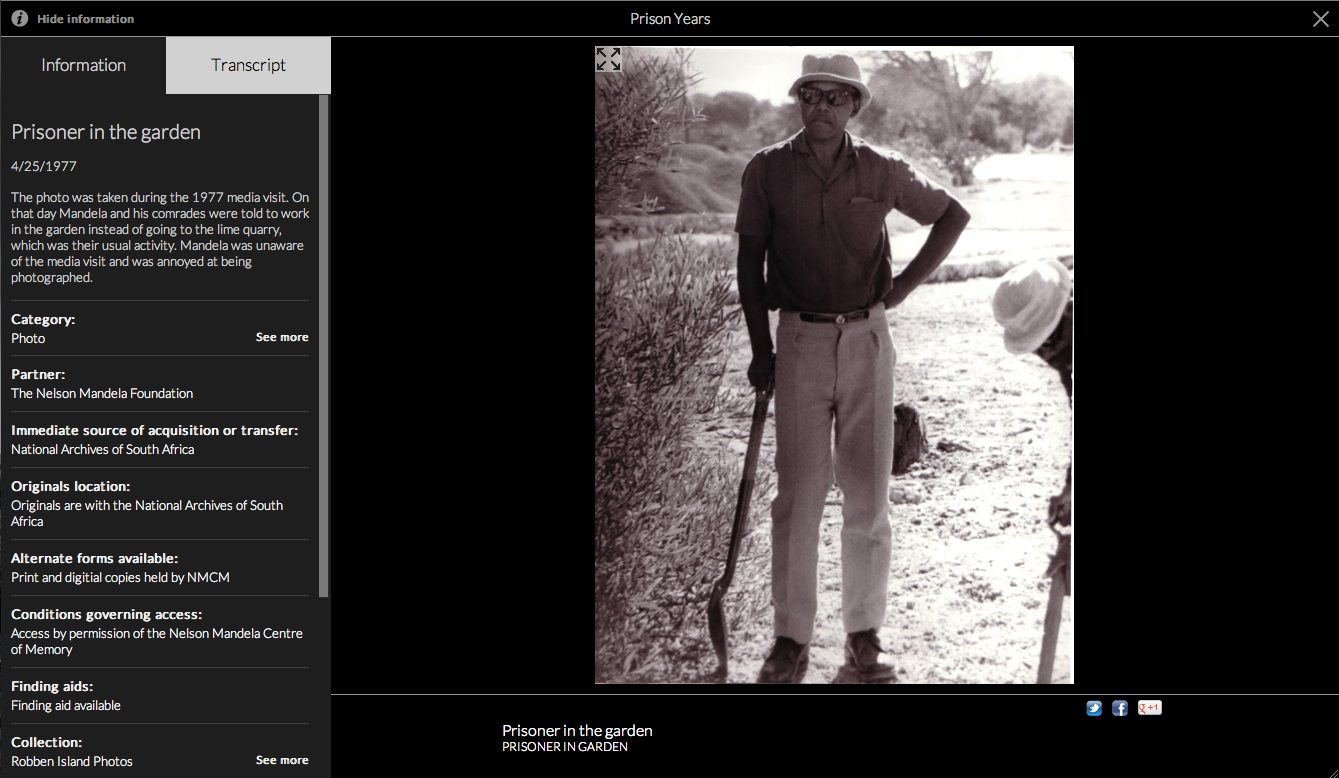 We’ve worked closely with the NMCM to create an interactive online experience which we hope will inspire you as much as us. You can search and browse the archives to explore different parts of Mandela’s life and work in depth: Early Life, Prison Years, Presidential Years, Retirement, Books for Mandela, Young People and My Moments with a Legend.  From there, you might want to see all the letters held by the archive, and click “See more” in the letters category, where you can discover all personal letters or use the time filter to explore his diaries and calendars written between 1988 and 1998, where you can see that in the last page of the last diary, he met with President Yoweri Kaguta Museveni of Uganda to exchange ideas about the situation in northern Uganda. If you were a researcher, you can search through various fragments of Madiba’s memory that relate to Ahmed Kathrada, his long-time comrade, politician and anti-apartheid activist, where you can find photos, videos, manuscripts and letters that relate to him. 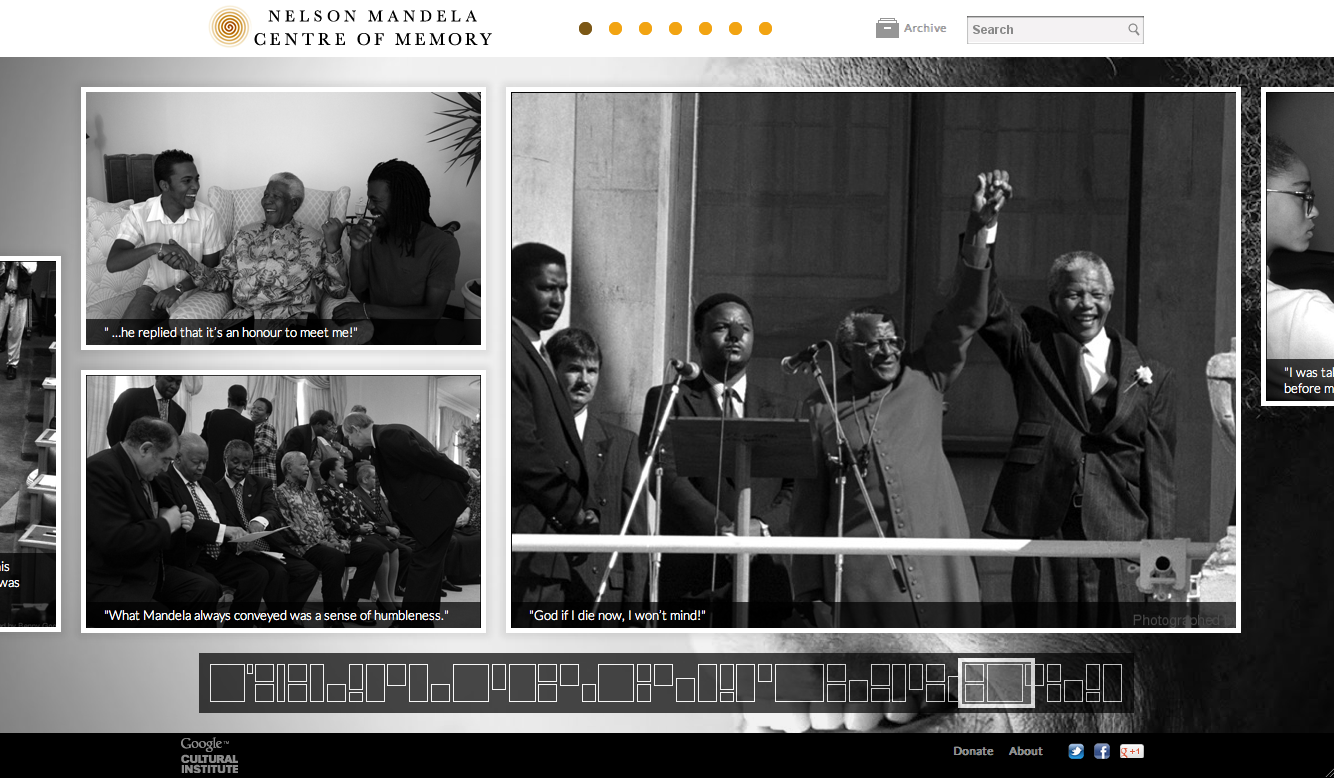 The Nelson Mandela Digital Archive project is an initiative by the Nelson Mandela Centre of Memory and the Google Cultural Institute, which helps to preserve and promote our diverse cultural and historical heritage. Some of our other initiatives include the Art Project, digitizing the Dead Sea Scrolls and bringing the Yad Vashem Holocaust materials online. |

Share this:

history… February 11

1752 – The Pennsylvania Hospital opened as the very first hospital in America.
1808 – Judge Jesse Fell experimented by burning anthracite coal to keep his house warm. He successfully showed how clean the coal burned and how cheaply it could be used as a heating fuel.
1812 – The term “gerrymandering” had its beginning when the governor of Massachusetts, Elbridge Gerry, signed a redistricting law that favored his party.
1858 – A French girl, Bernadette Soubirous, claimed to have seen a vision of the Virgin Mary near Lourdes.
1878 – The first U.S. bicycle club, Boston Bicycle Club, was formed.
1929 – The Lateran Treaty was signed. Italy now recognized the independence and sovereignty of Vatican City.
1936 – Pumping began the process to build San Francisco’s Treasure Island.
1937 – General Motors agreed to recognize the United Automobile Workers Union, which ended the current sit-down strike against them.
1938 – “The Big Broadcast of 1938” was released.
1940 – NBC radio presented “The Chamber Music Society of Lower Basin Street” for the first time.
1943 – General Dwight David Eisenhower was selected to command the allied armies in Europe.
1945 – During World War II, the Yalta Agreement was signed by U.S. President Franklin Roosevelt, British Prime Minister Winston Churchill and Soviet leader Josef Stalin. (Today in World War II History)
1957 – The NHL Players Association was formed in New York City.
1958 – Ruth Carol Taylor was the first black woman to become a stewardess by making her initial flight.
1960 – Jack Paar walked off while live on the air on the “Tonight Show” with four minutes left. He did this in response to censors cutting out a joke from the show the night before.
1968 – The new 20,000 seat Madison Square Garden officially opened in New York. This was the fourth Garden.
1972 – McGraw-Hill Publishing Co. and Life magazine canceled plans to publish an autobiography of Howard Hughes. The work turned out to be fake.
1975 – Margaret Thatcher became the first woman to head a major party in Britain when she was elected leader of the Conservative Party.
1979 – Nine days after the Ayatollah Ruhollah Khomeini returned to Iran (after 15 years in exile) power was seized by his followers.
1982 – ABC-TV’s presentation of “The Winds of War” concluded. The 18-hour miniseries cost $40 million to produce and was the most-watched television program in history at the time.
1982 – France nationalized five groups of major industries and 39 banks.
1984 – The tenth Space Shuttle mission returned to Earth safely.
1989 – Rev. Barbara C. Harris became the first woman to be consecrated as a bishop in the Episcopal Church.
1990 – Nelson Mandela was freed after 27 years in captivity.
1990 – In Tokyo, Japan, James “Buster” Douglas knocked out Mike Tyson in the tenth round to win the heavyweight championship.
1993 – Janet Reno was appointed to the position of attorney general by U.S. President Clinton. She was the first female to hold the position.
2000 – The space shuttle Endeavor took off. The mission was to gather information for the most detailed map of the earth ever made.
2000 – Great Britain suspended self-rule in Northern Ireland after the Irish Republican Army (IRA) failed to begin decommissioning (disarming) by a February deadline.
2002 – The six stars on NBC’s “Friends” signed a deal for $24 million each for the ninth and final season of the series.
2006 – In Texas, U.S. Vice President Dick Cheney accidentally shot and wounded a companion during a quail hunt.
2016 – It was reported that scientists had detected gravitational waves. The waves had been detected on September 14, 2015 by the Laser Interferometer Gravitational-wave Observatory (LIGO) detectors in Livingston, LA, and Hanford, WA.
on-this-day.com

 Be a Seed for Change
You must be logged in to post a comment.