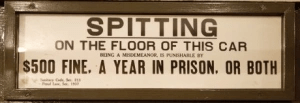
New York City passes the nation’s first anti-spitting law to combat tuberculosis, imposing fines and jail time. By 1910, more than 2,500 arrests are made—despite backlash from protesters, yep, spitting on anti-spitting signs.
Source: history.com

New York City passes the nation’s first anti-spitting law to combat tuberculosis, imposing fines and jail time. By 1910, more than 2,500 arrests are made—despite backlash from protesters, yep, spitting on anti-spitting signs.
Source: history.com
 88 – King Henry III fled Paris after Henry of Guise triumphantly entered the city.
1780 – Charleston, South Carolina fell to British forces.
1847 – William Clayton invented the odometer.
1870 – Manitoba entered the Confederation as a Canadian province.
1881 – Tunisia, in North Africa became a French protectorate.
1885 – In the Battle of Batoche, French Canadians rebelled against the Canadian government.
1888 – Charles Sherrill of the Yale track team became the first runner to use the crouching start for a fast break in a foot race.
1926 – The airship Norge became the first vessel to fly over the North Pole.
1926 – In Britain, a general strike by trade unions ended. The strike began on May 3, 1926.
1937 – Britain’s King George VI was crowned at Westminster Abbey.
1940 – The Nazi conquest of France began with the German army crossing Muese River.
1942 – The Soviet Army launched its first major offensive of World War II and took Kharkov in the eastern Ukraine from the German army.
1943 – The Axis forces in North Africa surrendered during World War II.
1949 – The Soviet Union announced an end to the Berlin Blockade.
1950 – The American Bowling Congress abolished its white males-only membership restriction after 34 years.
1957 – A.J. Foyt won his first auto racing victory in Kansas City, MO.
1965 – West Germany and Israel exchanged letters establishing diplomatic relations.
1970 – Ernie Banks, of the Chicago Cubs, hit his 500th home run.
1975 – U.S. merchant ship Mayaguez was seized by Cambodian forces in international waters.
1978 – The National Oceanic and Atmospheric Administration announced that they would no longer exclusively name hurricanes after women.
1982 – South Africa unveiled a plan that would give voting rights to citizens of Asian and mixed-race descent, but not to blacks.
1984 – South African prisoner Nelson Mandela saw his wife for the first time in 22 years.
1999 – Russian President Boris Yeltsin dismissed Prime Minister Yevgeny Primakov and named Interior Minister Sergei Stepashin as his successor.
2002 – Former U.S. President Carter arrived in Cuba for a visit with Fidel Castro. It was the first time a U.S. head of state, in or out of office, had gone to the island since Castro’s 1959 revolution.
2003 – In Texas, fifty-nine Democratic lawmakers went into hiding over a dispute with Republican’s over a congressional redistricting plan.
2008 – In the U.S., the price for a one-ounce First-Class stamp increased from 41 to 42 cents.
2015 – It was announced that Verizon would be acquiring AOL.

On May 9, 1914, President Woodrow Wilson issues a presidential proclamation that officially establishes the first national Mother’s Day holiday to celebrate America’s mothers.
The idea for a “Mother’s Day” is credited by some to Julia Ward Howe (1872) and by others to Anna Jarvis (1907), who both suggested a holiday dedicated to a day of peace. Many individual states celebrated Mother’s Day by 1911, but it was not until Wilson lobbied Congress in 1914 that Mother’s Day was officially set on the second Sunday of every May. In his first Mother’s Day proclamation, Wilson stated that the holiday offered a chance to “[publicly express] our love and reverence for the mothers of our country.”
Article Title Woodrow Wilson proclaims the first Mother’s Day holiday Author History.com Editors Website Name HISTORY URL https://www.history.com/this-day-in-history/woodrow-wilson-proclaims-the-first-mothers-day-holiday
Date Accessed May 7, 2023 PublisherA&E Television Networks Last Updated May 6, 2021
Original Published Date November 16, 2009
0330 – Constantinople, previously the town of Byzantium, was founded.
1573 – Henry of Anjou became the first elected king of Poland.
1647 – Peter Stuyvesant arrived in New Amsterdam to become governor.
1689 – French and English naval battle takes place at Bantry Bay.
1745 – French forces defeat an Anglo-Dutch-Hanoverian army at Fontenoy.
1792 – The Columbia River was discovered by Captain Robert Gray.
1812 – British prime Minster Spencer Perceval was shot by a bankrupt banker in the lobby of the House of Commons.
1816 – The American Bible Society was formed in New York City.
1857 – Indian mutineers seized Delhi from the British.
1858 – Minnesota was admitted as the 32nd U.S. state.
1860 – Giuseppe Garibaldi landed at Marsala, Sicily.
1889 – Major Joseph Washington Wham takes charge of $28,000 in gold and silver to pay troops at various points in the Arizona Territory. The money was stolen in a train robbery.
1894 – Workers at the Pullman Palace Car Company in Illinois went on strike.
1910 – Glacier National Park in Montana was established.
1927 – The Academy of Motion Picture Arts and Sciences was founded.
1934 – A severe two-day dust storm stripped the topsoil from the great plains of the U.S. and created a “Dust Bowl.” The storm was one of many.
1944 – A major offensive was launched by the allied forces in central Italy.
1947 – The creation of the tubeless tire was announced by the B.F. Goodrich Company.
1949 – Siam changed its name to Thailand.
1960 – Israeli soldiers captured Adolf Eichmann in Buenos Aires.
1967 – The siege of Khe Sanh ended.
1985 – More than 50 people died when a flash fire swept a soccer stadium in Bradford, England.
1995 – The Nuclear Nonproliferation Treaty was extended indefinitely. The treaty limited the spread of nuclear material for military purposes.
1996 – An Atlanta-bound ValuJet DC-9 caught fire shortly after takeoff from Miami and crashed into the Florida Everglades. All 110 people on board were killed.
1997 – Garry Kasparov, world chess champion, lost his first ever multi-game match. He lost to IBM’s chess computer Deep Blue. It was the first time a computer had beaten a world-champion player.
1998 – India conducted its first underground nuclear tests, three of them, in 24 years. The tests were in violation of a global ban on nuclear testing.
1998 – A French mint produced the first coins of Europe’s single currency. The coin is known as the euro.
2001 – U.S. Attorney General John Ashcroft announced his decision to approve a 30-day delay of the execution of convicted Oklahoma City bomber Timothy McVeigh. McVeigh had been scheduled to be executed on May 16, 2001. The delay was because the Federal Bureau of Investigation (FBI) had failed to disclose thousands of documents to McVeigh’s defense team. (Oklahoma)
a repost
Beginning in the 1850s, Ann Reeves Jarvis of West Virginia started Mothers’ Day Work Clubs in order to teach women proper child-care techniques and sanitation methods. In the years following the Civil War, these same clubs became a unifying force for a country ripped apart by conflict. In 1868, Jarvis and other women organized a Mothers Friendship Day, when mothers gathered with former soldiers of both the Union and Confederacy to promote reconciliation. After Ann Reeves Jarvis died in 1905, it was her daughter Anna Jarvis who would work tirelessly to make Mother’s Day a national holiday.

Anna Jarvis, who had no children of her own, conceived of Mother’s Day as an occasion for honoring the sacrifices individual mothers made for their children.
In May 1908, she organized the first official Mother’s Day events at a church in her hometown of Grafton, West Virginia, as well as at a Wanamaker’s department store in Philadelphia, where she lived at the time. Jarvis then began writing letters to newspapers and politicians pushing for the adoption of Mother’s Day as an official holiday. By 1912, many other churches, towns and states were holding Mother’s Day celebrations, and Jarvis had established the Mother’s Day International Association. Her hard-fought campaign paid off in 1914, when President Woodrow Wilson signed a bill officially establishing the second Sunday in May as Mother’s Day.
Jarvis’ conceived of of Mother’s Day as an intimate occasion—a son or daughter honoring the mother they knew and loved—and not a celebration of all mothers. For this reason, she always stressed the singular “Mother’s” rather than the plural. She soon grew disillusioned, as Mother’s Day almost immediately became centered on the buying and giving of printed cards, flowers, candies and other gifts. Seeking to regain control of the holiday she founded, Jarvis began openly campaigning against those who profited from Mother’s Day, including confectioners, florists and other retailers. She launched numerous lawsuits against groups using the name Mother’s Day, and eventually spent much of her sizeable inheritance on legal fees.
In 1925, when an organization called the American War Mothers used Mother’s Day as an occasion for fundraising and selling carnations, Jarvis crashed their convention in Philadelphia and was arrested for disturbing the peace. Later, she even attacked First Lady Eleanor Roosevelt for using Mother’s Day as an occasion to raise money for charity. By the 1940s, Jarvis had disowned the holiday altogether, and even actively lobbied the government to see it removed from the calendar. Her efforts were to no avail, however, as Mother’s Day had taken on a life of its own as a commercial goldmine. Largely destitute, and unable to profit from the massively successful holiday she founded, Jarvis died in 1948 in Philadelphia’s Marshall Square Sanitarium.
The sad history of Mother’s Day founder Anna Jarvis has done nothing to slow down the popularity—and commercialism—of the holiday. According to an annual spending survey conducted by the National Retail Federation, Americans will spend an average of $168.94 on Mother’s Day in 2013, a whopping 11 percent increase from 2012. In total, Mother’s Day spending is expected to reach $20.7 billion this year. In addition to the more traditional gifts (ranging from cards, flowers and candy to clothing and jewelry), the survey showed that an unprecedented 14.1 percent of gift-givers plan to buy their moms high-tech gadgets like smartphones and tablets.


 Be a Seed for Change
You must be logged in to post a comment.