repost – in memory
 Lonnie Bunch, museum director, historian, lecturer, and author, is proud to present A Page from Our American Story, a regular on-line series for Museum supporters. It will showcase individuals and events in the African American experience, placing these stories in the context of a larger story — our American story.
A Page From Our American Story
On July 5, 1852 approximately 3.5 million African Americans were enslaved — roughly 14% of the total population of the United States. That was the state of the nation when Frederick Douglass was asked to deliver a keynote address at an Independence Day celebration.
He accepted and, on a day white Americans celebrated their independence and freedom from the oppression of the British crown, Douglass delivered his now-famous speech What to the Slave is the Fourth of July. In it, Douglass offered one of the most thought provoking and powerful testaments to the hypocrisy, bigotry and inhumanity of slavery ever given.
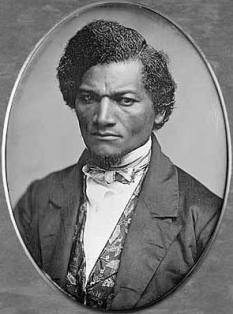
Daguerreotype of Frederick Douglass
(1847-1852) by Samuel J. Miller.
The Art Institute of Chicago
Douglass told the crowd that the arguments against slavery were well understood. What was needed was “fire” not light on the subject; “thunder” not a gentle “shower” of reason. Douglass would tell the audience: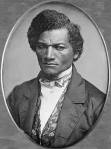
The feeling of the nation must be quickened; the conscience of the nation must be roused; the propriety of the nation must be startled; the hypocrisy of the nation must be exposed; and its crimes against God and man must be denounced.
Frederick Douglass was born into slavery, most likely in February 1818 — birth dates of slaves were rarely recorded. He was put to work full-time at age six, and his life as a young man was a litany of savage beatings and whippings. At age twenty, he successfully escaped to the North. In Massachusetts he became known as a voice against slavery, but that also brought to light his status as an escaped slave. Fearing capture and re-enslavement, Douglass went to England and continued speaking out against slavery.
He eventually raised enough money to buy his freedom and returned to America. He settled in Rochester, New York in 1847 and began to champion equality and freedom for slaves in earnest. By then, his renown extended far beyond America’s boundaries. He had become a man of international stature.
One suspects that Rochester city leaders had Douglass’ fame and reputation as a brilliant orator in mind when they approached him to speak at their Independence Day festivities. But with his opening words, Douglass’ intent became clear — decry the hypocrisy of the day as it played out in the lives of the slaves:
Fellow citizens, pardon me, and allow me to ask, why am I called upon to speak here today? What have I or those I represent to do with your national independence? Are the great principles of political freedom and of natural justice, embodied in that Declaration of Independence, extended to us? And am I, therefore, called upon to bring our humble offering to the national altar, and to confess the benefits, and express devout gratitude for the blessings resulting from your independence to us?
You can easily imagine the wave of unease that settled over his audience. The speech was long, as was the fashion of the day. A link to the entire address can be found at the end of this Our American Story. When you read it you will discover that, to his credit, Douglass was uncompromising and truthful:
This Fourth of July is yours, not mine. You may rejoice, I must mourn … What to the American slave is your Fourth of July? … a day that reveals to him more than all other days of the year, the gross injustice and cruelty to which he is the constant victim. To him your celebration is a sham … your shouts of liberty and equality, hollow mock; your prayers and hymns, your sermons and thanksgivings … hypocrisy — a thin veil to cover up crimes which would disgrace a nation of savages.
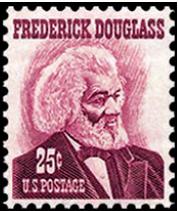
US Stamp honoring
Frederick Douglass, 1967.
US Postal Service
Reaction to the speech was strong, but mixed. Some were angered, others appreciative. What I’ve always thought most impressive about Douglass’ speech that day was the discussion it provoked immediately and in the weeks and months that followed.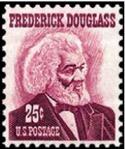
Certainly much has changed since Douglass’ speech. Yet the opportunity to discuss and debate the important impact of America’s racial history is very much a part of the National Museum of African American History and Culture. Douglass’ words remind us that many have struggled to ensure that the promise of liberty be applied equally to all Americans — regardless of race, gender or ethnicity. And that the struggle for equality is never over.
So, as we gather together at picnics, parades, and fireworks to celebrate the 4th of July, let us remember those, like Frederick Douglass, who fought and sacrificed to help America live up to its ideals of equality, fair play and justice.
Frederick Douglass’ life and words have left us a powerful legacy. His story, and the African American story, is part of us all.
To you and your family, have a joyous and safe Fourth of July and thank you for your interest in the National Museum of African American History and Culture.
All the best,
Lonnie Bunch
Director
P.S. To read the full text Frederick Douglass’ speech of July 5, 1852, click here: http://teachingamericanhistory.org/library/index.asp?document=162
We
hope you will consider making a contribution to the Museum. Thank you for your support.



 1096 – Crusaders under Peter the Hermit reached Sofia, Bulgaria. There they met their Byzantine escort, which brought them safely the rest of the way to Constantinople. by August 1.


 Be a Seed for Change
You must be logged in to post a comment.