
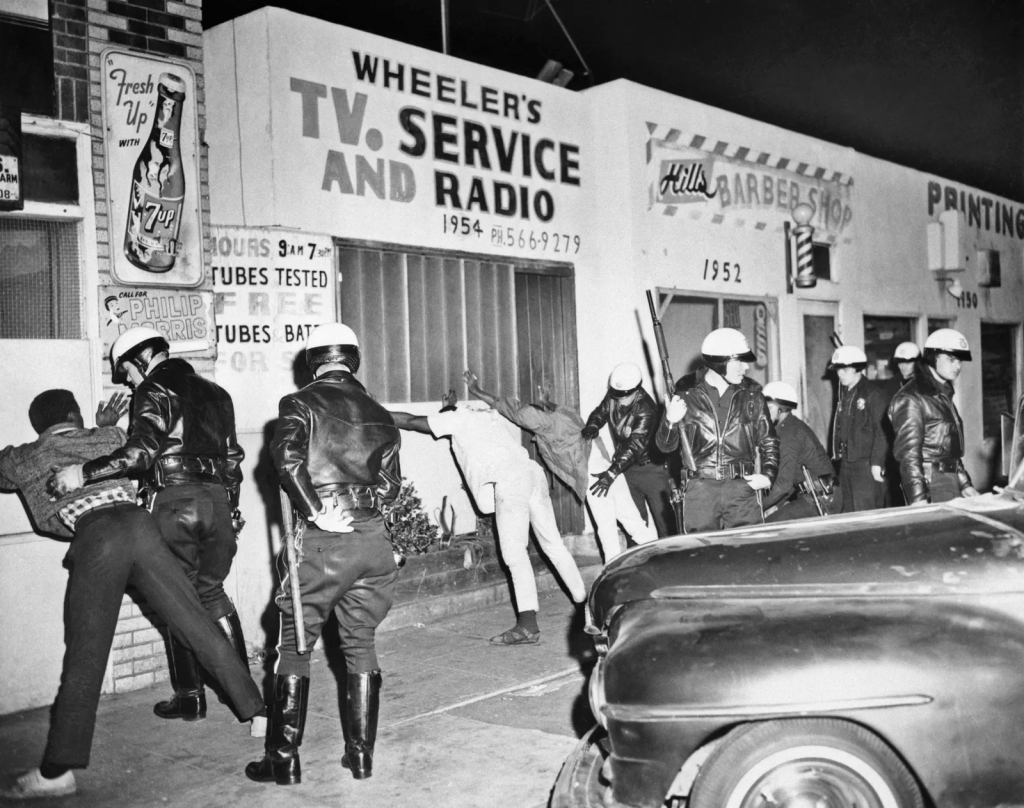
Over the last few years, I have posted articles about the 3rd, 4th, and media accounts of what were called the Watts Riots … and while there are several sides to this event … the accounts given all seem to be missing something, or some puzzle pieces were left out. I am not saying intentionally, but gotta say some accounts don’t seem to match the original reasons the riots started. I was about 12, didn’t live there, and the history books didn’t go there, let alone give out all the information. I admit to looking at these accounts over the years and deleting and reposting what sounded like the truth, but never that comfortable with the info …
It’s 2026, and deciding to delete the articles was the best thing ever. I will post what is labeled as … I will go and research this to make sure it’s accurate … etc.
Martin Luther King Jr. and Lyndon Johnson assessment of situation
In a taped White House phone conversation on August 20, 1965, Martin Luther King Jr. called U.S. President Lyndon Johnson to discuss the outcome of his meetings with LAPD chief William Parker and mayor Sam Yorty. King described Parker as a “very rude man,” while also not seeing “a willingness on the part of the mayor to grant just a few concessions to make to bring about a new sense of hope…,” but also noted that the people of the Watts area were in fear of a return by the “National Guard.” King noted how he was fearful of “retaliation in the white community” should the local National Guard return, noting how already “people have brought up guns, and Chief Parker went on television the other day. They need to do anti-riot crew and all that.” King recommended fighting poverty was a good solution in order to prevent a “race war,” and President Johnson accepted King’s recommendation to have Lee C. White come to the White House. Johnson also noted to King that despite publicly advocating for people to obey the law, he also believed that “there’s no use giving lectures on the law as long as you got rats eating on people’s kid – children and unemployed, and no roof over their head, and no job to go to, and may with a dope needle on one side a cancer on the other.”[51]
source: wiki
I used the internet, and a search for the specific conversation between Johnson and MLK jr the MillerCenter.org site popped up. This site is not just for Presidential information; it has conversations in both audio and transcription form! What better source than this!
Below is the conversation between Johnson and King jr.
In 1965, Reverend Dr. Martin Luther King Jr. reported on his visit to Los Angeles following the uprising in the Watts section of the city. King informed President Johnson that the city’s mayor and police chief seemed deeply unresponsive to the problems in the area, and he urged an intensification of the administration’s anti-poverty efforts.
President Johnson: [speaking over King] But I wanted you to know I’d said that. Pardon me for
interrupting. Go ahead.
Martin Luther King Jr.: That’s all right. But in my meeting with Police Chief [William H.] Parker
and Mr. [Samuel W. “Sam”] Yorty—Mayor Yorty—I just felt that they are absolutely insensitive to the
problem and to the needs, to really cure the situation. Now, Mr. Parker is a very rude man—we just
couldn’t get anywhere with him—but I just don’t see a willingness even on the part of the mayor to
grant just a few concessions to make—to bring about a new sense of hope and [unclear]. Now, what
is frightening about it is that you hear all of these tones of violence. The people out there in the Watts
area, they’d assumed the National Guard indeed were going back in. The minute that happens there
will be retaliation in the White community this time. Last time there was not, which was wonderful.
But the people have bought up guns, and Chief Parker went on television the other day, they need to
do an anti-riot crew, and all of that.
So that I’m fearful that if something isn’t done to give a new sense of hope to the people in that area—
and they are poverty-stricken—that a full-scale race war can develop here. And I’m concerned about
it, naturally, because I know that violence—a riot at the end of the day wouldn’t—doesn’t help.
President Johnson: That’s right. Now, what should we do about it? What’s your
recommendation?
King: Well, the problem is I think that poverty—if they could get, in the next few days, this poverty
program going in Los Angeles [California], I believe that it would help a great deal.
President Johnson: I’ll get him over here in the morning. We’ll get at it. Where are you going to
be?
King: I’ll be in Atlanta [Georgia] in the morning.
President Johnson: All right. We’ll call you back. Lee [C. White] will call you, or I’ll call you if I
have time, and we’ll explore it. Is that the net of what you’re recommending?
King: That’s right. [President Johnson acknowledges.] I think this would be greatly—this would
help greatly.
President Johnson: Well, we were ahead of it, and we got to keep ahead of it, and we’re not now
unless we do. But they never publicized it any, and you—you have—you’re on television, and you
ought to make them. Hell, tell them to read it, write and get it, [King acknowledges] and let’s get
busy. And let’s get into this housing. Let’s get into this unemployment. Let’s get into this health. Let’s
get into this Social Security situation. Let’s get into this education. Let’s get into—I said this morning,
“I spent the biggest part of my life for the last four years on civil rights bills, but it doesn’t—all of it
comes to naught if you have a situation like war in the world or a situation in Los Angeles.”
King: Yes.
President Johnson: And I said, “A man’s got no more right to destroy property with a Molotov
cocktail in Los Angeles than the Ku Klux Klan has to go out and destroy a life. And what we’ve got to
do is all obey the law. But there’s no use giving lectures on the law as long as you got rats eating on
people’s kid—children, and unemployed, and no roof over their head, and no job to go to, and maybe
with a dope needle in one side, and a cancer in the other.”
King: Yeah, that’s it.
CITATION: “Lyndon B. Johnson and Martin Luther King Jr. on 20 August 1965,” Conversation
WH6508-07-8578, Presidential Recordings Digital Edition [Lyndon B. Johnson and Civil Rights, vol.
2, ed. Kent B. Germany] (Charlottesville: University of Virginia Press, 2014–).
URL: http://prde.upress.virginia.edu/conversations/4005551
This conversation was transcribed by the Miller Center’s Presidential Recordings Program with the
generous support of the National Historical Publications and Records Commission.
Full information about this conversation: LBJ, King, and the Watts Revolt
millercenter.org

 Be a Seed for Change