
1957 Central High School integrated – September 4, 23- 25,1957


Called, The Little Rock Nine

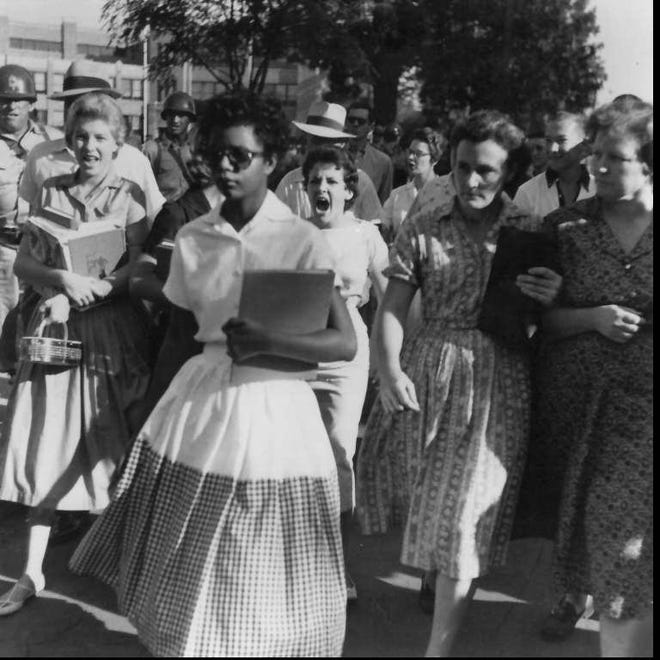
Under escort from the U.S. Army’s 101st Airborne Division, nine black students enter all-white Central High School in Little Rock, Arkansas. Three weeks earlier, Arkansas Governor Orval Faubus had surrounded the school with National Guard troops to prevent its federal court-ordered racial integration. After a tense standoff, President Dwight D. Eisenhower federalized the Arkansas National Guard and sent 1,000 army paratroopers to Little Rock to enforce the court order.

On May 17, 1954, the U.S. Supreme Court ruled unanimously in Brown v. Board of Education of Topeka that racial segregation in educational facilities was unconstitutional. Five days later, the Little Rock School Board issued a statement saying it would comply with the decision when the Supreme Court outlined the method and time frame in which desegregation should be implemented.Whites harass Elizabeth Eckford, one of nine African-American students attempting to attend Central High School in Little Rock, Ark., on Sept. 4, 1957. The governor sent National Guard troops in to keep the nine out.
Arkansas was at the time among the more progressive Southern states in regard to racial issues. The University of Arkansas School of Law was integrated in 1949, and the Little Rock Public Library in 1951. Even before the Supreme Court ordered integration to proceed “with all deliberate speed,” the Little Rock School Board in 1955 unanimously adopted a plan of integration to begin in 1957 at the high school level. The National Association for the Advancement of Colored People (NAACP) filed suit, arguing the plan was too gradual, but a federal judge dismissed the suit, saying that the school board was acting in “utmost good faith.” Meanwhile, Little Rock’s public buses were desegregated. By 1957, seven out of Arkansas’ eight state universities were integrated.

In the spring of 1957, there were 517 black students who lived in the Central High School district. Eighty expressed an interest in attending Central in the fall, and they were interviewed by the Little Rock School Board, which narrowed down the number of candidates to 17. Eight of those students later decided to remain at all-black Horace Mann High School, leaving the “Little Rock Nine” to forge their way into Little Rock’s premier high school.

In August 1957, the newly formed Mother’s League of Central High School won a temporary injunction from the county chancellor to block integration of the school, charging that it “could lead to violence.” Federal District Judge Ronald Davies nullified the injunction on August 30. On September 2, Governor Orval Faubus—a staunch segregationist—called out the Arkansas National Guard to surround Central High School and prevent integration, ostensibly to prevent the bloodshed he claimed desegregation would cause. The next day, Judge Davies ordered integrated classes to begin on September 4. 

September 4, 1957: Arkansas troops block “Little Rock Nine” from segregated high school

That morning, 100 armed National Guard troops encircled Central High School. A mob of 400 white civilians gathered and turned ugly when the black students began to arrive, shouting racial epithets and threatening the teenagers with violence. The National Guard troops refused to let the black students pass and used their clubs to control the crowd. One of the nine, 15-year-old Elizabeth Eckford, was surrounded by the mob, which threatened to lynch her. She was finally led to safety by a sympathetic white woman.

Little Rock Mayor Woodrow Mann condemned Faubus’ decision to call out the National Guard, but the governor defended his action, reiterating that he did so to prevent violence. The governor also stated that integration would occur in Little Rock when and if a majority of people chose to support it. Faubus’ defiance of Judge Davies’ court order was the first major test of Brown v. Board of Educationand the biggest challenge of the federal government’s authority over the states since the Reconstruction Era.

The standoff continued, and on September 20 Judge Davies ruled that Faubus had used the troops to prevent integration, not to preserve law and order as he claimed. Faubus had no choice but to withdraw the National Guard troops. Authority over the explosive situation was put in the hands of the Little Rock Police Department.

On September 23, as a mob of 1,000 whites milled around outside Central High School, the nine black students managed to gain access to a side door.

However, the mob became unruly when it learned the black students were inside, and the police evacuated them out of fear for their safety. That evening, President Eisenhower issued a special proclamation calling for opponents of the federal court order to “cease and desist.” On September 24, Little Rock’s mayor sent a telegram to the president asking him to send troops to maintain order and complete the integration process. Eisenhower immediately federalized the Arkansas National Guard and approved the deployment of U.S. troops to Little Rock. That evening, from the White House, the president delivered a nationally televised address in which he explained that he had taken the action to defend the rule of law and prevent “mob rule” and “anarchy.”

On September 25, the Little Rock Nine entered the school under heavily armed guard.

Troops remained at Central High School throughout the school year, but still the black students were subjected to verbal and physical assaults from a faction of white students. Melba Patillo, one of the nine, had acid thrown in her eyes, and Elizabeth Eckford was pushed down a flight of stairs. The three male students in the group were subjected to more conventional beatings. Minnijean Brown was suspended after dumping a bowl of chili over the head of a taunting white student. She was later suspended for the rest of the year after continuing to fight back. The other eight students consistently turned the other cheek. On May 27, 1958, Ernest Green, the only senior in the group, became the first black to graduate from Central High School.

Governor Faubus continued to fight the school board’s integration plan, and in September 1958 he ordered Little Rock’s three high schools closed rather than permit integration. Many Little Rock students lost a year of education as the legal fight over desegregation continued. In 1959, a federal court struck down Faubus’ school-closing law, and in August 1959 Little Rock’s white high schools opened a month early with black students in attendance.

All grades in Little Rock public schools were finally integrated in 1972

Meet Governor Orval Faubus – did you know his story?


Born January 7, 1910 – December 14, 1994) was an American politician who served as the 36th Governor of Arkansas from 1955 to 1967, as a member of the Democratic Party.

In 1957, he refused to comply with a decision of the U.S. Supreme Court in the 1954 case Brown v. Board of Education, and ordered the Arkansas National Guard to prevent black students from attending Little Rock Central High School. This event became known as the Little Rock Crisis.

Faubus’s name became internationally known during the Little Rock Crisis of 1957, when he used the Arkansas National Guard to stop African Americans from attending Little Rock Central High School as part of federally ordered racial desegregation.

Critics have long charged that Faubus’s fight in Little Rock against the 1954 Brown v. Board of Education decision by the U.S. Supreme Court that separate schools were inherently unequal was politically motivated. The ensuing battle helped to shield him from the political fallout from a tax increase. Journalist Harry Ashmore (who won a Pulitzer Prize for his columns on the subject) portrayed the fight over Central High as a crisis manufactured by Faubus. Ashmore said that Faubus used the Guard to keep blacks out of Central High School because he was frustrated by the success his political opponents were having in using segregationist rhetoric to arouse white voters.

Faubus’s decision led to a showdown with President Dwight D. Eisenhower and former Governor Sid McMath.

On September 5, 1957, Eisenhower sent a telegram to Faubus in which he wrote “The only assurance I can give you is that the Federal Constitution will be upheld by me by every legal means at my command.”

This was a response to Faubus’s concerns about being taken into custody and his telephones being wired. Eisenhower did say in his telegram that the Department of Justice was collecting facts as to why there was a failure to comply with the courts.[7] This led to the September 14 conference where Faubus and Eisenhower discussed the Court order in Newport, Rhode Island. The quoted “friendly and constructive discussion” led to Faubus claiming his desire to comply with his duty to the Constitution, personal opinions aside. Faubus did express his hope that the Department of Justice would be patient.[8] He did stay true to his word and on September 21, President Eisenhower released a statement which announced that Faubus had withdrawn his troops, the Little Rock School Board was carrying out desegregation plans, and local law was ready to keep order.[9]

On September 23, however, Little Rock Mayor Woodrow Wilson Mann sent a telegram to Eisenhower stating a mob had formed at Central High School. State police made efforts to control the mob, but for the safety of the newly enrolled children, they were sent home. The mayor stressed how this was a planned act and that the principal agitator, Jimmy Karam, was an associate of Governor Faubus. The mayor further stated his belief that there was no way the governor could not have been aware of this planned attack.[10] In October 1957, Eisenhower federalized the Arkansas National Guard and ordered them to return to their armories which effectively removed them from Faubus’s control. Eisenhower then sent elements of the 101st Airborne Division to Arkansas to protect the black students and enforce the federal court order. The Arkansas National Guard later took over protection duties from the 101st Airborne Division. In retaliation, Faubus shut down Little Rock high schools for the 1958–1959 school year. This is often referred to as “The Lost Year” in Little Rock.[11]

In a 1985 interview with a Huntsville, Arkansas, student, Faubus stated that the crisis was due to an “usurpation of power” by the federal government.[citation needed] The State knew forced integration by the federal government was going to meet with unfavorable results from the Little Rock public. In his opinion, Faubus was acting in the State’s best interest at the time.

Though Faubus later lost general popularity as a result of his support for segregation, at the time he was included among the “Ten Men in the World Most Admired by Americans”, according to Gallup’s most admired man and woman poll for 1958. This dichotomy was later summed up as follows: Faubus was both the “best loved” and “most hated” of Arkansas politicians of the second half of the twentieth century.[citation needed]

The Little Rock Crisis inspired the song “Fables of Faubus” by jazz artist Charles Mingus.[12]

Faubus was elected governor to six two-year terms and hence served for twelve years. He maintained a defiant, populist image, while he shifted toward a less confrontational stance with the federal government, particularly during the administrations of Presidents John F. Kennedy and Lyndon B. Johnson, with each of whom he remained cordial, and both of whom carried Arkansas.

In the 1956 general election, Faubus, having already beaten Jim Johnson, overwhelmed GOP candidate Roy Mitchell, later the GOP state chairman from Hot Springs, 321,797 (80.7%) to 77,215 (19.4%). In 1958, he defeated Republican George W. Johnson of Greenwood in Sebastian County by drawing 82.5% of the votes.

In 1962, Faubus broke with the White Citizens’ Councils and other groups, who preferred, but did not officially endorse, U.S. Representative Dale Alford in that year’s gubernatorial primary.[13] Faubus cast himself as a moderate, he completely ignored the race issue during the 1962 election campaign, and barely secured a majority over Alford, McMath, and three other candidates. He then handily defeated the Republican Willis Ricketts, a then 37-year-old pharmacist from Fayetteville in the general election.[4]

While Faubus was still shunned by black leaders, he nevertheless won a large percent of the black vote. In 1964, when he defeated the Republican Winthrop Rockefeller by a 57–43 percent margin, Faubus won 81 percent of the black vote. He even collected a share of the base Republican vote from the conservative party members who had sided with former Republican state chairman William L. Spicer of Fort Smith, an intraparty rival of Rockefeller.

1960 presidential election[edit]

During the 1960 presidential election, at a secret meeting held in a rural lodge near Dayton, Ohio, the National States Rights Party (NSRP) nominated Faubus for President and retired U.S. Navy Rear Admiral John G. Crommelin of Alabama for Vice President. Faubus, however, did not campaign on this ticket actively, and won only 0.07% of the vote (best in his native Arkansas: 6.76%), losing to the John F. Kennedy and Lyndon B. Johnson ticket.[citation needed]

Source: wiki.org

If you see inaccurate information, please notify them

For more History re: Little Rock Nine… the link below https://www.history.com/news/the-story-behind-the-famous-little-rock-nine-scream-image

It might be said that this man was a Dixiecrat, NOT a true member of the Democratic Party maybe a supporter of Kennedy by then?

– Nativegrl77

USDA~ FSN ~ FDA ~ September 2026 -Recalls – Food Safety Alerts – Previous Month & last day of prior month update


** B. Braun Medical Inc. Issues Voluntary Nationwide Recall of 0.9% Sodium Chloride Injection USP, 100 mL, in a 150 mL PAB® Container Due to the Presence of Particulate Matter. Product was distributed Nationwide to hospital and healthcare facilities from February 27, 2026 to August 3, 2026.

B. Braun is notifying its distributors and customers by mail and is arranging for return and replacement of all recalled products. Customers that have the recalled product should return to place of purchase.

Consumers with questions regarding this recall can contact B. Braun by emailing recalls@bbraunusa.com, Monday to Friday 8:00am to 5:00pm EST.

** American Regent, Inc. Issues Voluntary Nationwide Recall of Three Lots of Epinephrine Injection, USP 30 mg/ 30 mL (1 mg/mL) Due to the Presence of Particulate Matter and Lack of Assurance of Sterility. September 3, 2026 – New Albany, OH, American Regent, Inc. is conducting a nationwide voluntary recall of three lots of Epinephrine Injection, USP 30 mg/ 30 mL (1 mg/mL) multidose vials to the consumer level. Customer complaints were received for leaking and cracked vials, resulting in a lack of assurance of sterility. The firm’s investigation also revealed the presence of particulate matter identified as Nylon, Cellulosic, Acrylic, Polyethylene, and Glass. Epinephrine Injection, USP 30 mg/ 30 mL (1 mg/mL) packaged in a multi dose vials, administered intravenously, intramuscularly, or subcutaneously and is to be used by or under the direction of a physician. Epinephrine Injection, USP is indicated for the emergency treatment of allergic reactions (Type I), including anaphylaxis, which may result from insect stings or bites, foods, drugs, sera, diagnostic testing substances, and other allergens, as well as idiopathic anaphylaxis or exercise-induced anaphylaxis. Epinephrine Injection, USP is also indicated to increase mean arterial blood pressure in adult patients with hypotension associated with septic shock. Epinephrine Injection, USP is a clear, colorless, sterile solution available in a 30 mL multiple-dose vial containing 1 mg/mL. The affected Lot Numbers 25128L1C0, 25280L1C0, and 26108L1C0 were distributed nationwide in the United States. Phone: 800-645-1706 (8:00AM-6:00PM 
EST, Monday – Thursday, 8:00AM- 
4:00PM EST, Friday)American Regent, Inc. 
Customer Service

** Frutas y Hortalizas del Sur S.A. Expands Recall to Include One Lot of Great Value Frozen Organic Triple Berry Blend Because of Potential Contamination with Escherichia coli O145:H28 (E. coli O145). This recalled product was shipped to select Walmart stores in 16 states, including Alabama, Arkansas, Florida, Illinois, Indiana, Kentucky, Louisiana, Minnesota, Mississippi, Missouri, North Carolina, Ohio, Oklahoma, South Carolina, Texas, and Wisconsin. Consumers should check their freezers for the affected product.

The affected product is:

  • Product: Great Value Organic Triple Berry Blend 10 OZ (Including Strawberries, Blackberries and Blueberries), with UPC: 7874211226
  • Package Size: 10 oz
  • Lot Code: 6040 01-6 (in front of the package)
  • Best If Used By Date: February 9, 2028

Consumers who have Great Value Organic Triple Berry 10 OZ with lot code 6040 01-6 should not consume it.Media Contact: Joshua Weiss

Info.foodsafety@comfrut.com or 336-899-5612.

Monday – Friday 8 AM – 6 PM EST 

** The Centers for Disease Control and Prevention (CDC) has confirmed 11,485 patients in the current iceberg lettuce-linked Cyclospora outbreak as of Aug. 27. Patients have been confirmed in three more states: Georgia, Tennessee and Texas. The number of deaths related to the outbreak still stands at two. The CDC continues to investigate additional Cyclospora outbreaks across the country.

** Another sprout product under recall; seed supplier refuses to issue recall

An unnamed seed company is now under investigation in an outbreak traced to fresh sprouts. And, another product has been added to the recall of implicated sprouts.

By Coral Beach 

** Alert issued by officials in Hong Kong about formaldehyde in rice noodles

Authorities in Hong Kong have issued a warning about a brand of imported rice noodles because of formaldehyde. The Centre for Food Safety (CFS) of the Food and Environmental Hygiene

By News Desk 

** LMSI LLC/Kofinas Olive Oil Issues a Voluntary Recall of its Garlic Mediterranean Infused Extra Virgin Olive Oil for Using a Garlic Essential Oil Not Approved for Culinary Use. LMSI LLC/ Kofinas Olive Oil is issuing a voluntary recall of its Garlic Mediterranean infused extra virgin olive oil for using a garlic essential oil not approved for culinary use. The flavored oil was bottled in glass bottles in 500 ml, 250 ml, and 100 ml sizes.

The recalled products were available for sale from August 31, 2025, to August 27, 2026, at the following locations:

Montgomery Store & Infusion Kitchen: 8210 Market Place Ln., Cincinnati, OH 45242

Findlay Market: 1801 Race St., Cincinnati, OH 45202

Online sales directly from www.kofinasoliveoil.comExternal Link Disclaimer.