
 |
|||||||||
 |
|
|
|
||||||
|
|
Businessweek has released a groundbreaking article connecting Indonesia‘s palm oil industry to widespread cases of forced and child labor. The stories are truly terrifying, including workers, many of whom are children, being defrauded, abused, and held captive on palm plantations. All to grow a plant and extract its oil for use in junk food, lipsticks and other household items in our supermarkets.
|
|||||||
Tag Archives: Slavery


History ~ July 5, 1852 – What to the American slave is your Fourth of July? … in memory
Lonnie Bunch, museum director, historian, lecturer, and author, is proud to present A Page from Our American Story, a regular on-line series for Museum supporters. It will showcase individuals and events in the African American experience, placing these stories in the context of a larger story — our American story.
A Page From Our American Story
On July 5, 1852 approximately 3.5 million African Americans were enslaved — roughly 14% of the total population of the United States. That was the state of the nation when Frederick Douglass was asked to deliver a keynote address at an Independence Day celebration.
He accepted and, on a day white Americans celebrated their independence and freedom from the oppression of the British crown, Douglass delivered his now-famous speech What to the Slave is the Fourth of July. In it, Douglass offered one of the most thought provoking and powerful testaments to the hypocrisy, bigotry and inhumanity of slavery ever given.
Daguerreotype of Frederick Douglass
(1847-1852) by Samuel J. Miller.
The Art Institute of Chicago
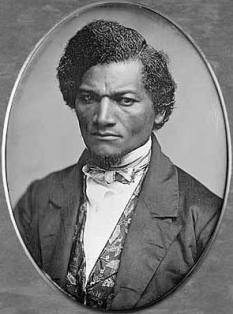
Douglass told the crowd that the arguments against slavery were well understood. What was needed was “fire” not light on the subject; “thunder” not a gentle “shower” of reason. Douglass would tell the audience:
The feeling of the nation must be quickened; the conscience of the nation must be roused; the propriety of the nation must be startled; the hypocrisy of the nation must be exposed; and its crimes against God and man must be denounced.
Frederick Douglass was born into slavery, most likely in February 1818 — birth dates of slaves were rarely recorded. He was put to work full-time at age six, and his life as a young man was a litany of savage beatings and whippings. At age twenty, he successfully escaped to the North. In Massachusetts he became known as a voice against slavery, but that also brought to light his status as an escaped slave. Fearing capture and re-enslavement, Douglass went to England and continued speaking out against slavery.
He eventually raised enough money to buy his freedom and returned to America. He settled in Rochester, New York in 1847 and began to champion equality and freedom for slaves in earnest. By then, his renown extended far beyond America’s boundaries. He had become a man of international stature.
One suspects that Rochester city leaders had Douglass’ fame and reputation as a brilliant orator in mind when they approached him to speak at their Independence Day festivities. But with his opening words, Douglass’ intent became clear — decry the hypocrisy of the day as it played out in the lives of the slaves:
Fellow citizens, pardon me, and allow me to ask, why am I called upon to speak here today? What have I or those I represent to do with your national independence? Are the great principles of political freedom and of natural justice, embodied in that Declaration of Independence, extended to us? And am I, therefore, called upon to bring our humble offering to the national altar, and to confess the benefits, and express devout gratitude for the blessings resulting from your independence to us?
You can easily imagine the wave of unease that settled over his audience. The speech was long, as was the fashion of the day. A link to the entire address can be found at the end of this Our American Story. When you read it you will discover that, to his credit, Douglass was uncompromising and truthful:
This Fourth of July is yours, not mine. You may rejoice, I must mourn … What to the American slave is your Fourth of July? … a day that reveals to him more than all other days of the year, the gross injustice and cruelty to which he is the constant victim. To him your celebration is a sham … your shouts of liberty and equality, hollow mock; your prayers and hymns, your sermons and thanksgivings … hypocrisy — a thin veil to cover up crimes which would disgrace a nation of savages.
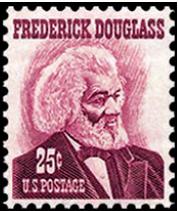
US Stamp honoring
Frederick Douglass, 1967.
US Postal Service
Reaction to the speech was strong, but mixed. Some were angered, others appreciative. What I’ve always thought most impressive about Douglass’ speech that day was the discussion it provoked immediately and in the weeks and months that followed.
Certainly much has changed since Douglass’ speech. Yet the opportunity to discuss and debate the important impact of America’s racial history is very much a part of the National Museum of African American History and Culture. Douglass’ words remind us that many have struggled to ensure that the promise of liberty be applied equally to all Americans — regardless of race, gender or ethnicity. And that the struggle for equality is never over.
So, as we gather together at picnics, parades, and fireworks to celebrate the 4th of July, let us remember those, like Frederick Douglass, who fought and sacrificed to help America live up to its ideals of equality, fair play and justice.
Frederick Douglass’ life and words have left us a powerful legacy. His story, and the African American story, is part of us all.
To you and your family, have a joyous and safe Fourth of July and thank you for your interest in the National Museum of African American History and Culture.
All the best,
Lonnie Bunch
Director
P.S. To read the full text Frederick Douglass’ speech of July 5, 1852, click here: http://teachingamericanhistory.org/library/index.asp?document=162
We hope you will consider making a contribution to the Museum.
a repost – in memory
Share this:

The Emancipation Proclamation — The 13th Amendment, a journey in American History …from Lonnie Bunch, museum director, historian, author, lecturer – a repost from 2010
| a repost from 2010 |
 |
 Lonnie Bunch, museum director, historian, lecturer, and author, is proud to present A Page From Our American Story, a regular on-line series for Museum supporters. It will showcase individuals and events in the African American experience, placing these stories in the context of a larger story — our American story.A Page From Our American Story Lonnie Bunch, museum director, historian, lecturer, and author, is proud to present A Page From Our American Story, a regular on-line series for Museum supporters. It will showcase individuals and events in the African American experience, placing these stories in the context of a larger story — our American story.A Page From Our American Story
13th Amendment to the
On December 18, 1865, 145 years ago, Secretary of State William Seward announced to the world that the United States had constitutionally abolished slavery — the 13th Amendment had been ratified. The ratification of the 13th Amendment, the first of the Reconstruction Amendments, was truly the beginning of the end of one our nation’s ugliest and saddest eras. Historically, however, it has always been overshadowed by President Abraham Lincoln’s “Emancipation Proclamation.” While Lincoln’s initial pronouncement to his Cabinet on September 22, 1862, formally tied slavery to the Civil War, he repeatedly stated that preserving the Union was his primary objective — not ending slavery.
In essence, Lincoln’s proclamation — officially signed and issued on January 1, 1863 — freed only slaves in Confederate states where he and the Union Army could not force the issue, but allowed slavery to continue in states where the Union could impose its will. The Emancipation Proclamation was a work of political irony. Lincoln understood slavery was wrong, but did not want to anger the border states that had remained supportive of the Union. However, the Emancipation Proclamation served as a catalyst for abolitionists in Congress to start working in earnest to end slavery in every state. It began on December 14, 1863, when House Republican James Ashley of Ohio introduced an amendment to ban slavery throughout the United States. Later that month, James Wilson of Iowa introduced another amendment calling for an end to slavery. Less than a month later, on January 11, 1864, Missouri Senator John Henderson, a member of the War Democrats — Democrats who supported the Civil War and opposed the Copperheads and Peace Democrats — submitted a joint resolution also wanting an amendment to end slavery. Now, as civil war ravaged the nation, the legislative battle on Capitol Hill to end the injustice of slavery and treat African Americans as equal citizens was launched on two fronts — the House of Representatives and the US Senate. On February 10, 1864, the Senate Judiciary Committee passed and brought the 13th Amendment to the full Senate. While in the House, one week after the Senate was moving ahead, Representatives took their first vote on the measure. The House vote well short of the two-thirds majority needed to pass, and it was clear the anti-slavery supporters in the House were in for a long struggle. On the other hand, the Senate moved quickly. Senators wasted little time following the Judiciary Committee’s recommendation for passage. On April 8, 1864, the amendment was overwhelmingly passed, 38-6, eight votes more than constitutionally required. Four months after the first House vote, in June, 1864, the House tried for a second time to pass the amendment. The vote was closer, but again the abolitionists failed to get the two-thirds majority they needed for passage.
The year drew to a close with Lincoln’s reelection. Yet the House had failed to produce a bill abolishing slavery. Lincoln’s patience with the House was reaching its end. At the same time, abolitionists declared his reelection as a mandate from the people to end slavery. More pressure was brought to bear on the hold-outs in the House to pass the bill. At last, on January 31, 1865, the House passed the 13th Amendment. Though not needed, as a symbolic gesture of approval, President Lincoln signed the document and then sent it to the states for ratification. Initially, ratification seemed a given. By the end of March, 19 states had voted for the amendment. Then the process bogged down, and by April 14, 1865, the date President Lincoln was assassinated, only 21 states were on board. Suddenly, Vice President Andrew Johnson, himself a War Democrat from Tennessee, was in the White House. Johnson was staunchly pro-Union, but he was less passionate about ending slavery. At this point the question was how much support would he provide toward speeding the end of slavery? Abolitionists were relieved when Johnson used his power as the Chief Executive to force Southern states to ratify the amendment as part of his Reconstruction policy. On December 6, 1865, nearly twelve months after President Lincoln had ceremoniously signed the document, Georgia became the 27th state to ratify the 13th Amendment. The three-quarters of the states needed to make the amendment law had finally been reached, and shortly afterward Seward made his historic announcement. Sadly, life for Black Americans did not meet the promise of freedom. Southern states adopted “Black Codes” and “Jim Crow laws” — rules and restrictions that by-passed constitutional requirements — and continued to treat African Americans as second class citizens. The tumult and grassroots uprising that eventually spawned such famous legislation as the Civil Rights Act of 1964 is a subject all its own. Today, however, let us remember the tremendous stride that America took 145 years ago with the ratification of the 13th Amendment. Together with the 14th Amendment that afforded African Americans citizenship, due process, and equal rights under the law and the 15th Amendment that gave African Americans the right to vote, a constitutional backbone was provided for what would become one of America’s greatest revolutions — the Civil Rights Movement.
|


Share this:


Black History… is American History

The featured image is by -Alice Ravenel Huger Smith, 1876-1958 “Loading a Rice Schooner”,c.1935
“I am no friend of slavery, but i prefer the liberty of my own country to that of another people, and the liberty of my own race to that of another race. The liberty of the descendants of Africa in the United States is incompatible with the safety and liberty of the European descendants. Their slavery forms an exception (resulting from a stern and inexorable necessity) to the general liberty in the United States.”
– Henry Clay
***********************************
Richard Powell said, “Jacob Lawrence maintained that he was not a “protest” painter but a depictor of scenes. He had ambitious visions and experimented considerably with his styles over the decades. Some of his works in the series”Over the line” are a bit clumsy, but most likely intentionally so and always strong and there is little ambiguity about his sympathy for his subjects.”
I strongly suggest looking reading and researching the works …”scenes” of the great Jacob Lawerence … they speak loud and clear – say what so many of us are feeling yet too timid to express.
– Richard Powell
Please checkout the link below …
https://whitney.org/www/jacoblawrence/overview.html
I am a big Jacob Lawrence fan … met him; he was very calm quiet and gracious and UW was very fortunate to have him as an “Artist in Residence” and faculty member. Anyway, his “scenes” speak to the current social conditions of today and the quote I choose to use for my rant is from Henry Clay … a symbol of conservatism … in a bad way and could explain the need for both the “Harriet Tubman” and”Migration of the Negro” series – Nativegrl77
Share this:

Solomon Northup …Black History
 |
‘Twelve Years a Slave‘:
5 Facts on the Real Solomon Northup
|
 yes, it’s attached to wiki now yes, it’s attached to wiki now |


You must be logged in to post a comment.