
 |
|||||||||
 |
|
|
|
||||||
|
|
Businessweek has released a groundbreaking article connecting Indonesia‘s palm oil industry to widespread cases of forced and child labor. The stories are truly terrifying, including workers, many of whom are children, being defrauded, abused, and held captive on palm plantations. All to grow a plant and extract its oil for use in junk food, lipsticks and other household items in our supermarkets.
|
|||||||
Tag Archives: Cargill


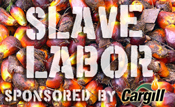
Stop palm oil slavery … Ashley Schaeffer, Rainforest Action Network
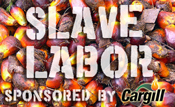 The palm oil plantations that Cargill has purchased from—and distributed to America’s household food brands—are rife with human rights violations, including slavery.
Want to remove this shocking reality from your pantry? Start by letting Cargill know that slave labor is unacceptable.
In Java last year, I interviewed two men with identical stories of being lured away from their hometowns with the promise of well paid work by Cargill supplier Kuala Lumpur Kepong (KLK).
The two were exposed to toxic chemicals in the palm oil fields with no protection and kept under lock and key at night by armed security. Each finally escaped these horrendous slave labor conditions without ever being paid.
I need your help to convince Cargill to stop filling America’s food supply with palm oil that causes environmental and human rights violations like these.
You’ve already been a massive help in putting Cargill on the path to protecting Indonesia’s rainforests. Just last week, Cargill announced it will finally be offering North American customers palm oil certified by the Roundtable on Sustainable Palm Oil (RSPO). Just two years ago Cargill claimed this was impossible. Your pressure made it happen. Thank you.
We’ve clearly got a few more steps to go to ensure Cargill’s on the right side of rainforests, and I’m asking you to take those steps by my side.
Are you with me?
For the forests,
Ashley Schaeffer
Rainforest Agribusiness Campaigner
Twitter: @probwithpalmoil
Share this:

Fed up with Cargill, taking our demands to its customers
It has begun!
I’m here in Minnesota today to kick off The Power Is In Your Palm Tour, a traveling roadshow that will visit a dozen of the Snack Food 20—companies using conflict palm oil in their popular snack food products—at their US headquarters. I’ll be working with the dedicated activists on the Palm Oil Action Team to deliver our demands to each of these companies: Take conflict palm oil tied to rainforest destruction, orangutan extinction, and human rights violations out of your snack foods!
Fittingly, we started the tour at the world headquarters of Cargill, the #1 importer of conflict palm oil into the US. We just hand-delivered over 100,000 petitions calling on Cargill to commit to transparency and safeguards that will eliminate the conflict palm oil that is driving orangutans to the brink of extinction from its global supply chain.

After years of making similar demands, though, we’re tired of waiting. Cargill has had its chance to do the right thing. After today, we’re taking our demands directly to Cargill’s customers—many of whom are amongst the Snack Food 20.
The Power Is In Your Palm Tour will travel across the US to deliver the message far and wide that you and me can change how these companies do business. When we take action, the Snack Food 20 will have to remove conflict palm oil from their products. And to do that, the Snack Food 20 will have to tell Cargill that it’s time to remove conflict palm oil from its supply chain.
Here’s how you can help:
1. Sign up for the Palm Oil Action Team—you’ll get all the latest calls to action and will make a huge contribution to The Power Is In Your Palm Tour. Together, we’ll pressure the Snack Food 20 to change their ways.
2. Chip in $5 to keep the tour rolling! We can’t do any of this without your support. Just $5 will go a long way.
It’s so important that you get involved now because we have truly reached The Last Stand of the Orangutan. Best estimates place the population of orangutans in the wilds of Sumatra and Borneo at just 60,600. We really have no time to waste in convincing the Snack Food 20 and Cargill to make sure the products they sell aren’t destroying precious habitat for these great red apes.
Thanks for all you do! And stay tuned, because the next event of The Power Is In Your Palm Tour is going down this Thursday, and we’ll finally be naming the Snack Food 20 and publicly calling on them to clean up their act. You’ll have a big role to play in making that call as loud and clear as possible!
 |
 |
For the great red ape, |
|
Jess Serrante National Agribusiness Organizer Twitter: @Jess_Serrante
|
Share this:

U.S. Food & Drug Administration (FDA).
03/06/2013 08:12 PM EST
Tri-Union Seafoods LLC is voluntarily recalling a limited amount of Chicken of the Sea brand 5-ounce cans of chunk white albacore tuna in water. The seams on the lids of the cans do not meet the standard for seam quality.
03/06/2013 01:23 PM EST
Bumble Bee Foods, LLC, has issued a voluntary recall on specific codes of 5-ounce Chunk White Albacore and Chunk Light Tuna products. The recall has been issued because the products do not meet the companies standards for seal tightness.
03/05/2013 12:36 PM EST
The Kroger Co. (NYSE: KR) Bakery in Clackamas, Oregon is recalling select Wheat Bread products sold at the company’s Fred Meyer Stores in Idaho, Oregon and Washington and QFC stores in Oregon and Washington because these products may contain pieces of plastic. Customers should return the product to stores for a full refund or replacement.
03/05/2013 07:13 PM EST
Cargill’s animal nutrition business today announced a voluntary recall of certain brands of its ruminant mineral products because they were deficient in vitamins A, D and E. The affected products were manufactured at Cargill’s facilities in McPherson, Kansas, and Montgomery City, Missouri, between Dec. 7, 2012, and Feb. 27, 2013.
Related articles
- China plans FDA-like food, drug watchdog: report (marketwatch.com)
- Activists fight FDA approval of AquaBounty’s genetically engineered salmon (mcclatchydc.com)
- FDA panel sees risk in long-used osteoporosis drug (kfwbam.com)
- FDA panel sees risk in long-used osteoporosis drug (wfaa.com)
Share this:

Cargill needs to come clean … Ashley Schaeffer, Rainforest Action Network
With palm oil in half of all products for sale in US grocery stores, we have the right to know the true cost of its production.
Cargill is the #1 importer of palm oil into the US, but the company refuses to be transparent about who it does business with. For instance: Is Cargill still sourcing from the notorious palm oil company Duta Palma even though this company is embroiled in severe social conflicts with communities near its destructive palm plantations?
Dozens of people are gathering outside Cargill’s offices today in Minneapolis to ask the company to come clean about its operations.
Will you help us amplify their voices by writing to Cargill now and demanding transparency around its “no-trade list”?
In the past, Cargill has said Duta Palma was on its “no-trade list,” but the company has never made this list public and RAN has reason to believe Cargill’s policy of sourcing from any company that pays membership dues to the Roundtable on Sustainable Palm Oil allows it to get palm oil from Duta Palma.
Please email Cargill CEO Greg Page now and ask him to come clean.
In 2009, Rainforest Action Network released a case study documenting illegal rainforest burning by Duta Palma on community lands used by the people of Semunying Jaya in Borneo. Duta Palma doesn’t have permits to operate these plantations and police refuse to do anything about this blatant land theft and environmental destruction.
So community members took action themselves.
A few weeks ago, members of the Semunying Jaya community seized several pieces of machinery, trucks, bulldozers and chainsaws, then barricaded the doors of Duta Palma’s palm nursery, shutting down operations. The community members are now facing possible criminal charges for standing up for the health and safety of their home.
We have the right to know: Is Cargill profiting from the oppression of the people of Semunying Jaya by buying palm oil from Duta Palma? Please demand transparency now.
For the forests,
Ashley Schaeffer
Rainforest Agribusiness Campaigner


You must be logged in to post a comment.