Tag Archives: history

August … a month full of historic events


270px-Hurricane_Katrina_Mobile_Alabama_flooded_parking_lot_20050829just another rant …

August~

 remember Katrina … remind folks what happened on the Gulf Coast as the people fled, some were forced out into the streets some died in the Katrina disaster trying to get out safely; while others faced excessive force violence and death

August 1, 1838 – Slavery was abolished in Jamaica. It had been introduced by Spanish settlers 300 years earlier in 1509.

August 2, 1776 – In Philadelphia, most of the 55-56 members of the Continental Congress signed the parchment copy of the Declaration of Independence.

August 3
1936 – Jesse Owens won the first of his four Olympic gold medals.

1943 – Gen. George S. Patton verbally abused and slapped a private. Later, Gen. Dwight D. Eisenhower ordered him to apologize for the incident.

1981 – U.S. traffic controllers with PATCO, the Professional Air Traffic Controllers Organization, went on strike. They were fired just as U.S. President Reagan had warned.

1992 – The U.S. Senate voted to restrict and eventually end the testing of nuclear weapons.

2004 – NASA launched the spacecraft Messenger. The 6 1/2 year journey was planned to arrive at the planet Mercury in March 2011. On April 30, 2015, Messenger crashed into the surface of Mercury after sending back more than 270,000 pictures.

August 4, 1962 – Apartheid opponent Nelson Mandela was arrested by security police in South Africa. He was then tried and sentenced to five years in prison. In 1964, he was placed on trial for sabotage, high treason and conspiracy to overthrow the government and was sentenced to life in prison. A worldwide campaign to free him began in the 1980s and resulted in his release on February 11, 1990, at age 71 after 27 years in prison. In 1993, Mandela shared the Nobel Peace Prize with South Africa’s President F.W. de Klerk for their peaceful efforts to bring a nonracial democracy to South Africa. In April 1994, black South Africans voted for the first time in an election that brought Mandela the presidency of South Africa.

August 4, 1964 – Three young civil rights workers, James Chaney, Andrew Goodman and Michael Schwerner, were found murdered and buried in an earthen dam outside Philadelphia, Mississippi. They had disappeared on June 21 after being detained by Neshoba County police on charges of speeding. They were participating in the Mississippi Summer Project organized by the Student Nonviolent Coordinating Committee (SNCC) to increase black voter registration. When their car was found burned on June 23, President Lyndon Johnson ordered the FBI to search for the men.

August 5, 1861 – President Abraham Lincoln signed into law the first Federal income tax, a 3 percent tax on incomes over $800, as an emergency wartime measure during the Civil War. However, the tax was never actually put into effect.

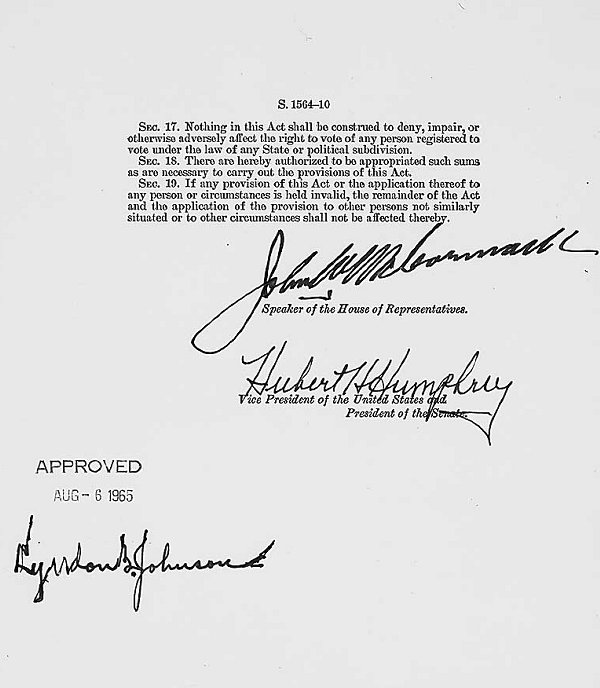
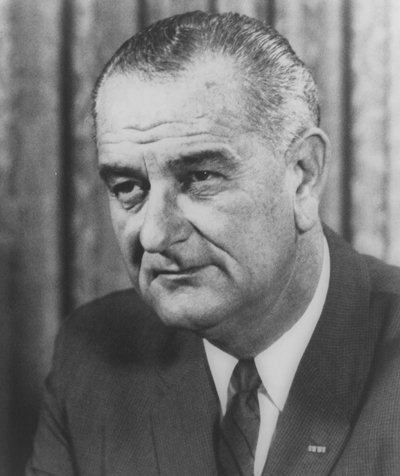
August 6, 1965 – The Voting Rights Act of 1965 was signed into law by President Lyndon B. Johnson. The Act suspended literacy, knowledge and character tests designed to keep African Americans from voting in the South. It also authorized the appointment of Federal voting examiners and barred discriminatory poll taxes. The Act was renewed by Congress in 1975, 1984 and 1991.

August 6-10, 1787 – The Great Debate occurred during the Constitutional Convention. Outcomes included the establishment of a four-year term of office for the President, granting Congress the right to regulate foreign trade and interstate commerce, and the appointment of a committee to prepare a final draft of the Constitution.

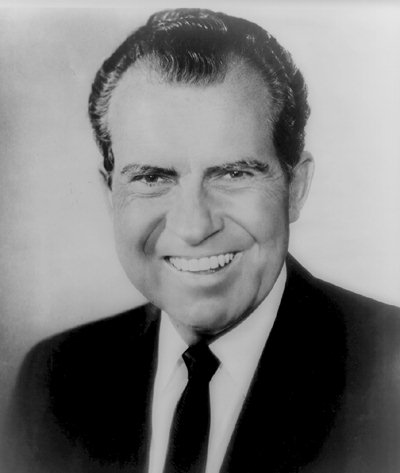
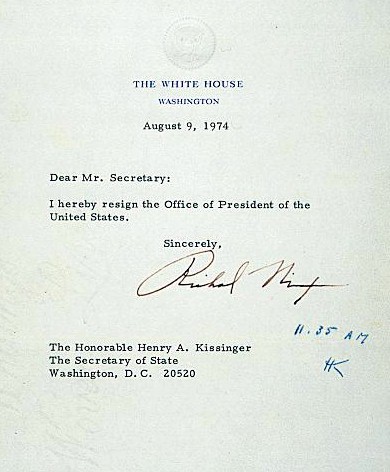
August 9, 1974 – Effective at noon, Richard M. Nixon resigned the presidency as a result of the Watergate scandal. Nixon had appeared on television the night before and announced his decision to the American people. Facing possible impeachment by Congress, he became the only U.S. President ever to resign.

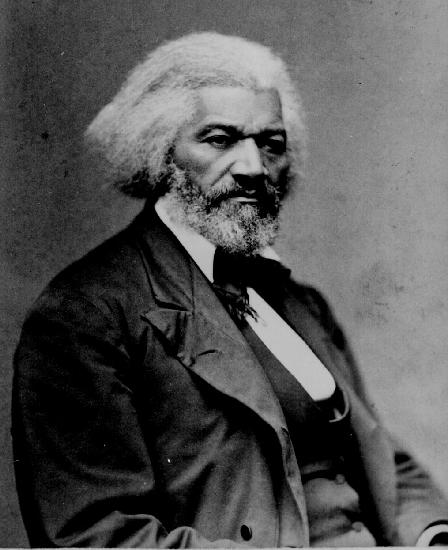
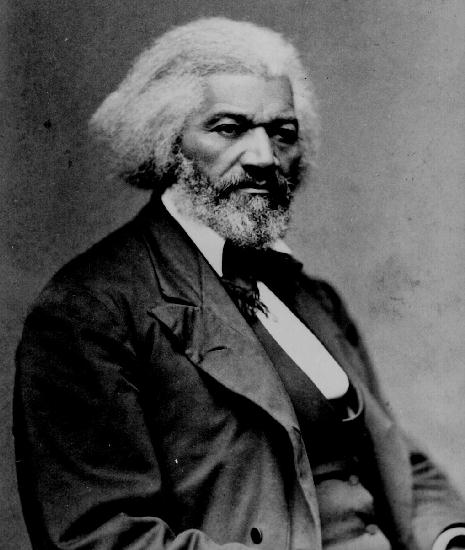
August 10, 1863 – The President meets with abolitionist Frederick Douglass who pushes for full equality for Union ‘Negro troops.’

August 11, 1841Frederick Douglass, an escaped slave, spoke before an audience in the North for the first time. During an anti-slavery convention on Nantucket Island, he gave a powerful, emotional account of his life as a slave. He was immediately asked to become a full-time lecturer for the Massachusetts Antislavery Society.

August 11-16, 1965 – Six days of riots began in the Watts area of Los Angeles, triggered by an incident between a white member of the California Highway Patrol and an African American motorist. Thirty-four deaths were reported and more than 3,000 people were arrested. Damage to property was listed at $40 million.

On August 14, 1862, Abraham Lincoln did something unprecedented in presidential history up to that point: he met with a small delegation of black leaders (all free: 5 black clergymen). But the meeting did not auger a decision to give African Americans a voice in government. In essence, Lincoln sought to lobby these men in essence to agree to a divorce. In other words, the President wanted to get black Americans behind his plan to colonize them abroad. –Source http://quod.lib.umich.edu/l/lincoln/lincoln5/1:812?rgn=div1;singlegenre=All;sort=occur;subview=detail;type=simple;view=fulltext;q1=August+14

August 14, 1935 – President Roosevelt signed the Social Security Act establishing the system which guarantees pensions to those who retire at age 65. The Social Security system also aids states in providing financial aid to dependent children, the blind and others, as well as administering a system of unemployment insurance.

August 15, 1969 – Woodstock began in a field near Yasgur’s Farm at Bethel, New York. The three-day concert featured 24 rock bands and drew a crowd of more than 300,000 young people. The event came to symbolize the counter-culture movement of the 1960’s.

August 18, 1920 – The 19th Amendment to the U.S. Constitution was ratified, granting women the right to vote.

August 24-

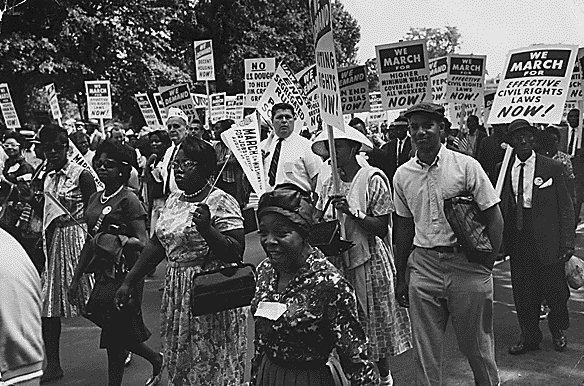
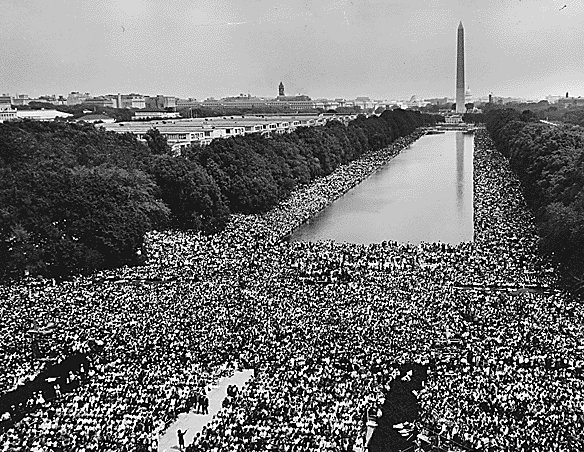
August 28, 1963 – The March on Washington occurred as over 250,000 persons attended a Civil Rights rally in Washington, D.C., at which Rev. Dr. Martin Luther King, Jr. made his now-famous I Have a Dream speech.

    August 28, 1955 The death of Emmett Till

 August 29, 2005 Hurricane Katrina slams into Gulf Coast

August 30 1967  Thurgood Marshall confirmed as Supreme Court justice

1983 U.S. Air Force Lieutenant Colonel Guion S. Bluford becomes the first African American to travel into space when the space shuttle Challenger

August 31

Source: http://www.historyplace.com

~Nativegrl77

Quote of the Day …


“The people of Texas are informed that in accordance with a Proclamation from the Executive of the United States, all slaves are free. This involves an absolute equality of rights and rights of property between former masters and slaves, and the connection heretofore existing between them became that between employer and free laborer.”

Audubon day … April 26


Birds of America
April 26 is
Audubon daymockingbird

by Slayer

John James Audubon (1785-1851) was America’s foremost ornithological illustrator. After studying drawing in Paris under the French painter Jacques Louis David, Audubon struggled for many years to make a living from his art, shuttling back and forth between Europe and the United States and supplementing his income by giving drawing lessons, turning out portraits, playing the flute or violin at local dances, and at one time running a general store.

In 1820 he began a flatboat excursion down the Mississippi River to seek out new varieties of birds to paint. Eventually he had enough bird portraits to publish in book form. Birds of America, produced with the help of engraver Robert Havell, Jr., contains 435 hand-colored plates and was published in “elephant folio” format to accommodate the life-sized portrayals of birds on which Audubon insisted.

After his death in 1851, Audubon’s wife Lucy returned to teaching to support herself. One of her students, George Bird Grinnell, became the editor of Forest and Stream magazine and in 1886 organized the Audubon Society for the study and protection of birds. Today there are many branches of this organization, known as the National Audubon Society, and it remains dedicated to the conservation of wildlife and natural resources. Its members honor Audubon on his birthday, April 26. In some states, Audubon Day and Arbor Day are celebrated together by planting trees in bird sanctuaries.

Read more: http://www.answers.com/topic/audubon-day#ixzz1t9SHCcAV

On this day: March 31, 1889


ParisOriginally intended as a temporary installation, the Eiffel Tower has become one of the most enduring symbols of France and the industrial age.

On March 31, 1889, the Eiffel Tower is dedicated in Paris in a ceremony presided over by Gustave Eiffel, the tower’s designer, and attended by French Prime Minister Pierre Tirard, a handful of other dignitaries, and 200 construction workers.

In 1889, to honor of the centenary of the French Revolution, the French government planned an international exposition and announced a design competition for a monument to be built on the Champ-de-Mars in central Paris. Out of more than 100 designs submitted, the Centennial Committee chose Eiffel’s plan of an open-lattice wrought-iron tower that would reach almost 1,000 feet above Paris and be the world’s tallest man-made structure. Eiffel, a noted bridge builder, was a master of metal construction and designed the framework of the Statue of Liberty that had recently been erected in New York Harbor.

Eiffel’s tower was greeted with skepticism from critics who argued that it would be structurally unsound, and indignation from others who thought it would be an eyesore in the heart of Paris. Unperturbed, Eiffel completed his great tower under budget in just two years. Only one worker lost his life during construction, which at the time was a remarkably low casualty number for a project of that magnitude. The light, airy structure was by all accounts a technological wonder and within a few decades came to be regarded as an architectural masterpiece.

The Eiffel Tower is 984 feet tall and consists of an iron framework supported on four masonry piers, from which rise four columns that unite to form a single vertical tower. Platforms, each with an observation deck, are at three levels. Elevators ascend the piers on a curve, and Eiffel contracted the Otis Elevator Company of the United States to design the tower’s famous glass-cage elevators.

The elevators were not completed by March 31, 1889, however, so Gustave Eiffel ascended the tower’s stairs with a few hardy companions and raised an enormous French tricolor on the structure’s flagpole. Fireworks were then set off from the second platform. Eiffel and his party descended, and the architect addressed the guests and about 200 workers. In early May, the Paris International Exposition opened, and the tower served as the entrance gateway to the giant fair.

The Eiffel Tower remained the world’s tallest man-made structure until the completion of the Chrysler Building in New York in 1930. Incredibly, the Eiffel Tower was almost demolished when the International Exposition’s 20-year lease on the land expired in 1909, but its value as an antenna for radio transmission saved it. It remains largely unchanged today and is one of the world’s premier tourist attractions.

http://www.history.com

History… March 13


0607 – The 12th recorded passage of Halley’s Comet occurred.

1519 – Cortez landed in Mexico.

1639 – Harvard University was named for clergyman John Harvard.

1660 – A statute was passed limiting the sale of slaves in the colony of Virginia.

1777 – The U.S. Congress ordered its European envoys to appeal to high-ranking foreign officers to send troops to reinforce the American army.

1781 – Sir William Herschel discovered the planet Uranus.

1852 – The New York “Lantern” newspaper published the first “Uncle Sam cartoon”. It was drawn by Frank Henry Bellew.

1865 – Jefferson Davis signed a bill authorizing slaves to be used as soldiers for the Confederacy.

1868 – The U.S. Senate began the impeachment trial of President Andrew Johnson.

1877 – Chester Greenwood patented the earmuff.

1878 – The first collegiate golf match was played between Oxford and Cambridge.

1884 – Standard time was adopted throughout the U.S.

1900 – In South Africa, British Gen. Roberts took Bloemfontein.

1901 – Andrew Carnegie announced that he was retiring from business and that he would spend the rest of his days giving away his fortune. His net worth was estimated at $300 million.

1902 – In Poland, schools were shut down across the country when students refused to sing the Russian hymn “God Protect the Czar.”

1902 – Andrew Carnegie approved 40 applications from libraries for donations.

1908 – The people of Jerusalem saw an automobile for the first time. The owner was Charles Glidden of Boston.

1911 – The U.S. Supreme Court approved corporate tax law.

1915 – The Germans repelled a British expeditionary force attack in France.

1918 – Women were scheduled to march in the St. Patrick’s Day Parade in New York due to a shortage of men due to wartime.

1925 – A law in Tennessee prohibited the teaching of evolution.

1930 – It was announced that the planet Pluto had been discovered by scientist Clyde Tombaugh at the Lowell Observatory.

1933 – U.S. banks began to re-open after a “holiday” that had been declared by President Roosevelt.

1935 – Three-thousand-year-old archives were found in Jerusalem confirming some biblical history.

1940 – The war between Russia and Finland ended with the signing of a treaty in Moscow.

1941 – Adolf Hitler issued an edict calling for an invasion of the U.S.S.R.

1942 – Julia Flikke of the Nurse Corps became the first woman colonel in the U.S. Army.

1943 – Japanese forces ended their attack on the American troops on Hill 700 in Bougainville.

1946 – Reports from Iran indicated that Soviet tanks units were stationed 20 miles from Tehran.

1946 – Premier Tito seized wartime collaborator General Draja Mikhailovich in a cave in Yugoslavia.

1951 – Israel demanded $1.5 billion in German reparations for the cost of caring for war refugees.

1951 – The comic strip “Dennis the Menace” appeared for the first time in newspapers across the country.

1957 – Jimmy Hoffa was arrested by the FBI on bribery charges.

1963 – China invited Soviet President Khrushchev to visit Peking.

1969 – The Apollo 9 astronauts returned to Earth after the conclusion of a mission that included the successful testing of the Lunar Module.

1970 – Cambodia ordered Hanoi and Viet Cong troops to leave.

1970 – Digital Equipment Corp. introduced the PDP-11 minicomputer.

1972 – “The Merv Griffin Show” debuted in syndication for Metromedia Television.

1974 – The U.S. Senate voted 54-33 to restore the death penalty.

1974 – An embargo imposed by Arab oil-producing countries was lifted.

1980 – A jury in Winamac, IN, found Ford Motor Company innocent of reckless homicide in the deaths of three young women that had been riding in a Ford Pinto.

1988 – The board of trustees off Gallaudet University in Washington, DC, chose I. King Jordan to be its first deaf president. The college is a liberal arts college for the hearing-impaired.

1990 – The U.S. lifted economic sanctions against Nicaragua.

1991 – Exxon paid $1 billion in fines and for the clean-up of the Alaskan oil spill.

1995 – The first United Nations World Summit on Social Development concluded in Copenhagen, Denmark.

1997 – Sister Nirmala was chosen by India’s Missionaries of Charity to succeed Mother Teresa as leader of the Catholic order.

2002 – Fox aired “Celebrity Boxing.” Tonya Harding beat Paula Jones, Danny Banaduce beat Barry Williams and Todd Bridges defeated Vanilla Ice.

2003 – Japan sent a destroyer to the Sea of Japan amid reports that North Korea was planning to test an intermediate-range ballistic missile.

2003 – A report in the journal “Nature” reported that scientists had found 350,000-year-old human footprints in Italy. The 56 prints were made by three early, upright-walking humans that were descending the side of a volcano.

2006 – In New York, the official start of construction of the National September 11 Memorial & Museum began.

2012 – After 244 years of publication, Encyclopædia Britannica announced it would discontinue its print edition.